Quick Answer: The main slow cooker disadvantages are long cooking time, no browning, watery sauces, mushy texture, possible food safety mistakes, and poor results with some foods. A slow cooker is useful for soups, stews, roasts, and meal prep, but it is not the best choice for frozen meat, crispy food, raw kidney beans, seafood, pasta, or reheating leftovers.
Slow cookers are popular in the USA, UK, Canada, and Australia because they make cooking easier. You can add ingredients, turn the cooker on, and let it work for hours. This makes slow cookers helpful for busy families, office workers, students, and meal preppers.
But slow cookers are not perfect. Many people buy one expecting every meal to be easy, rich, and delicious. Then they notice common problems: the food tastes bland, the sauce is too watery, the meat becomes dry, or the vegetables turn too soft. Some mistakes can also create food safety concerns.
This guide explains the most important slow cooker disadvantages, why they happen, and how to fix them. The goal is not to make you avoid slow cookers. The goal is to help you use one safely and get better results.
Slow Cooker Disadvantages at a Glance
| Disadvantage | Why It Happens | Quick Fix |
|---|---|---|
| Long cooking time | Slow cookers use low, steady heat | Plan meals ahead |
| No browning | The lid traps steam and moisture | Sear meat first |
| Watery food | Liquid does not evaporate much | Use less liquid |
| Mushy vegetables | Long cooking breaks them down | Add soft vegetables later |
| Dry lean meat | Lean cuts overcook easily | Use fattier cuts or shorter cooking |
| Frozen meat risk | It heats too slowly | Thaw meat first |
| Raw kidney bean risk | Low heat may not destroy toxins | Boil beans first |
| Poor reheating | Slow cooker heats leftovers slowly | Reheat on stove, microwave, or oven |
| No crispy texture | Moist cooking softens food | Finish in oven or air fryer |
| Bulky appliance | Ceramic insert can be heavy | Choose the right size |
Slow Cooker vs Crock Pot Disadvantages: Are They the Same?
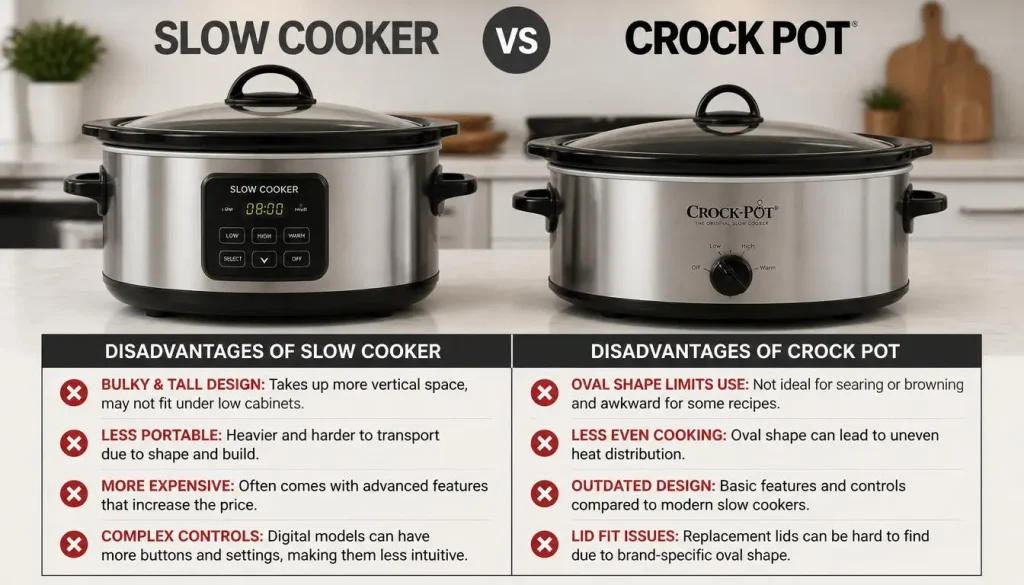
Yes, most slow cooker and Crock Pot disadvantages are the same. “Crock-Pot” is a popular brand name, while “slow cooker” is the general name for this type of appliance.
Both usually cook food slowly using low, steady heat. Both are great for soups, stews, pulled meat, chili, and roasts. But both also have the same common problems:
- Long cooking time
- No crispy finish
- No natural browning
- Watery sauces
- Mushy vegetables
- Food safety concerns if used incorrectly
- Poor results with some foods
So if you search for crock pot disadvantages, crockpot disadvantages, or disadvantages of slow cooker cooking, the main answers are very similar.
Slow Cooker Pros and Cons: Quick Comparison
A slow cooker has real benefits, but it also has limits.
| Pros | Cons |
|---|---|
| Easy hands-off cooking | Takes many hours |
| Great for tough cuts of meat | Does not brown or crisp food |
| Helpful for meal prep | Can make food watery |
| Good for soups and stews | Some foods become mushy |
| Lower heat than an oven | Not ideal for quick meals |
| Useful for busy families | Needs food safety care |
| Keeps food warm for serving | Warm setting can be misused |
A slow cooker is worth using when the recipe fits the appliance. It is less useful when you want fast cooking, crispy texture, or delicate ingredients.
Slow Cookers Take a Long Time
The first disadvantage is obvious: slow cookers are slow.
Many recipes take 4 to 8 hours. Some large meat recipes take even longer. This is fine if you plan ahead, but it is frustrating if you need a quick dinner.
Slow cooking works best when you prepare ingredients in the morning or the night before. If you forget to start early, a slow cooker may not help you.
How to fix it:
- Use a slow cooker for planned meals.
- Prep ingredients the night before.
- Choose recipes with realistic cooking times.
- Use a programmable model if possible.
- Use a pressure cooker when you need food faster.
A slow cooker is convenient, but it is not a last-minute cooking tool.
Slow Cookers Do Not Brown or Crisp Food
One of the biggest slow cooker disadvantages is the lack of browning. Browning gives meat, onions, garlic, and vegetables deeper flavor. It also makes food look more appetizing.
A slow cooker traps steam under the lid. This keeps food moist, but it also stops proper browning. That is why slow cooker meat can look pale or soft if you add it raw.
This matters for foods like:
- Beef stew
- Pot roast
- Pulled pork
- Chicken thighs
- Sausages
- Onions and garlic
How to fix it:
- Brown meat in a pan before adding it.
- Sauté onions and garlic first.
- Brown sausages before slow cooking.
- Finish chicken skin under the broiler or in an air fryer.
- Add fresh herbs or acid at the end for brightness.
This one extra step can make slow cooker food taste much better.
Why Slow Cooker Food Tastes Bland or Watery
Slow cooker food can taste bland for several reasons. The most common reason is that there is no browning. Another reason is too much liquid.
In a pot on the stove, liquid evaporates as food cooks. In a slow cooker, the lid traps moisture. That means sauces do not reduce much. If you use the same amount of liquid as a stovetop recipe, the final dish may become thin and watery.
Spices and herbs can also lose strength during long cooking. Fresh herbs added at the beginning may taste dull by the end.
How to fix bland or watery food:
- Use less liquid than you would for stovetop cooking.
- Sear meat first.
- Add tomato paste, spices, or aromatics after blooming them in oil.
- Add fresh herbs near the end.
- Add lemon juice, vinegar, or hot sauce before serving.
- Remove the lid near the end if your recipe allows.
- Thicken sauce with cornstarch slurry.
- Reduce the sauce in a pan after cooking.
Slow cooker meals need flavor layering. If everything goes in raw, the result can taste flat.
Common Slow Cooker Texture Problems
Slow cookers are good for tender food, but they are not good for every texture. Long, moist cooking can make some ingredients too soft.
Why Slow Cooker Meat Gets Dry
This surprises many people. A slow cooker is moist, but lean meat can still become dry. Chicken breast, lean pork, and lean beef can overcook during long cooking.
Better choices:
- Chicken thighs
- Pork shoulder
- Beef chuck roast
- Brisket
- Short ribs
These cuts have more connective tissue and fat, so they stay tender during long cooking.
Why Vegetables Turn Mushy
Soft vegetables can fall apart in a slow cooker. Zucchini, peas, spinach, broccoli, and bell peppers may become too soft if cooked for hours.
Best fix: Add soft vegetables near the end. Use hearty vegetables like carrots, potatoes, onions, celery, and turnips for long cooking.
Why Pasta and Rice Become Too Soft
Pasta and rice absorb liquid while they cook. If they sit in the slow cooker too long, they can become mushy or gluey.
Best fix: Cook pasta separately or add it near the end. Add rice only when the recipe is designed for slow cooking.
Why Seafood Turns Rubbery
Fish, shrimp, and scallops cook quickly. Long cooking makes them rubbery and dry.
Best fix: Add seafood during the last 15 to 30 minutes, depending on the recipe.
Frozen Meat Can Be Unsafe in a Slow Cooker
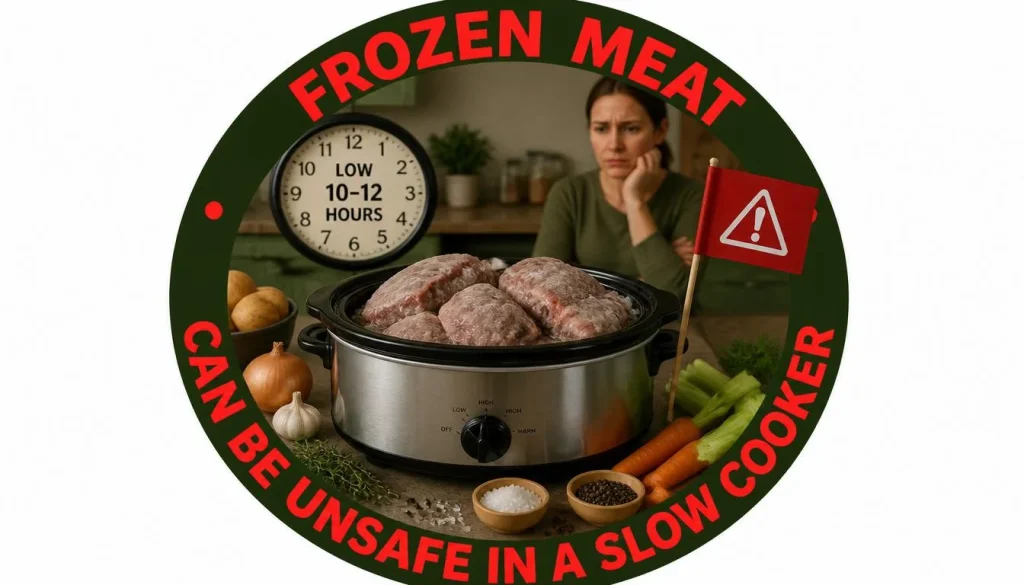
Putting frozen meat in a slow cooker is one of the most important safety mistakes to avoid. Slow cookers heat gradually. If meat starts frozen, it may stay too long at unsafe temperatures before it fully cooks.
USDA slow cooker guidance says meat or poultry should be thawed before putting it into a slow cooker. It also advises keeping the lid in place and using the right amount of food in the cooker.
Safe fix:
- Thaw meat in the refrigerator before cooking.
- Do not thaw meat on the counter.
- Cut large pieces of meat into smaller portions.
- Use a food thermometer.
- Start with thawed chicken, beef, pork, or turkey.
FoodSafety.gov also recommends giving frozen meat, poultry, or seafood enough time to thaw safely before adding it to a slow cooker.
Raw Kidney Beans Should Not Be Cooked Directly in a Slow Cooker
Raw or dried kidney beans are a special safety concern. They contain a natural toxin called phytohaemagglutinin. Slow cooking alone may not destroy it properly, especially if the beans do not boil first.
Kansas State University Extension recommends soaking dry beans, draining them, then boiling them in fresh water before slow cooking. It also notes that the toxin is destroyed at boiling temperature, but slow cookers may not get hot enough to make raw beans safe.
Safe fix for kidney beans:
- Soak dried kidney beans.
- Drain the soaking water.
- Boil the beans in fresh water.
- Add the boiled beans to the slow cooker.
- Use canned beans if you want the easiest option.
Canned beans are already cooked, so they are usually easier and safer for slow cooker recipes.
Slow Cookers Are Not Good for Reheating Leftovers
A slow cooker is designed for slow cooking, not fast reheating. Leftovers need to heat quickly enough to stay safe. A slow cooker may take too long to bring cold food up to a safe temperature.
USDA guidance says reheating leftovers in a slow cooker is not recommended. Instead, leftovers should be reheated on the stove, in the microwave, or in a conventional oven, then the slow cooker can be used to keep food hot.
Best reheating methods:
- Microwave
- Stovetop
- Oven
After reheating, you can move the food to a slow cooker on warm for serving.
Are There Any Health Disadvantages of Slow Cooking?
Slow cookers are not bad for your health when used correctly. The health concerns usually come from wrong use, not from the appliance itself.
Common health-related risks include:
- Cooking frozen meat from frozen
- Reheating leftovers too slowly
- Cooking raw kidney beans without boiling
- Leaving food out too long
- Holding food at unsafe temperatures
- Not checking internal temperature
FoodSafety.gov says a food thermometer is the only reliable way to know that food has reached a safe internal temperature.
Used correctly, a slow cooker can make healthy meals with vegetables, beans, lean protein, broth, and whole-food ingredients. Used incorrectly, it can create food safety problems.
Food Safety Depends on Correct Slow Cooker Use
A slow cooker can be safe, but you need to follow basic rules.
Use these safety tips:
- Start with clean hands and clean utensils.
- Keep meat refrigerated before cooking.
- Thaw meat before adding it.
- Do not overfill the slow cooker.
- Keep the lid closed during cooking.
- Use the correct heat setting.
- Check meat with a food thermometer.
- Store leftovers quickly.
- Do not leave cooked food sitting out overnight.
FoodSafety.gov explains that the danger zone is between 40°F and 140°F, where germs can grow rapidly, and hot food should be kept at 140°F or above after cooking.
Is It Safe to Leave a Slow Cooker On All Day or Overnight?
Modern slow cookers are designed for long cooking, but safe use depends on the appliance and your setup.
It is safer to leave a slow cooker on when:
- The appliance is in good condition.
- The cord is not damaged.
- The cooker sits on a heat-safe surface.
- It is not near towels, curtains, paper, or clutter.
- It is not overfilled.
- The lid fits properly.
- You follow the manual.
Do not leave a slow cooker unattended if the cord is damaged, the ceramic insert is cracked, the lid does not fit, or the appliance acts strangely.
For overnight cooking, use recipes designed for long cooking. Avoid foods that overcook quickly, such as seafood, pasta, rice, or lean chicken breast.
Slow Cooker Warm Setting Can Be Misused
The warm setting is useful, but it is often misunderstood. It is designed to keep cooked food warm. It is not meant to cook raw food.
Do not use the warm setting to cook raw meat, poultry, or beans. Food may stay at unsafe temperatures for too long.
Use warm only after food has fully cooked. For parties or long serving times, check that the food stays hot. If food cools too much, reheat it properly before serving again.
Appliance Safety Problems to Watch For
Slow cookers are simple appliances, but they still need care.
Watch for these issues:
- Cracked ceramic insert
- Damaged power cord
- Loose plug
- Broken lid
- Peeling coating
- Unstable base
- Burning smell
- Hot exterior
- Overfilled insert
A cracked ceramic insert should be replaced. A damaged cord should not be used. If the appliance smells like burning or turns off randomly, stop using it.
Also, do not lock transport clamps while cooking unless your manual says it is allowed. Some lids have locking clips for travel, not for cooking.
Slow Cookers Can Create Leftover Storage Problems
Slow cookers often make large meals. That is helpful for meal prep, but it can create storage problems.
A full ceramic insert can be heavy and slow to cool. If you put a deep pot of hot food straight into the fridge, the center may cool slowly. It can also warm nearby foods.
Better method:
- Move leftovers into shallow containers.
- Refrigerate them within 2 hours.
- Keep portions small so they cool faster.
- Freeze extra food if you will not eat it soon.
Food Standards Australia New Zealand explains that the 2-hour/4-hour rule is based on how quickly microorganisms grow in food between 5°C and 60°C.
Do Slow Cookers Destroy Nutrients?
Any cooking method can reduce some nutrients, especially heat-sensitive vitamins. Slow cooking is no exception.
However, slow cooker meals often keep nutrients in the liquid. If you eat the broth, sauce, or stew liquid, you may still consume many of the minerals and water-soluble nutrients that move out of the food during cooking.
The bigger nutrition issue is overcooking vegetables until they lose texture and color.
How to protect nutrition:
- Do not overcook vegetables.
- Add delicate vegetables near the end.
- Eat the cooking liquid when possible.
- Use whole-food ingredients.
- Avoid too much salt, sugar, or processed sauce.
Are Slow Cookers Expensive to Run?
Slow cookers run for many hours, so people often worry about electricity cost. The answer depends on your model, wattage, heat setting, cooking time, and local energy price.
In many homes, a slow cooker uses less power than a full-size oven, but it runs for longer. A pressure cooker may cook faster, while an oven may use more heat but give better browning.
The best approach is to check your appliance wattage and your local electricity rate. Do not assume every slow cooker costs the same to run.
Foods That Do Not Work Well in a Slow Cooker
Some foods are not ideal for slow cooking.
| Food | Problem | Better Fix |
|---|---|---|
| Frozen meat | Food safety risk | Thaw first |
| Raw kidney beans | Natural toxin risk | Soak and boil first |
| Pasta | Gets mushy | Add near the end |
| Rice | Can become gluey | Use slow cooker-specific recipes |
| Seafood | Turns rubbery | Add near the end |
| Dairy | Can curdle | Add late |
| Crispy chicken | Skin becomes soft | Finish in oven |
| Bacon | Loses crisp texture | Cook separately |
| Fresh herbs | Lose flavor | Add before serving |
| Soft vegetables | Break down | Add later |
The slow cooker works best for foods that benefit from low, moist heat.
Not Every Recipe Converts Well to a Slow Cooker
Some recipes need major changes before they work in a slow cooker. A stovetop or oven recipe may use too much liquid for a slow cooker. Dairy may curdle. Pasta may overcook. Crispy toppings may become soggy.
Before converting a recipe, ask:
- Does this food need browning?
- Does it need crisp texture?
- Does it contain dairy?
- Does it contain pasta or rice?
- Does it use seafood?
- Does it need liquid to reduce?
If the answer is yes, the recipe may need adjustment.
Slow Cooker vs Pressure Cooker vs Oven: Which Is Better?
Each cooking method has a different purpose.
| Appliance | Best For | Main Limitation |
|---|---|---|
| Slow cooker | Hands-off soups, stews, roasts | Slow, no browning |
| Pressure cooker | Fast tender meals | Less traditional texture |
| Oven | Roasting, browning, crisping | Needs more monitoring |
| Dutch oven | Deep flavor and control | Requires stovetop or oven time |
| Air fryer | Crisping and reheating | Not ideal for large stews |
Choose a slow cooker when you want convenience. Choose an oven or Dutch oven when you want browning. Choose a pressure cooker when you want speed.
Who Should Avoid or Limit Slow Cooker Use?
A slow cooker may not be ideal for everyone.
You may not enjoy slow cooking if you:
- Need fast meals every day
- Prefer crispy food
- Cook seafood often
- Forget to thaw meat
- Have very little kitchen space
- Do not like leftovers
- Prefer precise texture control
- Want strong roasted flavor
A slow cooker is a tool, not a perfect solution for every kitchen.
How to Avoid Most Slow Cooker Disadvantages
Most slow cooker problems are easy to fix.
Use these tips:
- Thaw meat before cooking.
- Brown meat first for better flavor.
- Use less liquid than stovetop recipes.
- Add dairy near the end.
- Add pasta and rice near the end.
- Boil kidney beans before slow cooking.
- Do not reheat leftovers in a slow cooker.
- Use a food thermometer.
- Do not overfill the insert.
- Keep the lid closed during cooking.
- Add fresh herbs before serving.
- Store leftovers in shallow containers.
- Choose the right size slow cooker.
- Replace cracked or damaged inserts.
- Follow the user manual.
These small changes solve most slow cooker complaints.
Final Verdict: Are Slow Cookers Worth It?
Slow cookers are worth it if you use them for the right meals. They are excellent for soups, stews, chili, pulled pork, pot roast, beans that have been properly prepared, and family meal prep.
But slow cookers have clear disadvantages. They are slow. They do not brown or crisp food. They can make sauces watery. Some foods become mushy. Frozen meat, raw kidney beans, and reheating leftovers can create food safety problems if handled incorrectly.
The best answer is balanced: a slow cooker is useful, but it is not perfect. Use it for recipes that benefit from low, moist heat. Use another method when you need speed, browning, crisp texture, or delicate cooking.
FAQs
What are the main disadvantages of a slow cooker?
The main disadvantages are long cooking time, no browning, no crispy texture, watery sauces, mushy vegetables, dry lean meat, and food safety risks when used incorrectly.
What are the disadvantages of Crock Pot cooking?
Crock Pot cooking has the same disadvantages as slow cooking. It can take many hours, produce watery food, soften textures too much, and require careful food safety practices.
Are slow cookers bad for your health?
Slow cookers are not bad for your health when used correctly. The main risks come from frozen meat, raw kidney beans, poor reheating, and unsafe leftover handling.
Can you leave a slow cooker on all day?
Yes, many slow cookers are designed for long cooking. Use a safe appliance, follow the manual, keep it on a heat-safe surface, and do not overfill it.
Is it safe to leave a slow cooker on overnight?
It can be safe if the appliance is in good condition and the recipe is designed for long cooking. Do not use a damaged cord, cracked insert, or unsafe setup.
Can you put frozen meat in a slow cooker?
No, it is better to thaw meat first. Frozen meat may heat too slowly in a slow cooker and stay too long at unsafe temperatures.
Can you cook raw kidney beans in a slow cooker?
Raw kidney beans should not be cooked directly in a slow cooker. Soak and boil them first, or use canned kidney beans.
Can you reheat leftovers in a slow cooker?
Reheating leftovers in a slow cooker is not recommended. Use the microwave, stovetop, or oven first, then use the slow cooker to keep food warm.
Why does slow cooker food taste bland?
Slow cooker food can taste bland because there is little browning, too much moisture, and herbs or spices can lose strength during long cooking. Brown meat first and finish with fresh herbs or acid.
Why is my slow cooker food watery?
Slow cooker food becomes watery because steam stays trapped under the lid. Use less liquid and thicken the sauce near the end if needed.
Why does meat get dry in a slow cooker?
Lean meat can get dry when cooked too long. Chicken breast and lean pork are common examples. Use fattier cuts or reduce cooking time.
What foods should not be cooked in a slow cooker?
Frozen meat, raw kidney beans, pasta, rice, seafood, dairy-heavy sauces, crispy foods, and fresh herbs do not work well unless handled carefully.
Do slow cookers destroy nutrients?
Slow cooking can reduce some heat-sensitive nutrients, like many cooking methods. Eating the broth or sauce can help retain nutrients that move into the liquid.
Are slow cookers expensive to run?
It depends on wattage, cooking time, setting, and local electricity rates. Slow cookers often use less power than ovens but run for longer.
Is a slow cooker better than a pressure cooker?
A slow cooker is better for hands-off cooking. A pressure cooker is better for speed. The best choice depends on your recipe and schedule.
Are slow cookers worth buying?
Yes, slow cookers are worth buying if you cook soups, stews, roasts, chili, and meal prep meals. They are less useful if you need fast meals or crispy textures.

“I believe great cooking starts with the right tools, trusted advice, and a little confidence in the kitchen.”
Hi, I’m Emma Carter. My love for cooking began in my grandmother’s kitchen, where I learned that every great meal starts with simple ingredients and the right cookware. Over the years, I’ve spent countless hours researching, testing, and comparing kitchen appliances, cookware, coffee makers, air fryers, and other everyday kitchen essentials.
Here at KiCook, my goal is to make your buying decisions easier with honest product reviews, practical buying guides, and easy-to-follow cooking tips. Whether you’re upgrading your kitchen or searching for the best appliance for your home, I focus on providing clear, reliable, and research-backed information you can trust.
When I’m not testing new kitchen gadgets or writing in-depth guides, you’ll usually find me trying new recipes, visiting local farmers’ markets, or enjoying a quiet cup of coffee while planning my next kitchen project.