
YES—a crock pot is safe when you use thawed ingredients, cook food to a verified safe temperature, and keep hot food at 140°F (60°C) or above. Poultry must reach 165°F (74°C), ground meat 160°F (71°C), and whole cuts 145°F (63°C) with a three-minute rest.
A crock pot can cook food safely for hours, but only when it heats correctly and ingredients do not spend too long between 40°F and 140°F (4°C to 60°C). That range is the food-safety “danger zone,” where bacteria can multiply quickly. These crock pot safety tips help you control time, temperature, and handling from prep to storage.
The biggest limitation is gradual heating. Frozen meat, an overfilled pot, repeated lid lifting, or a delayed start can keep food warming too slowly. A meal may look cooked around the edges while the centre remains below a safe temperature.
You will learn practical slow cooker safety tips for thawing meat, choosing settings, checking doneness, handling power cuts, holding food warm, reheating leftovers, and storing meals. You will also see the crock pot safety rules that matter most for chicken, stews, roasts, and overnight cooking.
Why Crock Pot Safety Tips Matter at Home
Slow cookers turn inexpensive cuts, vegetables, beans, and simple sauces into low-effort meals. They suit busy households across the USA, UK, Australia, and Canada. That convenience makes crock pot safety tips essential when dinner cooks unattended.
Following crock pot safety tips does not remove the need for temperature control. Perishable food should not remain between 40°F and 140°F (4°C to 60°C) for more than two hours. Hot food should stay at 140°F (60°C) or above. These limits matter when you load the pot, use WARM, transport food to a party, or leave leftovers on the counter. The USDA’s official slow cooker guidance advises thawing all meat and poultry before cooking, and confirms that the danger zone for bacterial growth is 40°F to 140°F (4°C to 60°C).
One of the most important precautions is extra care with chicken. A large frozen breast or whole frozen chicken can warm too slowly. Even when the sauce bubbles, the thickest part may not have reached 165°F (74°C). Ground beef, pork, lamb, and veal need 160°F (71°C). Whole cuts need 145°F (63°C) plus a three-minute rest.
Modern safe cooking practices also account for programmable and app-connected cookers that switch to WARM, send alerts, and track elapsed time. AI tools can remind you to thaw meat. Batch cooking can reduce energy use and food waste, but cool extra portions promptly and verify safety with a thermometer.
Regional food safety standards: UK readers can find equivalent guidance at food.gov.uk. Australian readers should reference the Food Standards Australia New Zealand guidelines. Canadian readers can consult Canada’s food safety guidelines. Temperature requirements are consistent across all four countries.
How to Follow Crock Pot Safety Rules
The safest setting depends on the recipe, food size, starting temperature, and appliance. Use this comparison before applying any crock pot safety tips.
| Setting | UK/AU Term | Best Use | Safety Detail | Recommended? |
|---|---|---|---|---|
| LOW | Slow / Low | All-day stews, roasts, beans, and sauces | Safe for thawed ingredients when the cooker works correctly and the recipe allows enough time | Yes |
| HIGH | High | Faster recipes or the first cooking hour | Raises temperature sooner, but you must still verify doneness with a thermometer | Yes |
| WARM | Keep Warm | Holding fully cooked food for serving | Food must remain at 140°F (60°C) / 60°C or above at all times | Yes, for holding only |
| Delayed Start | Delayed Start / Timer | Waiting hours before cooking begins | Raw meat and dairy may sit too long in the danger zone (40°F–140°F / 4°C–60°C) | No |
| Frozen Meat on LOW | Frozen Meat on Low | Cooking directly from frozen | The centre can remain below 140°F (60°C) too long, allowing bacteria to multiply | No |
| Reheating Leftovers | Reheating on Low | Warming yesterday’s meal | Slow reheating keeps food in the danger zone too long | No — reheat to 165°F (74°C) / 74°C first on stovetop or microwave |
Temperatures vary by brand, size, age, and model. Always test food with an instant-read thermometer rather than trusting the dial setting alone.
These guidelines work best when the insert is one-half to two-thirds full, unless the manufacturer says otherwise. Too little food can overcook. Too much can delay heating, especially with dense meat, potatoes, or thick sauces.
Never use WARM to cook raw ingredients. That setting holds already-cooked food. Near the end, check several thick areas with an instant-read thermometer. Avoid touching bone or the hot crock, which can produce a false reading.
Step-by-Step Guide
Apply this approach in order so the cooker heats food efficiently and safely.
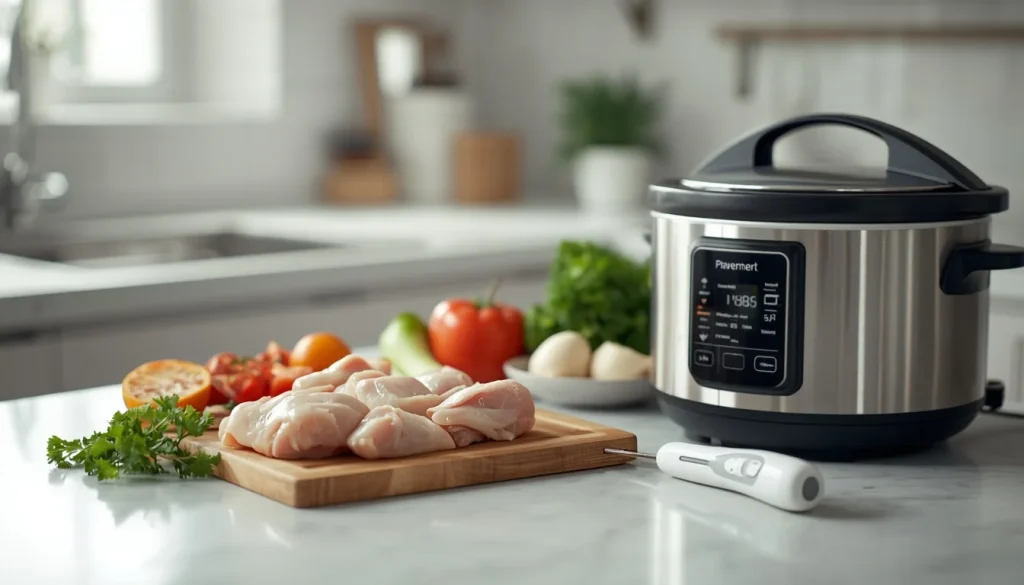
- Thaw meat safely. Defrost meat or poultry in the refrigerator. Use cold water or a microwave only when you will cook it immediately.
- Cut large pieces. Divide oversized roasts into smaller portions so heat reaches the centre faster. Keep poultry pieces similar in thickness.
- Load dense foods correctly. Place carrots and potatoes near the bottom and sides, where heat builds first. Put thawed meat above them unless the recipe says otherwise.
- Use the right fill level. Keep the pot about one-half to two-thirds full. Pro tip: Split an oversized batch between two cookers instead of packing one to the lid.
- Start cooking immediately. Select LOW or HIGH as soon as the ingredients are loaded. Never let raw meat, cream, or stock wait on a delayed timer.
- Keep the lid closed. Open it only when the recipe requires stirring or testing. Each lift releases heat and extends cooking.
- Check exact temperatures. Test poultry at 165°F (74°C), ground meat at 160°F (71°C), and whole cuts at 145°F (63°C). Pro tip: Check the thickest two or three pieces.
- Store leftovers quickly. Transfer food to shallow containers within two hours. Refrigerate promptly, then reheat leftovers rapidly to 165°F (74°C).
- Test your slow cooker annually.
Heat water in the appliance on LOW for 8 hours and check the temperature. A properly functioning slow cooker should reach at least 185°F (85°C). If yours falls short, replace it before using it for poultry or large cuts of meat. - Never reheat leftovers in a slow cooker.
A slow cooker takes too long to move cold food through the danger zone. Always reheat leftovers rapidly on the stovetop or in a microwave to 165°F (74°C) first — then transfer to the slow cooker on WARM if you need to hold the food for serving. - Handle the lid carefully during transport.
If you are transporting a finished dish to a gathering, keep the lid secured with rubber bands or lid locks, and carry the cooker flat. Never leave transported food below 140°F (60°C) for more than 2 hours — including travel time. - When in doubt, throw it out.
If the power went out while you were away, if the food smells unusual, or if you cannot confirm the food reached a safe internal temperature, discard it. No slow cooker meal is worth a foodborne illness risk for your family.

Expert Tips & Common Mistakes
Pro Tips
Use safe slow cooking to improve both safety and meal quality.
- Test an older cooker. Heat water in the appliance and follow the manufacturer’s temperature-test instructions. Replace a unit that heats inconsistently.
- Leave headroom. Stop at roughly two-thirds full for thick stews and large cuts. This gives heat room to circulate.
- Check near the end. Begin testing 30 minutes before the estimated finish, then close the lid quickly. You will confirm safety without badly overcooking dinner.
- Plan overnight meals. Start with chilled, thawed ingredients and a reliable recipe. Make sure the cooker will not switch off before morning.
- Cool batches in small portions. Divide food into shallow containers no deeper than about 2 inches or 5 centimetres so they cool faster.
Slow-cooker testing from Serious Eats shows why appliance-specific checks matter: cooking temperatures can differ noticeably between models.
Testing by Serious Eats found that cooking temperatures can vary significantly between slow cooker brands and models — in some cases by more than 50°F. This variation is why checking the actual food temperature with a thermometer matters more than trusting the dial setting. You can read the full analysis at seriouseats.com.
Common Mistakes
Even careful preparation can fail when these mistakes slow heating or hide unsafe temperatures.
- Cooking frozen meat directly. Frozen centres warm slowly, so food can remain in the danger zone long enough for bacteria to multiply.
- Using WARM as a cooking mode. WARM holds finished food. Raw chicken or meat may never heat quickly enough to become safe.
- Reheating leftovers slowly. A crock pot may take too long to move cold food through 40°F to 140°F. Reheat it rapidly to 165°F (74°C), then transfer it for holding.
- Ignoring a power cut. When you were away and cannot tell how long the cooker was off, discard the food. Smell and appearance cannot confirm safety.
FAQs About Crock Pot Safety Tips
Can I leave a crock pot on LOW while I am at work?
Yes. These crock pot safety tips apply when the appliance is in good condition, the recipe is designed for LOW, and all meat is fully thawed. Keep the cooker within its recommended fill range and avoid delayed starts with perishable ingredients. A programmable model that switches to WARM can limit overcooking, but confirm the meal reaches its required internal temperature before eating.
Is it safe to cook chicken overnight in a slow cooker?
Yes, thawed chicken can cook overnight when the recipe provides enough time and the cooker heats reliably. Chicken must reach 165°F (74°C) in the thickest part. Do not start with frozen chicken or use WARM for cooking. Refrigerate leftovers within two hours after serving.
Can I put frozen beef or chicken straight into a crock pot?
No. Frozen meat can remain between 40°F and 140°F (4°C to 60°C) too long because a crock pot heats gradually. Thaw meat in the refrigerator first. For faster thawing, use cold water or a microwave and cook immediately. A pressure cooker is a better option when the meat is still frozen.
Why is my crock pot not getting hot enough?
The insert may be overfilled, the lid may not fit, or the heating base may be failing. Repeated lid lifting also slows cooking. Check with a thermometer rather than judging by bubbles. If poultry cannot reach 165°F (74°C) within the recipe time, finish it immediately with another safe method and test or replace the cooker.
Can I reheat chilli or stew overnight in a crock pot?
No. Cold leftovers should not reheat slowly overnight. Heat chilli or stew rapidly on the stove, in the microwave, or in the oven until every portion reaches 165°F (74°C). Then move it to a preheated crock pot and use WARM, provided the food stays at 140°F (60°C) or above.
How long can food stay on the WARM setting?
Food can stay on WARM only while its temperature remains at least 140°F (60°C). Check it with a clean thermometer during parties or long serving periods. Quality can decline after a few hours, even when the food remains hot enough. Discard food that has stayed below 140°F for more than two hours.
What should I do if the power goes out while the crock pot is cooking?
When you are home, move the food immediately to a stovetop, oven, grill, or another working appliance and finish cooking it. When you return after an unknown outage, discard the food because you cannot confirm how long it stayed below a safe temperature. Never rely on smell or appearance.
Conclusion
The most important takeaway from these crock pot safety tips is to control both time and temperature. Start with thawed ingredients, use LOW or HIGH rather than WARM for cooking, keep the lid closed, and verify doneness with a thermometer. Poultry needs 165°F (74°C), ground meat needs 160°F (71°C), and hot food must remain at 140°F (60°C) or above.
These slow cooker safety tips also protect food after cooking. Reheat leftovers rapidly, cool large batches in shallow containers, and discard meals after an unknown power interruption. Smart cookers, app alerts, and AI kitchen tools can improve timing, but they cannot replace a thermometer or sound crock pot safety rules.
Safe slow cooking is not about watching the pot all day; it is about setting up the meal correctly before you walk away.
Check your cooker, thaw tonight’s ingredients, and place a clean food thermometer beside it before you begin.
“I believe great cooking starts with the right tools, trusted advice, and a little confidence in the kitchen.”
Hi, I’m Emma Carter. My love for cooking began in my grandmother’s kitchen, where I learned that every great meal starts with simple ingredients and the right cookware. Over the years, I’ve spent countless hours researching, testing, and comparing kitchen appliances, cookware, coffee makers, air fryers, and other everyday kitchen essentials.
Here at KiCook, my goal is to make your buying decisions easier with honest product reviews, practical buying guides, and easy-to-follow cooking tips. Whether you’re upgrading your kitchen or searching for the best appliance for your home, I focus on providing clear, reliable, and research-backed information you can trust.
When I’m not testing new kitchen gadgets or writing in-depth guides, you’ll usually find me trying new recipes, visiting local farmers’ markets, or enjoying a quiet cup of coffee while planning my next kitchen project.