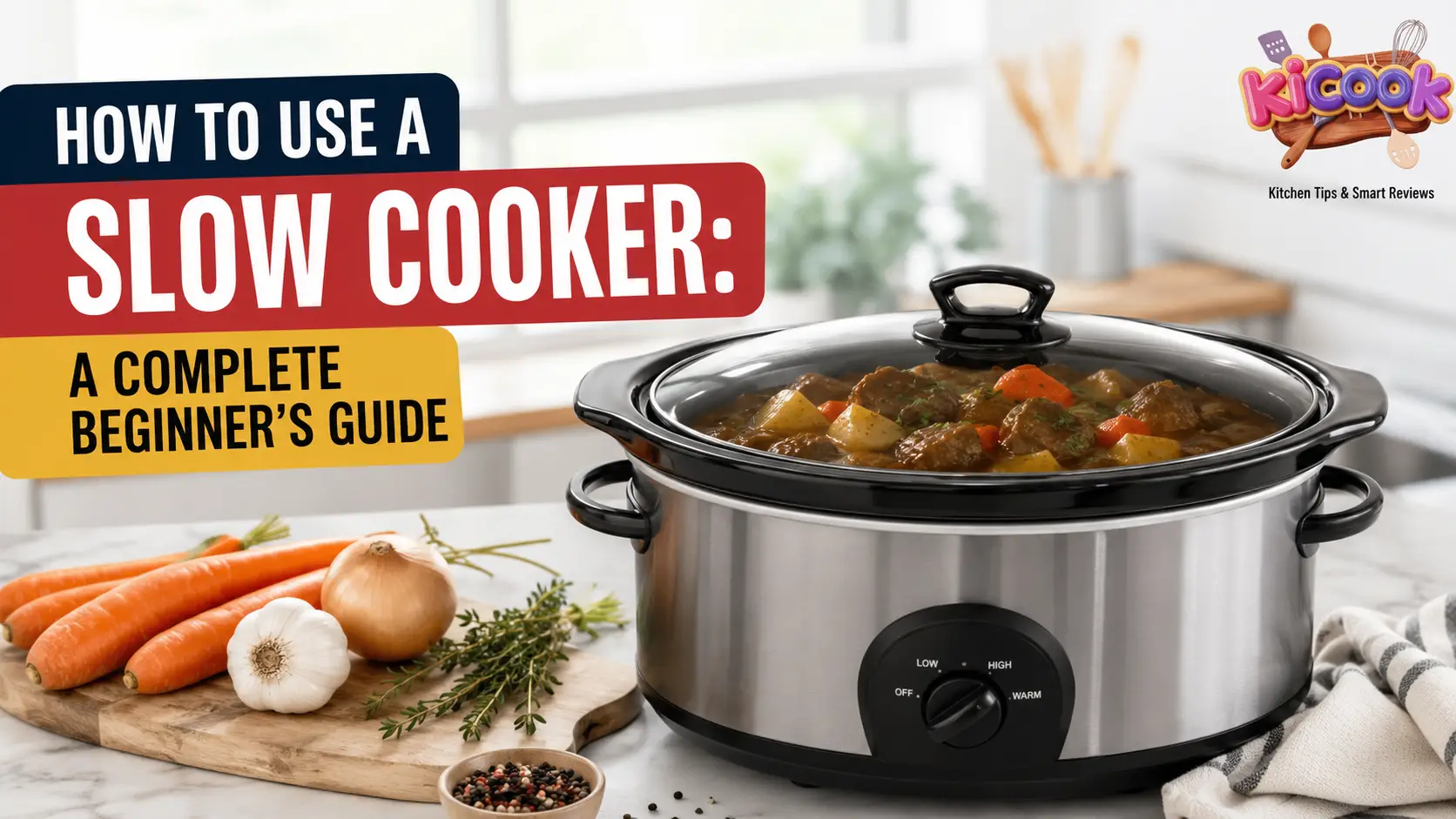
A slow cooker is one of the easiest kitchen appliances to use, but beginners often have important questions. How much liquid should you add? Should meat or vegetables go in first? Is it safe to leave a slow cooker running while you are away? Should you cook on Low or High?
To use a slow cooker, prepare and layer the ingredients inside the removable pot, add the amount of liquid specified in the recipe, place the lid securely on top, and select the recommended temperature and cooking time. Keep the lid closed during cooking and use a food thermometer to check that meat has reached a safe internal temperature before serving.
This complete beginner’s guide explains how to use a slow cooker safely, choose the right settings, avoid common mistakes, and get tender, flavorful results every time.
What Is a Slow Cooker?
A slow cooker is an electric countertop appliance that cooks food gradually at a low, steady temperature. It is commonly used for soups, stews, curries, roasts, beans, casseroles, pulled meat, sauces, and other dishes that benefit from long cooking.
The appliance traps heat and moisture inside a covered cooking pot. This slow, moist cooking method helps soften tough cuts of meat, blend flavors, and cook meals with minimal attention.
Main Parts of a Slow Cooker
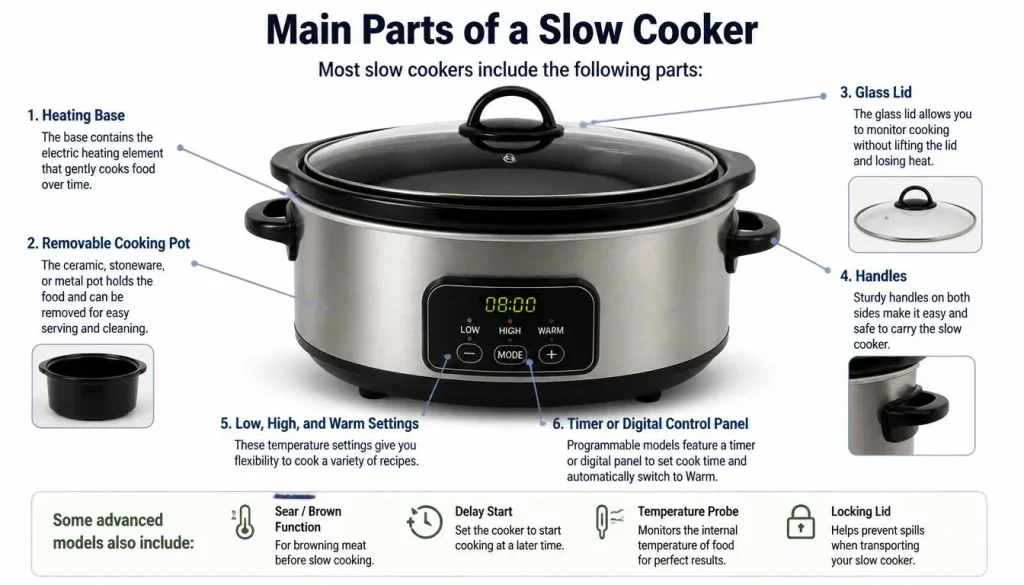
Most slow cookers include the following parts:
- A heating base
- A removable ceramic, stoneware, or metal cooking pot
- A glass lid
- Handles
- Low, High, and Warm settings
- A timer or digital control panel on programmable models
Some advanced models also include temperature probes, automatic shut-off features, sauté functions, or multiple cooking modes.
Slow Cooker vs. Crock-Pot
A slow cooker is a type of kitchen appliance. Crock-Pot is a popular brand of slow cooker.
People often use the terms interchangeably, especially in the United States and Canada. In the UK and Australia, “slow cooker” is generally the more common term.
How Does a Slow Cooker Work?
A slow cooker heats food from the base and sometimes around the sides of the pot. The lid traps steam, creating a moist cooking environment.
Because very little moisture escapes, slow-cooked meals usually need less liquid than stovetop meals. The long cooking time also allows connective tissue in tougher cuts of meat to break down, producing a tender texture.
A slow cooker is not designed to cook food quickly. It gradually brings the ingredients to a safe cooking temperature, which is why correct preparation, thawing, and food handling are important.
What Do the Slow Cooker Settings Mean?
Understanding the controls will help you choose the best setting for each recipe.
Low Setting
The Low setting is ideal for meals that cook throughout the day. It is commonly used for:
- Beef stew
- Pot roast
- Pulled pork
- Curries
- Soups
- Casseroles
- Tough cuts of meat
Low usually produces the most tender meat because connective tissue has more time to soften.
High Setting
The High setting cooks food faster. It can be useful when you have less time, but it is not always the best option for every dish.
High works well for:
- Soups
- Vegetable dishes
- Some chicken recipes
- Dips
- Quick slow-cooker meals
A recipe that takes eight hours on Low may take approximately four to five hours on High, but this is not a universal rule.
Warm or Keep-Warm Setting
The Warm setting is designed to keep fully cooked food hot until serving. It should not be used to cook raw meat, poultry, seafood, or other uncooked ingredients.
Food held on Warm should remain at or above 140°F or 60°C. The exact amount of time food can remain on Warm depends on the appliance, the recipe, and food-safety conditions.
Auto and Timer Settings
Programmable slow cookers allow you to select a cooking time. When the selected time ends, the appliance may automatically switch to Warm.
This feature is useful when you are working or away from the kitchen. However, avoid using a delayed-start function with raw meat, poultry, dairy products, or other perishable foods because they may remain at an unsafe temperature before cooking begins.
Choosing the Right Slow Cooker Size
Slow cooker capacity is usually measured in quarts in the United States and litres in the UK, Canada, and Australia.
The best size depends on the number of people you are feeding and the type of recipes you prepare.
| Slow Cooker SizeBest For | |
|---|---|
| 1.5–3 quarts or 1.5–3 litres | One or two people, sauces, dips, small meals |
| 3–5 quarts or 3–5 litres | Couples, small families, side dishes |
| 5–7 quarts or 5–7 litres | Families, whole chicken, roasts, batch cooking |
| 7 quarts or litres and above | Large families, entertaining, large-batch meals |
Most slow cookers work best when they are approximately one-half to three-quarters full.
If the pot is too empty, food may cook too quickly or dry out. If it is overfilled, food may cook unevenly or take too long to reach a safe temperature.
Using a very large slow cooker for a small recipe may also affect cooking time. Choose a cooker size that matches the recipe whenever possible.
How to Use a Slow Cooker Step by Step
Follow these steps when using a slow cooker for the first time.
Step 1: Read the Instruction Manual
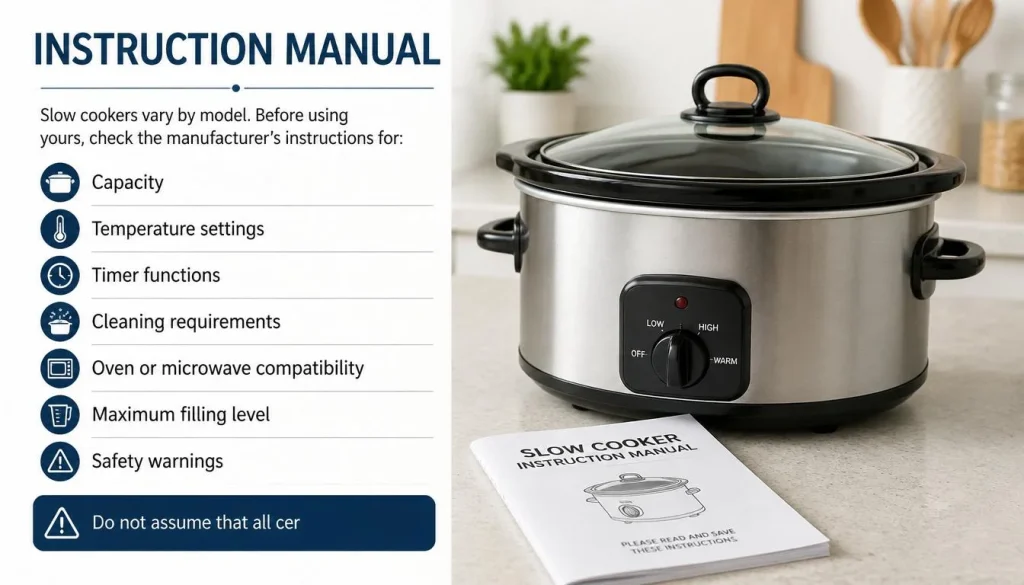
Slow cookers vary by model. Before using yours, check the manufacturer’s instructions for:
- Capacity
- Temperature settings
- Timer functions
- Cleaning requirements
- Oven or microwave compatibility
- Maximum filling level
- Safety warnings
Do not assume that all ceramic or metal inserts can be used in the oven, microwave, refrigerator, freezer, or on a stovetop.
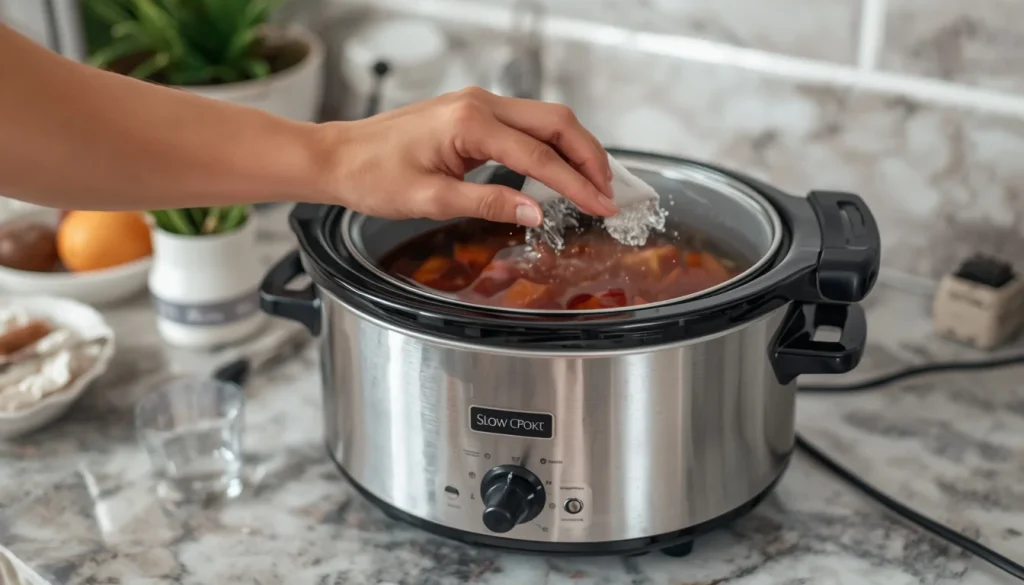
Step 2: Clean the Slow Cooker
Before first use, wash the removable cooking pot and lid with warm, soapy water.
Rinse and dry them completely.
Wipe the heating base with a damp cloth, but never immerse the electrical base, power cord, or plug in water.
Step 3: Prepare the Ingredients
Wash vegetables, trim excess fat from meat, and cut ingredients into evenly sized pieces.
Use thawed meat and poultry. Frozen meat can remain at an unsafe temperature for too long while the slow cooker gradually heats.
Keep prepared ingredients refrigerated until you are ready to begin cooking.
Step 4: Brown Meat When Helpful
Raw meat can usually be cooked directly in a slow cooker, provided that it is fully thawed and reaches a safe internal temperature.
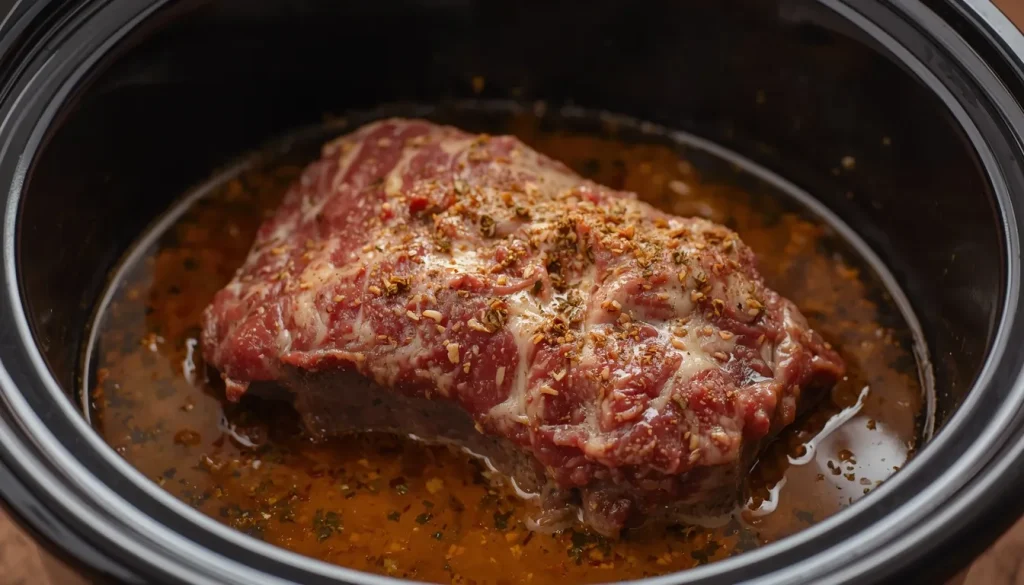
However, browning meat in a frying pan before slow cooking can improve:
- Color
- Flavor
- Texture
- Appearance of the finished sauce
Browning is especially helpful for beef stew, pot roast, pork shoulder, sausages, and ground meat.
For ground beef, lamb, pork, or turkey, browning and draining excess fat before slow cooking can prevent a greasy final dish.
Step 5: Layer the Ingredients Correctly
Dense vegetables generally take longer to cook than meat and softer vegetables.
Place firm root vegetables near the bottom and sides of the pot, where they receive more direct heat.
A common layering order is:
- Potatoes, carrots, parsnips, turnips, and onions
- Meat or poultry
- Sauce, stock, tomatoes, or other liquid
- Softer vegetables
- Dairy, pasta, seafood, fresh herbs, and delicate ingredients near the end
Cut firm vegetables into similar-sized pieces so they cook evenly.
Step 6: Add the Correct Amount of Liquid
Slow cookers lose very little moisture during cooking. You usually need less liquid than you would use in an oven or stovetop recipe.
Follow the liquid amount in a tested slow-cooker recipe whenever possible.
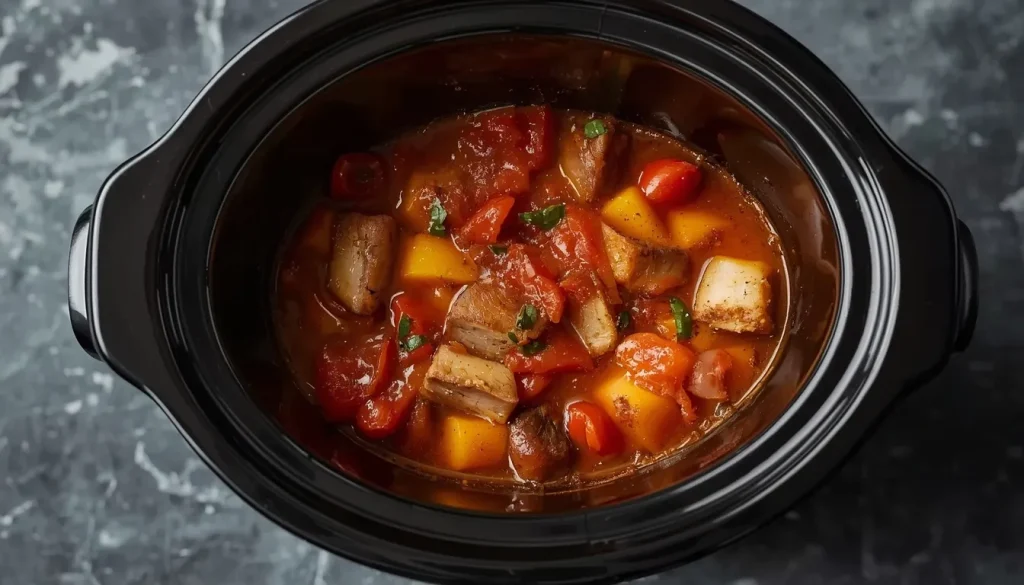
Suitable liquids include:
- Water
- Stock or broth
- Tomato sauce
- Chopped tomatoes
- Coconut milk
- Cooking sauce
- Wine, when properly balanced in the recipe
The ingredients do not always need to be completely covered. Meat and vegetables release additional moisture while cooking.
Too much liquid may produce a thin, watery sauce.
Step 7: Fill the Cooker Properly
Aim to fill the slow cooker between one-half and three-quarters full.
Do not pack ingredients above the maximum fill line.
Overfilling can cause:
- Uneven cooking
- Excessive cooking time
- Liquid spilling from the pot
- Food taking too long to reach a safe temperature
Underfilling may cause food to cook faster than expected or become dry.
Step 8: Put the Lid On
Place the lid securely on the slow cooker.
Do not lock a travel lid during cooking unless the manufacturer specifically states that it is designed to be locked while heating. Many locking lids are intended only for transportation.
Step 9: Select Low or High
Choose the setting and cooking time recommended by the recipe.
Use Low when you want a longer cooking time and more tender meat. Use High when the recipe supports faster cooking.
Do not use Warm as a substitute for Low.
Step 10: Keep the Lid Closed
Avoid lifting the lid unnecessarily.
Every time you open the slow cooker, heat and steam escape. This can increase cooking time and affect the final texture.
Most slow-cooker recipes do not need frequent stirring.
Open the lid only when the recipe tells you to add an ingredient, stir the food, check doneness, or thicken the sauce.
Step 11: Check That the Food Is Fully Cooked
Cooking time alone does not prove that food is safe.
Use a clean food thermometer to check meat and poultry in the thickest part.
| Food | Minimum Safe Internal Temperature |
|---|---|
| Chicken and turkey | 165°F or 74°C |
| Ground beef, pork, lamb, and veal | 160°F or 71°C |
| Whole cuts of beef, pork, lamb, and veal | 145°F or 63°C, followed by a rest |
| Fish | 145°F or 63°C |
| Reheated leftovers | 165°F or 74°C |
Cooking recommendations may vary by country, so follow the food-safety guidance applicable to your location.
Step 12: Serve and Store the Food Safely
Once the meal is cooked, serve it promptly or switch the slow cooker to Warm.
Refrigerate leftovers within two hours. Divide large amounts into shallow containers so they cool more quickly.
Do not allow a large ceramic pot filled with hot food to sit at room temperature for an extended period.
What Order Should Ingredients Go Into a Slow Cooker?
The correct ingredient order helps everything finish cooking at approximately the same time.
Root Vegetables
Place firm vegetables at the bottom or around the sides.
Examples include:
- Potatoes
- Carrots
- Parsnips
- Sweet potatoes
- Turnips
- Onions
Cut them into evenly sized pieces.
Meat and Poultry
Place meat over the firm vegetables unless the recipe gives different instructions.
Tough cuts usually work better than very lean cuts because they contain connective tissue and fat that soften during long cooking.
Good slow-cooker cuts include:
- Beef chuck
- Brisket
- Pork shoulder
- Lamb shoulder
- Chicken thighs
- Short ribs
Soft Vegetables
Add delicate vegetables later in the cooking process to prevent them from becoming mushy.
Examples include:
- Peas
- Spinach
- Courgette or zucchini
- Bell peppers
- Broccoli
- Fresh green beans
Dairy Products
Milk, cream, sour cream, yogurt, and some cheeses may separate or curdle during long cooking.
Add them during the final 15 to 30 minutes unless the recipe specifically instructs otherwise.
Evaporated milk, cream cheese, or other stable ingredients may tolerate longer cooking, depending on the recipe.
Pasta and Rice
Pasta and rice can become soft or absorb too much liquid when cooked for several hours.
Add pasta near the end and cook only until tender.
Rice requires the correct type and liquid ratio. Use a recipe developed specifically for slow-cooker rice rather than guessing.
Seafood
Fish, prawns, shrimp, scallops, and other seafood cook quickly.
Add seafood near the end of the cooking time to avoid a dry or rubbery texture.
Fresh Herbs and Acidic Ingredients
Fresh herbs often lose their brightness during long cooking. Add delicate herbs such as parsley, basil, coriander, or cilantro near the end.
A small amount of lemon juice, lime juice, or vinegar added before serving can brighten a dish that tastes flat.
Does a Slow Cooker Need Water?
A slow cooker does not always need added water.
Some ingredients release enough moisture on their own. Examples include:
- Tomatoes
- Onions
- Mushrooms
- Chicken
- Beef
- High-water vegetables
However, soups, stews, beans, grains, and sauces usually require some liquid.
Always follow the recipe. Do not run an empty slow cooker or attempt dry cooking unless the manufacturer and recipe confirm that it is safe.
Should Meat Be Covered With Liquid?
Meat does not always need to be completely submerged.
A pot roast, whole chicken, or pork shoulder may cook successfully with a relatively small amount of liquid because the meat and vegetables release moisture.
Soups and stews usually require more liquid than roasts.
Should You Add Hot or Cold Liquid?
Follow the recipe and the manufacturer’s instructions.
Avoid pouring boiling liquid into a refrigerator-cold ceramic insert because the sudden temperature change may cause cracking.
Similarly, do not place a very hot crock on a cold or wet surface.
Room-temperature or warm liquid is often suitable, but the safest choice depends on the slow cooker model and recipe.
Slow Cooker Cooking-Time Guide
Cooking times vary based on the appliance, recipe size, ingredient temperature, cut size, and how full the slow cooker is.
The following times are general estimates only.
| Food | Low Setting | High Setting |
|---|---|---|
| Boneless chicken breasts | 2½–4 hours | 1½–3 hours |
| Chicken thighs | 4–6 hours | 2–4 hours |
| Beef stew | 7–9 hours | 4–5 hours |
| Pot roast | 8–10 hours | 5–6 hours |
| Pork shoulder | 8–10 hours | 5–7 hours |
| Vegetable soup | 6–8 hours | 3–4 hours |
| Lentil dishes | 6–8 hours | 3–5 hours |
Always follow the recipe and confirm doneness with a thermometer when cooking meat or poultry.
Is Four Hours on High the Same as Eight Hours on Low?
Sometimes, but not always.
A common conversion is:
- Eight hours on Low equals approximately four to five hours on High
- Six hours on Low equals approximately three to four hours on High
However, delicate meat, dairy-based dishes, desserts, grains, and certain vegetables may not produce the same result on both settings.
Low is often better for tough cuts of meat because the longer cooking time allows more connective tissue to break down.
Can You Switch From High to Low?
You can switch settings on many models, but changing the temperature may alter the total cooking time.
If a recipe starts on High and switches to Low, follow its instructions carefully. Avoid making major time adjustments unless you understand how much cooking remains.
Can You Prepare a Slow Cooker Meal the Night Before?
Yes, but proper storage is important.
You can wash and cut vegetables, trim meat, measure seasonings, and prepare sauces the night before. Store the ingredients in covered containers in the refrigerator.
It is often safer to store meat separately from vegetables to reduce cross-contamination.
Some manufacturers allow the removable crock to be refrigerated, while others warn against moving a cold ceramic pot directly into a heated base.
Check the instruction manual before refrigerating the insert.
To reduce the risk of thermal shock:
- Do not pour boiling liquid into a cold ceramic crock
- Do not place a refrigerator-cold crock into a preheated base
- Do not place a hot crock on a cold countertop
- Avoid sudden temperature changes
Do not assemble a meal with raw meat and leave it at room temperature overnight.
Can You Cook Frozen Meat in a Slow Cooker?
It is safer to thaw meat and poultry before placing them in a slow cooker.
A slow cooker heats gradually. Frozen meat may remain too long in the temperature range where bacteria can multiply.
Safe thawing methods include:
- In the refrigerator
- In cold water, changed regularly
- In the microwave, followed by immediate cooking
Do not thaw meat on the kitchen counter.
Commercial frozen slow-cooker meals should only be used when their packaging provides specific instructions for safe slow cooking.
Can You Put Raw Meat in a Slow Cooker?
Yes. Fully thawed raw meat can usually be placed directly in a slow cooker.
Keep raw meat refrigerated before cooking, prevent it from touching ready-to-eat foods, and wash utensils and surfaces after handling it.
The meat must reach a safe internal temperature before serving.
Browning raw meat is optional for many recipes, but it can improve flavor and appearance.
Can You Cook Dried Kidney Beans in a Slow Cooker?
Raw or undercooked red kidney beans can contain high levels of a natural lectin that may cause illness.
Do not rely on a slow cooker alone to make raw dried kidney beans safe.
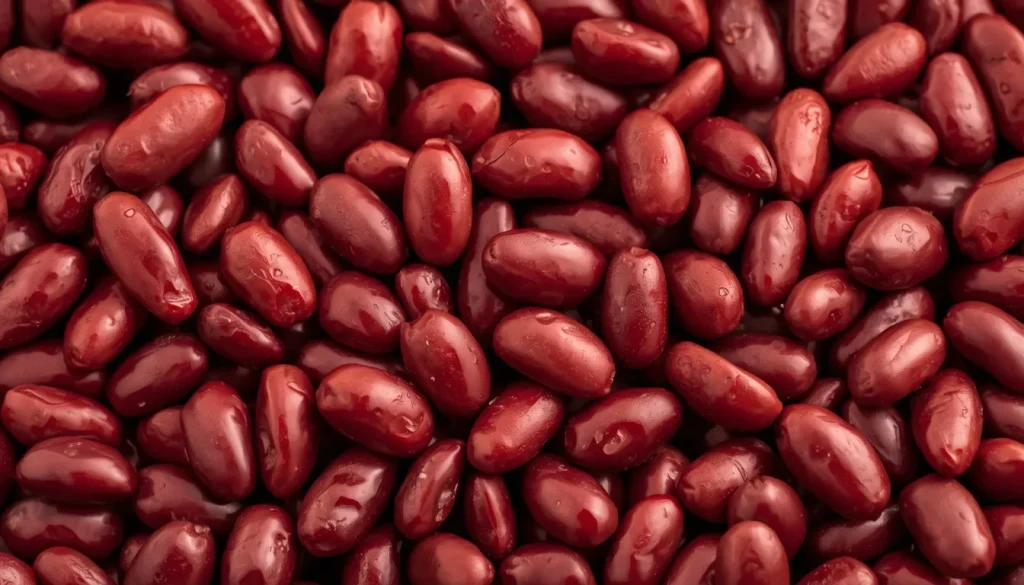
Before adding dried kidney beans to a slow cooker:
- Sort and rinse the beans.
- Soak them according to the package instructions.
- Drain and replace the soaking water.
- Boil the beans vigorously on the stovetop according to the package or local food-safety guidance.
- Add the properly prepared beans to the slow cooker.
Canned kidney beans are already cooked. Drain and rinse them before adding them near the end of a recipe.
Other dried beans may have different preparation requirements, so always read the package instructions.
How to Double or Halve a Slow Cooker Recipe
You can adjust many slow-cooker recipes, but do not assume every ingredient and cooking time should be changed equally.
Doubling a Recipe
Before doubling a recipe:
- Check the cooker’s maximum capacity
- Keep the pot below the maximum fill line
- Maintain the original ingredient ratios
- Be careful when doubling liquid
- Allow additional time if the pot is fuller
- Check meat with a thermometer
Cooking time usually does not need to be doubled, but a fuller slow cooker may take longer to heat.
Halving a Recipe
When halving a recipe:
- Use a smaller slow cooker when possible
- Reduce ingredients proportionally
- Begin checking the food earlier
- Watch lean meat carefully because it may dry out
A very small quantity in a large slow cooker may cook faster than expected.
How to Convert an Oven or Stovetop Recipe
Not every recipe can be converted successfully, but soups, stews, braises, curries, and roasts usually adapt well.
Reduce the Liquid
Because a slow cooker traps moisture, reduce the liquid used in a stovetop or oven recipe unless the dish is a soup.
Choose a Suitable Cooking Time
As a general starting point:
| Original Cooking Time | Slow Cooker on Low | Slow Cooker on High |
|---|---|---|
| 15–30 minutes | 4–6 hours | 1½–3 hours |
| 30–60 minutes | 6–8 hours | 3–4 hours |
| 1–2 hours | 8–10 hours | 4–6 hours |
These are approximate conversions. Ingredient size, meat type, and recipe volume may change the timing.
Change the Ingredient Order
Place dense vegetables at the bottom. Add meat above them. Add dairy, seafood, pasta, fresh herbs, and soft vegetables later.
Adjust Seasoning Before Serving
Long cooking can soften or dilute certain flavors.
Taste the dish near the end and adjust with:
- Salt
- Pepper
- Fresh herbs
- Lemon juice
- Vinegar
- Chili
- Spices
Foods That Work Well in a Slow Cooker
Slow cookers are especially good for dishes that benefit from moisture and long cooking.
Popular choices include:
- Beef stew
- Chicken curry
- Chili
- Pot roast
- Pulled pork
- Lamb shoulder
- Vegetable soup
- Lentil soup
- Pasta sauce
- Beans
- Casseroles
- Oatmeal
- Bread pudding
- Fruit desserts
- Hot dips
Foods That Need Extra Care
Some foods can be cooked in a slow cooker but require careful timing or preparation.
Lean Meat
Chicken breast, pork loin, and other lean cuts can become dry if cooked for too long.
Seafood
Add seafood near the end because it cooks quickly.
Pasta
Add pasta late and monitor it carefully to prevent a mushy texture.
Rice
Use the correct rice variety and liquid ratio.
Dairy
Add most milk, cream, yogurt, and cheese near the end.
Alcohol
Slow cookers do not evaporate liquid as quickly as uncovered pans. Too much wine, beer, or spirits may leave a strong alcohol flavor.
Green Vegetables
Broccoli, peas, spinach, and similar vegetables may become dull and overcooked if added too early.
How Long Can Food Stay in a Slow Cooker?
Cooked food can remain in the slow cooker on Warm for a limited period, provided that it stays at a safe hot-holding temperature.
The manufacturer may provide a recommended maximum Warm time. Food quality may decline even when the temperature remains safe.
Can You Leave a Slow Cooker On While You Are Out?
Many slow cookers are designed for unattended countertop cooking, but basic precautions are important.
Before leaving:
- Place the appliance on a flat, stable, heat-resistant surface
- Keep it away from curtains, paper, and walls
- Make sure the cord and plug are undamaged
- Do not use an extension lead unless the manufacturer permits it
- Fill the pot correctly
- Use enough liquid for the recipe
- Check that the lid is secure
- Select the correct setting
- Keep the appliance away from children and pets
Do not use an old or damaged slow cooker unattended.
Can You Leave a Slow Cooker On Overnight?
Many recipes are cooked overnight on Low. This can be safe when the appliance is in good condition, the recipe is suitable, and the slow cooker is used according to the manufacturer’s instructions.
Do not cook raw food overnight on Warm.
Can You Reheat Leftovers in a Slow Cooker?
A slow cooker is not the best appliance for reheating cold leftovers because it may warm them too slowly.
Reheat leftovers rapidly on a stovetop, in a microwave, or in an oven until they reach 165°F or 74°C. You may then transfer the hot food to a preheated slow cooker to keep it warm.
What Should You Do During a Power Outage?
If the power goes out while you are away and you do not know how long the food has been without heat, discard the food.
If you are at home when the power fails, continue cooking with another safe heat source if possible, such as:
- A stovetop
- An oven
- An outdoor grill used safely
If the food was fully cooked before the power outage, it may remain hot for a limited time with the lid closed. When safety is uncertain, discard it.
Do not taste food to decide whether it is safe.
Where Can You Use the Slow Cooker Insert?
Compatibility depends on the material and manufacturer.
Can the Insert Go in the Refrigerator?
Some removable crocks can be refrigerated, but sudden temperature changes may crack ceramic or stoneware.
Check the manual before refrigerating the insert.
Can the Insert Go in the Oven?
Some inserts are oven-safe up to a stated temperature. Others are not.
The lid may have a different temperature limit from the pot.
Can the Insert Go in the Microwave?
Some stoneware inserts are microwave-safe, but metal inserts are not.
Always check the appliance instructions.
Can You Put the Insert on the Stovetop?
Most ceramic slow-cooker pots are not designed for direct stovetop heat.
Using ceramic stoneware on a burner may cause cracking or breakage.
Some modern slow cookers include metal inserts specifically designed for stovetop browning. Use this feature only when the manufacturer confirms that it is safe.
How to Prevent Thermal Shock
Thermal shock happens when ceramic or stoneware experiences a sudden temperature change.
To reduce the risk:
- Do not place a hot crock in cold water
- Do not put a hot crock on a cold or wet surface
- Do not add boiling liquid to a cold crock
- Do not move a frozen crock directly into a hot base
- Let the crock cool before washing
- Use a heat-resistant mat or dry towel under a hot insert
Do not use a cracked, chipped, or damaged cooking pot.
Common Slow Cooker Mistakes
Avoiding these mistakes can improve safety, flavor, and texture.
Adding Too Much Liquid
Slow cookers trap moisture. Use less liquid than you would for an uncovered stovetop dish.
Opening the Lid Repeatedly
Each opening releases heat and may extend the cooking time.
Overfilling the Pot
An overfilled cooker may heat slowly and cook unevenly.
Underfilling the Pot
A small amount of food in a large cooker may cook too quickly.
Using Frozen Meat
Thaw meat and poultry before slow cooking.
Adding Dairy Too Early
Milk, cream, yogurt, and cheese may separate during long cooking.
Cooking Everything for the Same Amount of Time
Firm vegetables, meat, pasta, seafood, and dairy do not cook at the same speed.
Using Warm to Cook Raw Food
Warm is for holding cooked food, not cooking raw ingredients.
Assuming Longer Is Always Better
Lean meat, vegetables, pasta, and poultry can overcook.
Ignoring Internal Temperature
Use a thermometer instead of relying only on color or texture.
Reheating Cold Food Slowly
Reheat leftovers rapidly before transferring them to the slow cooker.
How to Fix Common Slow Cooker Problems
Why Is My Slow Cooker Meal Watery?
Common causes include:
- Too much added liquid
- Frozen vegetables releasing water
- Excess fat
- Condensation from the lid
- A recipe not designed for slow cooking
To thicken the sauce:
- Mix cornstarch with cold water and stir it in
- Use a flour slurry
- Mash some cooked vegetables
- Remove the lid and cook on High briefly
- Transfer the sauce to a pan and reduce it
- Add tomato paste, cream cheese, or another suitable thickener
Do not add dry cornstarch directly because it may form lumps.
Why Is the Meat Still Tough?
Tough meat often needs more time, not less.
Other causes include:
- The wrong cut of meat
- Pieces that are too large
- Insufficient liquid
- An underfilled or overfilled cooker
- Opening the lid repeatedly
- Cooking at an unsuitable temperature
Cuts such as chuck, brisket, and pork shoulder become tender after their connective tissue has had enough time to break down.
Why Is the Meat Dry?
Possible causes include:
- Using a very lean cut
- Cooking too long
- Using a slow cooker that is too large
- Not using enough sauce
- Cutting the meat too small
- Cooking chicken breast like chicken thighs
Choose meat suited to long cooking and start checking lean cuts earlier.
Why Are the Vegetables Still Hard?
Possible causes include:
- Placing firm vegetables on top
- Cutting them too large
- Overfilling the pot
- Adding acidic ingredients too early
- Not allowing enough cooking time
Place root vegetables near the bottom and cut them into smaller, even pieces.
Why Does the Food Taste Bland?
Long cooking can soften some flavors.
Improve a bland dish with:
- Salt
- Black pepper
- Fresh herbs
- Lemon or lime juice
- Vinegar
- Chili
- Fresh garlic
- Toasted spices
- A small amount of Worcestershire sauce or soy sauce, when suitable
Taste and adjust the seasoning before serving.
How to Know if a Slow Cooker Is Working
The outside of the heating base should become warm or hot during use. Some models also have an indicator light.
If food remains cold or fails to cook within the expected time:
- Confirm that the outlet works
- Check that the cooker is plugged in
- Make sure the correct setting is selected
- Inspect the cord for damage
- Check that the removable pot is seated properly
- Stop using the appliance if it smells burnt, sparks, or heats inconsistently
Do not eat food that has remained at an unsafe temperature because of an appliance failure.
The manufacturer may provide a water-heating test for checking performance.
Are Slow Cooker Liners Safe?
Slow cooker liners can simplify cleanup when they are specifically designed for slow cookers and used according to their instructions.
Do not substitute ordinary plastic bags.
When using a liner:
- Check that it is suitable for your cooker size
- Do not use it on a stovetop
- Keep it away from direct flames
- Do not lift the liner while it contains very hot food
- Do not store food in it unless the packaging permits storage
- Follow the temperature limits
A liner does not replace normal food-safety practices.
Can You Use Foil or Parchment Paper?
Foil and parchment may be used in certain recipes, such as baked items, but they can affect heat circulation.
Do not completely block the sides or base unless the recipe and manufacturer permit it.
Never allow foil to contact exposed electrical heating elements.
Does a Slow Cooker Use a Lot of Electricity?
Slow cookers generally use less power per hour than a full-size electric oven, although they operate for longer periods.
To estimate the cost:
- Find the wattage on the appliance label.
- Multiply the wattage by the number of cooking hours.
- Divide by 1,000 to calculate kilowatt-hours.
- Multiply by your local electricity rate.
For example, a 250-watt slow cooker used for eight hours consumes approximately 2 kilowatt-hours.
Actual cost depends on the appliance, setting, cooking time, and electricity price in your location.
How to Clean a Slow Cooker
Allow the appliance to cool before cleaning.
Cleaning the Removable Pot and Lid
Wash the pot and lid with warm, soapy water.
Some models are dishwasher-safe, but check the manual.
For stuck-on food:
- Fill the cooled pot with warm, soapy water
- Allow it to soak
- Use a non-abrasive sponge
- Avoid metal scouring pads
Cleaning the Heating Base
Unplug the appliance.
Wipe the base with a damp cloth. Do not immerse it in water or pour liquid into it.
Dry it completely before storage.
Removing Odors
A paste made from baking soda and water may help remove odors from some removable crocks.
Rinse thoroughly afterward.
Avoid harsh chemicals unless the manufacturer approves them.
Easy Beginner Slow Cooker Chicken and Vegetable Stew
This simple recipe helps demonstrate the basic slow-cooker method.
Ingredients
- 1½ pounds or 680 grams boneless chicken thighs
- 3 medium potatoes, cut into chunks
- 3 carrots, sliced
- 1 onion, chopped
- 2 garlic cloves, minced
- 2 cups or 475 millilitres chicken stock
- 1 teaspoon dried thyme
- 1 teaspoon paprika
- ½ teaspoon black pepper
- Salt to taste
- 1 cup frozen peas
- 2 tablespoons cornstarch
- 2 tablespoons cold water
Instructions
- Place the potatoes, carrots, and onion in the bottom of the slow cooker.
- Put the chicken thighs on top.
- Add the garlic, thyme, paprika, pepper, and stock.
- Cover and cook on Low for approximately six to seven hours or on High for three to four hours.
- Check that the chicken has reached 165°F or 74°C.
- Remove the chicken, cut it into bite-sized pieces, and return it to the pot.
- Stir in the frozen peas.
- Mix the cornstarch with cold water to create a slurry.
- Stir the slurry into the stew.
- Cover and cook on High for another 15 to 20 minutes, or until thickened.
- Taste and adjust the seasoning before serving.
Cooking time may vary by slow cooker model and ingredient size.
Quick Slow Cooker Dos and Don’ts
| Do | Don’t |
|---|---|
| Read the instruction manual | Assume every slow cooker works the same way |
| Use thawed meat | Add large pieces of frozen meat |
| Follow a tested recipe | Guess the liquid quantity |
| Keep the lid closed | Open the lid repeatedly |
| Put firm vegetables near the bottom | Place large raw potatoes on top |
| Use a food thermometer | Judge meat safety by color alone |
| Add dairy and seafood later | Cook every ingredient for the same amount of time |
| Refrigerate leftovers promptly | Leave cooked food at room temperature |
| Use Warm for cooked food | Use Warm to cook raw food |
| Check the insert’s compatibility | Put ordinary ceramic stoneware on a stovetop |
Frequently Asked Questions
How do you use a slow cooker for the first time?
Wash the removable pot and lid, read the manual, prepare the ingredients, place firm vegetables at the bottom, add meat and liquid, cover the pot, and select Low or High. Keep the lid closed and check meat with a thermometer before serving.
Do you have to put water in a slow cooker?
No. Some recipes produce enough moisture from meat, vegetables, tomatoes, or sauce. Soups, beans, grains, and stews usually need added liquid. Follow a tested recipe rather than automatically adding water.
Can you put raw meat directly into a slow cooker?
Yes, provided that the meat is fully thawed, handled safely, and cooked to a safe internal temperature. Browning is optional but can improve flavor and color.
Can you put frozen chicken in a slow cooker?
It is safer to thaw chicken before slow cooking. Frozen chicken may take too long to reach a safe temperature.
Should meat or vegetables go in first?
Firm vegetables usually go at the bottom because they take longer to soften. Meat is commonly placed above them.
Is it better to cook on Low or High?
Low is often better for tough cuts of meat and all-day cooking. High is useful when less time is available. Follow the recipe because not every dish produces the same result on both settings.
Is four hours on High the same as eight hours on Low?
It is a common approximation, but not an exact rule. Meat type, recipe volume, cooker size, and ingredients affect the result.
How full should a slow cooker be?
Most slow cookers work best when they are approximately one-half to three-quarters full.
Do you need to preheat a slow cooker?
Most recipes do not require preheating. Follow the appliance manual and recipe instructions.
Can you leave a slow cooker on overnight?
Many slow-cooker recipes are suitable for overnight cooking on Low. Use a safe recipe, a properly functioning appliance, and a stable heat-resistant surface.
Can you open the lid while cooking?
You can, but avoid doing it unnecessarily. Opening the lid releases heat and can increase cooking time.
Can you overcook food in a slow cooker?
Yes. Lean meat, poultry, pasta, dairy, seafood, and soft vegetables can overcook even at a low temperature.
Can you put dairy products in a slow cooker?
Yes, but most dairy products are best added near the end to reduce curdling or separation.
Can you use a slow cooker without liquid?
Some recipes require little or no added liquid because the ingredients release moisture. Do not attempt dry cooking unless the recipe and appliance instructions confirm that it is suitable.
Can you reheat food in a slow cooker?
Do not use a slow cooker to slowly reheat cold leftovers. Reheat the food rapidly to 165°F or 74°C using a microwave, stove, or oven, then transfer it to the slow cooker to keep warm.
Can you use an Instant Pot as a slow cooker?
Many multicookers include a slow-cook function, but they may heat differently from a traditional slow cooker. Follow the multicooker instructions and use the recommended lid and vent position.
What is the difference between a slow cooker and a pressure cooker?
A slow cooker uses low heat over several hours. A pressure cooker uses pressure and high heat to cook food quickly. They require different recipes, liquid amounts, and safety procedures.
Final Thoughts
Learning how to use a slow cooker is simple once you understand the basic rules.
Prepare thawed ingredients, place firm vegetables near the bottom, avoid adding too much liquid, fill the pot correctly, select the appropriate setting, and keep the lid closed.
Use Warm only for holding cooked food, not for cooking raw ingredients. Add dairy, seafood, pasta, fresh herbs, and delicate vegetables near the end.
Most importantly, use a food thermometer when cooking meat and poultry, refrigerate leftovers promptly, and follow the instructions provided with your specific slow cooker.
With the right technique, a slow cooker can help you prepare tender, flavorful meals with less hands-on cooking and easier cleanup.
“I believe great cooking starts with the right tools, trusted advice, and a little confidence in the kitchen.”
Hi, I’m Emma Carter. My love for cooking began in my grandmother’s kitchen, where I learned that every great meal starts with simple ingredients and the right cookware. Over the years, I’ve spent countless hours researching, testing, and comparing kitchen appliances, cookware, coffee makers, air fryers, and other everyday kitchen essentials.
Here at KiCook, my goal is to make your buying decisions easier with honest product reviews, practical buying guides, and easy-to-follow cooking tips. Whether you’re upgrading your kitchen or searching for the best appliance for your home, I focus on providing clear, reliable, and research-backed information you can trust.
When I’m not testing new kitchen gadgets or writing in-depth guides, you’ll usually find me trying new recipes, visiting local farmers’ markets, or enjoying a quiet cup of coffee while planning my next kitchen project.