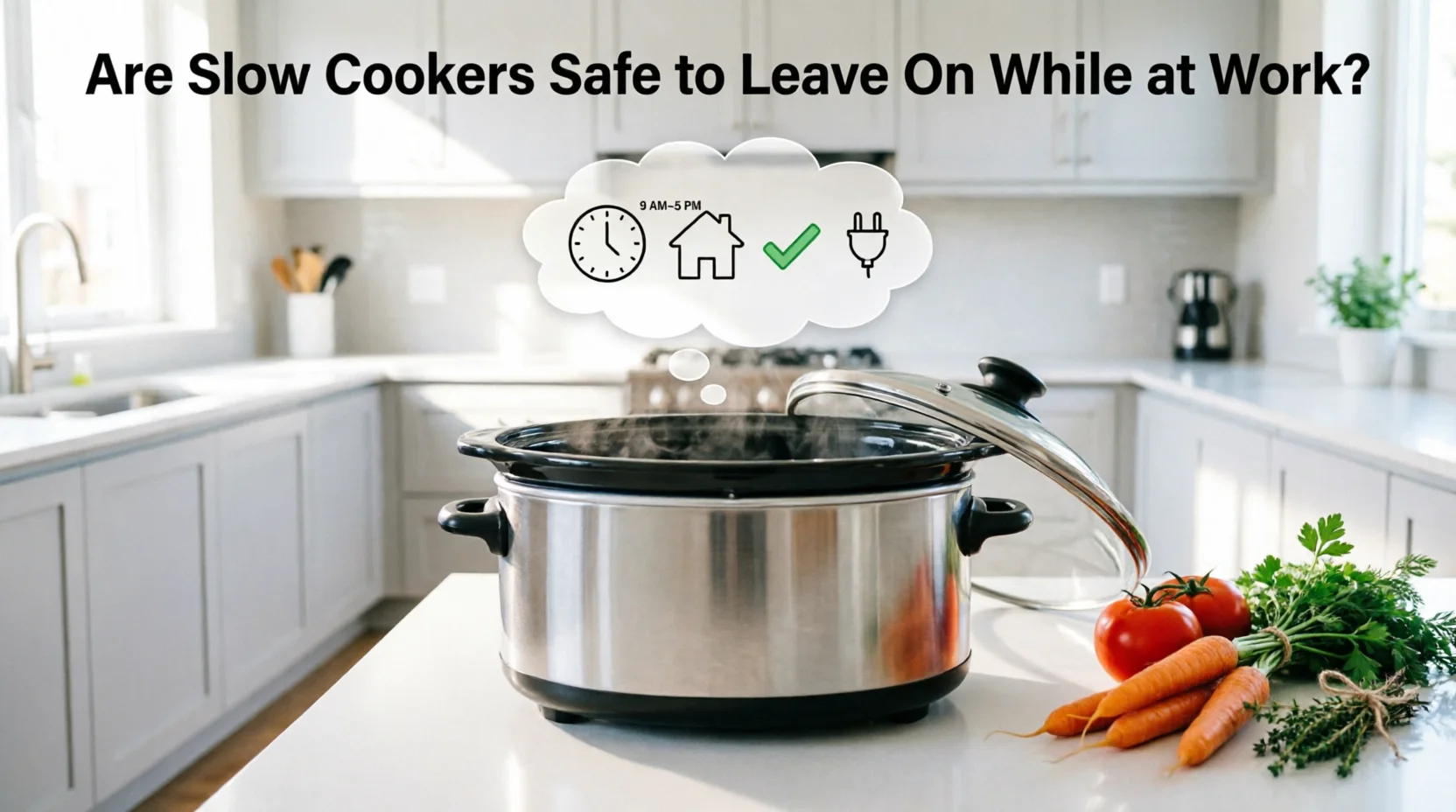
I get asked this question constantly: are slow cookers safe to leave on while at work? The short answer is yes—modern slow cookers are specifically designed to run unattended for hours, using low wattage and controlled heat to cook food safely while you’re away
What matters most is that your appliance is in good working order, placed correctly, and used according to manufacturer guidelines.
If you’ve ever stood at your office desk wondering whether that pot of chili is still simmering safely at home, you’re not alone. I’ve felt that same knot of worry—especially after hearing dramatic stories about kitchen fires.
The truth is, while no electrical appliance is 100% risk-free, slow cookers rank among the safest options for unattended cooking when used properly. Let me walk you through exactly how to keep your kitchen, your home, and your peace of mind protected.
The Real Concern: Fire Risk and Peace of Mind
Let’s address the elephant in the kitchen: fire. Cooking is the leading cause of home fires across the United States, Canada, and the UK, accounting for nearly half of all residential fire incidents
It’s completely understandable to feel anxious about leaving any heat-generating appliance running while you’re commuting or sitting in meetings.
But here’s what the data actually shows: slow cookers are responsible for fewer than 1% of all cooking-related fires
According to the National Fire Protection Association, slow cookers cause an average of just 231 fires per year in the U.S.—a remarkably low number compared to stovetops or ovens
In the UK, Electrical Safety First confirms that when used correctly, slow cookers present minimal fire risk
The key word there is “correctly.” Most slow cooker fires stem from three preventable issues: damaged cords or plugs, placement near flammable materials like curtains or paper towels, or overfilling the pot so food spills onto heating elements. When you address these basics, you dramatically reduce any remaining risk.
I learned this the hard way years ago. I once left my old slow cooker running on high while I ran errands, only to return and find the cord slightly warm and the unit sitting too close to a dish rack.
Nothing caught fire, but it was a wake-up call. Since then, I’ve developed a simple pre-departure checklist that takes less than 60 seconds—and I share it with everyone who asks me this question.
Your Simple, Practical Safety Checklist
Getting your slow cooker ready for a workday cook doesn’t require complicated steps. Here’s my proven routine that keeps things safe and stress-free:
1. Inspect the cord and plug before every use. Run your fingers along the entire length of the power cord. If you feel any fraying, cracks, or exposed wiring, retire the appliance immediately. Check that the plug fits snugly into a polarized outlet—never use an adapter or extension cord unless the manufacturer explicitly approves it
2. Position your slow cooker strategically. Place it on a stable, heat-resistant surface at least six inches away from walls, cabinets, or anything that could catch fire. Keep it clear of curtains, paper towels, wooden utensils, and plastic containers. I keep mine centered on my granite countertop, far from the edge where a curious pet or child might bump it.
3. Fill it properly—never over or under. Most manufacturers recommend filling slow cookers between one-half and two-thirds full
Too little food can cause overheating; too much can lead to uneven cooking or spills. If you’re making a small batch, consider using a smaller 2-quart model instead of forcing a 6-quart pot to work.
4. Prep ingredients safely. Always start with refrigerated perishables and add them to the slow cooker just before turning it on. Never put frozen meat directly into a slow cooker—it can linger too long in the “danger zone” (40°F–140°F) where bacteria multiply rapidly
The USDA recommends thawing meat in the refrigerator overnight before slow cooking
5. Set the right temperature for your schedule. If you’ll be gone 8+ hours, use the LOW setting. HIGH is best for shorter cooks (4 hours or less) when you’re home to monitor. Many newer models feature programmable timers that automatically switch to “keep warm” after cooking finishes—this is a fantastic safety upgrade worth considering
6. Lock down the lid—but not the lock. Make sure the lid sits securely to retain heat and moisture. However, if your model has a locking lid for transport, do not engage the lock during cooking. Trapped pressure can build up and potentially damage the unit
As food safety expert Mary Katherine Jeffers from the USDA puts it: “The direct heat from the pot and lengthy cooking time combine to destroy bacteria, making the slow cooker a good choice for safely cooking foods” when guidelines are followed
Going Deeper: Smart Features and Real-World Examples
Not all slow cookers are created equal, and understanding the features can make a big difference in safety and convenience. If you’re shopping for a new model or wondering whether to upgrade, here’s what to prioritize:
Programmable timers with auto shut-off. These models let you set a specific cook time (say, 7 hours), after which the unit automatically switches to “keep warm” or turns off entirely. This prevents overcooking and reduces fire risk if you get stuck late at work. I upgraded to a programmable model three years ago, and it’s been a game-changer for my Tuesday night meal prep.
Temperature probes. Some premium slow cookers include a probe that monitors internal food temperature. Once your roast hits 165°F (the safe temperature for poultry) or 145°F (for beef), the unit switches to warm mode. This takes the guesswork out of food safety.
Removable stoneware inserts. These make cleaning easier and let you prep ingredients the night before. Just store the filled insert in the fridge overnight, then pop it into the base in the morning. This also helps keep perishables cold longer before cooking begins.
Let me share a real example from my own life. Last winter, I prepared a beef stew on Sunday evening, stored the filled stoneware in the fridge, and popped it into the base at 7 a.m. Monday before heading to work. I set it to LOW for 9 hours. When I walked in the door at 4:30 p.m., the stew was perfectly tender, steaming hot, and safely held at 140°F+ on the keep-warm setting. No stress, no rush, no safety worries.
As cooking authority J. Kenji López-Alt notes: “The slow cooker’s greatest strength is its ability to transform tough, inexpensive cuts into tender meals with minimal supervision—but that only works if you respect its limits
Common Mistakes That Compromise Safety
Even with the best intentions, it’s easy to slip into habits that increase risk. Here are the most frequent errors I see—and how to avoid them:
Mistake #1: Using a smart plug or power strip. It might seem convenient to control your slow cooker via an app, but most manufacturers advise against this. Slow cookers draw steady power, and incompatible surge protectors can interfere with their operation or create electrical hazards. Plug directly into a wall outlet
Mistake #2: Leaving the lid off to “check progress.” Every time you lift the lid, the internal temperature drops 10–15 degrees, extending the time food spends in the danger zone
Trust the process. If your recipe says 8 hours on LOW, don’t peek at hour 6.
Mistake #3: Cooking large cuts without trimming. A whole chicken or thick roast may not heat evenly in a slow cooker. Cut meat into 2–3 inch chunks to ensure thorough, safe cooking throughout
Mistake #4: Ignoring recall notices. Register your appliance with the manufacturer when you buy it. If a safety issue arises, they can contact you directly. I registered my current slow cooker online in under two minutes—it’s one of the easiest safety steps you can take
Mistake #5: Assuming “keep warm” means “safe forever.” The keep-warm function maintains food above 140°F, but it’s not meant for indefinite holding. Consume or refrigerate leftovers within 2 hours of finishing the cook cycle to prevent bacterial growth
Food safety educator Dr. Jennifer Cline reminds us: “The goal isn’t perfection—it’s consistent application of basic principles. Wash hands, keep cold foods cold, cook to proper temperatures, and clean surfaces. That’s 90% of the battle”
My Personal Experience: What I’ve Learned After 10 Years
I’ve been using slow cookers regularly since 2016—through apartment living, home ownership, and even a cross-country move. Over that time, I’ve tested dozens of models, made countless meals, and yes, learned from a few close calls.
The biggest lesson? Consistency beats complexity. I don’t rely on fancy features alone. Instead, I follow the same five-step prep routine every single time: inspect, position, fill, prep, set. It takes less than a minute, but it builds a habit that protects my home.
I also keep a small fire extinguisher rated for kitchen use (Class K) mounted near—but not directly next to—my cooking area. It’s never been needed, but having it provides peace of mind. In the UK, Fire Safety First recommends similar precautions for all cooking appliances
Another personal tip: I set a phone reminder for 30 minutes before I expect to return home. This isn’t because I worry about fire—it’s so I can plan to be home when the cooking cycle ends, ensuring food doesn’t sit on “keep warm” longer than necessary. It’s a small habit that aligns with USDA guidance about timely food handling
Frequently Asked Questions on Are Slow Cookers Safe to Leave On While at Work?
Can I leave my slow cooker on overnight or while I sleep?
Yes, if it’s in good condition and placed safely. Many people use slow cookers for overnight oatmeal or breakfast casseroles. Just follow the same safety checklist: proper placement, correct fill level, and a functioning appliance
What’s the safest temperature setting for all-day cooking?
LOW (typically 190–200°F) is safest for unattended cooking longer than 6 hours. HIGH (around 300°F) is better for shorter cooks when you’re present. Always follow your recipe’s guidance
Do I need to stay home for the first 30 minutes to “make sure it heats up”?
No—this is a myth. Slow cookers are designed to heat gradually. As long as you start with refrigerated ingredients and the unit is functioning properly, it’s safe to leave immediately after turning it on
How do I know if my slow cooker is too old to use safely?
Check for frayed cords, loose plugs, cracked stoneware, or inconsistent heating. If your model is over 10 years old and lacks modern safety features like auto shut-off, consider upgrading. Registering your appliance helps you stay informed about recalls
Is it safe to use a slow cooker in an apartment or rental?
Absolutely—with extra attention to placement. Keep it away from shared walls if possible, ensure good ventilation, and confirm your rental’s electrical system can handle the load (most modern units draw under 300 watts)
What should I do if I smell something burning while I’m away?
If you have a smart smoke detector, you’ll get an alert. Otherwise, ask a trusted neighbor to check if you’re concerned. Never ignore unusual smells. If you return to find smoke, evacuate and call emergency services—don’t try to handle a fire yourself
Wrapping Up: Confidence Through Preparation
So, are slow cookers safe to leave on while at work? Yes—when you use a well-maintained appliance, follow basic placement and prep guidelines, and choose the right settings for your schedule. The data supports this: slow cookers cause far fewer fires than stovetops or ovens, and their low-wattage design makes them uniquely suited for unattended use
Your peace of mind matters just as much as the meal. By taking 60 seconds to inspect your cooker, position it wisely, and prep ingredients safely, you create a routine that protects your home without adding stress. And if you’re ever unsure, remember the USDA’s golden rule: when in doubt, keep cold foods cold, cook to proper temperatures, and clean as you go
If you found this guide helpful, I’d love to hear about your slow cooker wins—or your questions. Drop a comment below, and let’s keep making safe, delicious meals together. And if you’re ready to upgrade your appliance, check out Electrical Safety First’s product registration tool to stay informed about recalls and safety updates
Happy cooking—and even happier commuting, knowing your dinner’s got this.

“I believe great cooking starts with the right tools, trusted advice, and a little confidence in the kitchen.”
Hi, I’m Emma Carter. My love for cooking began in my grandmother’s kitchen, where I learned that every great meal starts with simple ingredients and the right cookware. Over the years, I’ve spent countless hours researching, testing, and comparing kitchen appliances, cookware, coffee makers, air fryers, and other everyday kitchen essentials.
Here at KiCook, my goal is to make your buying decisions easier with honest product reviews, practical buying guides, and easy-to-follow cooking tips. Whether you’re upgrading your kitchen or searching for the best appliance for your home, I focus on providing clear, reliable, and research-backed information you can trust.
When I’m not testing new kitchen gadgets or writing in-depth guides, you’ll usually find me trying new recipes, visiting local farmers’ markets, or enjoying a quiet cup of coffee while planning my next kitchen project.