
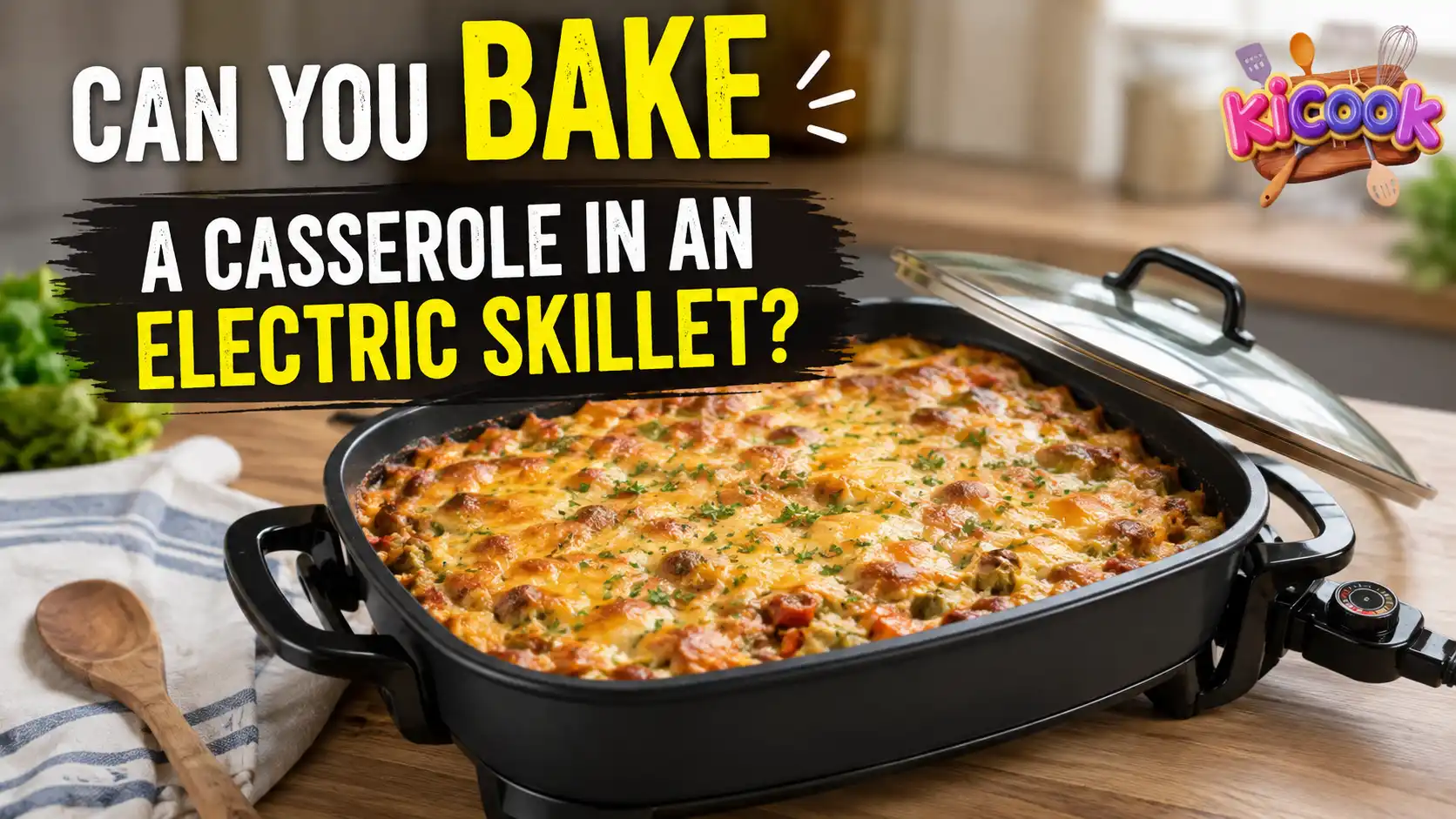
Yes, you can bake many types of casseroles in an electric skillet, especially if the skillet has adjustable temperature control, enough depth, and a tight-fitting lid.
An electric skillet does not heat food exactly like a conventional oven. Most of the heat comes from the bottom, while the lid traps heat and moisture around the food. Because of that, you may need to adjust the cooking temperature, liquid level, and cooking time when adapting a traditional oven casserole recipe.
Electric skillets work particularly well for breakfast casseroles, chicken and rice dishes, pasta casseroles, vegetable casseroles, and skillet-style lasagna.
The most important rule is simple: check the instructions for your specific electric skillet before using it for baking or casserole-style cooking.
Can You Really Bake a Casserole in an Electric Skillet?
In many cases, yes.
An electric skillet can act somewhat like a small countertop oven when the lid is closed. The heating element underneath the cooking surface provides steady heat, while the covered pan holds warm air and steam around the casserole.
However, the cooking environment is different from an oven.
A conventional oven surrounds the casserole with hot air. An electric skillet applies most of its heat from below. This means the bottom of your casserole may cook faster than the top.
That difference matters most when making casseroles that normally rely on a browned, crispy topping.
Electric skillets are best suited to casseroles that mainly need:
- Gentle, steady heat
- Moist cooking
- Melted cheese
- Tender pasta, rice, meat, or vegetables
- Covered cooking rather than strong top browning
For many everyday casseroles, they can be surprisingly convenient.
Electric Skillet vs. Electric Frying Pan: Is There a Difference?
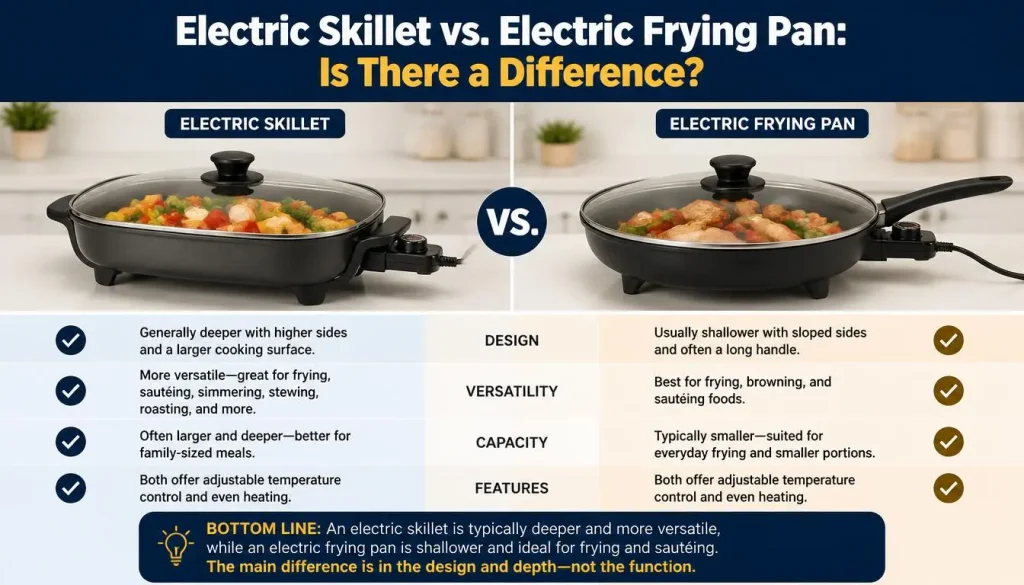
For practical cooking purposes, the terms electric skillet and electric frying pan usually describe very similar appliances.
In the United States and Canada, “electric skillet” is the more common term. In the UK and Australia, you may also see appliances described as electric frying pans.
Both typically have:
- A built-in heating element
- Adjustable temperature control
- A removable or attached thermostat
- High sides
- A fitted lid
So if you are wondering whether you can make a casserole in an electric frying pan, the answer is usually the same: yes, as long as the appliance is designed for covered cooking and your manufacturer allows it.
What Type of Electric Skillet Is Best for Casseroles?
Not every electric skillet is equally suitable for casserole cooking.
A few features make the job much easier.
Adjustable Temperature Control
A thermostat allows you to lower the heat after browning meat or vegetables.
This is important because casserole cooking usually works better at a moderate, steady temperature than at high frying heat.
Deep Sides
A deeper skillet gives you enough room for layered ingredients, bubbling sauces, rice, pasta, vegetables, and cheese.
It also reduces the chance of food overflowing while it cooks.
A Tight-Fitting Lid
The lid is one of the most important parts of electric skillet casserole cooking.
It helps trap:
- Heat
- Steam
- Moisture
Without a lid, the upper portion of the casserole may cook very slowly.
Even Heating
A good electric skillet should maintain reasonably even heat across the cooking surface.
Older or inexpensive models may develop hot spots, which can cause one area of the casserole to burn while another remains undercooked.
Enough Capacity
Do not choose a skillet that will be completely filled to the top.
Casseroles often bubble while cooking, so leaving some space below the lid is safer and usually helps the food cook more evenly.
Do You Need to Preheat an Electric Skillet?
Preheating is often helpful, but the exact method depends on your appliance.
If your recipe begins by browning ground beef, chicken, sausage, onions, or vegetables, preheating the skillet makes sense.
For many recipes, a starting temperature around 325°F to 350°F (163°C to 177°C) works well for browning.
Once the ingredients are browned, the temperature can usually be reduced for slower casserole cooking.
Some electric skillet manufacturers recommend preheating with the lid on, while others provide different instructions.
For that reason, follow your skillet’s manual rather than assuming every model should be preheated the same way.
What Temperature Should You Cook a Casserole at in an Electric Skillet?
There is no single temperature that works for every casserole.
The best setting depends on:
- The ingredients
- The depth of the casserole
- Whether the ingredients are raw or precooked
- The amount of liquid
- The skillet model
- Whether you are cooking directly in the skillet or using an approved baking pan
A useful general guide is:
| Cooking Task | Approximate Temperature |
|---|---|
| Browning meat or vegetables | 325–350°F / 163–177°C |
| Starting some casseroles | 300–350°F / 149–177°C |
| Slow covered casserole cooking | 200–300°F / 93–149°C |
| Keeping food warm | Use the skillet’s warm setting |
These are general starting points, not strict rules.
A casserole containing already-cooked pasta and sauce may need less cooking than a casserole containing raw chicken or uncooked rice.
Whenever possible, follow the recipe and your electric skillet manufacturer’s guidance.
How to Bake a Casserole in an Electric Skillet
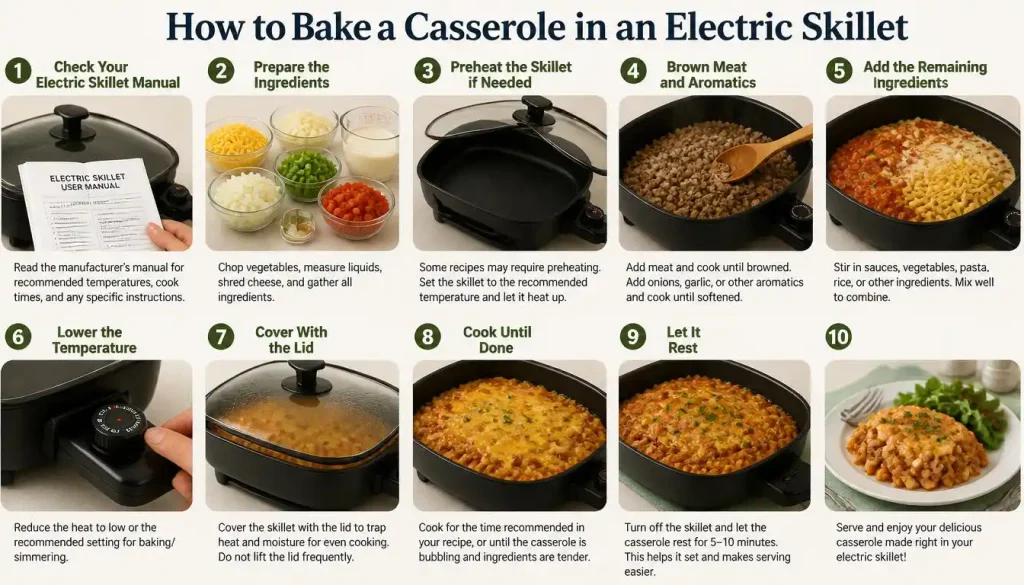
The basic process is straightforward.
Step 1: Check Your Electric Skillet Manual
Before you begin, confirm that your appliance is suitable for this type of cooking.
Also check whether the manufacturer allows:
- Baking pans inside the skillet
- Racks or trivets
- Foil
- Specific temperature settings
Step 2: Prepare the Ingredients
Chop vegetables, measure liquids, cook pasta if required, and prepare meat according to your recipe.
Using ingredients that are evenly sized helps the casserole cook more consistently.
Step 3: Preheat the Skillet if Needed
If you need to brown meat or sauté vegetables first, preheat the skillet to the appropriate temperature.
For many recipes, 325–350°F (163–177°C) is enough for this stage.
Step 4: Brown Meat and Aromatics
Cook ingredients such as:
- Ground beef
- Sausage
- Chicken pieces
- Onion
- Garlic
- Peppers
until they reach the stage required by your recipe.
If you are using poultry or other meats, make sure they eventually reach a safe internal temperature.
Step 5: Add the Remaining Ingredients
Add your:
- Pasta
- Rice
- Vegetables
- Sauce
- Broth
- Cheese
- Seasonings
Spread everything into an even layer.
Avoid piling ingredients too heavily in the center.
Step 6: Lower the Temperature
Once the casserole is assembled, reduce the heat if necessary.
Covered casserole cooking usually needs gentler heat than frying.
Step 7: Cover With the Lid
Place the lid securely on the skillet.
Keeping the lid on helps heat reach the upper layers of the casserole.
Step 8: Cook Until Done
Check the casserole near the end of the estimated cooking time.
Look for signs such as:
- Bubbling sauce
- Tender rice or pasta
- Soft vegetables
- Melted cheese
- Properly cooked meat
- A hot center
Step 9: Let It Rest
Allow the casserole to rest for about 5 to 10 minutes after switching off the skillet.
Resting helps sauces thicken and makes the casserole easier to serve.
Should You Cover a Casserole in an Electric Skillet?
In most cases, yes.
The lid helps create the enclosed cooking environment that an electric skillet needs to imitate oven-style cooking.
With the lid on, heat and moisture stay around the food instead of escaping immediately.
This is especially helpful for casseroles containing:
- Rice
- Pasta
- Potatoes
- Eggs
- Chicken
- Vegetables
Lid On vs. Lid Off
Keep the lid on during most of the cooking process.
You may remove or slightly vent the lid near the end if:
- The casserole contains too much moisture
- The sauce needs to thicken
- You want some steam to escape
Do this carefully because opening the lid also releases heat and can extend the cooking time.
How Do You Prevent Too Much Steam and Condensation?
Condensation is normal when cooking under a lid.
However, too much trapped moisture can make a casserole watery.
To reduce the problem:
- Do not add more liquid than the recipe requires.
- Drain canned ingredients well.
- Thaw and drain frozen vegetables when appropriate.
- Avoid opening the lid repeatedly early in the cooking process.
- Vent or remove the lid briefly near the end if your skillet allows it.
- Let the casserole rest before serving.
Remember that ingredients such as mushrooms, zucchini, frozen spinach, and frozen mixed vegetables can release a surprising amount of water during cooking.
How Long Does a Casserole Take in an Electric Skillet?
Many electric skillet casseroles take roughly 25 to 60 minutes, but cooking time varies considerably.
Here is a practical guide:
| Casserole Type | Approximate Cooking Time |
|---|---|
| Precooked pasta casserole | 25–40 minutes |
| Breakfast casserole | 30–45 minutes |
| Vegetable casserole | 25–45 minutes |
| Skillet lasagna | 35–50 minutes |
| Chicken and rice casserole | 40–60 minutes |
| Ground beef casserole | 30–45 minutes |
Treat these times as estimates.
The actual cooking time depends on:
- Skillet size
- Food depth
- Starting temperature of ingredients
- Heat setting
- Ingredient moisture
- Whether meat is already cooked
- How often the lid is opened
Instead of relying only on the clock, check whether the food is actually done.
Do You Need a Casserole Dish Inside the Electric Skillet?
Usually, no.
Many electric skillet casseroles are cooked directly in the pan.
However, some people use a separate heat-safe baking dish when their appliance manufacturer permits it.
Cooking Directly in the Skillet
This is usually the simplest method.
It works especially well for:
- Breakfast casseroles
- Pasta dishes
- Chicken and rice
- Ground beef casseroles
- Vegetable casseroles
- Skillet lasagna
You can often brown the ingredients, assemble the casserole, cook it, and serve it from the same pan.
That means fewer dishes to wash.
Using a Separate Baking Dish
A separate baking pan may be useful for certain recipes, but only if your electric skillet is designed for this method.
The dish must:
- Be heat-safe
- Fit comfortably inside the skillet
- Allow the lid to close
- Be approved for the cooking method you are using
Do not place ordinary glass cookware over intense direct bottom heat unless the cookware manufacturer specifically says it is safe for that use.
Do You Need a Rack or Trivet?
Some electric skillets can be used with an approved rack or trivet to lift a baking dish away from direct contact with the heating surface.
This may help create gentler heat around a separate pan.
However, this is not a universal electric skillet method.
Only use a rack, trivet, or baking insert if your appliance manufacturer allows it.
For most simple casserole recipes, cooking directly in the skillet is easier.
How to Convert an Oven Casserole Recipe for an Electric Skillet
You can adapt many oven casserole recipes, but it is better to make a few adjustments than to copy the oven instructions exactly.
Start With Moderate Heat
Because the heating element is directly beneath the food, very high heat can burn the bottom before the center finishes cooking.
Start lower if you are unsure.
Use the Lid
An oven surrounds food with heat.
An electric skillet does not.
The lid helps compensate by trapping hot air and steam.
Check the Food Earlier
Your casserole may cook differently from the oven version.
Begin checking before the original oven cooking time is completely finished.
Watch the Liquid
Covered electric skillet cooking retains moisture well.
A recipe designed for a dry oven may need slightly less liquid when cooked under a skillet lid.
Do not reduce liquid aggressively, though, especially when cooking rice or pasta.
Use Precooked Ingredients When Practical
If you are experimenting with a traditional recipe, partially cooking ingredients first can make the result more predictable.
Examples include:
- Browning meat
- Parboiling potatoes
- Cooking pasta until slightly firm
- Sautéing watery vegetables
Does a Casserole Cook Faster in an Electric Skillet Than in an Oven?
Sometimes, but not always.
An electric skillet often heats up faster than a full-size oven because there is less space to heat.
However, the casserole itself may not necessarily cook faster.
Cooking speed still depends on:
- Food thickness
- Temperature
- Moisture
- Ingredient density
- Skillet size
- Whether the ingredients are raw
A shallow pasta casserole may cook quickly, while a deep chicken-and-rice casserole can still require significant time.
Use doneness rather than speed as your main guide.
How Do You Brown the Top of a Casserole in an Electric Skillet?
Top browning is one of the biggest limitations of electric skillet cooking.
Since most of the heat comes from below, cheese may melt beautifully without developing the browned spots you would get from an oven broiler.
You can improve the topping by:
- Using shredded cheese that melts easily
- Adding toasted breadcrumbs
- Adding crispy onions just before serving
- Using already-toasted nuts or crumbs
- Finishing the casserole briefly in an oven or under a broiler if the cookware is oven-safe and the recipe allows it
Never place the electrical skillet base itself under a broiler or inside an oven unless the manufacturer explicitly says it is oven-safe.
How Do You Prevent a Watery Electric Skillet Casserole?
A watery casserole usually comes from excess moisture rather than insufficient cooking.
Common causes include:
- Too much broth or sauce
- Frozen vegetables releasing water
- Undrained canned ingredients
- Condensation under the lid
- Very watery fresh vegetables
- Not allowing the casserole to rest
To fix it:
- Remove or vent the lid near the end if your appliance permits.
- Allow the casserole to simmer gently.
- Avoid adding unnecessary liquid.
- Drain wet ingredients before adding them.
- Let the finished casserole rest for several minutes.
For future batches, slightly reduce the liquid if the same recipe repeatedly turns out too wet.
How Full Should an Electric Skillet Be?
Avoid filling the skillet all the way to the lid.
Leaving space helps:
- Prevent overflow
- Improve heat circulation
- Reduce mess
- Allow steam to move
- Make stirring easier
The exact maximum capacity depends on your appliance.
Never exceed the manufacturer’s recommended fill level.
If your recipe is too large for the skillet, divide it into two batches rather than overfilling the pan.
Best Casseroles to Make in an Electric Skillet
Some casseroles are naturally better suited to electric skillet cooking than others.
Chicken and Rice Casserole
Chicken and rice works well because it benefits from moist, covered cooking.
Using small chicken pieces and keeping the ingredients in an even layer helps everything cook at a similar rate.
Breakfast Casserole
Eggs, cheese, potatoes, sausage, and vegetables can all work well in a covered skillet.
Cook sausage or bacon first if the recipe calls for it, then lower the heat before adding the egg mixture.
Tuna Noodle Casserole
This is a good choice because the pasta and tuna are usually already cooked.
The skillet mainly needs to heat the ingredients through and melt the cheese.
Ground Beef and Pasta Casserole
Brown the ground beef first, drain excess fat, then add sauce, pasta, vegetables, and cheese.
It is an easy one-pan meal.
Vegetable Casserole
Vegetable casseroles can be excellent in an electric skillet.
Just keep an eye on vegetables that release a lot of water.
Skillet Lasagna
Lasagna-style casseroles work well when made with broken noodles, sauce, meat, ricotta or cottage cheese, and mozzarella.
Keeping the lid on helps soften the noodles and melt the cheese.
French Toast Casserole
A breakfast-style French toast casserole can also work in certain electric skillets, provided the appliance is suitable for this type of covered baking.
Which Casseroles Do Not Work Well in an Electric Skillet?
Electric skillets are useful, but they cannot reproduce every oven result.
Casseroles that may be less successful include:
Very Deep Casseroles
A thick casserole may cook too slowly in the middle.
Dishes That Need Strong Top Heat
If a recipe depends on a deeply browned cheese crust, an electric skillet may not provide the same finish.
Soufflé-Style Casseroles
Recipes that depend on carefully controlled surrounding heat and rising may perform better in an oven.
Very Dry Baked Casseroles
A skillet with a lid creates a relatively moist environment.
Recipes that depend on dry oven heat may turn out differently.
How to Tell When Your Casserole Is Done
Do not judge doneness only by whether the top looks cooked.
Check the center.
Depending on the recipe, look for:
- Bubbling sauce
- Melted cheese
- Tender pasta
- Soft potatoes
- Fully cooked rice
- Tender vegetables
- Properly cooked eggs
- Safe internal meat temperature
A food thermometer is especially useful when the casserole contains meat or poultry.
Food Safety for Meat, Poultry, and Egg Casseroles
Food safety matters more than exact cooking time.
For casseroles containing poultry, the chicken or turkey should reach at least 165°F (74°C) internally.
For egg-based casseroles, cook until the center is properly set rather than leaving it runny.
For dishes containing meat, use a food thermometer when possible and follow the safe internal temperature recommendation for that ingredient.
Insert the thermometer into the center or thickest part of the casserole, avoiding direct contact with the skillet surface.
Common Electric Skillet Casserole Problems and Fixes
| Problem | Likely Cause | What to Do |
|---|---|---|
| Bottom is burning | Heat is too high | Lower the temperature |
| Center is still cold | Casserole is too thick | Cook longer at lower heat |
| Casserole is watery | Too much moisture | Vent near the end and reduce excess liquid |
| Rice is still hard | Not enough liquid or cooking time | Add a small amount of hot liquid and continue cooking |
| Top is pale | No overhead heat | Use toasted toppings or an appropriate finishing method |
| Cheese melts unevenly | Uneven topping | Spread cheese evenly |
| Casserole is dry | Too much heat or too little liquid | Lower heat and add appropriate moisture |
| One side cooks faster | Hot spot or uneven layering | Spread food evenly and adjust positioning if safe |
| Food sticks to the pan | Too little oil or damaged coating | Use suitable oil and protect the nonstick surface |
Why Is My Casserole Cooking Unevenly?
Uneven cooking can happen for several reasons.
The Ingredients Are Too Thick in One Area
Spread ingredients in a level layer whenever possible.
The Skillet Has Hot Spots
Some skillets heat more strongly near the heating element.
Lowering the heat may help.
The Casserole Is Overfilled
Large, deep batches take longer for heat to reach the center.
Ingredients Started at Different Temperatures
For example, partially frozen chicken mixed with room-temperature sauce may cook unevenly.
Whenever possible, start with ingredients at similar temperatures.
How Do You Keep the Bottom of a Casserole From Burning?
This is one of the most common concerns when baking in an electric skillet.
To prevent a burnt bottom:
- Lower the temperature once the casserole begins simmering.
- Avoid leaving the skillet on a high browning setting.
- Use enough sauce or liquid for the recipe.
- Keep the ingredients evenly distributed.
- Check the casserole before the full estimated cooking time.
- Do not let sugary sauces sit over very high heat.
If the bottom repeatedly burns before the center cooks, your temperature is probably too high.
Electric Skillet vs. Oven for Casseroles
| Feature | Electric Skillet | Conventional Oven |
|---|---|---|
| Preheating | Usually fast | Usually slower |
| Heat source | Mainly from below | Surrounds the food |
| Top browning | Limited | Excellent |
| One-pan cooking | Excellent | Good |
| Small portions | Very convenient | Less efficient |
| Large casseroles | Limited by skillet size | Better |
| Countertop use | Yes | No |
| Summer cooking | Produces less kitchen heat | Can heat the kitchen |
| Moist covered cooking | Excellent | Excellent |
Neither appliance is always better.
The best choice depends on the casserole you are making.
When Is an Electric Skillet Better Than an Oven?
An electric skillet can be particularly useful when:
- Your oven is already being used.
- You are cooking for one or two people.
- You live in a small apartment.
- You are cooking in an RV or caravan.
- You have a temporary kitchen.
- You want to avoid heating the entire kitchen.
- You need an extra cooking appliance during holidays.
- You prefer one-pan meals.
It can also be handy during hot weather when you do not want to run a full-size oven for a small casserole.
How to Clean an Electric Skillet After Making a Casserole
Allow the skillet to cool before cleaning.
Then:
- Unplug the appliance.
- Remove the temperature control or probe if your model has a removable one.
- Wipe away loose food.
- Wash the cooking surface according to the manufacturer’s instructions.
- Use a soft sponge on nonstick surfaces.
- Avoid metal scrubbers and abrasive cleaners.
- Dry all parts thoroughly before storage.
Never immerse electrical components in water unless the manufacturer specifically states that they are waterproof and safe to immerse.
Frequently Asked Questions
Can You Bake in an Electric Skillet?
Yes, many electric skillets can handle certain types of covered baking and casserole cooking. Always check your appliance manual first because designs differ.
Can You Put a Casserole Dish in an Electric Skillet?
Sometimes. A heat-safe dish may be used in certain skillets if the manufacturer permits it and the dish fits without interfering with the lid.
What Temperature Do You Cook a Casserole in an Electric Skillet?
It depends on the recipe. Many casseroles are started or browned around 325–350°F (163–177°C) and then cooked at a lower temperature. Follow your recipe and appliance instructions.
How Long Does a Casserole Take in an Electric Skillet?
Many take approximately 25 to 60 minutes, although thick casseroles or recipes containing raw ingredients may take longer.
Can You Cook a Frozen Casserole in an Electric Skillet?
It is usually better to thaw a frozen casserole first unless your recipe and appliance instructions specifically support cooking from frozen. A frozen center can cook unevenly in an electric skillet.
Can You Use Aluminum Foil in an Electric Skillet?
Foil use depends on the appliance. Never block vents or allow foil to interfere with the heating controls. Check the manufacturer’s instructions before using it.
Can You Use Parchment Paper in an Electric Skillet?
Only if the manufacturer permits it and it can be used safely at the selected temperature. Do not allow parchment to touch exposed heating components.
Do You Need to Preheat an Electric Skillet?
Preheating is useful for browning and sautéing, but not every recipe needs the same preheating method. Follow your model’s instructions.
Can an Electric Skillet Replace an Oven?
For some meals, yes. It is useful for casseroles, one-pan meals, breakfast dishes, and covered cooking. However, it cannot fully replace an oven for recipes that require strong top heat, dry heat, or large baking capacity.
Can You Cook Lasagna in an Electric Skillet?
Yes. Skillet lasagna is one of the better casserole-style dishes for an electric skillet because the sauce, noodles, meat, and cheese can cook together under a lid.
Can You Make a Breakfast Casserole in an Electric Skillet?
Yes. Eggs, cheese, sausage, potatoes, and vegetables work well in a covered electric skillet when cooked at a controlled temperature.
Should the Lid Stay On While Cooking a Casserole?
Usually, yes. The lid traps heat and helps the top and center cook. You may briefly vent or remove it near the end if the casserole is too watery.
Can You Reheat a Casserole in an Electric Skillet?
Yes. Use low to moderate heat, add a small amount of moisture if the casserole is dry, and keep the lid on until the center is hot.
Can You Keep a Casserole Warm in an Electric Skillet?
Yes, if your skillet has a suitable warm or low-heat setting. Avoid holding food at an unsafe temperature for long periods.
Does an Electric Skillet Cook a Casserole Faster Than an Oven?
It may preheat faster, but the casserole itself is not guaranteed to cook faster. Thickness, temperature, ingredients, and skillet design all affect cooking time.
Final Verdict: Can You Bake a Casserole in an Electric Skillet?
Yes, you can bake a casserole in an electric skillet, and for the right recipe it can be an easy alternative to using a conventional oven.
The best results usually come from casseroles that benefit from moist, covered cooking, such as chicken and rice, breakfast casseroles, pasta dishes, vegetable casseroles, and skillet lasagna.
Use moderate heat, keep the lid on during most of the cooking process, avoid overfilling the skillet, and check the center for doneness rather than relying only on cooking time.
Most importantly, remember that electric skillets vary. A method that works perfectly in one model may need adjustment in another.
Once you understand how your skillet holds heat and moisture, casserole cooking becomes much easier—and you may find yourself reaching for the electric skillet even when the oven is available.

“I believe great cooking starts with the right tools, trusted advice, and a little confidence in the kitchen.”
Hi, I’m Emma Carter. My love for cooking began in my grandmother’s kitchen, where I learned that every great meal starts with simple ingredients and the right cookware. Over the years, I’ve spent countless hours researching, testing, and comparing kitchen appliances, cookware, coffee makers, air fryers, and other everyday kitchen essentials.
Here at KiCook, my goal is to make your buying decisions easier with honest product reviews, practical buying guides, and easy-to-follow cooking tips. Whether you’re upgrading your kitchen or searching for the best appliance for your home, I focus on providing clear, reliable, and research-backed information you can trust.
When I’m not testing new kitchen gadgets or writing in-depth guides, you’ll usually find me trying new recipes, visiting local farmers’ markets, or enjoying a quiet cup of coffee while planning my next kitchen project.