
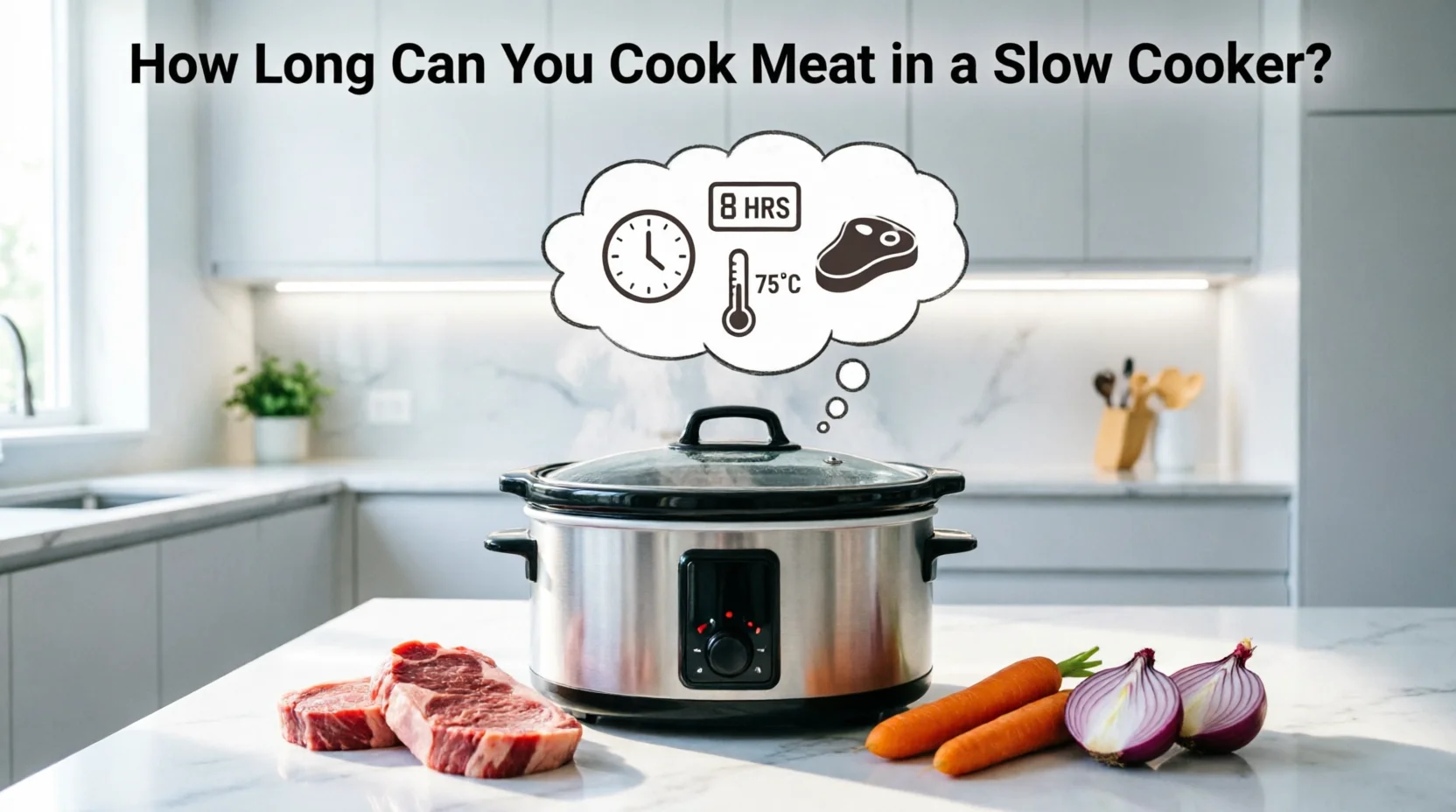
You can cook meat in a slow cooker for anywhere from 4 to 12 hours, depending on the cut and your heat setting. Low heat (typically 4–12 hours) is best for all-day cooking, while high (2–6 hours) works well for smaller cuts when you’re short on time.
I remember the first time I pulled a rock-hard beef roast out of my slow cooker after nine hours of “cooking.” I was frustrated, hangry, and convinced that appliance had it out for me. The truth was simpler—and more embarrassing: I had no clue how long to actually cook meat in a slow cooker. I just guessed. And guessing with a slow cooker means you either end up with meat that’s unsafe to eat or a dinner that feels like shoe leather.
You’re here because you’ve probably been there too. Maybe you’ve overcooked a pork shoulder into dry oblivion, or you’re worried about leaving your slow cooker on while you’re at work. Let’s cut through the confusion. I’ve spent over a decade writing about food safety and home cooking, and I’ve helped thousands of home cooks turn their slow cookers into reliable kitchen workhorses.
By the end of this guide, you will know exactly how long to cook any cut of meat, on any setting, with total confidence. No more guessing. No more ruined dinners.
The 3 biggest pain points around slow-cooker cooking times
Pain point #1: “I have no idea if my meat is actually safe to eat”
Here’s the scary truth. A slow cooker takes time to heat up. That means your meat can sit for hours in what food safety experts call the “danger zone”—between 40°F (4°C) and 140°F (60°C)—where bacteria multiply fast. According to the USDA, perishable food left in the danger zone for more than two hours should be thrown away, even if it looks and smells fine.
The fix: Always thaw meat completely before putting it in the slow cooker. Frozen meat dramatically extends the time your meal stays in the danger zone. Use a meat thermometer to check internal temperatures before serving. In the US, you can pick up an affordable digital thermometer at any grocery store. In the UK, look for one with a British kite mark. Australian and Canadian readers, grab one from your local kitchen supply shop.
Pain point #2: “My meat turns out tough and dry no matter what I do”
This one hurts. You spent good money on that cut, and now it’s chewy and sad. The issue is usually that you’re cooking the wrong cut for too long, or not long enough. Lean meats like chicken breast or pork tenderloin dry out fast in a slow cooker. Tough cuts like chuck roast or pork shoulder need long, slow cooking to break down connective tissue.
The fix: Match your cooking time to the cut. Tough cuts (beef chuck, brisket, pork shoulder) need 8–10 hours on low or 4–6 hours on high. Lean cuts (chicken breast, pork loin) only need 3–4 hours on low or 1–2 hours on high. And here’s a trick I learned from a chef in Toronto: sear your meat before adding it to the slow cooker. It locks in flavour and gives you a better texture.
Pain point #3: “I work long hours—how do I avoid overdoing it?”
This is the classic slow cooker struggle. You leave for work at 7 a.m., you won’t be home until 6 p.m., and most recipes say “cook for 8 hours.” So what happens when your food sits on “warm” for two extra hours? Many slow cookers automatically switch to a “keep warm” setting after the timer ends. But here’s the problem: “keep warm” usually hovers around 140°F (60°C)—still in the danger zone. The USDA says any food kept between 90–140°F needs to be refrigerated after just one hour.
The fix: Cook on low for 10–12 hours instead of 8. Most tough cuts actually benefit from the extra time. If your slow cooker has a programmable timer, use it. In Australia, many new models come with 12-hour cook settings. In Canada, look for a model with a built-in thermometer. You can also invest in a smart plug that lets you control your slow cooker from your phone—perfect for those unpredictable commutes from London or Manchester.
How long to cook meat in a slow cooker: The complete guide
Meat cooking times at a glance
Let me break this down in plain English. These times are estimates—your specific slow cooker might run a little hot or a little cool. Always use a meat thermometer to confirm.
| Type of meat | Weight | Low setting (hours) | High setting (hours) |
|---|---|---|---|
| Beef roast (chuck, brisket, round) | 2–3 lbs | 8–10 | 5–6 |
| Beef roast (large, 4–5 lbs) | 4–5 lbs | 10–12 | 6–8 |
| Pork shoulder / pulled pork | 3–4 lbs | 8–10 | 5–6 |
| Pork loin / tenderloin | 1–2 lbs | 4–6 | 2–3 |
| Whole chicken | 3–4 lbs | 6–8 | 4–5 |
| Chicken breasts (boneless) | 1–2 lbs | 3–4 | 1½–2 |
| Chicken thighs | 1–2 lbs | 4–6 | 2–3 |
| Lamb shoulder | 3–4 lbs | 8–10 | 5–6 |
| Ground meat (beef, turkey, pork) | 1–2 lbs | N/A (not ideal) | 2–3 |
| Stew meat (beef or lamb) | any | 6–8 | 3–4 |
Sources: Blue Jean Chef and Crock-Pot manufacturer guidelines
Why low and slow works better for most cuts
Here’s something I wish someone had told me years ago. The low setting is almost always better. It gives tough cuts time to break down collagen into gelatin, which makes meat tender and moist. The high setting is great when you’re in a pinch, but you’ll sacrifice some texture.
Most slow cookers reach a maximum temperature of 170–280°F (77–138°C) on high. On low, they hover around 170–200°F (77–93°C). Both are hot enough to kill bacteria, but low gives you a much wider margin for error.
Real-world example: My friend Sarah in Melbourne used to cook everything on high because she thought it was safer. Her pulled pork always came out dry and stringy. I convinced her to switch to low for 10 hours. The first time she tried it, she called me yelling, “It literally falls apart when I look at it!”
Cooking for a crowd: adjusting times for larger roasts
When you double the size of your roast, do you double the cooking time? Not exactly. A 2-pound roast might take 8 hours on low. A 4-pound roast takes 10–12 hours—not 16. The slow cooker’s temperature stays consistent, but the extra mass takes longer to reach that safe internal temperature.
When you place frozen meat directly into a slow cooker, it can take a long time for the centre of that meat to thaw and heat up. During that extended period, the meat may sit at temperatures that allow harmful bacteria to multiply.” — Darin Detwiler, LP.D., M.A.Ed., Assistant Teaching Professor at Northeastern University and food safety expert
What happens if you go over the recommended time?
I get asked this constantly. “My roast has been cooking for 11 hours instead of 8. Is it ruined?”
The answer depends on the cut. Tough cuts with lots of connective tissue (beef chuck, pork shoulder, lamb shanks) are forgiving. An extra 2–3 hours on low usually makes them even more tender. But lean cuts (chicken breast, pork tenderloin, lean beef roasts) will dry out and turn stringy if you go too long.
And here’s the safety part. If your slow cooker automatically switches to “warm” and you’re gone for an extra 4 hours, the food might drop into the danger zone. Food scientist Jessica Gavin puts it this way: “The concern is not whether the meat eventually gets hot enough. The concern is how long it takes to get there.” If you’re not sure how long your food sat below 140°F, trust your instincts and throw it out. It’s not worth getting sick over.
7 slow cooker safety rules you need to know
1. Always thaw meat first
This is the #1 mistake I see home cooks make. Never put frozen meat directly into a slow cooker. It stays in the danger zone for hours, and some bacteria produce heat-resistant toxins that won’t cook out even if the meat eventually reaches a safe temperature.
2. Preheat your slow cooker (especially for large cuts)
Turn it on high for 20–30 minutes before adding your ingredients. This jump-starts the heating process and minimises time in the danger zone.
3. Keep the lid closed
Every time you lift that lid, you lose heat. It can take 20–30 minutes for the temperature to recover. I know it’s tempting to check, but let the cooker do its job.
4. Use enough liquid
Most slow cooker recipes need at least 1/2 to 1 cup of liquid to generate the steam that cooks your food evenly and safely. Water, broth, wine, or sauce all work fine.
5. Fill it properly
Don’t overfill or underfill. Your slow cooker should be half to two-thirds full for best results. Too full and the food won’t cook evenly. Too empty and it might burn.
6. Check temperatures with a thermometer
The USDA recommends 145°F (63°C) for whole cuts of beef, pork, and lamb with a 3-minute rest. 160°F (71°C) for ground meats. 165°F (74°C) for poultry.
7. Refrigerate leftovers within 2 hours
Don’t let your slow cooker cool down on the counter. Transfer leftovers to shallow containers and get them in the fridge within two hours of cooking finished.
Nebraska Extension Educator Cami Wells, MS, RD, puts it simply: “A common concern I often hear is… make sure your slow cooker is the ultimate kitchen sidekick, not a ‘fast disaster.’
How to adapt slow cooker times for different countries
🇺🇸 USA
Your slow cooker likely follows USDA temperature guidelines. The danger zone is 40°F–140°F. If you live at high altitude (like Denver or Salt Lake City), expect slightly longer cooking times because water boils at a lower temperature.
🇬🇧 UK
UK slow cookers often use Celsius. The danger zone is roughly 4°C–60°C. According to UK food safety guidelines, always soak and boil raw kidney beans for at least 10 minutes before slow cooking, otherwise they can be toxic.
🇨🇦 Canada
Canadian guidelines align closely with the USDA. The Government of Canada recommends 63°C (145°F) for medium-rare beef roasts and 71°C (160°F) for medium. For slow cooking, most cuts should hit at least 71°C (160°F).
🇦🇺 Australia
Food Safety Australia New Zealand recommends an internal temperature of 75°C (167°F) for poultry and mince, and a holding temperature of 60°C (140°F) or above if you’re keeping food warm. If you’re using a slow cooker for a crowd, check the centre temperature of the largest piece with a probe thermometer.
Frequently Asked Questions on How long can you cook meat in slow cooker
Can I cook meat on low for 12 hours?
Yes, for tough cuts like beef chuck, pork shoulder, or lamb shanks, 12 hours on low is perfectly safe and often ideal. Lean cuts like chicken breast will dry out. Always start with thawed meat and check the internal temperature before serving.
Is it safe to leave meat in a slow cooker on warm overnight?
No. The “warm” setting typically holds food at around 140°F (60°C), which is borderline in the danger zone. The USDA recommends discarding perishable food left in the danger zone for more than 2 hours. If you need overnight cooking, use the low setting with a timer that shuts off automatically.
What happens if I cook meat for too long in a slow cooker?
Tough cuts become more tender—up to a point. After 12–14 hours on low, even chuck roast can start breaking down into mush. Lean cuts turn dry and stringy. Use a meat thermometer. If your pork shoulder hits 195°F–205°F (90°C–96°C), it’s done. Any hotter and it’s probably overdone.
Do I need to brown meat before slow cooking?
Not for safety reasons, but yes for flavour. Searing creates the Maillard reaction, which adds deep, savoury notes you can’t get from slow cooking alone. If you have 10 extra minutes, brown your meat in a hot pan with a little oil before adding it to the slow cooker.
Can I put frozen meat in a slow cooker if I cook it longer?
Absolutely not. This is one of the most dangerous slow cooker myths. Cooking frozen meat longer doesn’t fix the problem—the meat stays in the danger zone for hours before it thaws. Always thaw meat completely in the refrigerator before slow cooking.
Conclusion
Let me leave you with three things I want you to remember.
First, stop guessing. Use the cooking time chart in this guide. Match your cut to the right time and setting. A simple meat thermometer costs less than a takeaway meal and will completely change how you cook.
Second, thaw your meat. This one habit eliminates most of the safety risks around slow cooking. Plan ahead. Move your meat from the freezer to the fridge the night before.
Third, trust the process. Your slow cooker is one of the most forgiving tools in your kitchen—if you use it right. Low and slow wins the race. Don’t peek. Don’t rush. And definitely don’t put frozen meat in there.
You’ve got this. Now go make something delicious that falls apart the way it’s supposed to.

“I believe great cooking starts with the right tools, trusted advice, and a little confidence in the kitchen.”
Hi, I’m Emma Carter. My love for cooking began in my grandmother’s kitchen, where I learned that every great meal starts with simple ingredients and the right cookware. Over the years, I’ve spent countless hours researching, testing, and comparing kitchen appliances, cookware, coffee makers, air fryers, and other everyday kitchen essentials.
Here at KiCook, my goal is to make your buying decisions easier with honest product reviews, practical buying guides, and easy-to-follow cooking tips. Whether you’re upgrading your kitchen or searching for the best appliance for your home, I focus on providing clear, reliable, and research-backed information you can trust.
When I’m not testing new kitchen gadgets or writing in-depth guides, you’ll usually find me trying new recipes, visiting local farmers’ markets, or enjoying a quiet cup of coffee while planning my next kitchen project.