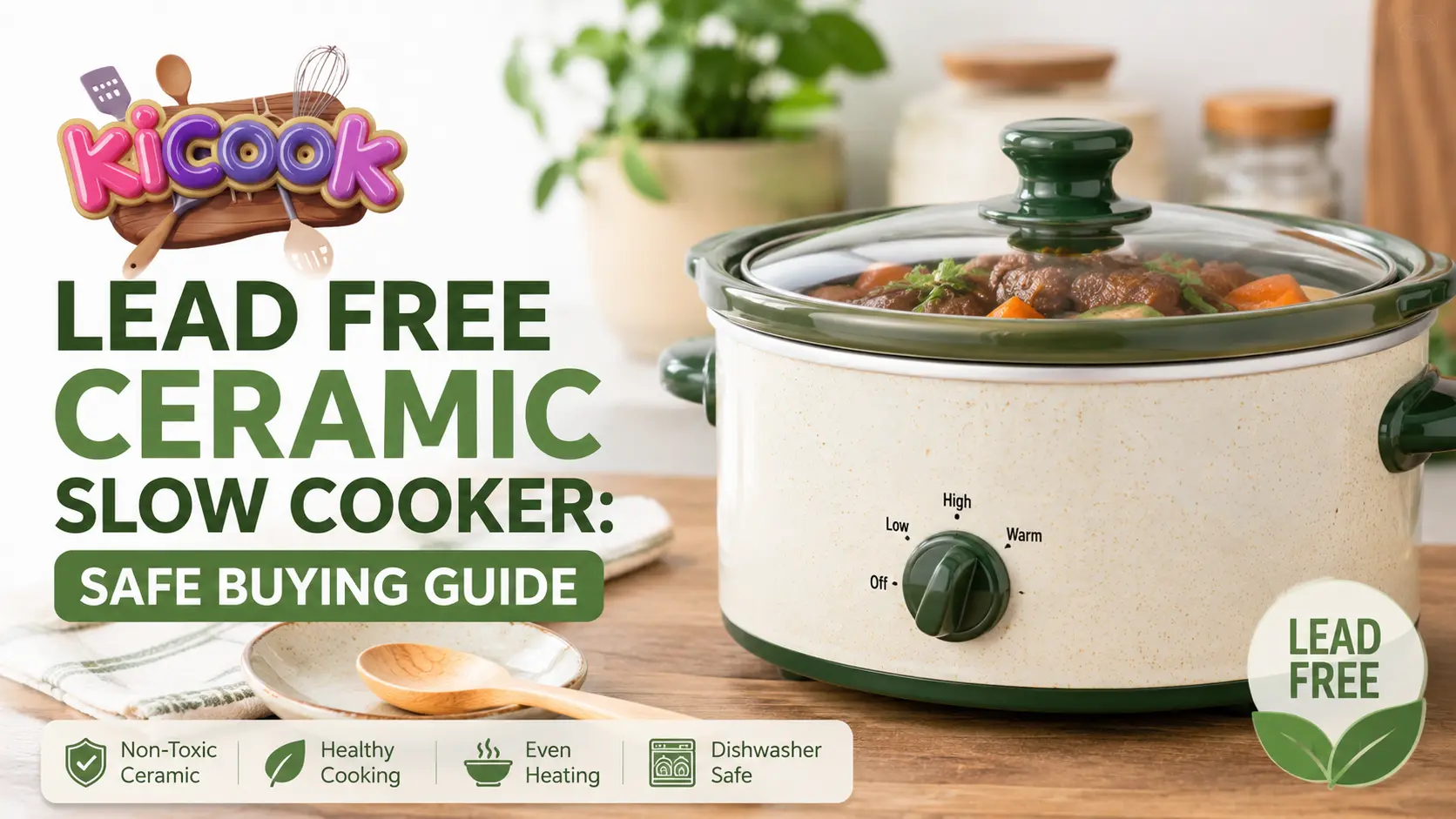
Quick Answer: A lead free ceramic slow cooker can be a safe choice if it uses food-grade ceramic, has clear lead and cadmium testing, and comes from a trusted manufacturer. Do not trust “lead free” or “non-toxic” labels blindly. Always check safety claims, material details, and whether the ceramic insert is cracked, chipped, or untested.
A lead free ceramic slow cooker is one of the most searched options for people who want safer cookware for soups, stews, chili, roasts, baby food, and weekly meal prep. Ceramic inserts are popular because they hold heat well, are easy to clean, and feel more natural than many nonstick coatings.
But many buyers have one important concern: can ceramic slow cookers contain lead? The concern is valid. Some ceramic cookware, especially old, damaged, handmade, decorative, or poorly tested glazed ceramic, may release lead or cadmium into food. This matters even more when food cooks for many hours.
The safest approach is not to avoid every ceramic slow cooker. The better approach is to know what to check before buying. This guide explains what lead free really means, how ceramic inserts compare with stainless steel, what red flags to avoid, and how readers in the USA, UK, Canada, and Australia can choose a safer slow cooker with confidence.
What Does Lead Free Ceramic Slow Cooker Mean?
A lead free ceramic slow cooker usually means the ceramic insert or glaze is made to avoid unsafe lead leaching into food. In simple words, the ceramic pot should be safe for cooking and food contact when used as directed.
However, “lead free” can be confusing. It may mean one of these things:
- The product has no intentionally added lead.
- The product meets legal lead migration limits.
- The ceramic glaze has been tested for lead release.
- The brand is using “lead free” as a marketing claim.
These are not always the same. A product that is called lead free should ideally have clear safety information, such as lead and cadmium testing, food-contact compliance, or a statement from the manufacturer.
The FDA warns that pottery with leachable lead should not be used for cooking, serving, or storing food. This is why buyers should look beyond marketing words and check whether the slow cooker insert is truly made for safe food use. :contentReference[oaicite:0]{index=0}
Lead Free Ceramic Slow Cooker vs Lead Free Crock Pot
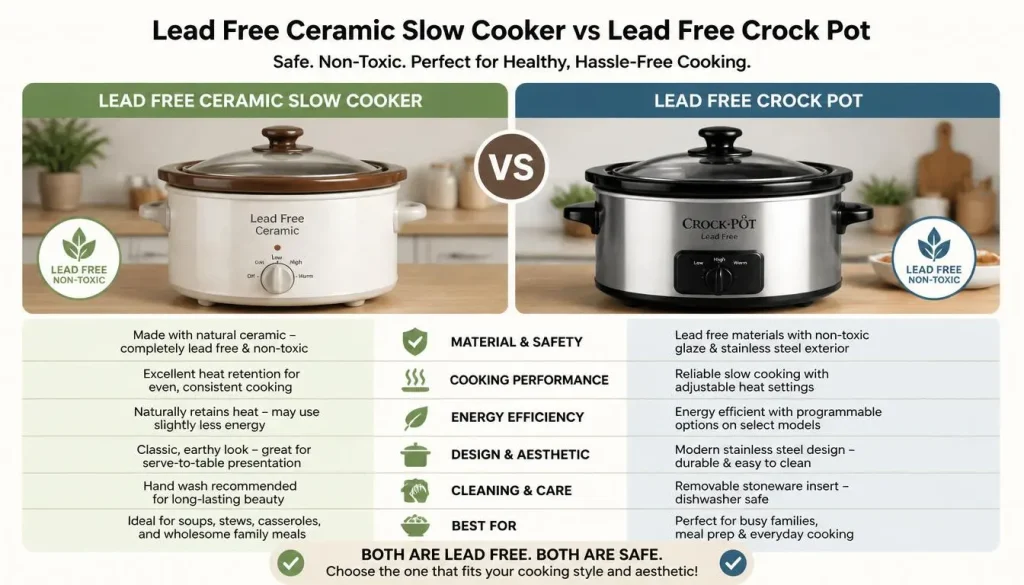
Many people use the terms “slow cooker” and “Crock Pot” in the same way. A Crock-Pot is a well-known brand name, while slow cooker is the general product category.
For safety, the buying concern is the same:
- Is the insert ceramic or stoneware?
- Is the ceramic glaze food-grade?
- Is it tested for lead and cadmium?
- Is it free from cracks, chips, and damaged glaze?
- Does the brand provide clear safety information?
So if you are searching for a lead free crock pot, lead free crockpot, or lead free ceramic slow cooker, you are usually looking for the same type of safety answer. Focus on the insert material, the glaze, the testing, and the product documentation.
Why People Worry About Lead in Ceramic Slow Cookers
People worry about lead in ceramic slow cookers because ceramic cookware often uses glaze. A glaze can make ceramic smooth, shiny, colorful, and easier to clean. Good-quality food-grade glaze should be safe when properly made and tested. Poor-quality glaze can be a concern.
Lead risk may be higher with:
- Old ceramic slow cookers
- Vintage Crock-Pot inserts
- Handmade pottery inserts
- Imported unverified ceramic
- Decorative ceramic not made for food
- Cracked or chipped ceramic
- Brightly colored low-quality glaze
- Products with no safety information
- Ceramic used with acidic food for long periods
Slow cooking adds another concern because food stays in contact with the ceramic surface for hours. If the glaze is unsafe, damaged, or not food-grade, longer cooking time may increase concern.
This does not mean every ceramic slow cooker is unsafe. It means buyers should choose tested, modern, food-grade ceramic from reputable brands.
Do Ceramic Slow Cookers Contain Lead?
Some ceramic products can contain lead in the glaze, decoration, or manufacturing process. The more important question is whether lead can migrate or leach into food.
A ceramic slow cooker may be considered safe when it meets food-contact safety standards and does not release unsafe levels of lead or cadmium during use. In Canada, glazed ceramic and glassware products are regulated for migratable lead and cadmium, and products that are not safe for food may require warnings such as “CONTAINS LEAD” or “DO NOT USE FOR FOOD.” :contentReference[oaicite:1]{index=1}
For a buyer, the best rule is simple: do not assume ceramic is safe just because it looks clean or modern. Look for product safety details.
Lead Free vs Lead Safe vs Non Toxic Slow Cooker
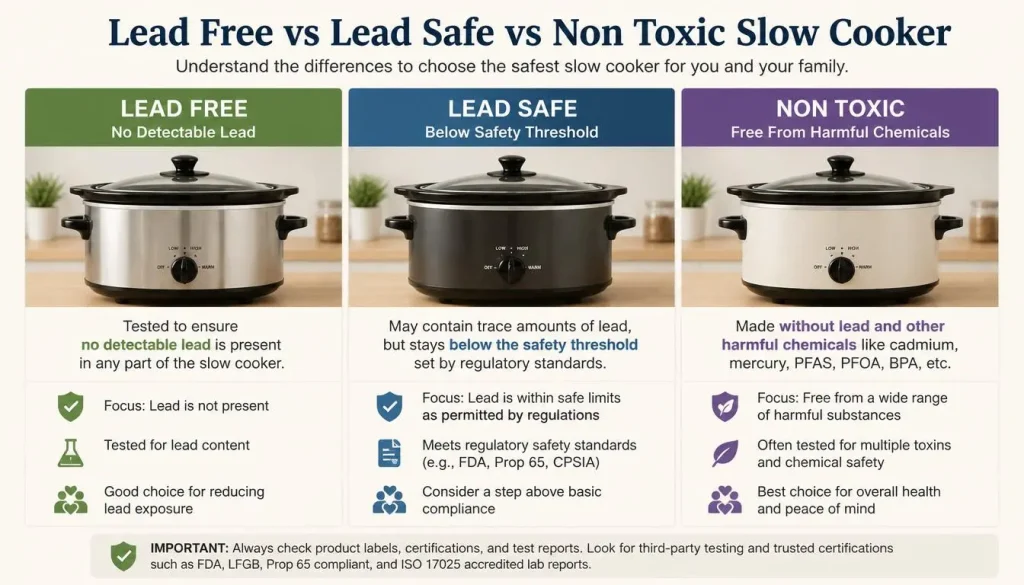
These terms are often used online, but they do not always mean the same thing.
| Term | What It Usually Means | Buyer Warning |
|---|---|---|
| Lead free | The product claims no lead concern | Ask for testing or compliance details |
| Lead safe | The product may meet legal limits | It may not mean absolute zero lead |
| Non toxic | Broad safety marketing term | Check lead, cadmium, PFAS, PTFE, and PFOA |
| Food-grade ceramic | Ceramic made for food contact | Better than decorative ceramic |
| Cadmium free | No unsafe cadmium concern | Important for colored glazes |
| PFAS free | No PFAS-type nonstick chemicals | More relevant for coated nonstick surfaces |
A good slow cooker should not rely on vague words only. The best products clearly explain the insert material and safety testing.
Why Cadmium-Free Matters in Ceramic Slow Cookers
Lead is not the only heavy metal buyers should think about. Cadmium is also important, especially in some ceramic glazes and colored decorations.
A product may say “lead free” but not mention cadmium. That is a gap. For better peace of mind, look for products that say:
- Lead and cadmium tested
- Lead free and cadmium free
- Food-grade ceramic
- Compliant with food-contact safety standards
This is especially important if the ceramic insert has a bright color, painted design, or glossy glaze. Plain white or neutral ceramic is not automatically safer, but highly decorated or unknown ceramic deserves more caution.
Is Ceramic Safe for Slow Cooking?
Ceramic can be safe for slow cooking when it is modern, food-grade, properly glazed, and tested. Many slow cookers use ceramic or stoneware inserts because they hold heat well and cook food evenly.
Ceramic slow cookers are useful for:
- Soup
- Chili
- Stew
- Pot roast
- Pulled chicken
- Pulled pork
- Beans
- Curry
- Meal prep recipes
The risk is not from ceramic itself. The risk comes from unsafe glaze, poor testing, old cookware, or damaged surfaces. A cracked or chipped insert should not be used because damage can make cleaning harder and may expose deeper layers of material.
If your ceramic insert is damaged, stained deeply, cracked, or rough inside, replacing it is the safer choice.
What Is the Safest Slow Cooker Insert Material?
There is no single perfect material for every buyer. The safest choice depends on what you want to avoid.
| Insert Material | Main Benefit | Possible Concern | Best For |
|---|---|---|---|
| Food-grade ceramic | Common, affordable, holds heat well | Needs lead and cadmium verification | Everyday slow cooking |
| Stoneware | Strong heat retention | Similar glaze concerns as ceramic | Soups, stews, roasts |
| Stainless steel | No ceramic glaze concern | Less common in slow cookers | Maximum peace of mind |
| Ceramic-coated metal | Easy cleaning | Coating can wear over time | Convenience cooking |
| Nonstick aluminum | Lightweight | Check PFAS, PTFE, and PFOA claims | Users who want easy cleanup |
| Glass | Non-reactive | Rare as a slow cooker insert | Visibility and simple food contact |
For many families, a tested ceramic insert is practical and safe. For buyers who want to avoid glaze concerns completely, a stainless steel insert may offer more peace of mind.
Ceramic Slow Cooker vs Stainless Steel Slow Cooker
A ceramic slow cooker is the most common option. It is easy to find, usually affordable, and works well for long cooking.
A stainless steel slow cooker insert is less common but attractive for health-conscious buyers. Stainless steel does not use ceramic glaze, so it avoids the specific concern of lead or cadmium in ceramic glaze.
| FeatureCeramic Slow CookerStainless Steel Slow Cooker | ||
|---|---|---|
| Availability | Very common | Less common |
| Heat retention | Excellent | Good |
| Glaze concern | Must verify safety | No ceramic glaze issue |
| Cleaning | Usually easy | Usually easy |
| Weight | Can be heavy | Often lighter |
| Best for | Most home cooks | Buyers avoiding ceramic glaze |
If you choose ceramic, verify the safety claims. If you choose stainless steel, check the grade, build quality, and whether the insert is removable.
Ceramic Insert vs Ceramic-Coated Slow Cooker
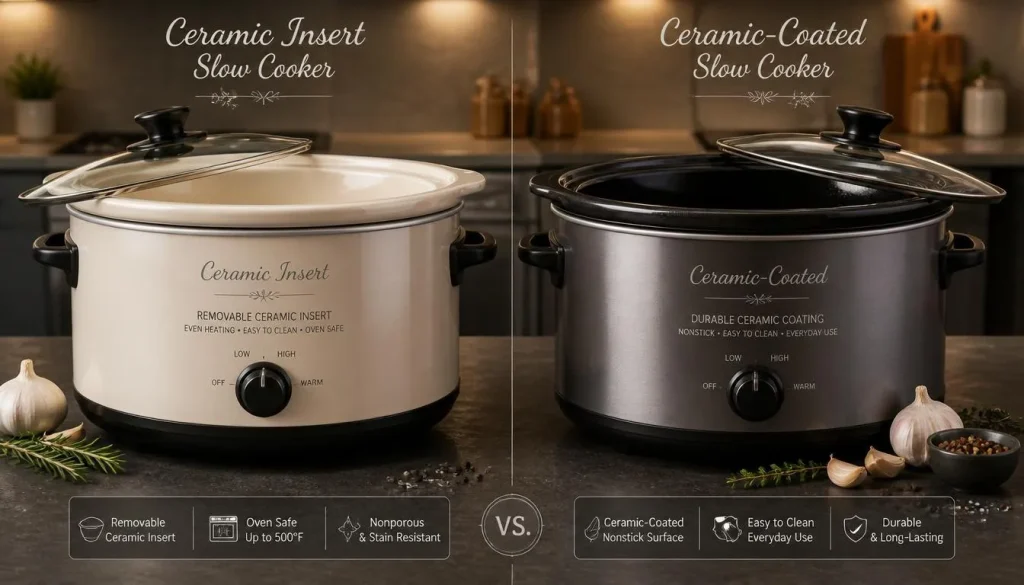
A ceramic insert and a ceramic-coated insert are not the same.
A ceramic insert is usually solid ceramic or stoneware. A ceramic-coated insert is often metal with a ceramic-style coating on the surface.
This matters because the safety questions are different.
For a solid ceramic insert, check:
- Lead
- Cadmium
- Food-grade glaze
- Cracks or chips
- Manufacturer testing
For a ceramic-coated insert, check:
- PFAS-free claim
- PTFE-free claim
- PFOA-free claim
- Coating durability
- Scratches or peeling
If a ceramic-coated insert becomes scratched, peeling, or damaged, replace it. Do not keep cooking on damaged coatings.
Should a Lead Free Ceramic Slow Cooker Also Be PFAS-Free?
Yes, it is smart to check this, especially if the product has a ceramic-coated nonstick surface.
Lead and cadmium are heavy metal concerns. PFAS, PTFE, and PFOA are coating-related concerns. A solid ceramic or stoneware crock may not have the same nonstick coating concerns as ceramic-coated metal, but buyers should still read the product details.
Look for phrases such as:
- PFAS free
- PTFE free
- PFOA free
- Lead free
- Cadmium free
- Food-contact safe
- Third-party tested
A slow cooker can be lead free but still use a coating that some buyers prefer to avoid. That is why “non-toxic slow cooker” should cover both heavy metals and coatings.
Can Acidic Foods Increase Lead Leaching?
Acidic foods can be more concerning when cooked in unsafe ceramic. Acid can interact with poorly made or lead-glazed surfaces and may increase the risk of metal migration.
Examples of acidic foods include:
- Tomato sauce
- Chili
- BBQ sauce
- Vinegar-based recipes
- Lemon or citrus dishes
- Wine-based stews
- Pickled ingredients
This does not mean you cannot cook chili or tomato sauce in a modern tested ceramic slow cooker. It means you should avoid using old, cracked, handmade, decorative, or unverified ceramic cookware for long acidic cooking.
The FDA has raised concerns about imported traditional pottery and the use of “Lead Free” claims when pottery may still present safety or labeling issues. :contentReference[oaicite:2]{index=2}
Are Old or Vintage Ceramic Slow Cookers Lead Free?
Old or vintage ceramic slow cookers are harder to verify. They may not have modern safety documentation, and the brand may no longer provide testing information for that specific insert.
Be extra careful with:
- Thrift-store slow cookers
- Inherited vintage Crock-Pots
- Inserts with no model number
- Cracked or crazed glaze
- Chipped ceramic
- Unknown imported products
- Old decorative ceramic cookware
If you cannot confirm that an old ceramic slow cooker is lead and cadmium safe, replacing it with a modern tested model is the safer option. This is especially true if you cook acidic meals or use the slow cooker often.
How to Know If Your Ceramic Slow Cooker Is Really Lead Free
Use this checklist before buying or using a ceramic slow cooker:
- Check the product manual.
- Read the manufacturer’s safety page.
- Look for lead and cadmium testing.
- Search for “food-grade ceramic” or “food-contact safe.”
- Check for a Prop 65 warning if buying in the USA.
- Ask customer support for safety documentation.
- Avoid products with no manufacturer details.
- Avoid vague “non-toxic” claims with no proof.
- Do not use cracked, chipped, or scratched ceramic.
- Replace old inserts if safety cannot be verified.
A trustworthy product should make safety information easy to find. If a brand avoids basic material questions, that is a red flag.
What Certifications or Safety Claims Should You Check?
When choosing a lead free ceramic slow cooker, look for clear safety language.
Useful claims include:
- Lead tested
- Cadmium tested
- Lead free
- Cadmium free
- Food-grade ceramic
- Food-contact safe
- FDA compliant food-contact material
- California Prop 65 compliant or warning disclosed
- UK or EU food-contact compliance
- Canada glazed ceramic and glassware compliance
- PFAS free, PTFE free, or PFOA free for coated surfaces
In the UK, ceramic articles intended to contact food are subject to rules that set limits for lead and cadmium migration and require certificates of compliance at marketing stages. :contentReference[oaicite:3]{index=3}
Do not expect every product page to include every detail. But a good brand should provide enough information to help you make a safe decision.
USA, UK, Canada, and Australia Safety Checklist
Since this topic matters to buyers in the USA, UK, Canada, and Australia, use this country-specific checklist.
| Country | What to Check Before Buying |
|---|---|
| USA | FDA food-contact language, Prop 65 warning, lead and cadmium testing |
| UK | Food-contact safe ceramic and lead/cadmium migration compliance |
| Canada | Glazed ceramic and glassware lead/cadmium compliance |
| Australia | Food-contact safe materials, trusted retailer, clear product safety claims |
Food Standards Australia New Zealand says all food sold in Australia and New Zealand must comply with the Food Standards Code, and FSANZ also explains that manufacturers must ensure food in contact with packaging is safe. :contentReference[oaicite:4]{index=4} :contentReference[oaicite:5]{index=5}
For buyers, the practical advice is simple: buy from trusted retailers, avoid unknown products with no safety details, and choose brands that clearly explain their materials.
Best Lead Free Ceramic Slow Cooker Features to Look For
A good lead free ceramic slow cooker should not only be safe. It should also be practical for daily use.
Look for these features:
- Lead and cadmium tested ceramic insert
- Removable ceramic or stoneware crock
- Clear food-contact safety information
- Programmable timer
- Low, high, and warm settings
- Glass lid
- Cool-touch handles
- Dishwasher-safe insert
- Strong warranty
- Good customer support
- Replacement insert availability
- Size options for your household
If a product has strong cooking features but no safety information, keep looking. A slow cooker is used for long cooking, so material quality matters.
Best Size for Your Family: 3 Quart, 6 Quart, or 8 Quart?
Choosing the right size helps you avoid waste and makes cooking easier.
| Size | Best For |
|---|---|
| 1.5 to 2 quart | Dips, sauces, single users, small portions |
| 3 to 4 quart | Couples, small families, side dishes |
| 5 to 6 quart | Most families, meal prep, soups, stews |
| 7 to 8 quart | Large families, batch cooking, roasts |
For most homes, a 6-quart lead free ceramic slow cooker is the most flexible size. It works for family meals, leftovers, and weekly meal prep.
If you often cook for one or two people, choose a smaller 3 or 4-quart model. If you cook large roasts, whole chicken, or big batches of chili, choose a 7 or 8-quart model.
Red Flags to Avoid When Buying a Ceramic Slow Cooker
Avoid a ceramic slow cooker if you notice these warning signs:
- No material details
- No lead or cadmium information
- No manufacturer website
- No customer support
- No safety documentation
- Extremely cheap unknown brand
- Decorative ceramic insert
- Handmade insert not marked food-safe
- Antique or vintage ceramic with unknown glaze
- Cracked or chipped insert
- Peeling ceramic coating
- Strong chemical smell
- Unclear country of manufacture
- No warranty or return policy
One red flag does not always mean a product is unsafe. But several red flags together mean you should choose a better option.
How to Use a Ceramic Slow Cooker Safely
Once you buy a safe ceramic slow cooker, proper use matters.
Follow these tips:
- Wash the ceramic insert before first use.
- Read the manual before cooking.
- Do not use the insert if it is cracked or chipped.
- Avoid sudden temperature changes.
- Do not place a hot insert into cold water.
- Do not place a cold insert into a preheated base.
- Use wooden, nylon, or silicone utensils.
- Avoid metal utensils that can scratch the surface.
- Do not use abrasive scrubbers.
- Replace the insert if the glaze becomes damaged.
Ceramic is durable, but it is not unbreakable. Thermal shock, rough cleaning, and metal utensils can shorten its life.
Cleaning and Maintenance Tips for Ceramic Inserts
Good cleaning keeps your slow cooker safer and longer lasting.
Use these simple tips:
- Let the insert cool before washing.
- Wash with warm water and mild dish soap.
- Soak stuck-on food before scrubbing.
- Use a soft sponge.
- Avoid steel wool.
- Use baking soda paste for stains.
- Dry the insert fully before storage.
- Check for cracks after cleaning.
- Store the lid separately if moisture gets trapped.
Do not ignore small chips or cracks. A damaged insert is harder to clean and may not be safe for long cooking.
Who Should Be Extra Careful?
Some people should be more careful when choosing cookware.
Be extra cautious if you are cooking for:
- Babies
- Young children
- Pregnant women
- Elderly family members
- People with health concerns
- Anyone eating slow cooker meals often
The FDA notes that lead exposure can be especially harmful for children and pregnant women, which is why unsafe lead-glazed pottery should not be used for food. :contentReference[oaicite:6]{index=6}
This does not mean you need to panic. It means you should avoid unverified ceramic cookware and choose tested food-grade products.
Lead Free Ceramic Slow Cooker Buying Checklist
Before you buy, use this quick checklist:
- Does the product say lead free?
- Does it also mention cadmium?
- Is the insert food-grade ceramic or stoneware?
- Does the brand provide safety documentation?
- Is there any Prop 65 warning?
- Is the insert removable?
- Is it free from cracks and chips?
- Is it dishwasher-safe?
- Is the size right for your family?
- Does the brand offer customer support?
- Are replacement parts available?
- Are reviews consistent and trustworthy?
If the answer is yes to most of these questions, the product is more likely to be a smart choice.
Final Verdict: Should You Buy a Lead Free Ceramic Slow Cooker?
Yes, a lead free ceramic slow cooker can be a good choice if it is modern, food-grade, tested, and sold by a trusted brand. Ceramic slow cookers are useful for family meals, soups, stews, roasts, chili, and meal prep.
The key is to choose carefully. Do not buy based only on words like “natural,” “healthy,” or “non-toxic.” Look for lead and cadmium testing, food-contact safety details, and clear manufacturer information.
If you already own an old, cracked, chipped, or unverified ceramic slow cooker, replacing it is the safer decision. If you want to avoid ceramic glaze concerns completely, consider a stainless steel slow cooker insert.
For most people, the best choice is a tested lead free and cadmium free ceramic slow cooker with a removable insert, simple controls, and a size that fits your household.
FAQs
What is a lead free ceramic slow cooker?
A lead free ceramic slow cooker is a slow cooker with a ceramic or stoneware insert that is marketed or tested to avoid unsafe lead leaching into food. The best options also mention cadmium testing and food-contact safety.
Are ceramic slow cookers lead free?
Some modern ceramic slow cookers are lead free or meet legal lead migration limits, but not all ceramic products should be trusted blindly. Always check the manufacturer’s safety information.
Do slow cookers contain lead?
Some ceramic or glazed cookware can contain lead in the glaze or decoration. The real concern is whether lead can leach into food. Choose tested food-grade ceramic from trusted brands.
Is ceramic safe for slow cooking?
Yes, food-grade ceramic can be safe for slow cooking when it is properly made, tested, and undamaged. Avoid old, cracked, chipped, decorative, or unverified ceramic inserts.
Can ceramic slow cookers leach lead?
Unsafe ceramic glaze can leach lead, especially if it is poorly made, damaged, or used with acidic foods. A tested lead free ceramic slow cooker should not release unsafe lead when used correctly.
Are old ceramic slow cookers safe?
Old ceramic slow cookers are harder to verify. If the insert is cracked, chipped, scratched, or has no safety documentation, replacing it is safer.
Is stoneware the same as ceramic in a slow cooker?
Stoneware is a type of ceramic material often used in slow cooker inserts. Like ceramic, it should be food-grade and tested for lead and cadmium safety.
What is the safest slow cooker insert material?
A tested food-grade ceramic insert can be safe. Stainless steel is also a strong option because it avoids ceramic glaze concerns. The safest choice depends on your health priorities and product testing.
Is stainless steel better than ceramic for slow cookers?
Stainless steel may be better for buyers who want to avoid ceramic glaze concerns. Ceramic is more common and holds heat well, but it should be verified as lead and cadmium safe.
What does cadmium-free mean in ceramic cookware?
Cadmium-free means the ceramic product should not release unsafe cadmium into food. Cadmium is another heavy metal concern, especially with some colored glazes or decorations.
Can acidic food cause lead leaching in ceramic?
Acidic food can increase concern if the ceramic glaze is unsafe or damaged. Tomato sauce, chili, vinegar, citrus, and wine-based meals should only be cooked in verified food-safe ceramic.
How do I know if my slow cooker is lead free?
Check the manual, brand website, product safety page, and customer support information. Look for lead and cadmium testing, food-grade ceramic claims, and food-contact compliance.
Are home lead test kits reliable for ceramic slow cookers?
Home lead test kits may detect some surface lead, but they may not prove that a slow cooker is safe during long heated cooking. Manufacturer testing or lab testing is more reliable.
Should I replace a scratched ceramic slow cooker insert?
Yes, replacement is a good idea if the insert is scratched, cracked, chipped, or has damaged glaze. Damaged ceramic is harder to clean and may be less safe for long cooking.
What should I avoid when buying a non-toxic slow cooker?
Avoid unknown brands with no safety details, vintage ceramic inserts, cracked or chipped cookware, decorative pottery, vague “non-toxic” claims, and products with no lead or cadmium information.

“I believe great cooking starts with the right tools, trusted advice, and a little confidence in the kitchen.”
Hi, I’m Emma Carter. My love for cooking began in my grandmother’s kitchen, where I learned that every great meal starts with simple ingredients and the right cookware. Over the years, I’ve spent countless hours researching, testing, and comparing kitchen appliances, cookware, coffee makers, air fryers, and other everyday kitchen essentials.
Here at KiCook, my goal is to make your buying decisions easier with honest product reviews, practical buying guides, and easy-to-follow cooking tips. Whether you’re upgrading your kitchen or searching for the best appliance for your home, I focus on providing clear, reliable, and research-backed information you can trust.
When I’m not testing new kitchen gadgets or writing in-depth guides, you’ll usually find me trying new recipes, visiting local farmers’ markets, or enjoying a quiet cup of coffee while planning my next kitchen project.