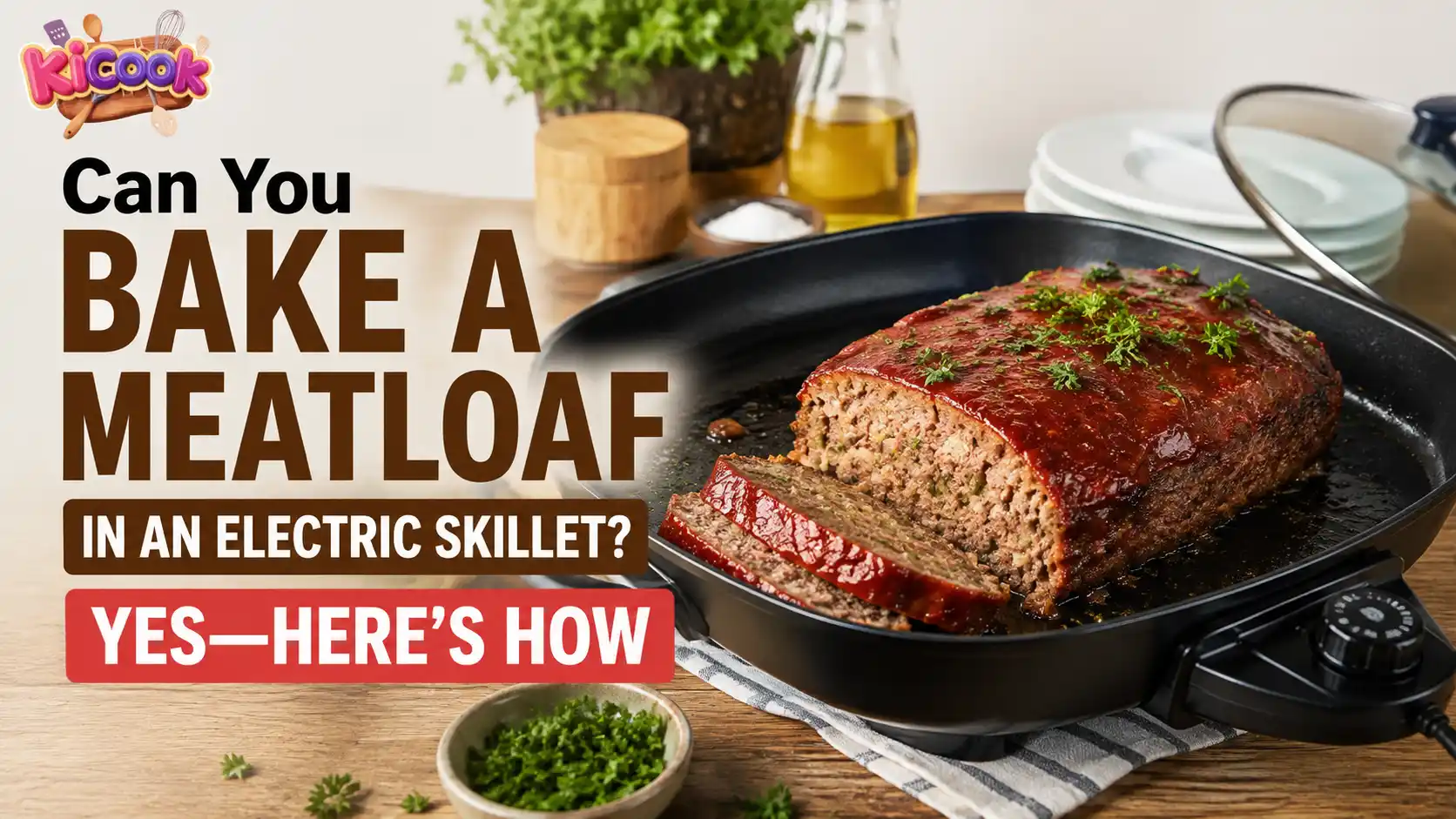
Yes, you can bake a meatloaf in an electric skillet, and it can turn out surprisingly moist and flavorful when you use the right temperature, keep the lid on, and check the center with a food thermometer.
An electric skillet does not bake exactly like a conventional oven. Most of its heat comes from underneath the food, while the lid traps heat and moisture around the meatloaf. That means you need a slightly different approach than simply copying an oven recipe.
A practical starting point for a traditional 1½-pound beef meatloaf is around 250°F (121°C) with the skillet covered. One established electric skillet meatloaf method uses this setting for about an hour, cooking until the center reaches 160°F.
The exact time can vary depending on the size and shape of the loaf, the meat mixture, your skillet, and how accurately its thermostat maintains temperature.
If you do not have access to an oven—or simply want to keep the kitchen cooler—an electric skillet can be a very useful alternative.
Can You Really Bake Meatloaf in an Electric Skillet?
Absolutely.
Technically, the cooking environment is different from traditional oven baking, but an electric skillet can handle meatloaf very well.
When you put the lid on, the skillet retains heat and moisture. The bottom of the pan supplies most of the direct heat, while the enclosed space around the loaf helps cook the upper and center portions.
This is similar to the way other covered dishes are prepared in an electric skillet. If you are interested in other oven-style meals, Kicook’s guide to baking casseroles in an electric skillet explains how covered electric skillet cooking differs from conventional baking.
Electric skillet meatloaf is particularly useful when:
- Your oven is already being used.
- Your oven is broken or unavailable.
- You live in an RV or small apartment.
- You want to avoid heating the whole kitchen in summer.
- You need an additional cooking appliance during holidays.
- You prefer one-pan meals.
- You want to cook vegetables alongside the meatloaf.
Electric skillets can also prepare far more than meatloaf. Kicook’s guide to what you can cook in an electric skillet covers meat, vegetables, pasta, rice, casseroles, breakfast foods, and other one-pan dishes.
What Size Electric Skillet Is Best for Meatloaf?
For a standard family-size meatloaf, a skillet with enough room for the loaf without forcing it against the sides is ideal.
A 12-inch electric skillet is usually adequate for a modest loaf, while larger skillets give you more space for potatoes, carrots, mushrooms, or onions around the meat.
More important than the exact width is the depth.
Look for:
- A well-fitting lid
- Enough clearance above the meatloaf
- Adjustable temperature control
- A reasonably deep cooking surface
- Enough room for heat to circulate around the loaf
A high-domed lid is particularly useful when making thicker foods.
Avoid making a loaf so tall that it nearly touches the lid. A slightly wider, lower loaf generally cooks more evenly because heat reaches the center faster.
Always check the instruction manual for your specific skillet before using it for baking-style cooking.
What Temperature Should You Cook Meatloaf in an Electric Skillet?
For a traditional beef meatloaf cooked directly in a covered electric skillet, 250°F (121°C) is a practical starting point.
A published electric skillet recipe using 1½ pounds of ground beef cooks the loaf covered at 250°F for approximately one hour, with final doneness determined by internal temperature rather than time alone.
Here is a useful reference:
| Cooking DetailGeneral Guide | |
|---|---|
| Electric skillet setting | Around 250°F / 121°C |
| Typical 1½ lb meatloaf | Around 1 hour |
| Beef/pork meatloaf internal temperature | 160°F / 71°C |
| Turkey/chicken meatloaf internal temperature | 165°F / 74°C |
| Resting time | 5–10 minutes |
These numbers are guides, not guarantees.
Your meatloaf is done when its center reaches the appropriate safe internal temperature.
225°F vs. 250°F: Which Is Better?
You may see both temperatures recommended for electric skillet meatloaf.
That is not necessarily a contradiction.
Different skillet designs use different heating elements, thermostats, pan materials, and lids.
One electric skillet meatloaf recipe uses 250°F, keeps the loaf covered, and cooks it for about an hour.
Older West Bend electric skillet instructions, on the other hand, include a meatloaf method using 225°F, followed by turning the loaf after 30 minutes and continuing for another 15 to 20 minutes.
So which should you use?
For a general direct-cooking method, 250°F is the more practical starting point. If your electric skillet manufacturer provides a specific meatloaf recipe using a different setting, follow the manufacturer’s instructions.
Do not assume that a temperature that works perfectly in one skillet will behave exactly the same in another.
If you are still learning how the numbers on your skillet correspond to actual heat, Kicook’s electric skillet temperature guide explains how temperature controls and heat levels can vary between models.
What You Need to Make Meatloaf in an Electric Skillet
You do not need complicated ingredients.
For a classic version, you can use:
Meatloaf Ingredients
- 1½ pounds ground beef
- 1 egg
- ¾ to 1 cup breadcrumbs
- ½ cup milk
- 1 small onion, finely chopped
- 1 tablespoon Worcestershire sauce
- 1 teaspoon garlic powder
- 1 teaspoon salt
- ½ teaspoon black pepper
Simple Meatloaf Glaze
- ⅓ cup ketchup
- 1 tablespoon mustard
- 1 to 2 tablespoons brown sugar
Equipment
You will need:
- Electric skillet with lid
- Large mixing bowl
- Measuring cups and spoons
- Spatula
- Instant-read food thermometer
The thermometer is not optional if you want to judge meatloaf doneness accurately.
The USDA specifically recommends using internal temperature rather than relying on color when cooking ground meat. Ground beef can appear brown before it has reached a safe temperature, while safely cooked meat can sometimes remain pink.
How to Cook Meatloaf in an Electric Skillet Step by Step
Here is a straightforward method that works well for a traditional electric skillet meatloaf.
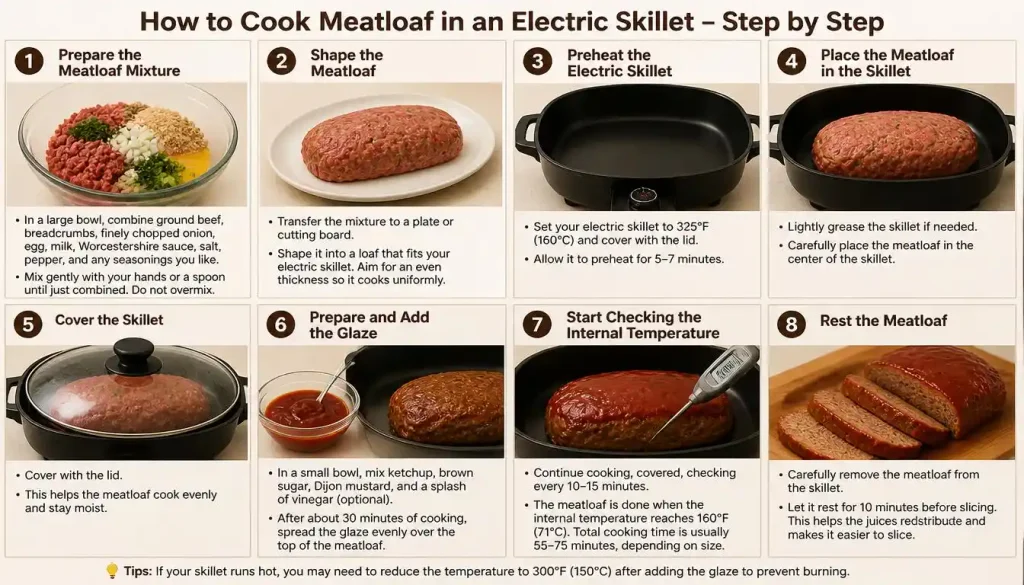
Step 1: Prepare the Meatloaf Mixture
Add the ground beef, egg, breadcrumbs, milk, chopped onion, Worcestershire sauce, garlic, salt, and pepper to a large bowl.
Mix until everything is evenly combined.
Do not aggressively knead the mixture.
Overworking ground beef compresses the mixture and can give you a dense, firm meatloaf rather than a tender one.
Use your hands or a large fork and stop mixing once the ingredients are distributed evenly.
Step 2: Shape the Meatloaf
Form the mixture into a loaf.
Do not make it unusually thick.
A wider, moderately low loaf will generally cook more evenly in an electric skillet than a very tall loaf because the heat has less distance to travel before reaching the center.
Try to keep the thickness relatively consistent from one end to the other.
Step 3: Preheat the Electric Skillet
Set your electric skillet to approximately 250°F (121°C) unless your appliance instructions specify another temperature.
Allow it to preheat according to the manufacturer’s directions.
You can lightly grease the cooking surface if needed, although ground beef usually releases some fat as it cooks.
Step 4: Place the Meatloaf in the Skillet
Carefully place the shaped loaf near the center of the skillet.
Leave some room around the sides.
If desired, this is also the time to add vegetables such as:
- Mushrooms
- Carrots
- Onion wedges
- Small potatoes
Do not overcrowd the skillet.
Step 5: Cover the Skillet
Put the lid on.
The lid is one of the most important parts of this cooking method because it traps heat around the upper portion of the meatloaf.
Avoid lifting it every few minutes.
Every time you remove the lid, heat and steam escape and the cooking temperature temporarily drops.
Step 6: Prepare and Add the Glaze
Mix ketchup, mustard, and brown sugar in a small bowl.
You can add the glaze early for a soft, flavorful coating or later in the cooking process if you prefer a less-steamed surface.
Because an electric skillet does not provide strong heat from above, the glaze will not caramelize exactly the same way it would under an oven broiler.
That is normal.
Step 7: Start Checking the Internal Temperature
For a 1½-pound loaf, begin checking as you approach the expected cooking time.
Insert the thermometer into the thickest part of the center.
For meatloaf made with ground beef, pork, lamb, or veal, the USDA safe minimum internal temperature is 160°F (71°C).
If your meatloaf contains ground turkey or chicken, it should reach 165°F (74°C).
Do not determine doneness by cutting the meatloaf open and checking whether it looks pink.
A thermometer is much more reliable.
Step 8: Rest the Meatloaf
Once the center reaches the correct temperature, remove the meatloaf from the heat and allow it to rest for approximately 5 to 10 minutes before slicing.
Resting gives the juices time to settle and helps the loaf hold together when cut.
How Long Does Meatloaf Take in an Electric Skillet?
There is no single cooking time that works for every meatloaf.
Thickness matters just as much as weight.
As a general reference, a 1½-pound meatloaf cooked covered at approximately 250°F may take around one hour.
A smaller or flatter loaf may finish sooner. A large, thick loaf may require longer.
Instead of treating cooking time as your final test, use it to decide when to start checking the temperature.
A useful approach is:
| Meatloaf Size | When to Start Checking |
|---|---|
| Small/flat loaf | Around 35–40 minutes |
| About 1½ lb | Around 50 minutes |
| Large/thick loaf | Around 60 minutes |
These are only checkpoints.
Continue cooking until the center reaches the appropriate safe internal temperature.
Do You Need to Flip Meatloaf in an Electric Skillet?
Usually, not necessarily.
Some electric skillet recipes cook meatloaf for the entire cooking period without flipping it.
For example, the 250°F covered method described earlier leaves the loaf in position during cooking.
However, some manufacturer-specific methods do call for turning the meatloaf. West Bend instructions for one skillet recipe cook the loaf at 225°F for 30 minutes, turn it, and continue cooking for another 15 to 20 minutes.
The important takeaway is:
Flipping is a cooking-method decision, not a universal meatloaf rule.
If your recipe is designed to cook without flipping, leave it alone.
If your manufacturer’s recipe calls for turning the loaf, follow those instructions carefully.
Trying to flip a soft meatloaf unnecessarily can cause it to split.
Should You Put Meatloaf Directly in the Electric Skillet?
In many cases, yes.
Cooking the meatloaf directly on the skillet surface is one of the simplest methods.
It gives you:
- Easy preparation
- Fewer dishes
- Direct bottom heat
- Space for vegetables around the meat
- Easy access for draining excess fat
A separate loaf pan is not normally necessary for the direct method.
However, some electric skillets can accommodate heat-safe inserts, racks, or baking pans.
Only use those accessories if the appliance manufacturer says they are safe for your particular skillet.
Never assume that an oven-safe dish is automatically suitable for direct use inside an electric skillet.
Can You Use a Loaf Pan Inside an Electric Skillet?
Possibly, but this depends on your appliance.
The pan would need to:
- Fit comfortably inside the skillet
- Allow the lid to close properly
- Be suitable for the cooking environment
- Be used according to the electric skillet manufacturer’s directions
The same principle applies to racks and trivets.
Kicook’s guide to baking casseroles in an electric skillet discusses why separate baking dishes and racks should only be used when the appliance manufacturer permits them.
For most beginners, shaping the meatloaf and cooking it directly in the skillet is easier.
Should You Put Water in an Electric Skillet When Cooking Meatloaf?
Usually, you do not need to add water when making a standard meatloaf directly in the skillet.
The meat itself releases moisture and fat, while ingredients such as milk, onion, eggs, ketchup, and Worcestershire sauce add additional moisture.
The covered skillet also retains more steam than a dry oven.
Adding too much water can make the outside of your meatloaf soft and prevent the sauce or glaze from thickening.
There are specialty methods that use racks, pans, or additional liquid, but those should be treated as separate recipes rather than a requirement for electric skillet meatloaf.
Should You Drain the Grease?
If a noticeable amount of fat accumulates around the meatloaf, you can carefully remove some of it.
This is especially helpful when using higher-fat ground beef.
Too much rendered fat can leave the bottom of the loaf greasy rather than browned.
Use a heat-safe spoon or turkey baster, or carefully follow your skillet manufacturer’s recommendations.
Be cautious because the fat and skillet will be extremely hot.
You can reduce the amount of grease by choosing moderately lean ground beef, but going extremely lean can make meatloaf drier.
How Do You Brown the Top of Meatloaf in an Electric Skillet?
This is one area where an electric skillet cannot perfectly imitate an oven.
A conventional oven surrounds food with hot air, and a broiler can apply intense heat directly from above.
An electric skillet provides most of its heat from the bottom.
As a result, the meatloaf will cook thoroughly, but the top may remain softer and less browned.
You can still improve the finish by:
- Using a thick ketchup-based glaze.
- Avoiding excessive liquid.
- Applying some glaze later in cooking.
- Briefly venting or removing the lid near the end if your recipe and appliance allow it.
- Allowing some surface moisture to evaporate.
Do not increase the skillet temperature dramatically just to brown the top. You may burn the bottom before improving the surface.
How to Keep Electric Skillet Meatloaf Moist
Dry meatloaf usually comes from the ingredients or overcooking rather than from the electric skillet itself.
Try these techniques.
Do Not Use Extremely Lean Meat
A little fat contributes flavor and moisture.
If you use very lean beef, consider adding enough moisture through ingredients such as milk, egg, finely chopped onion, or sauce.
Use a Binder
Breadcrumbs absorb and retain moisture while helping the loaf stay together.
Other possible binders include:
- Crushed crackers
- Quick oats
- Gluten-free breadcrumbs
Older electric skillet meatloaf instructions also use quick-cooking oatmeal successfully as a binder.
Do Not Overmix
Mix only until the ingredients come together.
Keep the Lid On
The lid helps retain moisture while the loaf cooks.
Do Not Overcook
Once the meat reaches its safe internal temperature, continuing to cook it unnecessarily will remove moisture.
Rest Before Slicing
Cutting immediately allows more juices to escape onto the cutting board.
Give the loaf a few minutes first.
Why Is My Electric Skillet Meatloaf Burning on the Bottom?
This usually happens because the bottom receives direct heat while the top does not.
Possible causes include:
- Skillet temperature is too high.
- Thermostat runs hotter than indicated.
- The skillet has a hot spot.
- Meatloaf is cooking too long.
- The loaf contains a sugary sauce that reaches the skillet surface.
- The cooking surface is very thin.
If the bottom is burning, reduce the heat slightly.
Do not automatically use a much higher temperature just because the center is cooking slowly.
Instead, keep the lid closed and give the heat time to reach the center.
Why Is My Meatloaf Still Raw in the Middle?
A cooked exterior with a raw center usually means heat has not reached the middle quickly enough.
Common causes include:
The Loaf Is Too Thick
A tall loaf takes longer to cook.
Shape it wider and slightly flatter next time.
The Temperature Is Too Low
If your skillet is dramatically underheating, cooking can take much longer.
You Keep Opening the Lid
Removing the lid repeatedly releases trapped heat.
Your Skillet Thermostat Is Inaccurate
Electric skillet thermostats cycle on and off, and older controls may not match the temperature printed on the dial.
The Meatloaf Is Simply Not Finished
Cooking times are estimates.
If the center has not reached the safe temperature, continue cooking.
Do not eat undercooked ground beef based solely on appearance. USDA guidance specifies 160°F for ground beef and other ground red meats and 165°F for ground poultry.
Why Does My Meatloaf Fall Apart?
A meatloaf that crumbles usually has a structural problem.
Possible causes include:
- Too little egg
- Too few breadcrumbs
- Too much liquid
- Very large vegetable pieces
- Slicing immediately after cooking
- Trying to flip a soft loaf unnecessarily
For about 1½ pounds of meat, one egg and an appropriate amount of breadcrumbs generally provide enough structure.
Finely chop onion and other vegetables so they integrate into the mixture rather than creating large weak spots.
And most importantly, let the finished meatloaf rest before slicing.
Can You Cook Potatoes and Vegetables With Meatloaf?
Yes, and this is one of the biggest advantages of using an electric skillet.
You can place vegetables around the meatloaf so they cook in the same pan.
Good choices include:
- Small potatoes
- Carrots
- Mushrooms
- Onions
- Green beans
A published electric skillet meatloaf recipe uses sliced button mushrooms around the loaf, while another skillet meatloaf recipe cooks potatoes, carrots, and onions alongside the meat.
Keep vegetable pieces fairly uniform so they cook at a similar rate.
Dense vegetables such as large potatoes may need to be cut into smaller pieces.
Can You Make Turkey Meatloaf in an Electric Skillet?
Yes.
The cooking method is similar, but there is one major food-safety difference.
Ground turkey and ground chicken should reach 165°F (74°C) internally rather than the 160°F minimum used for ground beef, pork, lamb, and veal.
Turkey meatloaf is leaner than many beef versions, so it can dry out more easily.
Ingredients such as:
- Finely chopped onion
- Milk
- Egg
- Breadcrumbs
- Grated vegetables
- Tomato-based sauce
can help retain moisture.
Electric Skillet Meatloaf Variations
Once you understand the basic technique, the recipe is easy to customize.
Beef Meatloaf
The traditional option.
Ground beef works well with onion, breadcrumbs, Worcestershire sauce, ketchup, mustard, garlic, and pepper.
Beef and Pork Meatloaf
Combining beef and ground pork can produce a richer, more tender loaf.
Remember that the mixture still needs to reach at least 160°F internally.
Turkey Meatloaf
A lighter option that works especially well with herbs, onion, garlic, and a flavorful glaze.
Cook ground poultry to 165°F.
Oatmeal Meatloaf
Quick oats can replace breadcrumbs in some recipes.
Cracker Meatloaf
Finely crushed crackers also work as a binder and can add a slightly different texture.
BBQ Meatloaf
Replace some or all of the ketchup glaze with barbecue sauce.
Watch sauces containing a lot of sugar because they may burn if they contact the hot cooking surface.
Electric Skillet Meatloaf vs. Oven-Baked Meatloaf
Both methods can produce a good meal, but they behave differently.
| Feature | Electric Skillet | Conventional Oven |
|---|---|---|
| Main heat source | Mostly underneath | Heat surrounds food |
| Lid | Usually used | Usually unnecessary |
| Top browning | Limited | Better |
| Kitchen heat | Lower | Higher |
| Preheating | Usually quicker | Usually slower |
| Portability | Excellent | Poor |
| Vegetables in same pan | Easy | Easy |
| Useful without oven | Yes | No |
| Temperature behavior | Varies by model | More standardized |
If your priority is a deeply browned top, the oven has an advantage.
If your priority is convenience, portability, lower kitchen heat, or freeing your oven for another dish, the electric skillet is excellent.
Common Electric Skillet Meatloaf Mistakes
Avoid these common problems.
1. Cooking at Too High a Temperature
Higher heat does not necessarily mean faster, better meatloaf.
It can burn the outside before the middle is ready.
2. Making the Loaf Too Thick
A lower, wider loaf cooks more predictably.
3. Constantly Opening the Lid
You lose heat every time you check the loaf.
4. Overmixing the Meat
This can make the finished meatloaf dense.
5. Adding Too Much Liquid
Electric skillets retain moisture under the lid, so excessive liquid can create a soggy texture.
6. Trusting Cooking Time Alone
Two 1½-pound meatloaves can cook at different speeds depending on shape and ingredients.
7. Judging Doneness by Color
This is one of the most important mistakes to avoid.
USDA research has shown that ground beef can brown before it has reached the appropriate safe internal temperature. Use a food thermometer.
8. Slicing Immediately
Let the meatloaf rest so it holds together better.
9. Ignoring the Appliance Manual
Electric skillets differ significantly in temperature control, construction, and approved cooking methods.
How to Store Leftover Electric Skillet Meatloaf
Allow leftovers to cool briefly, then refrigerate them promptly in a covered container.
The USDA advises refrigerating perishable cooked food within two hours under normal conditions and using most cooked leftovers within three to four days.
You can also freeze individual slices for longer storage.
Separating slices before freezing makes it easier to reheat only what you need.
How to Reheat Meatloaf Without Drying It Out
Place meatloaf slices in the electric skillet over relatively low heat.
Add a small splash of:
- Water
- Beef broth
- Tomato sauce
- Gravy
Then cover the skillet.
The added moisture and lid help prevent the meatloaf from drying out.
For food safety, USDA guidance recommends reheating leftovers to 165°F (74°C).
Once dinner is finished, make sure you clean the appliance according to its manufacturer’s instructions. If you are unsure which pieces can be submerged or placed in a dishwasher, Kicook’s guide on whether electric skillets are dishwasher safe explains the precautions for removable pans, lids, heating bases, and electrical components.
Frequently Asked Questions About Can You Bake a Meatloaf in an Electric Skillet
Can you bake meatloaf in an electric frying pan?
Yes. The terms “electric frying pan” and “electric skillet” are often used for the same general type of appliance, particularly across different countries.
A deep electric frying pan with a fitted lid and adjustable thermostat can usually cook meatloaf using the same general method, provided the manufacturer permits it.
Can you make meatloaf without an oven?
Yes.
An electric skillet is one of several ways to prepare meatloaf without a conventional oven.
It is particularly useful for RVs, small kitchens, holiday cooking, or warm weather when you do not want to heat the whole kitchen.
What temperature do you cook meatloaf in an electric skillet?
Around 250°F (121°C) is a useful starting point for the covered direct-cooking method.
However, appliance-specific recipes may use different settings, so check your manufacturer’s instructions.
How long does a 1½-pound meatloaf take in an electric skillet?
A traditional 1½-pound electric skillet meatloaf may take around one hour at 250°F, but cooking time can vary significantly.
Use a thermometer rather than the clock as the final test.
How long does a 2-pound meatloaf take in an electric skillet?
A 2-pound loaf will generally take longer than a smaller loaf, especially if it is thick.
There is no universal time because shape, ingredients, starting temperature, and skillet performance all affect cooking.
Begin checking toward the later part of cooking and continue until the center reaches the safe temperature.
Do you cover meatloaf in an electric skillet?
Yes, for most electric skillet methods.
The lid traps heat around the top and sides of the meatloaf and helps compensate for the fact that most direct heat comes from below.
Do you have to flip meatloaf?
Not always.
Some recipes cook the loaf completely without flipping, while certain manufacturer methods instruct you to turn it halfway through.
Follow the method designed for your skillet and recipe.
Do you add water when cooking meatloaf in an electric skillet?
Usually not for a standard direct-cooking method.
Meatloaf already contains moisture, and the covered skillet traps steam.
Can you use foil in an electric skillet?
It depends on the appliance.
Do not place foil in or around heating components unless your manufacturer’s instructions specifically allow it.
Never use foil in a way that interferes with the thermostat, electrical connections, or safe airflow.
Can you use a loaf pan inside an electric skillet?
Some models may allow it, but others may not.
Use only cookware and accessories approved by the appliance manufacturer.
Can you cook potatoes with meatloaf in an electric skillet?
Yes.
Cut potatoes into relatively small, evenly sized pieces and arrange them around the loaf.
Carrots, onions, mushrooms, and green beans are other convenient options.
Can you make chicken or turkey meatloaf in an electric skillet?
Yes.
The biggest difference is final internal temperature.
Ground poultry should reach 165°F (74°C).
How do you know when electric skillet meatloaf is done?
Insert a food thermometer into the thickest part of the center.
Ground beef, pork, lamb, and veal meatloaf should reach at least 160°F (71°C), while ground chicken or turkey should reach 165°F (74°C) according to USDA guidance.
Final Verdict: Is an Electric Skillet Good for Meatloaf?
Yes, an electric skillet is a genuinely useful way to make meatloaf.
The key is understanding that you are not simply recreating an oven inside a frying pan.
Most of the heat comes from underneath, so moderate temperature, a fitted lid, proper loaf shape, and accurate temperature checking matter.
For a traditional 1½-pound beef meatloaf, around 250°F (121°C) with the lid on is a practical starting point. Cook until the thickest part reaches 160°F (71°C) rather than relying on cooking time alone. Ground poultry versions should reach 165°F (74°C).
Keep the loaf reasonably wide rather than excessively tall, avoid opening the lid repeatedly, drain excess grease if necessary, and let the finished meatloaf rest before slicing.
You may not get the same deeply browned top that an oven or broiler produces, but you can still get a tender, juicy, flavorful meatloaf—and you can do it without turning on the oven.

“I believe great cooking starts with the right tools, trusted advice, and a little confidence in the kitchen.”
Hi, I’m Emma Carter. My love for cooking began in my grandmother’s kitchen, where I learned that every great meal starts with simple ingredients and the right cookware. Over the years, I’ve spent countless hours researching, testing, and comparing kitchen appliances, cookware, coffee makers, air fryers, and other everyday kitchen essentials.
Here at KiCook, my goal is to make your buying decisions easier with honest product reviews, practical buying guides, and easy-to-follow cooking tips. Whether you’re upgrading your kitchen or searching for the best appliance for your home, I focus on providing clear, reliable, and research-backed information you can trust.
When I’m not testing new kitchen gadgets or writing in-depth guides, you’ll usually find me trying new recipes, visiting local farmers’ markets, or enjoying a quiet cup of coffee while planning my next kitchen project.