

An electric skillet is a convenient appliance for frying, simmering, sautéing, braising, its own heating element and temperature control, you can use it when your stovetop is full or when you need a portable cooking surface.
However, an electric skillet can develop problems over time. It may stop heating, cook food unevenly, shut off unexpectedly, produce smoke, or develop a damaged nonstick surface. Some problems have simple causes, such as a loose temperature probe or an unsuitable heat setting. Others may indicate a serious electrical fault.
This guide explains 15 common electric skillet problems, their likely causes, safe troubleshooting steps, and signs that the appliance should be repaired or replaced.
Electric Skillet Troubleshooting Chart
| Problem | Most Likely Cause | First Thing to Check |
|---|---|---|
| Skillet will not turn on | Outlet, plug, or probe problem | Test the wall outlet |
| Power is on but there is no heat | Loose or failed temperature control | Reinsert the probe |
| Skillet keeps shutting off | Normal cycling or faulty connection | Watch the indicator light |
| Skillet overheats | Inaccurate thermostat | Lower the setting and test |
| Uneven heating | Hot spots, warping, or element failure | Preheat the empty skillet |
| Slow heating | Poor connection or too much food | Check the probe and load |
| Probe falls out | Worn or incompatible control | Check model compatibility |
| Light or display fails | Control or display problem | Confirm whether the pan heats |
| Breaker keeps tripping | Overloaded circuit or electrical fault | Unplug the skillet |
| Plug or cord gets hot | Loose connection or damaged wiring | Stop using the appliance |
| Skillet smokes | Excess oil, residue, or overheating | Lower the temperature |
| Food sticks | Poor preheating or coating damage | Inspect the cooking surface |
| Coating peels | Utensil, cleaning, or heat damage | Stop using if it is flaking |
| Skillet wobbles | Warped body or damaged feet | Place it on a level surface |
| Skillet is hard to clean | Burnt residue or wrong cleaning method | Soak or wash as instructed |
Important Safety Checks Before Troubleshooting
Electric skillets combine high temperatures, hot oil, food, and electricity. Always make safety your first priority.
Before checking the appliance:
- Turn the temperature control to OFF.
- Unplug the skillet from the wall outlet.
- Allow the skillet to cool completely.
- Remove the temperature-control probe if the manufacturer permits it.
- Keep the plug, cord, and temperature control away from water.
- Place the skillet on a dry, stable, heat-resistant surface.
Manufacturer instructions commonly warn users not to immerse the heat control, cord, or plug in water. They also recommend unplugging the appliance and allowing it to cool before cleaning. ng the electric skillet immediately if you notice:
- Sparks
- Exposed wiring
- A frayed power cord
- Melted plastic
- Scorch marks
- Smoke coming from the connector
- A strong electrical burning smell
- A cracked temperature-control housing
- A loose wall plug
- Repeated breaker or RCD/GFCI tripping
Do not open the temperature controller or skillet base to attempt an internal electrical repair. Contact the manufacturer, an authorized repair service, or a qualified appliance technician.
1. Electric Skillet Will Not Turn On
When an electric skillet shows no light, no sound, and no heat, the problem may be with the power source rather than the skillet itself.

Possible Causes
- The wall outlet has no power
- A circuit breaker has tripped
- A GFCI or RCD outlet needs resetting
- The plug is loose
- The temperature control is set to OFF
- The probe is not fully inserted
- The cord or plug is damaged
- An internal electrical component has failed
How to Fix It
Begin with the simplest checks:
- Turn the temperature dial to OFF.
- Unplug the appliance.
- Remove and firmly reinsert the temperature-control probe.
- Plug the skillet directly into a suitable wall outlet.
- Test the outlet with another small appliance.
- Reset the breaker, GFCI, or RCD if necessary.
- Turn the temperature control to a normal cooking setting.
Check the cord for cuts, crushed sections, exposed wires, burn marks, or melted areas. Do not continue testing if the cord or plug is damaged.
When to Replace or Repair It
If the outlet works and the control is properly connected but the skillet remains completely dead, the probe or an internal component may have failed. Try only a manufacturer-approved replacement control. If a compatible replacement is unavailable, replacing the skillet may be more practical.
2. Electric Skillet Turns On but Does Not Heat
Sometimes the indicator light or digital display works, but the cooking surface remains cold.

Possible Causes
- The temperature probe is not making full contact
- The dial is set too low
- The probe terminals are dirty
- The temperature control has failed
- The heating element has failed
- An internal connection is damaged
- The skillet has entered a protection or error mode
How to Fix It
Unplug the appliance and let it cool. Remove the temperature control and inspect the connector.
Look for:
- Grease or food around the socket
- Bent contact points
- Moisture
- Corrosion
- Dark scorch marks
- Loose or damaged plastic
Wipe the exterior of the connector with a dry or slightly damp cloth, but never push water into the socket. Let every component dry fully before reconnecting it.
Set the control to a medium temperature and allow the skillet several minutes to preheat. Many models need approximately 5 to 10 minutes to reach the selected temperature. to Replace or Repair It
If the indicator works but the entire cooking surface stays cold, either the temperature control or the internal heating system may have failed. Do not open the skillet to test live electrical parts. Contact the manufacturer or replace the appliance.
3. Electric Skillet Keeps Shutting Off or Cycling On and Off
An indicator light that switches on and off does not always mean the skillet is faulty.
When Cycling Is Normal
Electric skillets use a thermostat to regulate heat. Once the skillet reaches the selected temperature, the controller may temporarily stop sending power to the heating element. It turns the heat back on when the temperature falls.
Depending on the model, the indicator light may turn off when the selected temperature is reached and come back on while the skillet reheats. Some manufacturer instructions specifically state that the light goes out after preheating. s the Shut-Off Is Abnormal
There may be a problem if:
- The skillet becomes completely cold
- It takes an unusually long time to restart
- Moving the probe restores power
- The display repeatedly resets
- The light flickers rapidly
- Cooking stops before the food is done
- The plug feels loose
- The appliance loses power at every temperature setting
How to Fix It
- Confirm that the probe is fully inserted.
- Plug the appliance directly into a wall outlet.
- Avoid sharing the circuit with other high-power appliances.
- Inspect the cord, probe, and skillet socket.
- Allow the skillet to cool if it may have overheated.
- Test it with a small amount of food at a moderate setting.
If the power changes whenever the cord moves, stop using the skillet. That may indicate a broken internal wire or loose connector.
4. Electric Skillet Gets Too Hot or Burns Food
A skillet that becomes excessively hot can burn food even when the temperature dial appears to be set correctly.
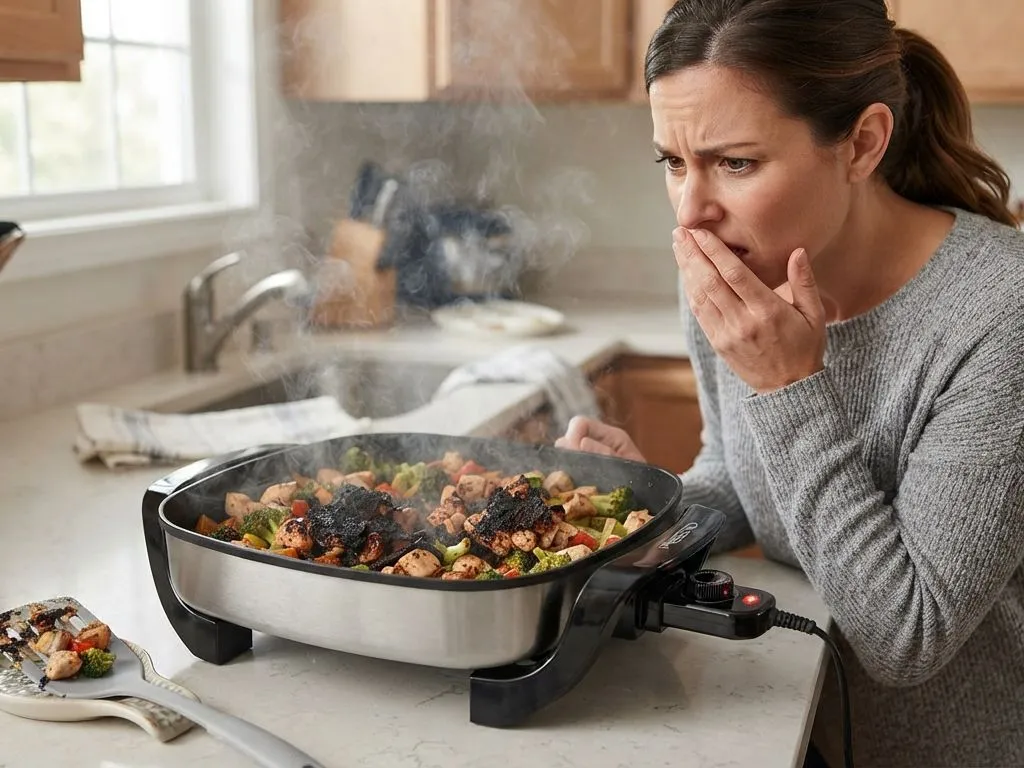
Possible Causes
- The temperature setting is too high
- The skillet was preheated for too long
- The pan was heated while empty
- The thermostat is inaccurate
- The temperature probe is defective
- The cooking surface has severe hot spots
- Sugar, sauces, or grease are burning onto the surface
How to Fix It
Reduce the selected temperature and allow the skillet to stabilize before adding more food.
For a basic temperature check, use a cooking-surface thermometer that is suitable for the expected temperature range. Compare the reading with the control setting after the skillet has completed preheating.
Do not expect the surface temperature to remain at one exact number every second. Thermostats cycle within a range. However, very large temperature differences, constant overheating, or smoke at low settings suggest a problem.
When to Replace It
Stop using the appliance if it continues heating at the OFF setting, becomes dangerously hot at low settings, or cannot regulate its temperature. A faulty controller can create a burn or fire risk.
5. Electric Skillet Heats Unevenly or Has Hot Spots
Uneven heat can cause food to burn in one area while remaining undercooked in another.
Possible Causes
- The skillet did not preheat fully
- Food is overcrowded
- The pan is warped
- Oil is pooling on one side
- The heating element is partly damaged
- The skillet is sitting on an uneven surface
- Thick food is placed over only one section
- The skillet has a naturally warmer central area
How to Test for Uneven Heating
You can perform a simple test after checking the manufacturer’s care instructions.
Lightly coat the cooking surface with oil or place several similar pieces of bread across the pan. Heat the skillet at a moderate setting and observe which areas brown first.
You may also use an infrared thermometer, but shiny surfaces can produce inaccurate readings. A suitable contact thermometer may provide a more reliable comparison.
How to Improve Heat Distribution
- Preheat the skillet before adding food
- Spread food evenly
- Avoid overcrowding
- Rotate or move food during cooking
- Use the lid when appropriate
- Place the skillet on a level surface
- Cook large quantities in batches
If one entire section remains cold while another becomes extremely hot, the internal heating element may be failing.
6. Electric Skillet Heats Slowly or Loses Heat
An electric skillet may take longer to heat when it is heavily loaded, but it should not remain lukewarm indefinitely.
Possible Causes
- The probe is not fully connected
- The temperature is set too low
- The skillet is connected through an unsuitable extension cord
- The circuit voltage is unstable
- Too much cold or frozen food was added
- The lid is being removed repeatedly
- The cooking surface is overcrowded
- The heating element is weakening
- The skillet has a lower wattage than expected
Initial Heating Versus Heat Recovery
Initial heating is the time the empty or lightly loaded skillet takes to reach the selected setting. Heat recovery is the time it needs to return to that temperature after cold food is added.
Adding frozen vegetables, refrigerated meat, a large amount of liquid, or too many ingredients at once can cause a noticeable temperature drop.
How to Fix It
- Preheat the skillet before adding food
- Thaw food when the recipe allows
- Cook in smaller batches
- Keep the lid closed when simmering
- Use the correct temperature setting
- Connect the appliance directly to a suitable outlet
- Confirm that the temperature probe is secure
Some manufacturer guidance recommends preheating an electric skillet uncovered for approximately 5 to 10 minutes. ng has become progressively slower despite proper use, the controller or heating element may be wearing out.
7. Temperature-Control Probe Is Loose or Keeps Falling Out
A removable probe must make secure contact with the skillet. A loose control can cause intermittent power, inaccurate temperatures, or no heat.
Possible Causes
- The probe is not fully inserted
- Grease or residue is blocking the socket
- The connector has worn with age
- The wrong replacement probe is being used
- The socket is cracked
- The contact points are bent or damaged
Are Electric Skillet Temperature Probes Universal?
No. Two probes may look similar but have different:
- Connector dimensions
- Pin spacing
- Voltage ratings
- Current ratings
- Temperature ranges
- Thermostat designs
- Safety certifications
Use the exact replacement listed for the skillet’s brand and model whenever possible. Do not force a probe into a socket.
How to Fix It
Unplug the appliance, let it cool, and inspect the socket. Remove exterior grease with a soft cloth. Do not insert metal tools or pour cleaner into the connector.
If the probe still feels loose, replace it only with an approved compatible part. Replace the entire skillet if the socket itself is cracked, burnt, or deformed.
8. Indicator Light or Digital Display Is Not Working
Some electric skillets use a basic indicator light, while newer models may have a digital display.
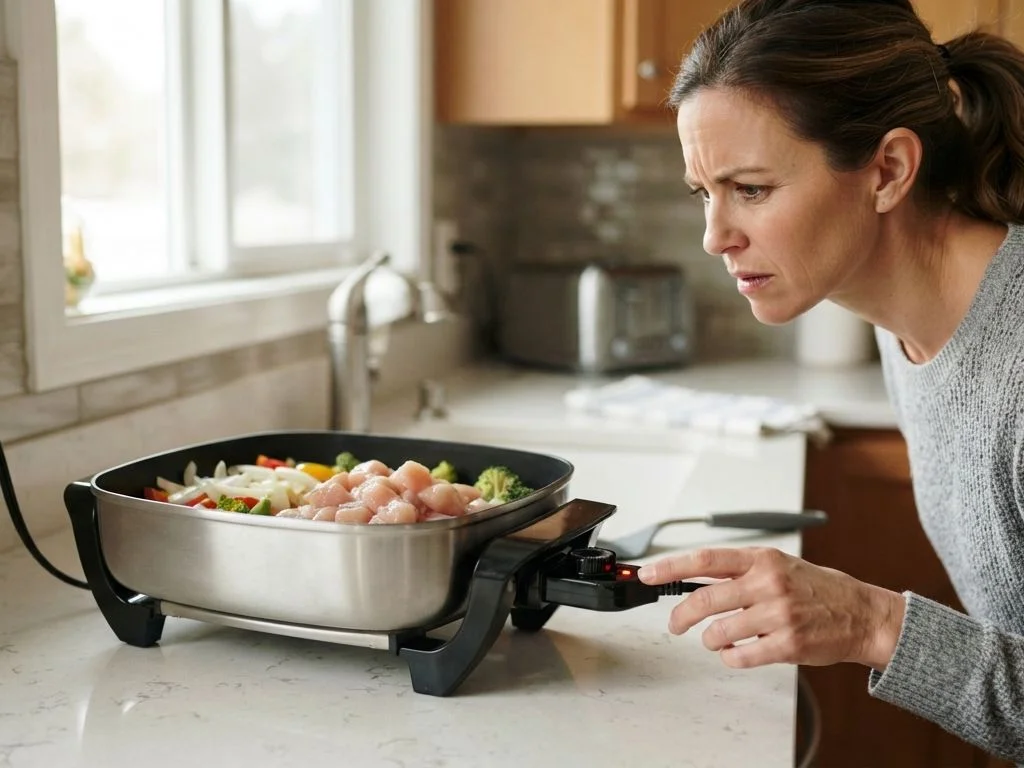
Common Symptoms
- The light never turns on
- The light stays on continuously
- The light flickers
- The display flashes
- Buttons do not respond
- An error code appears
- The skillet heats even though the light is off
- The display works but the pan stays cold
What the Indicator Light Usually Means
On many models, the light shows that the heating element is receiving power. It may switch off when the selected temperature is reached and come back on when more heat is needed. Always check the manual because indicator behavior differs between models.
How to Troubleshoot It
- Confirm that the outlet works.
- Reconnect the temperature probe.
- Set the control above its minimum setting.
- Allow the skillet to preheat.
- Check whether the cooking surface heats normally.
- Look for moisture or damage around the controls.
A failed indicator does not automatically mean the heating element has failed. However, the appliance should not be used if you cannot reliably control or confirm its operating state.
For a digital model, follow the manufacturer’s instructions for resetting the control or interpreting error codes.
9. Electric Skillet Keeps Tripping the Breaker, GFCI, or RCD
A breaker that trips once may indicate an overloaded circuit. Repeated tripping can signal a serious electrical problem.
Possible Causes
- Too many appliances are using the same circuit
- The outlet is faulty
- Water has entered the connector
- The cord is damaged
- The heating element has developed a short
- The temperature control is defective
- An unsuitable extension lead is being used
What to Do
- Turn the skillet off.
- Unplug it immediately.
- Check whether other high-power appliances were operating.
- Let the skillet dry fully if it was recently washed.
- Inspect the cord and connector for visible damage.
- Reset the breaker only after unplugging the appliance.
You may test the skillet once in another suitable outlet on a different circuit, provided there is no visible damage, moisture, smoke, or burning smell.
If it trips the second circuit, stop using it. Do not keep resetting the breaker.
Water entering an electric cooking appliance can create a shock hazard. A CPSC recall involving an electric griddle, for example, identified water entering through a cracked heating element as a potential shock risk. lug, Cord, or Temperature Probe Gets Hot, Buzzes, or Smells Burnt
Electric cooking appliances draw significant power. A slightly warm cord may occur on some models, but a hot, buzzing, melting, or discoloured connection is not normal.
Warning Signs
- The plug is too hot to touch comfortably
- Plastic is soft or deformed
- The outlet has brown or black marks
- The connector makes a buzzing or crackling sound
- Sparks appear when the cord moves
- Power cuts in and out
- There is a burning-plastic smell
- The probe socket looks scorched
Possible Causes
- Loose electrical contact
- A worn wall outlet
- Damaged internal wiring
- Corroded terminals
- An overloaded power strip
- An underrated extension cord
- A defective temperature control
- Grease or moisture inside the connector
What to Do
Turn the skillet off and unplug it by holding the plug, not pulling the cord. Do not reconnect it until the cause has been professionally assessed.
Never tape over a damaged cord, bend connector pins, scrape electrical contacts with a knife, or continue using a melted plug.
11. Electric Skillet Produces Excessive Smoke
Smoke does not always come from an electrical problem. It may come from cooking oil, burnt food, or residue on the surface.
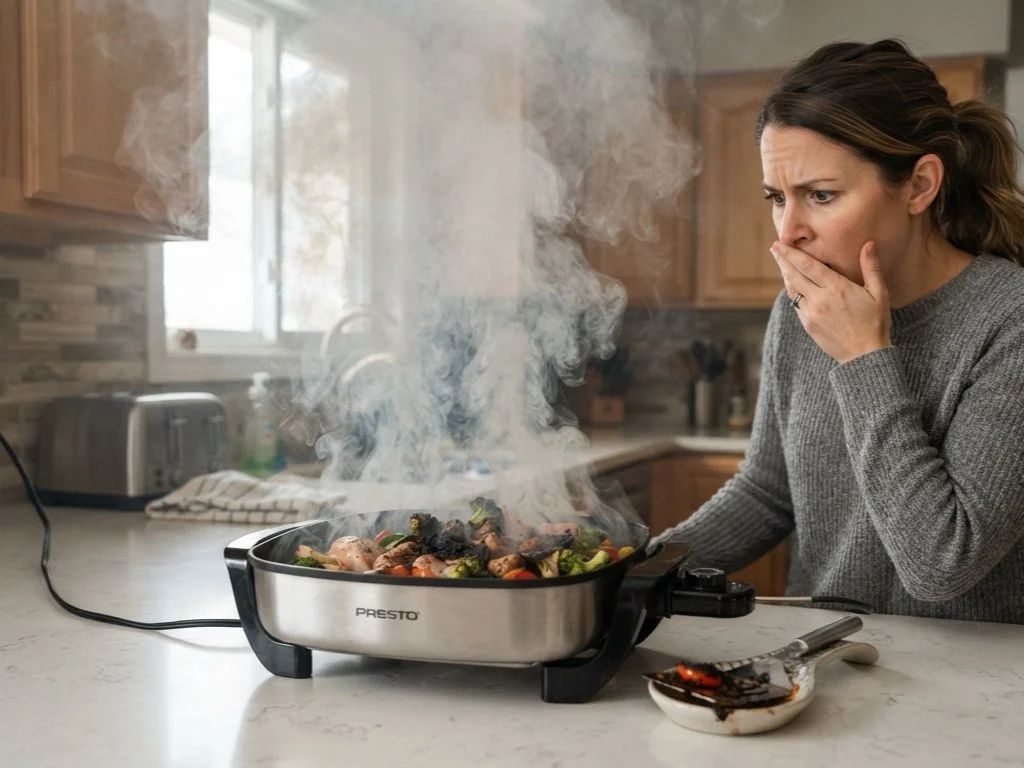
Common Cooking-Related Causes
- Oil has exceeded its smoke point
- The temperature is too high
- Grease has accumulated
- Food residue is burning
- Sugary sauce has stuck to the pan
- The skillet was heated while empty
- Oil splashed onto the exterior
How to Stop the Smoking
- Turn the temperature down
- Remove the food if it is burning
- Use an oil suitable for the cooking temperature
- Avoid heating an empty skillet for too long
- Clean burnt residue after the pan cools
- Use less oil when appropriate
When Smoke Is Dangerous
Unplug the skillet immediately if smoke comes from:
- The plug
- The temperature probe
- The socket
- The power cord
- The bottom electrical housing
Do not pour water onto an electrical appliance or a pan containing burning oil.
12. Food Keeps Sticking to the Electric Skillet
Food can stick even when the skillet has a nonstick cooking surface.
Possible Causes
- The pan was not preheated
- The temperature is too low
- The temperature is too high
- Too little oil or fat was used
- Food was turned too soon
- The pan is overcrowded
- Sticky cooking-spray residue has formed
- The nonstick coating is damaged
- Food moisture is preventing browning
How to Prevent Sticking
For eggs and pancakes, use a moderate heat setting and a small amount of butter or oil.
For meat, let the surface preheat before adding the food. Meat may initially stick and then release more easily after a crust develops.
For fish, dry the surface before cooking and avoid moving it repeatedly.
For frozen foods, remove excess ice and avoid placing too many pieces in the skillet at once.
Wooden, nylon, silicone, or heat-safe plastic utensils are generally preferable on nonstick surfaces. Manufacturer instructions commonly recommend avoiding metal utensils to help preserve the coating. onstick Coating Is Scratched, Peeling, or Flaking
A damaged coating can make food stick and may release visible flakes into meals.
Common Causes
- Metal utensils
- Knives used inside the skillet
- Steel wool
- Abrasive cleaners
- Stacking heavy cookware inside the pan
- Repeated overheating
- Long-term wear
- Incorrect dishwasher use
Can You Continue Using It?
Minor surface marks do not always affect performance immediately. However, you should stop using the skillet when:
- The coating is visibly peeling
- Flakes are entering food
- Deep scratches expose the base material
- Large areas have lost their finish
- The pan has become difficult to clean
- Food burns severely in damaged areas
Do not attempt to repair the surface using paint, household coating products, or DIY seasoning methods unless the manufacturer specifically approves them.
Dishwasher guidance varies. Some skillets are dishwasher-safe after the temperature control is removed, while other manuals warn that repeated dishwasher washing can gradually reduce nonstick performance. lectric Skillet Is Warped, Wobbly, or Has Loose Handles
A skillet should sit securely on a flat, heat-resistant surface.
Possible Causes
- The skillet was dropped
- The pan experienced sudden temperature changes
- The body has warped
- A rubber foot is missing
- A leg or handle screw is loose
- Plastic supports have cracked
- The countertop is uneven
- The base was assembled incorrectly
Signs of Warping
- Oil flows to one side
- The skillet rocks when touched
- The lid no longer fits properly
- Food cooks faster on one side
- Hot liquid is close to spilling
- The skillet moves when food is stirred
How to Fix It
First, place the appliance on another level surface. Check the feet, handles, and visible screws after the appliance has been unplugged and cooled.
Tighten only accessible manufacturer-installed screws, and do not overtighten them. Replace cracked handles or broken feet with approved parts.
Manufacturer instructions stress that handles should be assembled and fastened correctly before the appliance is used. arry or move a skillet containing hot oil or hot food unless absolutely necessary. Some manufacturer manuals specifically warn against moving a loaded skillet because of the risk of burns. the appliance if the cooking body is badly warped, the base is unstable, or the handles cannot be secured.
15. Electric Skillet Has Burnt-On Residue, Rust, or Discoloration
Burnt food, grease, mineral deposits, and oxidation can affect the appearance and performance of an electric skillet.
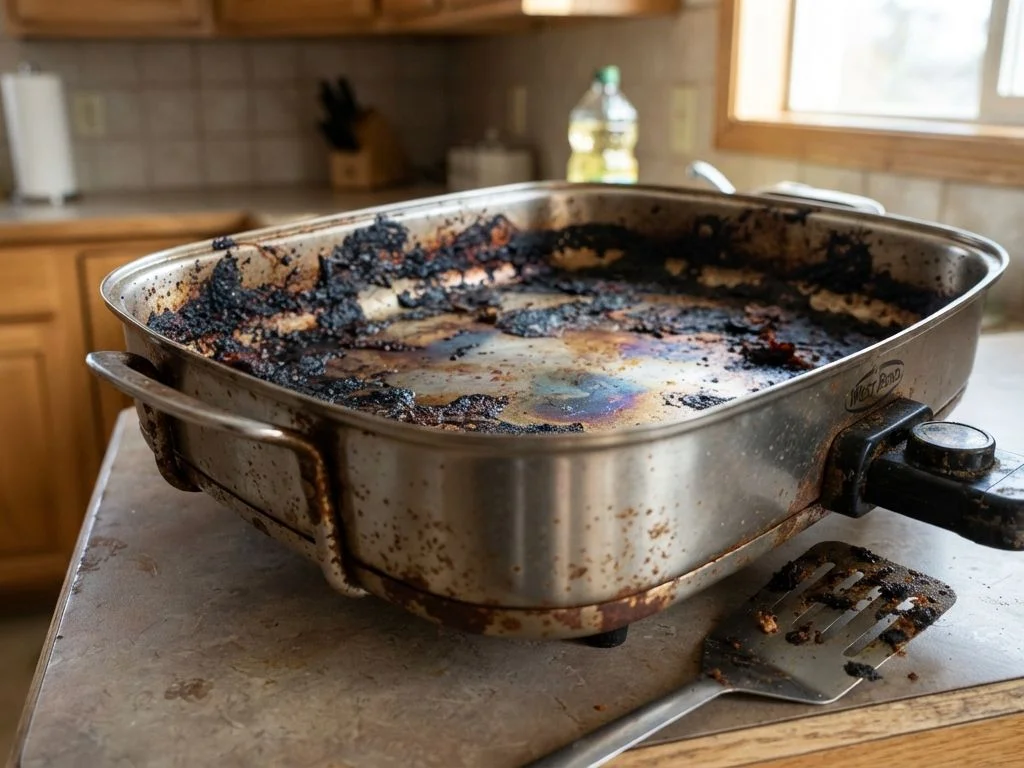
How to Clean Burnt-On Food
- Turn the control to OFF.
- Unplug the appliance.
- Let it cool completely.
- Remove the temperature control.
- Wipe away loose grease and food.
- Wash the skillet with warm water and mild dish soap.
- Use a soft sponge or manufacturer-approved nylon pad.
- Rinse and dry thoroughly.
Do not use steel wool, sharp tools, or harsh abrasive cleaners on a nonstick surface. Official care instructions for several models warn that abrasive pads and cleaners can damage the finish. and Corrosion
Rust may appear around screws, exposed metal, or damaged areas. Corrosion may also develop on connector parts if they are exposed to moisture.
Do not use the skillet if corrosion has damaged the electrical socket, probe terminals, cord, or heating system.
Grey, Black, or White Discoloration
Discoloration may result from:
- Mineral deposits
- Dishwasher detergent
- Overheating
- Grease buildup
- Aluminum oxidation
- Normal changes to unfinished metal
Check the manual before using vinegar, baking soda, or another cleaning method. A cleaner that is safe for one surface may damage another.
Additional Electric Skillet Lid Problems
Although lid problems are not always related to the electrical system, they can affect cooking performance and safety.
Glass Lid Does Not Fit Correctly
Possible causes include:
- Food blocking the rim
- A warped skillet body
- An incorrectly positioned lid
- A bent metal rim
- The wrong replacement lid
Do not force the lid into place.
Steam Escapes Around the Lid
A small amount of steam escaping around the edge may be normal. Excessive leakage may occur when:
- The pan is overfilled
- The lid is not seated correctly
- The body is warped
- The steam vent is blocked
- The food is boiling too aggressively
Reduce the heat and keep your face and hands away from escaping steam.
Water Drips From the Lid
Condensation forms when hot steam touches the cooler lid. Lift the lid slowly and tilt it away from your face so hot water runs back into the skillet.
Replace a chipped, cracked, or badly damaged glass lid.
How to Tell Whether the Outlet, Probe, or Heating Element Is Faulty
Correctly identifying the source of the problem can prevent unnecessary replacement.
Signs the Outlet May Be the Problem
- Other appliances do not work in the outlet
- The plug feels loose
- The GFCI or RCD has tripped
- The outlet is discoloured
- Power cuts out when the plug moves
Do not use a damaged outlet. Contact a qualified electrician.
Signs the Temperature Probe May Be Faulty
- Temperature is consistently inaccurate
- The skillet overheats
- Heat cuts out when the probe moves
- The dial feels loose
- The connector is burnt
- The appliance works intermittently
- An approved replacement probe solves the problem
Signs the Heating Element May Be Faulty
- The indicator light works but the pan stays cold
- One large section does not heat
- Heating has become extremely slow
- The probe and outlet appear functional
- The skillet repeatedly trips a breaker without visible cord damage
Internal heating-element testing should be left to a qualified technician.
Can You Use an Extension Cord With an Electric Skillet?
Plugging the skillet directly into a suitable wall outlet is generally the safest option.
When the manufacturer permits an extension cord, it must:
- Be rated for at least the appliance’s electrical load
- Be grounded when the skillet requires grounding
- Be fully uncoiled during use
- Be kept away from hot surfaces
- Remain dry
- Not create a trip hazard
- Not be connected to another extension cord
- Not be shared with several high-power appliances
Never use a lightweight household extension lead with a high-power cooking appliance. Stop using any cord that becomes hot, smells burnt, or shows damage.
When Should You Repair or Replace an Electric Skillet?
A small external problem may be worth fixing, especially when an approved replacement part is available. Electrical damage, severe warping, or a deteriorating cooking surface often justifies replacing the appliance.
| Condition | Clean or Adjust | Replace a Part | Replace the Skillet |
|---|---|---|---|
| Probe is not fully inserted | Yes | Possibly | No |
| Connector has light exterior grease | Yes | No | No |
| Approved probe has failed | No | Yes | Possibly |
| Lid knob is loose | Yes | Possibly | No |
| Handle is cracked | No | Yes | Possibly |
| Nonstick coating is peeling | No | No | Yes |
| Cord is frayed | No | Possibly | Often |
| Socket is melted | No | No | Yes |
| Skillet body is badly warped | No | No | Yes |
| Appliance sparks or smokes electrically | No | No | Yes |
| Breaker trips repeatedly | No | Technician only | Often |
| Digital control cannot regulate heat | No | Possibly | Possibly |
Consider the appliance’s age, warranty, replacement-part availability, and repair cost. Never continue using a dangerous appliance simply because it still produces heat.
Check the Model Number, Warranty, and Product Recalls
Before buying a replacement probe or arranging a repair, find the model number. It is often printed on a label under the skillet or near the power connection.
Use the number to:
- Find the correct instruction manual
- Confirm replacement-part compatibility
- Check warranty coverage
- Contact the manufacturer
- Search for recalls or safety notices
Consumers in the United States can check the Consumer Product Safety Commission. Canada, the United Kingdom, and Australia have their own official product-safety and recall databases.
If the skillet is recalled, follow the official remedy. Do not continue using or repairing it unless the recall instructions specifically permit that action.
How to Prevent Electric Skillet Problems
Good use and maintenance can prevent many common failures.
Preheat Properly
Allow the appliance to reach the selected temperature before adding food unless the recipe or manual instructs otherwise.
Avoid Overcrowding
Too much food lowers the surface temperature and causes uneven cooking.
Use Suitable Utensils
Use wooden, nylon, silicone, or other manufacturer-approved utensils on nonstick surfaces.
Keep the Probe Dry
Never wash or immerse the temperature control unless its manual clearly states that it is waterproof.
Use the Correct Replacement Parts
Match replacement probes, cords, handles, lids, and controls to the exact model.
Clean the Skillet After Use
Remove grease and food residue before they harden. Always cool and unplug the appliance first.
Avoid Thermal Shock
Do not pour cold water into a very hot skillet. Sudden temperature changes may damage or warp some materials.
Store the Cord Carefully
Avoid sharp bends, tight knots, and pressure on the probe connection.
Check Handles and Feet
Periodically inspect screws, handles, legs, and rubber feet for looseness or damage.
Follow Model-Specific Dishwasher Instructions
A removable skillet body may be dishwasher-safe, but the electrical control usually is not. Confirm the instructions for your exact model.
Frequently Asked Questions About 15 Common Electric Skillet Problems
Why Is My Electric Skillet Not Heating Up?
The most common causes are a loose temperature probe, a faulty outlet, an incorrect setting, a damaged temperature control, or a failed heating element. Test the outlet and reconnect the probe before considering an internal failure.
Why Does My Electric Skillet Keep Turning Off?
It may be normal thermostat cycling. The skillet switches heat on and off to maintain the selected temperature. It is more likely to be a fault if the pan becomes completely cold, the display resets, or moving the cord restores power.
Is It Normal for the Indicator Light to Turn On and Off?
Yes, on many models. The light may switch off when the selected temperature is reached and turn on again when the heating element needs to restore heat. Check your model’s manual for its exact indicator behavior.
Why Is the Indicator Light On but the Skillet Is Not Heating?
The probe may not be making proper contact, or the controller, heating element, or internal wiring may have failed. Unplug the appliance and inspect the connector for dirt, moisture, or damage.
Why Does My Electric Skillet Heat Unevenly?
Uneven heating can result from incomplete preheating, overcrowding, a warped pan, an uneven countertop, or a partially failed heating element.
Why Does My Electric Skillet Lose Heat After I Add Food?
Cold or frozen ingredients absorb heat quickly. Add smaller quantities, preheat fully, thaw food when appropriate, and cook in batches.
Why Is My Electric Skillet Plug Getting Hot?
A hot plug may indicate a loose outlet, damaged cord, poor electrical contact, overloaded extension cord, or failing temperature control. Unplug the appliance and stop using it if the plug is very hot, discoloured, buzzing, or melting.
Why Is My Electric Skillet Making a Buzzing or Crackling Noise?
A quiet thermostat click may be normal. Loud buzzing or crackling from the plug, cord, or probe may indicate a loose electrical connection. Stop using the skillet if the noise is accompanied by flickering, heat, sparks, or a burning smell.
Are Electric Skillet Temperature Probes Universal?
No. Probe dimensions and electrical ratings vary. Use a replacement approved for the skillet’s exact brand and model.
Can You Submerge an Electric Skillet in Water?
Some removable skillet bodies can be immersed after the control is removed, while others have different restrictions. The temperature control, plug, and cord should not be immersed unless the manufacturer explicitly states otherwise.
Can You Use an Extension Cord With an Electric Skillet?
Direct wall connection is preferable. When an extension cord is permitted, it must have an adequate electrical rating and be used according to the appliance manual.
Can You Use an Electric Skillet With a Scratched Coating?
A small superficial mark may not require immediate disposal, but stop using the skillet if the coating is deeply scratched, peeling, or flaking into food.
How Do You Clean Burnt Food From an Electric Skillet?
Unplug and cool the appliance, remove the temperature control, and clean the cooking surface with warm soapy water and a non-abrasive sponge. Follow the manufacturer’s instructions for soaking and dishwasher use.
How Long Does an Electric Skillet Take to Heat Up?
Preheating time varies by size, wattage, starting temperature, and heat setting. Many models take approximately 5 to 10 minutes.
How Long Should an Electric Skillet Last?
There is no universal lifespan. Usage frequency, build quality, temperature-control durability, coating condition, cleaning habits, and replacement-part availability all affect how long it remains safe and useful.
Final Thoughts
Many electric skillet problems begin with one of four areas: the wall outlet, temperature-control probe, heating system, or cooking surface.
Start with simple external checks. Confirm that the outlet works, reconnect the temperature probe, use the correct heat setting, and inspect the appliance for visible damage. Normal thermostat cycling should not be confused with a complete loss of power.
Stop using the skillet when you notice sparks, repeated breaker tripping, exposed wires, melted connectors, strong electrical odors, severe warping, unstable handles, or peeling nonstick coating.
When troubleshooting cannot be completed safely from the outside, contact the manufacturer or replace the appliance. No meal is worth the risk of an electric shock, fire, or serious burn.

“I believe great cooking starts with the right tools, trusted advice, and a little confidence in the kitchen.”
Hi, I’m Emma Carter. My love for cooking began in my grandmother’s kitchen, where I learned that every great meal starts with simple ingredients and the right cookware. Over the years, I’ve spent countless hours researching, testing, and comparing kitchen appliances, cookware, coffee makers, air fryers, and other everyday kitchen essentials.
Here at KiCook, my goal is to make your buying decisions easier with honest product reviews, practical buying guides, and easy-to-follow cooking tips. Whether you’re upgrading your kitchen or searching for the best appliance for your home, I focus on providing clear, reliable, and research-backed information you can trust.
When I’m not testing new kitchen gadgets or writing in-depth guides, you’ll usually find me trying new recipes, visiting local farmers’ markets, or enjoying a quiet cup of coffee while planning my next kitchen project.



1 thought on “15 Common Electric Skillet Problems and How to Fix Them”