
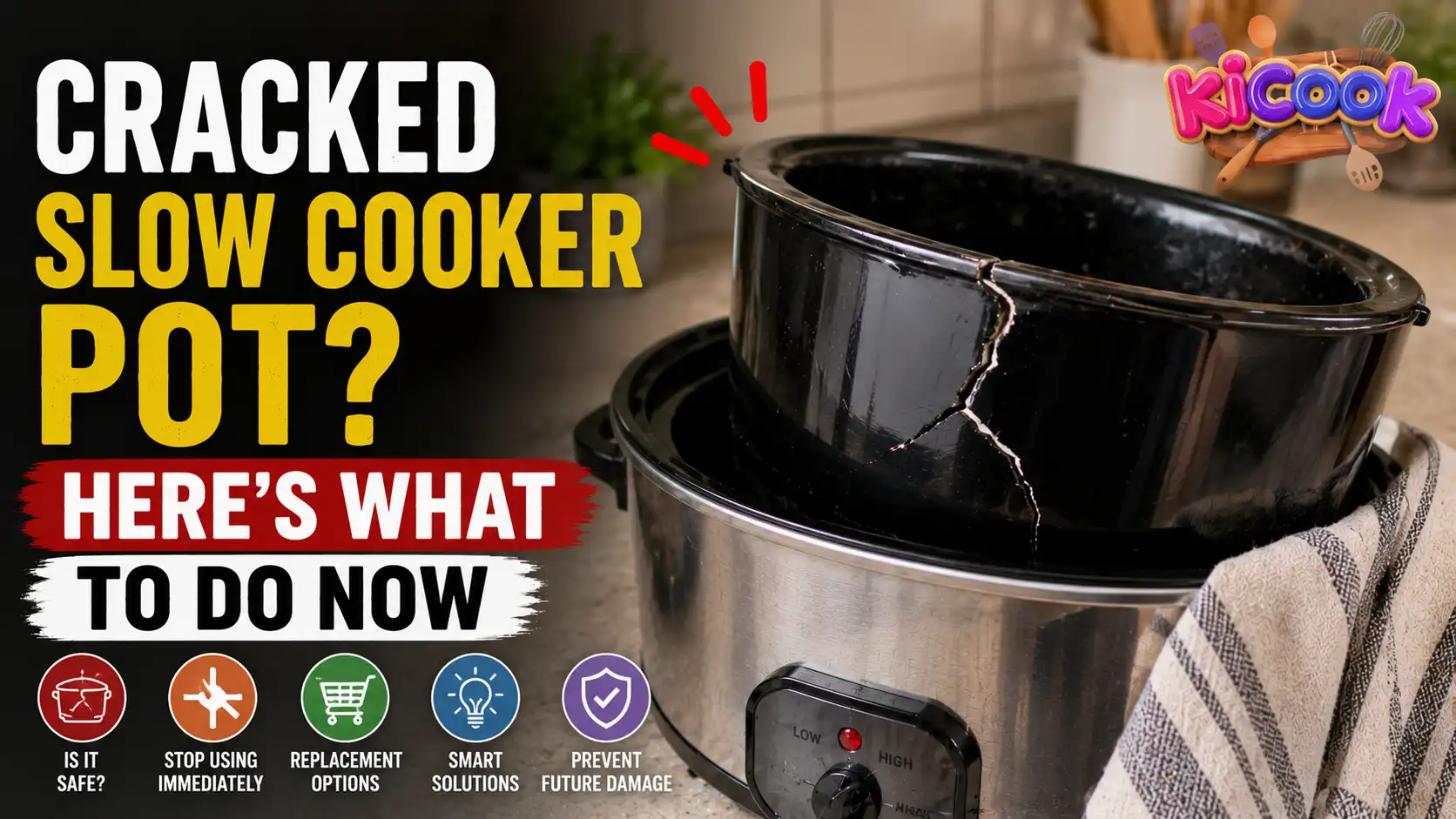
A cracked slow cooker ceramic pot is usually caused by sudden temperature changes (thermal shock), physical damage, or wear over time. Using a cracked pot is unsafe because it can leak fluid into the electrical base, trap harmful bacteria, or shatter during cooking.
Why You’re Here (And Why That Crack Feels So Frustrating)
You pull your trusty slow cooker off the shelf, fill it with a delicious recipe, and walk away. Hours later, you’re ready for a perfect meal. Then you see it: a hairline crack running across the ceramic insert. Your heart sinks.
I’ve been there. After more than a decade helping home cooks solve kitchen problems, I’ve seen everything from a six-quart pot splitting mid-stew to tiny cracks ruining a family dinner. That sinking feeling is real because we rely on these appliances.
Here’s the good news: you can fix this. By the time you finish this article, you’ll know exactly why your pot cracked, whether you can safely repair it, and the smartest way to get cooking again. Let’s sort this out together.
The Three Biggest Frustrations (And How To Handle Each One)
When your slow cooker ceramic pot cracks, it’s rarely just one issue. Most people face one of these three common headaches.
1. “I Washed It Like Always, Then I Saw The Crack”
This is the most heartbreaking scenario. You’ve been careful. You let it cool before washing. But one day, there it is.
Why it happens: Even careful cooks can accidentally cause thermal shock—sudden temperature changes that stress the ceramic until it gives way. Maybe you set a warm pot on a cold granite countertop. Or you rinsed it with cool water just a few minutes too soon. Ceramic expands and contracts at different rates when temperatures change quickly, and eventually, it cracks.
What you can do today: First, stop using the cracked pot immediately. Even a small hairline crack can grow during cooking, and hot liquid could leak into the base, creating an electrical hazard. Second, check if your pot is still under warranty—many brands cover manufacturing defects for up to a year. If you’re in the US, call the manufacturer’s customer service line (like 1-800-557-4825 for some brands). In the UK, brands like Morphy Richards offer helplines to help with replacements.
Real-world example: My friend Sarah in Melbourne thought she was being safe by letting her pot cool for 15 minutes before washing. But the inside was still warm, and the cold tap water created a temperature swing of nearly 50 degrees Celsius. The crack appeared instantly. Now she waits until the pot is completely cool to the touch—sometimes a full hour after cooking ends.
2. “My Slow Cooker Cracked While Cooking Dinner”
This is the scary one. You’re halfway through cooking a family meal, and you hear a pop or notice liquid seeping out.
Why it happens: The most common culprit here is uneven heating. Maybe you added frozen meat directly to a hot pot, creating a cold spot that stressed the ceramic. Or perhaps you refrigerated the ceramic insert overnight with food inside, then placed a cold pot into a hot base the next morning.
What you can do right now: Don’t panic. If the crack appears while cooking:
- Turn off and unplug the slow cooker immediately.
- Move the food to another pot or a large bowl, being careful not to spill hot liquid.
- Finish cooking on the stovetop if needed. This is safe as long as you transfer the food promptly.
- Inspect the base. If any liquid leaked into the outer metal housing, do not use the slow cooker again until it’s been professionally inspected or replaced.
Pro tip: If you use slow cooker liners (the disposable plastic bags), your food never touched the cracked ceramic directly. That means dinner is completely safe to eat.
3. “I’ve Replaced The Insert Before—Why Does It Keep Happening?”
If you’re on your second or third insert, there’s likely an underlying issue with how you’re using or storing your slow cooker.
Why it happens: Repeated cracking suggests a pattern. Are you placing the ceramic insert directly on a stovetop burner to sear meat? (Most inserts aren’t stovetop safe.) Are you overfilling the pot, causing pressure to build? Or is your heating element wearing unevenly, creating hot spots that stress the ceramic over time?
What you can do today:
- Stop preheating the slow cooker empty. Always add food before turning the unit on.
- Never use metal utensils inside the ceramic pot. Scratches can weaken the surface and give cracks a place to start.
- Check your countertops. If you frequently place a hot pot on a cold stone or granite surface, use a trivet or a folded kitchen towel as a buffer.
For Canadian and US readers: Many brands sell replacement inserts starting at around 20to30 US. In Canada, retailers like Amazon carry compatible inserts for common models. Australian cooks can find replacements through kitchenware stores or directly from brands like Breville and Sunbeam.
Bottom line: If you’ve cracked more than one insert, it’s time to examine your habits. Thermal shock is almost always preventable.
Why You Should Never Ignore A Cracked Slow Cooker Pot
Before we talk about fixes, let’s address the elephant in the room: can you just keep using it?
Honestly, no. Even a tiny crack is a gamble.
Here’s why:
- Food safety risk: Bacteria love to hide in cracks where soap and water can’t reach. Damaged ceramic surfaces can trap food particles, leading to contamination. Food safety experts agree: replace ceramic cookware once it’s chipped or cracked.
- Electrical hazard: If liquid seeps through the crack and into the metal base, you risk short-circuiting the appliance or starting a fire.
- Shattering during use: A weak crack can turn into a full break mid-cooking, sending hot food and ceramic shards everywhere. That’s a burn risk and a mess no one wants.
- Chemical leaching concerns: Older or poorly made ceramic pots might contain lead or cadmium in their glaze. When the surface cracks, those substances could leach into acidic foods like tomato sauce or chili. The FDA tests for lead in ceramic cookware, but a crack makes any pot riskier.
“Replace ceramic cookware if it becomes chipped or cracked since damaged surfaces can trap bacteria or leach chemicals into food.” — Julia Smith, COO of Mendocino Food Consulting
One more warning: You might see internet tricks about boiling a cracked pot in milk to “seal” the crack. This doesn’t work for long, and it certainly doesn’t make the pot food safe again. Save your milk for your morning coffee.
What You Can Actually Do With A Cracked Slow Cooker Pot
Okay, so you can’t safely cook with it. But you have options.
Option 1: Replace Just The Insert
This is almost always the best path forward. If the metal base of your slow cooker still works fine, you don’t need to buy a whole new unit.
- Check compatibility. Replacement inserts come in specific sizes (like 4-quart, 6-quart, or 8-quart) and shapes (round or oval). Match your model number to the replacement part.
- Shop smart. In the US, check the Crock-Pot website for official parts. In the UK, brands like Morphy Richards and Tower offer replacements. Canadian shoppers can find parts on Amazon Canada or through local retailers. Australian buyers can look for replacements at stores like Kitchen Warehouse or online.
- Expect to pay. Most replacement inserts cost between 20and40 US (or roughly £15–£30, 30–55 CAD, 35–65 AUD). That’s a fraction of a new slow cooker.
- Check warranty first. If your slow cooker is less than a year old, the manufacturer might replace the cracked insert for free. Keep your receipt handy.
“A cracked slow cooker insert is a safety hazard. It can leach materials into your food, and the insert could potentially shatter during use. Replace it immediately.” — Kitchen Appliance Safety Report, 2026
Option 2: Repurpose The Cracked Pot (Without Cooking)
Just because you can’t cook with it doesn’t mean it’s useless. Here are creative, safe ways to give your cracked ceramic pot a second life:
- Plant pot liner. Drill a drainage hole (carefully!) and use it inside a decorative planter for houseplants.
- Garden scooper. That cracked pot makes a great tool for scooping soil or mulch.
- Craft supply holder. Store paintbrushes, markers, or knitting supplies in it.
- Outdoor birdbath. Place it upside down on a post, then set a shallow bowl on top.
Just remember: never use a cracked ceramic pot for food again, even for dry goods like flour or sugar. Cracks can hold moisture and mold.
Option 3: Recycle Responsibly
If repurposing isn’t your thing, recycle the ceramic insert.
- In the US and Canada, some recycling centers accept ceramics for use in construction materials or as landfill cover. Call your local facility first—most won’t accept ceramic in regular curbside recycling.
- In the UK, check with your local council. Some areas accept ceramics at household waste recycling centres (HWRCs).
- In Australia, look for “hard waste” collection days or take it to a resource recovery centre.
The metal base can also be recycled as scrap metal or e-waste, depending on your local rules.
Option 4: Know When To Buy A Whole New Slow Cooker
Sometimes replacement isn’t worth it. Consider buying a new slow cooker if:
- The replacement insert costs nearly as much as a new unit (especially for budget models)
- The base is old, scratched, or has any signs of electrical issues
- You’ve been wanting to upgrade to a model with programmable timers or a larger capacity
“Even a small hairline crack can weaken the ceramic and cause it to shatter during cooking. It’s best to replace the bowl to avoid any safety hazards.” — Irvingdiner Appliance Specialists
How To Prevent Your Next Slow Cooker Pot From Cracking
Once you’ve replaced your cracked ceramic pot, let’s make sure this never happens to you again. These simple habits will keep your new insert safe for years.
1. Master Temperature Transitions
Sudden temperature changes are the number one cause of cracked ceramic. Train yourself to think in gradual shifts:
- Always place the ceramic insert into the cold base before turning the power on. Never preheat an empty pot.
- Let the pot cool completely before washing—at least 30 to 60 minutes after cooking ends.
- Never pour cold liquid into a hot pot. If a recipe calls for adding broth or water during cooking, warm it up first.
- Don’t refrigerate food inside the ceramic insert if you plan to reheat it in the slow cooker the next day. Transfer leftovers to a different container.
Real-world example: My neighbour in Texas used to prep her slow cooker meals the night before by loading the insert with ingredients and putting the whole thing in the fridge. The next morning, she’d place a cold pot directly into a hot base. Three cracked inserts later, she switched to mixing ingredients in a separate bowl overnight and transferring them in the morning. No cracks since.
2. Thaw Meat Completely Before Cooking
Cooking frozen meat in a slow cooker isn’t just bad for your pot—it’s unsafe. The USDA warns that frozen meat can stay too long in the “danger zone” (40°F–140°F / 4°C–60°C), where bacteria multiply rapidly.
Frozen meat also creates a concentrated cold spot that expands unevenly, stressing the ceramic until it cracks. Always thaw meat in the refrigerator overnight before adding it to your slow cooker.
3. Treat Ceramic With Care
Ceramic is durable, but it’s not indestructible.
- Use silicone, wood, or plastic utensils only. Metal spatulas and spoons scratch the glaze, weakening the surface.
- Don’t bang the pot against the faucet when washing. Even small impacts can create micro-cracks that grow over time.
- Store the insert safely. Don’t stack heavy pots or pans on top of it. If you nest multiple inserts, put a soft cloth between them.
- Watch for “crazing.” That’s the network of tiny surface cracks that can appear in the glaze over time due to normal wear. Crazing looks like a cracked pot but is usually just surface-level. However, if the ceramic itself is cracked (not just the glaze), replace it.
4. Know Your Appliance’s Limits
Check your slow cooker manual (yes, that booklet you stuffed in a drawer). Some models have specific warnings:
- Do not use the ceramic insert on a stovetop burner unless the manual explicitly says it’s safe.
- Do not put a hot lid into cold water—that’s another thermal shock risk.
- Do not submerge the ceramic pot in water for long periods. The unglazed area on the bottom is porous and can absorb water, weakening the structure over time.
What About Crazing Vs. Cracking?
One question I hear often: “Is my pot cracked or just crazed?”
Crazing is a network of tiny, hairline cracks in the glaze only—the shiny outer coating. The ceramic underneath is still intact. Crazing happens naturally over years of use and doesn’t usually affect safety. Your pot might look a little tired, but it’s still fine to use.
Cracking goes through the ceramic itself. You can often feel the crack with your fingernail, or you might see light through it when you hold the pot up. Cracks are not safe.
If you’re not sure, run your finger along the suspected crack. If your nail catches, that’s a real crack. If it’s smooth, it might just be crazing. When in doubt, replace the insert.
Frequently Asked Questions
Is it safe to use a slow cooker with a cracked ceramic pot?
No. Using a cracked ceramic insert is not safe. Even a small crack can let liquid seep into the electrical base, trap bacteria, or cause the pot to shatter during cooking.
Can I repair a cracked slow cooker pot with food-safe glue?
No. No food-safe adhesive can reliably withstand the prolonged heat and moisture inside a slow cooker. Epoxies and glues can break down during cooking, potentially leaching chemicals into your food. The only safe solution is to replace the insert.
How much does a replacement ceramic insert cost?
In the US, replacement inserts typically cost 20to20to40 depending on size and brand. In the UK, expect £15 to £30. Canadian prices range from 30to30to55 CAD, and Australian buyers pay roughly 35to35to65 AUD.
Will my warranty cover a cracked slow cooker pot?
Yes, if the crack is due to a manufacturing defect. Most slow cooker warranties last one year from the date of purchase. However, cracks caused by thermal shock, physical damage, or misuse are not covered. Always keep your receipt and contact the manufacturer directly for warranty claims.
Why do slow cookers crack even when I follow all the rules?
Sometimes manufacturing defects are to blame. Tiny air bubbles, uneven firing, or weak spots in the ceramic can cause cracking even under normal use. If your pot cracks within the first few uses with no obvious cause, contact the manufacturer—it may be a defect covered by warranty.
Three Takeaways To Get You Back To Cooking
Let’s wrap this up with what you actually need to remember:
1. Never cook in a cracked ceramic pot. It’s not worth the risk of electrical shock, shattered ceramic, or contaminated food.
2. Replace the insert, not the whole slow cooker. Replacement inserts cost 20–40 and are easy to find online or from the manufacturer. Check your warranty first—you might get a free replacement.
3. Prevent future cracks by avoiding sudden temperature changes. Let the pot cool completely before washing, thaw frozen meat first, and never put a cold insert into a hot base.
You’ve got this. A cracked slow cooker pot is frustrating, but it’s also fixable. Take a deep breath, order that replacement insert (or repurpose the old one as a planter), and get back to making the cozy, hands-off meals you love.
Your slow cooker’s best days are still ahead.

“I believe great cooking starts with the right tools, trusted advice, and a little confidence in the kitchen.”
Hi, I’m Emma Carter. My love for cooking began in my grandmother’s kitchen, where I learned that every great meal starts with simple ingredients and the right cookware. Over the years, I’ve spent countless hours researching, testing, and comparing kitchen appliances, cookware, coffee makers, air fryers, and other everyday kitchen essentials.
Here at KiCook, my goal is to make your buying decisions easier with honest product reviews, practical buying guides, and easy-to-follow cooking tips. Whether you’re upgrading your kitchen or searching for the best appliance for your home, I focus on providing clear, reliable, and research-backed information you can trust.
When I’m not testing new kitchen gadgets or writing in-depth guides, you’ll usually find me trying new recipes, visiting local farmers’ markets, or enjoying a quiet cup of coffee while planning my next kitchen project.