
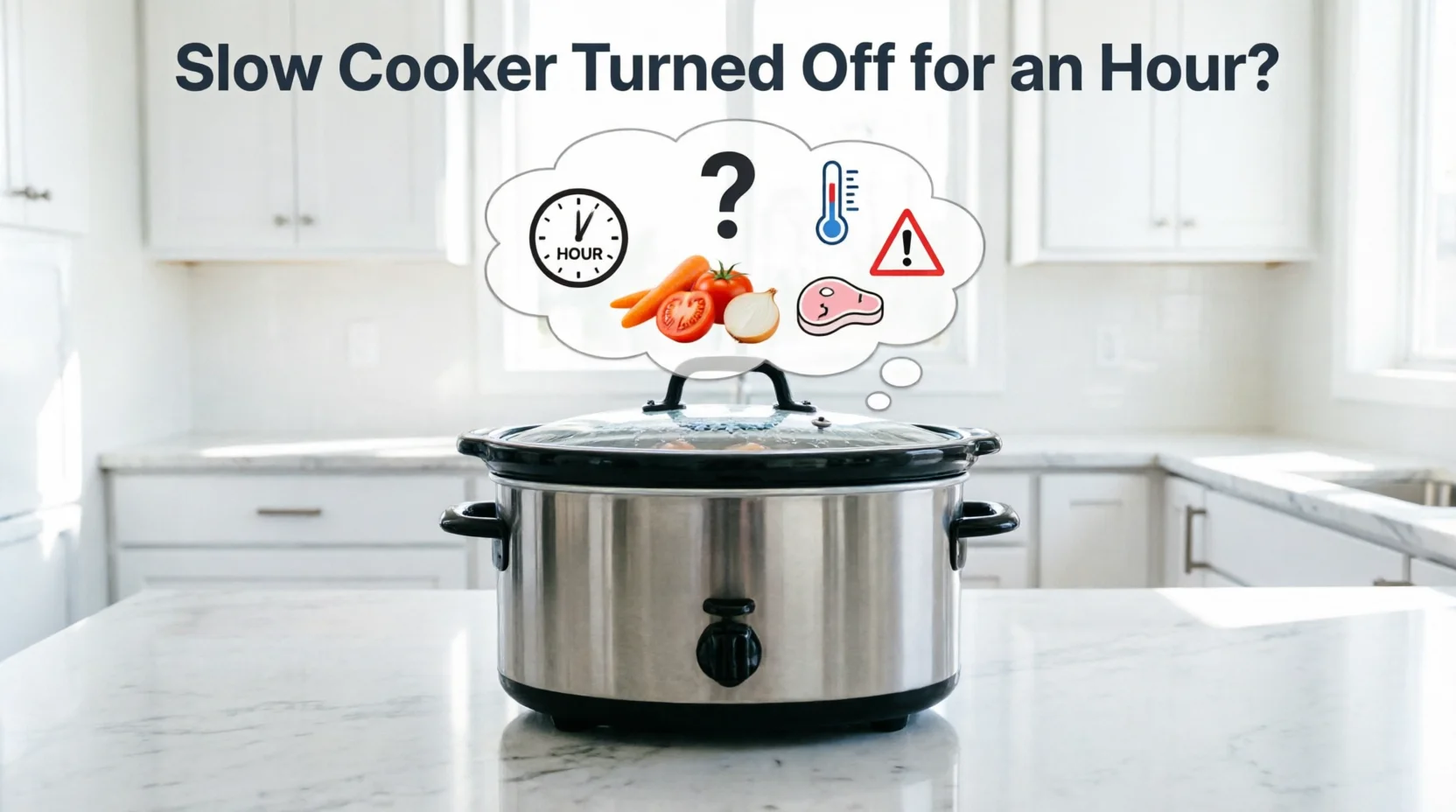
If your slow cooker turned off for an hour, the food is safe to consume only if it was already fully cooked and its temperature stayed above 60°C (140°F). If the food was raw or dropped below this temperature, you must discard it to prevent foodborne illness.
The Panic of the Cold Crockpot: What Just Happened?
You walk into the kitchen, expecting the rich, savory aroma of a warm beef stew or a perfectly simmered chicken dinner. Instead, you notice a dark digital screen or a dial pointing to a machine that feels lukewarm. Your slow cooker turned off for an hour, and a wave of frustration hits you. We have all been there, whether a loose plug, a brief power outage, or an accidental flick of a switch caused the mishap.
I have spent over a decade testing kitchen appliances and helping home cooks fix everyday kitchen blunders. I know how annoying it is to think about wasting expensive ingredients and starting dinner from scratch.
In this guide, we will look at exactly what happens to your food during that hour of lost heat. You will learn how to check if your meal is salvageable, how to handle specific ingredients like meat and vegetables, and how to protect your kitchen from this issue in the future.
3 Critical Slow Cooker Pain Points (And How to Fix Them Now)
When your appliance loses power, your mind immediately goes to the worst-case scenario. Let us break down the three most common problems you face right now, why they happen, and the exact steps you can take to handle them.
1. The Food Safety “Danger Zone” Uncertainty
The biggest worry is whether bacteria grew while the machine was off. Food safety agencies across the globe—like the USDA in the United States and the Food Standards Agency (FSA) in the United Kingdom—warn against the “Danger Zone.” This is the temperature range between 4°C and 60°C (40°F to 140°F) where harmful bacteria multiply rapidly.
- The Solution: You need to measure the internal temperature of the food immediately using a digital food thermometer. If the temperature of the food is still above 60°C (140°F), the food is perfectly safe. You can turn the machine back on and finish cooking. If it fell below that mark, bacteria may have started to grow.
2. Raw Meat Was Sitting in Lukewarm Liquid
If your slow cooker turned off for an hour at the very beginning of the cooking cycle, you are dealing with raw meat. Raw chicken, beef, or pork sitting in warm water creates an ideal environment for pathogens like Salmonella and E. coli.
- The Solution: If the meat was raw or only partially cooked when the power went out, and it sat for an hour below 60°C (140°F), you must throw it away. Do not try to save it by switching the cooker to high or boiling it on the stove. Toxins produced by certain bacteria are heat-resistant and will not be destroyed by reheating.
3. Wasting Expensive Ingredients
Throwing away a large roast or a whole chicken hurts your grocery budget, whether you are buying organic beef in Canada or grass-fed lamb in Australia. It is tempting to take a risk just to save the money.
- The Solution: Group your ingredients logically before making a decision. Pure vegetable soups, beans, and high-acid tomato sauces are much more resilient than dairy or meat. If a vegetarian chili dropped to 50°C (122°F) for an hour, you can generally bring it back to a boil on a traditional stove top and continue cooking safely.
How Long Can a Slow Cooker Stay Off Before Food Spoils?
To understand why an hour is the critical tipping point, we have to look at how these appliances retain heat. Heavy stoneware inserts hold onto heat remarkably well. If the lid stays firmly in place, the residual heat will protect your food for a short window of time.
If your meal was already simmering on high for four hours before the power cut out, the liquid inside was likely around 95°C (203°F). When the machine shuts off, that large mass of hot food cools down slowly. In a standard kitchen environment, it takes roughly 45 to 60 minutes for a full pot of hot food to drop into the danger zone.
“A fully heated slow cooker acts like an insulated container. However, once the internal temperature drops below 140°F, you enter a strict two-hour window for safety.” — Dr. Barbara Ingham, Food Safety Specialist and Professor at the University of Wisconsin-Madison
If you catch the mistake within an hour, and your thermometer proves the food is still hot, you are in the clear. If you do not own a thermometer, look for signs of residual heat like steam rising when you gently touch the lid, or bubbling around the edges.
Step-by-Step Recovery Plan: What to Do Next
If you just discovered your appliance is cold, do not panic. Follow this step-by-step checklist to determine your next move.
Step 1: Check the Lid and the Time
Do not lift the lid immediately, as this releases the remaining trapped steam and drops the internal temperature by several degrees. Try to estimate exactly when the machine stopped working. Did the power blink an hour ago while you were in the living room? Has the digital display reset to a flashing 0:00?
Step 2: Take the Temperature
Insert a digital probe thermometer directly into the thickest part of the meat or into the center of the stew.
- 60°C (140°F) or Higher: Your food is safe. Plug the unit back in, turn it to high to recover lost heat quickly, and finish your recipe.
- Below 60°C (140°F): Proceed to the next step to evaluate the ingredients.
Step 3: Evaluate the Ingredients
Use this quick reference table to decide whether to save or discard your meal if the temperature dropped too low:
| Ingredient Type | Raw/Partially Cooked | Fully Cooked Before Power Loss |
| Beef, Pork, & Lamb | Discard immediately | Reheat to 74°C (165°F) on a stove |
| Chicken & Turkey | Discard immediately | Discard (high risk for fast bacterial growth) |
| Vegetables & Lentils | Reheat on stove top | Reheat and serve |
| Dairy-Based Soups | Discard immediately | Discard immediately |
The Scientific Reason Why Reheating Spoiled Food Doesn’t Work
A common misconception is that you can kill off any bad bugs by boiling the food on your kitchen stovetop or putting it in a hot oven. While high heat does kill live bacteria, it does not remove the dangerous byproducts they leave behind.
Certain bacteria, such as Staphylococcus aureus, produce dangerous enterotoxins as they multiply in lukewarm food. These toxins are incredibly stable and can withstand boiling temperatures for extended periods. If your raw chicken sits at 35°C (95°F) for an hour, the bacteria will thrive. Even if you cook that chicken until it falls apart, the toxins remain active and can cause severe food poisoning.
“Reheating food that has sat in the danger zone will not make it safe. Some bacteria produce toxins that are not destroyed by cooking temperatures.” — Mitzi Baum, CEO of Stop Foodborne Illness
For peace of mind, you can review the official food storage guidelines provided by the Australian Department of Health and Aged Care or your local health authority. They consistently enforce the “2-hour/4-hour rule” for handling ambient-temperature foods.
Real-World Scenarios: Is My Dinner Ruined?
Let us look at three common everyday examples to see how these rules apply in real life.
Scenario A: The Morning Power Outage in Manchester
Sarah set her slow cooker to low at 8:00 AM to cook a raw pork shoulder. A brief power cut hit her neighborhood at 9:00 AM, turning the machine off. She returned home at 4:00 PM to find a cold pot of raw meat. Because the meat remained raw and sat in cold water for seven hours, the entire meal had to go into the bin.
Scenario B: The Accidental Unplug in Toronto
Mark cooked a batch of beef chili. It finished cooking at 5:00 PM and switched to the “Keep Warm” setting. At 6:00 PM, Mark accidentally bumped the plug while cleaning the counter. He noticed the error at 7:00 PM. He checked the chili with a thermometer, and it read 62°C (144°F). Because the food was already cooked and stayed out of the danger zone, Mark plugged it back in and served it safely.
Scenario C: The Loose Dial in Texas
Elena was cooking a hearty potato and leek soup. The dial was bumped to the off position for an hour. When she checked it, the temperature was 52°C (125°F). Since the soup contained no meat or dairy, she transferred it to a traditional pot on her gas stove, brought it to a rolling boil for ten minutes, and safely saved her dinner.
How to Prevent Slow Cooker Power Failures
You can minimize the risk of losing another meal by implementing a few quick safety steps in your kitchen routine.
- Use a Smart Plug: Plug your appliance into a smart plug that connects to your smartphone. Many smart plugs will send an alert to your phone if the energy draw drops to zero, letting you know the machine has stopped working.
- Secure Your Outlets: Kitchen counters in modern homes across Canada, the US, and the UK feature sensitive GFCI or RCD safety outlets. These can trip easily if you use multiple heavy appliances like a kettle and a toaster at the same time. Keep your slow cooker on a dedicated outlet circuit when you leave the house.
- Choose a Manual Model: If you live in an area prone to quick power flickers, use an older manual slow cooker with a physical mechanical dial rather than a digital one. When power returns after a brief outage, a manual machine turns back on automatically, whereas a digital model remains turned off until you press start again.
“When it comes to automated cooking, manual dial switch appliances offer better resilience against brief power drops than digital control panels.” — Consumer Reports Appliance Evaluation Team
Frequently Asked Questions
Can I eat meat if the slow cooker turned off for an hour?
You can eat the meat only if it was fully cooked beforehand and the internal temperature remained above 60°C (140°F). If the meat was raw or the temperature dropped below this point, you must discard it to prevent illness.
Will turning the cooker to high save the food?
No, turning the cooker to high will not save food that has spent too much time below 60°C (140°F). High heat kills live bacteria but cannot destroy heat-stable toxins produced during the shutdown period.
How long does a slow cooker stay hot when turned off?
A slow cooker generally keeps food hot and out of the danger zone for about 45 to 60 minutes, provided the lid stays on. The exact time depends on the volume of food and the ambient temperature of your kitchen.
What happens if my slow cooker loses power while I am at work?
If your digital machine loses power while you are away, it will stay turned off even when power returns. If you cannot verify how long the machine was cold, you must throw the food away for safety reasons.
Is vegetable soup safe if the cooker turned off?
Vegetable-based dishes are safer than meat or dairy dishes. If the vegetables are already soft, you can safely rescue the soup by moving it to a stovetop pot and boiling it thoroughly.
Summary of Next Steps
Discovering that your kitchen helper has stopped working is incredibly frustrating, but your health is always worth more than the cost of a meal. Keep these three points in mind:
- Always test your food with a digital thermometer immediately upon discovery.
- Discard raw meat or dairy that has dropped below 60°C (140°F) for over an hour.
- Protect future meals by using secure outlets or switching to a manual dial appliance.
Grab your food thermometer right now, check that internal temperature, and make the safest choice for your family.

“I believe great cooking starts with the right tools, trusted advice, and a little confidence in the kitchen.”
Hi, I’m Emma Carter. My love for cooking began in my grandmother’s kitchen, where I learned that every great meal starts with simple ingredients and the right cookware. Over the years, I’ve spent countless hours researching, testing, and comparing kitchen appliances, cookware, coffee makers, air fryers, and other everyday kitchen essentials.
Here at KiCook, my goal is to make your buying decisions easier with honest product reviews, practical buying guides, and easy-to-follow cooking tips. Whether you’re upgrading your kitchen or searching for the best appliance for your home, I focus on providing clear, reliable, and research-backed information you can trust.
When I’m not testing new kitchen gadgets or writing in-depth guides, you’ll usually find me trying new recipes, visiting local farmers’ markets, or enjoying a quiet cup of coffee while planning my next kitchen project.