You know the moment. One machine is calling your name because you want café drinks at home, and the other one quietly brews twelve cups and asks nothing of you. Deciding between the Kismile 20 Bar Compact Espresso Machine vs AIRMSEN Drip Coffee Maker 12-Cup Programmable usually comes down to which morning you actually live.
Short answer: the Kismile 20 Bar Compact Espresso Machine wins if you want milk drinks and a tiny footprint, and the AIRMSEN Drip Coffee Maker 12-Cup Programmable wins if you want a full pot, a timer, and fewer things to go wrong. Our editorial comparison leans on manufacturer specifications, the Specialty Coffee Association brewing standard, and aggregate verified buyer feedback from both listings. Here's how they look on paper before the rounds start.
| Product | Details | Rating | Buy |
|---|---|---|---|
Editor’s Choice  | Kismile 20 Bar Compact Espresso Machine | ★★☆☆☆2.9/5 | |
Top Pick  | AIRMSEN Drip Coffee Maker 12-Cup Programmable | ★★★★☆4/5 |
Tale of the Tape
Two philosophies, one counter. Numbers first, then the fight.
Meet the contenders
These two keep landing on the same shortlist because they sit close enough on price that a browser tab feels like a coin flip. Here's what each one actually is.
1. Kismile 20 Bar Compact Espresso Machine
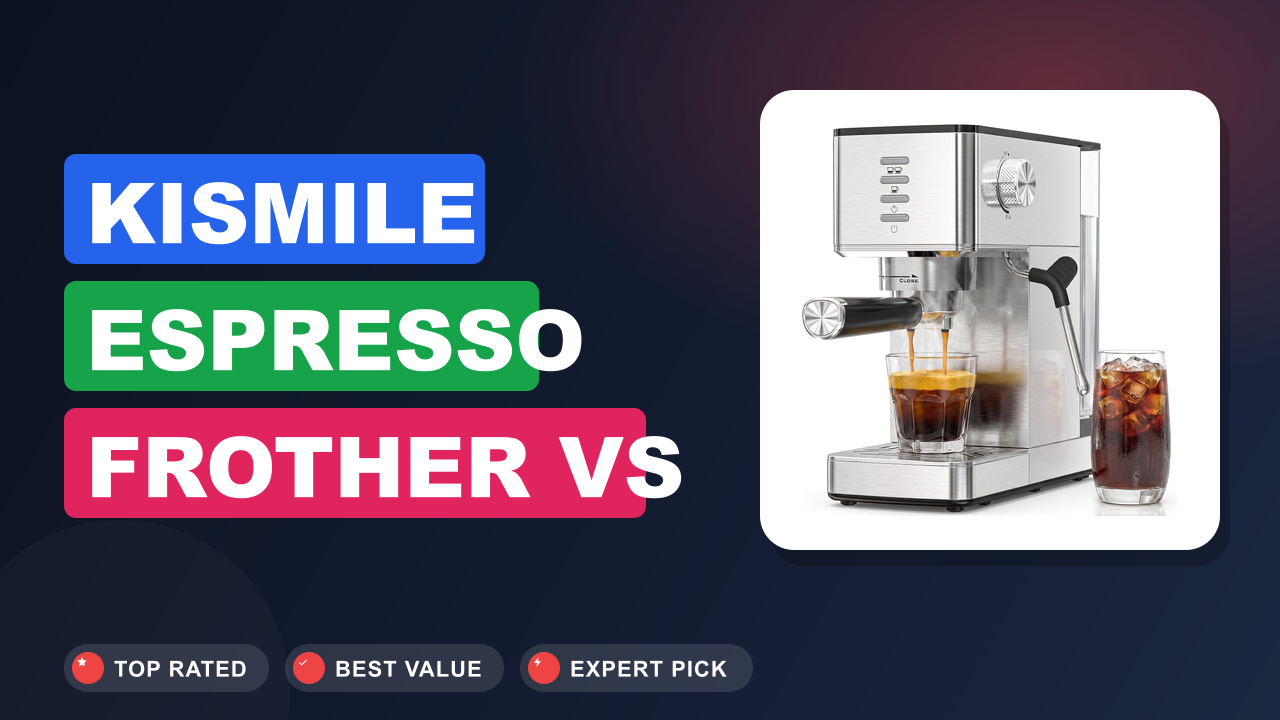
This is a compact semi-automatic espresso machine with a 20-bar pump and a manual milk frothing steam wand, aimed at people who want lattes on a counter that's already crowded. In our research it's the more interesting machine on paper and the fussier one in daily use, with a reported 2.9/5 rating driven mostly by shot-to-shot inconsistency. It gives you the café look and the café drink menu, and it asks for technique in return.
2. AIRMSEN Drip Coffee Maker 12-Cup Programmable
A 12-cup programmable drip brewer that trades drama for dependability, and its reported 4/5 rating shows it. You load the basket and reservoir at night, set the timer, and a full carafe is waiting when you walk in. It's the kind of machine households quietly keep for years, then replace with the same thing.
Round 1: Build Quality
Fewer parts under pressure means fewer ways to fail, and that's the whole story of this round.
The Kismile puts a pump, a boiler path, a group seal, and a steam valve through repeated pressure cycles. Every one of those is a wear point. Editorial analysis of the 2.9/5 rating clusters around exactly that: weeping seals, sagging pressure after a few months, and pump noise that gets louder with age.
The AIRMSEN is mechanically simpler. A heating element, a shower head, and a glass carafe do the work, and glass is the obvious weak link. But verified buyer feedback at 4/5 reflects a hot water path that mostly stays out of trouble.
Round winner: AIRMSEN Drip Coffee Maker 12-Cup Programmable, because a 4/5 reported rating against 2.9/5 is the clearest reliability signal in this entire comparison.
Round 2: Cup Quality and Range
Only one of these machines can make a latte. That single fact decides the round, even though it isn't the whole picture.
The Kismile can pull a concentrated shot with crema and steam milk into microfoam for a flat white or cortado. The 20-bar figure is a maximum pump rating, not the pressure landing on the puck, so puck prep carries a lot of weight here. Aggregate feedback about sour or watery shots usually traces back to dose and tamp, not a defect.
The AIRMSEN is the consistency machine. Following the Specialty Coffee Association's brewing standard of roughly 55 grams of coffee per litre of water lands you in the accepted extraction window, and a flat basket forgives an uneven bed. You'll want to read up on the brewers that taste best if that consistency matters more to you than variety.
Round winner: Kismile 20 Bar Compact Espresso Machine, because the AIRMSEN's better average cup still can't produce espresso, steamed milk, or anything built on top of either.
Round 3: Daily Ease of Use
A machine you'll actually use at 6:40am beats a machine you admire on Sunday.
With the Kismile, the routine includes warm-up, dosing, tamping, knocking out a hot puck, rinsing the steam wand, and emptying a drip tray. Descaling intervals arrive faster than most buyers expect, and a descale reminder that won't clear after you've finished the job is a common frustration in this category. Hard water makes all of it worse.
The AIRMSEN routine is filter, grounds, water, button. Programmable brewing means the work happens the night before, and a warming plate holds the pot ready.
Round winner: AIRMSEN Drip Coffee Maker 12-Cup Programmable, because it removes roughly five handling steps from every single morning.
Round 4: Capacity and Output
Twelve cups is about 60 oz. That number is why this round isn't close.
The Kismile makes one drink at a time, in shot-sized volumes, and a small reservoir means refilling mid-session if you're making drinks for two. Great if your household drinks espresso. Frustrating if your household drinks mugs.
The AIRMSEN brews a full carafe in one pass, which covers a couple of commuters, a thermos, or iced coffee later in the day. If you're regularly hosting, machines built for a full table are worth a look beyond both of these.
Round winner: AIRMSEN Drip Coffee Maker 12-Cup Programmable, because 60 oz per cycle versus a couple of ounces per cycle isn't a close call.
Round 5: Footprint and Storage
Small counters reward small machines, and this is where the espresso maker finally pays you back.
The Kismile is a compact body built for tight spaces: apartment kitchens, dorm desks, offices with a shared shelf. You still need headroom above to lift the reservoir lid and clearance behind for the wand side, so measure before you commit.
The AIRMSEN needs room for the carafe plus a few inches above the lid, and a warming plate left running all morning will eventually leave a scorched ring on a glass pot. It's also bulkier to store, and it suits a setup that has to travel less well than a small espresso body does.
Round winner: Kismile 20 Bar Compact Espresso Machine, because raw counter square footage is the one metric where its compact design clearly beats a 12-cup machine.
Round 6: Value and Running Costs
Sticker price is only the first payment. The grinder question decides the rest.
Espresso is unforgiving about grind, so the Kismile quietly requires a burr grinder worth the counter space, and pre-ground supermarket espresso is a compromise you'll taste. Add filters for the basket, a knock box, and a milk pitcher, and the real cost of ownership climbs well past the machine itself.
The AIRMSEN runs on paper filters that cost cents and takes pre-ground coffee without complaint. As of 2026, industry consumption data from the National Coffee Association still shows most US drinkers brewing at home daily, which is exactly the use case the drip machine is priced for. A medium grind suited to a flat-bottom drip basket is all the tuning it needs.
Round winner: AIRMSEN Drip Coffee Maker 12-Cup Programmable, because it reaches a good cup at a lower total cost, while the Kismile needs a supporting cast to perform.
The Scorecard
| Round | Winner |
|---|---|
| 1. Build quality and durability | AIRMSEN Drip Coffee Maker 12-Cup Programmable |
| 2. Cup quality and range | Kismile 20 Bar Compact Espresso Machine |
| 3. Daily ease of use | AIRMSEN Drip Coffee Maker 12-Cup Programmable |
| 4. Capacity and output | AIRMSEN Drip Coffee Maker 12-Cup Programmable |
| 5. Footprint and storage | Kismile 20 Bar Compact Espresso Machine |
| 6. Value and running costs | AIRMSEN Drip Coffee Maker 12-Cup Programmable |
Final tally: AIRMSEN 4, Kismile 2.
The pattern is worth noticing. The AIRMSEN takes the rounds that decide whether you're still using a machine in month eight, and the Kismile takes the two rounds about what's physically possible and where it physically fits.
The Decision
On overall value, the AIRMSEN Drip Coffee Maker 12-Cup Programmable takes it. It costs less, it's rated 4/5 against 2.9/5, it brews 60 oz at a time, and it needs nothing but grounds and water to succeed. Very few buyers regret a dependable drip brewer.
Many regret a fussy espresso machine that never quite dialled in.
But choose the Kismile 20 Bar Compact Espresso Machine if milk drinks are the actual point. If you drink one or two beverages a day, want a cortado rather than a mug, and you're working with a narrow counter, the trade-offs tilt the other way. Budget for a burr grinder, accept a learning curve on grind and tamp, and treat the first bag of beans as calibration.
It's also the more sensible pick if you'd rather buy machines that do both jobs later and start simple now.
Frequently Asked Questions
Is the Kismile 20 Bar better than a drip machine for lattes?
Yes, and it isn't a debate. Drip brewing can't produce espresso, so no drip brewer will give you a base for a latte, cappuccino, or Americano made properly. The Kismile's 20-bar pump and manual steam wand cover both halves of the drink, milk included.
The honest caveat is repeatability: aggregate buyer feedback suggests you'll pour a few mediocre shots before your grind, dose, and tamp line up. If lattes are the goal, the workflow is worth it.
Is the AIRMSEN 12-cup better than the Kismile for a family of four?
For four people drinking regular coffee, clearly yes. A 12-cup carafe covers the table in one cycle, while the Kismile makes drinks one at a time in shot volumes. For four people drinking espresso drinks, neither machine is ideal, since the Kismile becomes a queue.
Also factor in sediment: an overflowing or poorly seated basket is one reason people keep asking about grit in the bottom of the cup, and a full carafe means more coffee sitting on a warming plate.
Which one holds up better after a year of daily use?
Based on reported ratings and the mechanical layout of each, the AIRMSEN. Its 4/5 versus 2.9/5 gap maps onto how many parts sit under pressure: a pump, group seal, and steam valve wear differently than a heating element and a shower head. Daily espresso will also shorten the descaling interval on the Kismile, and skipped descaling is the fastest way to lose pressure.
Either machine will last longer with filtered water and a monthly cleaning habit.

“I believe great cooking starts with the right tools, trusted advice, and a little confidence in the kitchen.”
Hi, I’m Emma Carter. My love for cooking began in my grandmother’s kitchen, where I learned that every great meal starts with simple ingredients and the right cookware. Over the years, I’ve spent countless hours researching, testing, and comparing kitchen appliances, cookware, coffee makers, air fryers, and other everyday kitchen essentials.
Here at KiCook, my goal is to make your buying decisions easier with honest product reviews, practical buying guides, and easy-to-follow cooking tips. Whether you’re upgrading your kitchen or searching for the best appliance for your home, I focus on providing clear, reliable, and research-backed information you can trust.
When I’m not testing new kitchen gadgets or writing in-depth guides, you’ll usually find me trying new recipes, visiting local farmers’ markets, or enjoying a quiet cup of coffee while planning my next kitchen project.