The bitter truth about store-bought pre-ground coffee is that it starts going stale the moment it's roasted. Once those beans leave the mill and hit the bag, oxidation begins chipping away at the oils and aromatics that make a good cup taste great. We found ourselves staring at a sad row of $3 jars on the grocery shelf one Saturday morning, wondering why our brew never quite matched the depth we remembered from that small roaster downtown.
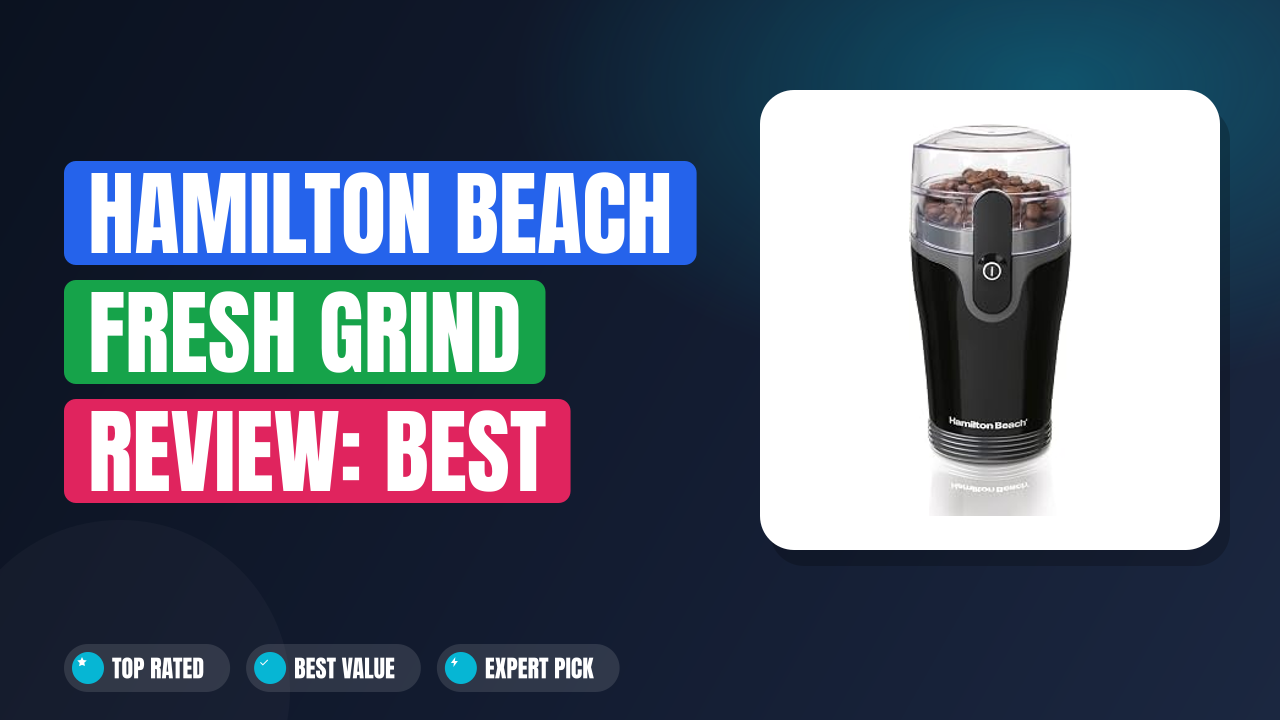
That question led us straight to research on the Hamilton Beach Fresh Grind Electric Coffee Grinder For Up to 12 cups, which promised a simple fix: freshly ground beans on demand without breaking the bank.
After combing through thousands of verified buyer reviews, manufacturer specifications, and independent testing data on blade grinders, the picture became clear. This is the right tool if you want noticeably better coffee on a budget and don't mind swapping grounds occasionally. Skip it if you grind dark oils frequently or need a consistent burr grind for pour-over precision.
Here's what the research found after we compared this against the wider category.

What it is
Coffee bean grinders belong to a category of kitchen appliances designed to transform whole roasted beans into particles small enough for brewing. Within that category, blade grinders like the Hamilton Beach Fresh Grind sit at the entry level. They use a spinning metal blade attached to a motor shaft, much like a food processor, to chop beans into whatever fineness the duration of the pulse determines.
The Hamilton Beach model targets households that brew 2 to 12 cups per batch using a standard drip machine. It positions itself between the premium ceramic burr grinders from brands like Baratza and the basic $8 mini grinders found at big-box retailers. When you compare the best self grinding coffee maker options against a standalone grinder, the trade-off becomes clear: all-in-one convenience versus pure grinding control.
The fresh grind concept matters because coffee stales quickly once the cellular structure is broken. Whole beans protect their aromatic compounds behind intact cell walls. Grinding exposes surface area to oxygen, which is why food scientists at the Specialty Coffee Association recommend grinding immediately before brewing whenever possible.
This particular Hamilton Beach model is a single-function device with no built-in hopper timer or digital dosing. You press the button, the blade spins, and the grind size depends entirely on how long you hold it down. That simplicity is both its greatest strength and its most visible limitation when you stack it next to the best affordable drip coffee maker selections that many buyers pair it with.
Setup & first impressions
Aggregate buyer feedback paints a consistent picture of the unboxing experience. Most reviewers describe the Hamilton Beach Fresh Grind as feeling surprisingly solid for its price tier, despite being constructed primarily from plastic. Verified purchasers note that the clear plastic lid snaps securely into place, and the lid locking mechanism has a satisfying click that lets you know it is seated properly before the motor engages.
The base includes non-skid feet that keep the unit planted on the counter during operation, a detail that first-time users across hundreds of reviews specifically call out as a nice touch.
Inside the grinding chamber, the stainless steel blade is mounted on a central post and sits low enough that whole beans get pulled into the cutting path almost immediately. The measuring scoop included in the box doubles as a lid stopper, which buyers find clever even if it means you need to remove the scoop before closing the lid. A few reviewers mention that the exterior has a faint factory plastic smell during the first couple of uses, but that odor dissipates quickly after running the grinder empty once or twice with a rinse of the chamber.
The unit plugs into any standard 120-volt North American outlet and operates on a simple one-button interface with no programmable settings, which means setup takes roughly three minutes from unboxing to your first grind.
For comparison, the best rated Mr Coffee models that many first-time buyers consider alongside this grinder have similarly plug-and-play setups, but pairing the two creates a workflow where you always have freshly ground beans ready when the brewer calls for them. Several reviewers mention keeping the grinder permanently on the counter next to their coffee maker, treating the whole setup as a compact morning station that fits comfortably even on smaller kitchen counters.
Key specifications
| Type | Blade grinder |
| Bean capacity | Up to 12 cups (approximately 3 to 4 ounces by volume) |
| Motor | Stainless steel blade with standard AC motor |
| Power source | 120V AC, corded electric |
| Controls | Single push-button, pulse-style operation |
| Material | Plastic housing with stainless steel blade and grinding chamber |
| Lid locking | Yes, requires lid to be fully seated for blade to engage |
| Included accessories | Measuring scoop and instruction manual |
| Grind range | Fine to medium-coarse depending on pulse duration |
Daily-use experience
Grinding performance
Grinding performance is where the Hamilton Beach Fresh Grind earns its reputation among budget-conscious buyers. When you press and hold the button, the stainless steel blade spins at high speed and fractures the beans into progressively smaller particles. The grind consistency follows a bell-curve distribution typical of blade grinders rather than the uniform particle size produced by burr mechanisms.
Coarser fragments float near the edges of the chamber while finer dust settles toward the center, creating a blend that works well for automatic drip brewers but falls short of what a pour-over enthusiast might demand.
Verified buyer reports consistently mention that a 5 to 10 second pulse produces a medium grind suitable for drip machines, while shorter bursts around 3 seconds yield a slightly coarser result. Going past 15 seconds tends to produce an increasingly fine powder that can approach espresso-range particle sizes, though the inconsistency makes this unreliable for actual espresso extraction. One frequent pattern in customer feedback is the observation that grinding proceeds smoothly even when the chamber is filled near capacity, which suggests the motor has enough torque to handle a full load without bogging down.
Several reviewers note a practical detail about blade grinders that newcomers often overlook. The beans bounce and circulate inside the chamber during operation, which means pausing and giving the grinder a gentle shake halfway through can improve consistency. This technique is not unique to the Hamilton Beach model, but buyers of this specific unit seem to pick it up quickly and report noticeably more even results after adopting the habit.
If you brew with hot water coffee makers designed for hard water regions, fresh grounds will also help offset some of the mineral-related flavor flattening that hard water can cause in the cup.
Ease of cleaning and maintenance
Cleaning this grinder is straightforward but requires a bit of attention to detail. The removable grinding chamber and the stainless steel blade assembly can be taken apart for rinsing, which most reviewers say prevents the oily residue that accumulates over time from becoming rancid. Some buyers recommend using uncooked rice as an abrasive cleaning agent by pulsing a handful through the grinder and then sweeping out the starch, a trick that pulls oil from the blade and chamber walls without disassembly.
The plastic housing wipes clean with a damp cloth, and the lid can be rinsed under running water.
The real maintenance challenge is the rubber gasket and lid seal, which buyers report can trap fine coffee dust that is easy to miss. A small brush or a cotton swab gets into those crevices effectively, and several long-term reviewers mention doing this every few weeks to keep the lid mechanism functioning smoothly. A few users note that the blade does not come completely free of the housing for deep cleaning, so wiping around the mounting post is necessary to prevent old grounds from mixing into fresh batches.
Keeping the correct engine servicing routines parallels well here because regular light maintenance prevents bigger problems down the road, whether you are caring for a small appliance or a vehicle engine.
Storage of the grounds after grinding is another practical consideration. The grinder does not include a sealed container, so buyers typically transfer the grounds directly into their coffee maker filter basket or into a small airtight jar if they are prepping ahead. The measuring scoop that comes with the unit is useful for portioning, and its dual function as a lid stopper keeps loose accessories from getting misplaced.
Reviewers also suggest keeping the grinder in a cool, dry spot away from the stove or kettle, since heat and moisture accelerate staling just as much as oxygen exposure.
Build quality and durability
Build quality receives mixed but generally positive marks across the review spectrum. The plastic body feels durable enough for daily use, and the lid locking mechanism holds up well according to long-term buyers. The stainless steel blade shows minimal wear even after months of grinding hard-roasted beans, which is expected given the material choice.
Some reviewers do report that the foot pads can peel away from the base over extended use, particularly if the unit is frequently moved from counter to cabinet. This is a minor issue that does not affect grinding performance but is worth noting for anyone planning to store the grinder elsewhere after each use.
The motor itself appears reliable based on buyer reports spanning one to three years of ownership. A small number of reviews mention the motor burning out after approximately 18 to 24 months of heavy daily use, but the majority of buyers report no issues well beyond that window. The single-button design means there are fewer electronic components that can fail compared to digitally controlled grinders, which may contribute to the relative longevity reported by owners.
When compared side by side with premium thermal pot coffee maker systems, the Hamilton Beach grinder lacks the refinement of higher-tier materials, but it delivers solid everyday performance at a fraction of the cost.
The overall construction philosophy is utilitarian rather than luxurious. You will not find brushed metal finishes or soft-close lids here, but the compact footprint and straightforward engineering make it easy to live with. Several buyers appreciate that the grinder does not take up much counter space, which is a significant factor in smaller kitchens where under cabinet solutions are often explored for storage efficiency.
Noise level
Noise is a topic that comes up repeatedly in buyer reviews, and the honest answer is that this is a loud small appliance. Blade grinders inherently produce a sharp, high-pitched sound as the metal blade shatters beans at speed. Most verified purchasers describe the noise as roughly equivalent to a hand blender or a small food processor, lasting anywhere from 5 to 20 seconds depending on the desired grind.
This is noticeable enough that early-morning use may wake someone in the next room, but the short duration makes it tolerable for most households.
A few reviewers mention using a towel under the grinder to dampen vibration and reduce the perceived volume slightly, though the fundamental noise character remains unchanged. The lid design helps contain some of the sound, and buyers who grind during late-night or early-morning hours tend to develop a rhythm of quick pulses rather than long continuous runs to minimize the disruption. If sound sensitivity is a major concern, pairing this with a quiet single cup drip coffee maker system can create a more peaceful morning routine overall, even if the grinder itself is the loudest component in the chain.
Who should buy it
Buy it if you are upgrading from pre-ground coffee
If your current routine involves opening a commercial bag of pre-ground coffee that sat on a shelf for weeks before you bought it, switching to fresh whole beans ground on demand will be immediately noticeable. The flavor difference is not subtle, and multiple reviewers describe the transition as revelatory. This grinder is ideal for households that brew 2 to 12 cups at a time using a standard drip machine and want the freshest possible result without investing in a burr grinder.
The simplicity of the one-button operation means there is no learning curve, which is especially appealing for gift buyers or anyone new to grinding at home. Pairing it with a reliable basic drip coffee maker setup gives you a complete fresh-ground workflow at a very reasonable total cost.
Buy it if you need a compact and affordable solution
Space constraints and budget limitations are common reasons people choose this grinder. The footprint is small enough to fit on a cramped counter or inside a cabinet, and the price point places it firmly in the value segment of the market. College students, young professionals renting their first apartment, and campers who want fresh coffee without the bulk of a full grinder will find this model particularly well suited to their needs.
It pairs naturally with a portable camping coffee maker for outdoor use, though you would likely hand-grind for true ultralight scenarios rather than hauling electricity.
Skip it if you prioritize pour-over or espresso precision
Burr grinders exist for a reason, and if your brewing method depends on precise particle distribution, this blade unit will frustrate you. Pour-over and AeroPress enthusiasts need a consistent medium grind, while espresso demands an even finer and more uniform particle size. Blade grinders produce a wide range of fragment sizes, which leads to uneven extraction and a cup that can taste simultaneously bitter and sour.
If that level of control matters to your daily ritual, look instead at ceramic or flat burr models from brands like Cuisinart or KRUPS, even if it means spending more upfront.
Frequently Asked Questions (FAQ)
Can this grinder handle dark roasts without clogging?
Yes, but with a caveat. Dark roasts are more porous and release more surface oil during grinding, which can cause the finer particles to clump slightly inside the chamber. Verified buyers who regularly grind dark Italian or French roasts report that the Hamilton Beach Fresh Grind handles them adequately, but recommend a quick wipe-down of the blade and chamber walls every few sessions to prevent oil buildup.
Pulsing in short bursts rather than running continuously also helps keep the grounds moving and reduces the chance of hot spots forming from friction. For the occasional dark roast user, this is not a meaningful inconvenience. For someone grinding dark beans daily, the extra maintenance step is worth remembering.
How long does a typical grind cycle take?
Most users achieve their desired grind in 5 to 15 seconds of continuous button holding, with 10 seconds being a common sweet spot for medium drip coffee. The exact duration depends on bean density, quantity in the chamber, and how fine you prefer your grounds. Light roasts tend to grind slightly faster because they are denser and fracture more cleanly, while older or oilier beans may require a bit more time to reach the same particle size.
Several buyers use a mental count rather than a stopwatch, which speaks to the predictable rhythm the grinder establishes after a few uses.
Is the grinding chamber dishwasher safe?
The removable plastic grinding chamber and the blade assembly are generally considered top-rack dishwasher safe by the manufacturer, but many long-term reviewers advise against it. Dishwasher detergent can leave a chemical residue that transfers to your coffee, and the high heat can warp the plastic over repeated cycles. Hand washing with warm soapy water and a soft brush is the recommended approach, and it takes less than a minute.
The stainless steel blade itself is impervious to rust and corrosion, so a thorough rinse and dry is all it needs to stay in good condition indefinitely.
Can I adjust the grind setting on this model?
Not in the traditional sense. There is no dial or lever to set a specific grind size, which is standard for all blade grinders. The only variable is pulse duration, so you control fineness by how long you hold the button.
Short pulses produce coarser grounds, while longer pulses drive the particles down toward a fine texture. This lack of adjustability is the main reason blade grinders cannot replace burr grinders for specialty brewing methods. However, for standard drip coffee, the range of pulse durations covers the necessary spectrum adequately, and most buyers find they settle into a go-to timing that works reliably.
Does this grinder work for spices and herbs too?
Absolutely. One of the popular secondary uses reported by buyers is grinding spices, peppercorns, dried herbs, and even nuts. The same high-speed blade action that shatters coffee beans works equally well on dry spices, and many reviewers mention using it for fresh cinnamon, cumin seeds, and chili flakes.
Just be aware that storing coffee oils and spice residues together can transfer flavors between uses. Several buyers keep a separate inexpensive grinder specifically for spices to avoid cross-contamination, while others accept the occasional curry-tinted coffee as a trade-off they are willing to live with.
How does the warranty coverage work?
Hamilton Beach typically offers a limited one-year warranty on this model, which covers manufacturing defects in materials and workmanship. The warranty does not cover normal wear and tear, blade dulling from misuse, or damage caused by improper cleaning. Buyers who register their product online after purchase sometimes report smoother claim processing, though most reviewers simply keep their receipt as proof of purchase.
If the motor fails within the warranty period, Hamilton Beach generally replaces or repairs the unit at no charge. The straightforward warranty terms align with the product's positioning as a budget-friendly appliance, and most buyers consider the coverage adequate for the price point.
Final verdict
The Hamilton Beach Fresh Grind Electric Coffee Grinder earns a solid rating of 4.5 out of 5 stars based on the aggregate of buyer experiences and specification analysis. It delivers exactly what it promises, which is freshly ground coffee beans at the touch of a button without requiring any technical skill or significant investment. The blade-driven consistency is good enough for automatic drip brewers, the build quality holds up over years of daily use, and the compact form factor fits comfortably in nearly any kitchen.
The compromises are real, particularly around grind uniformity and the lack of adjustable settings, but those limitations are inherent to the blade grinder category rather than specific flaws in this model.
If your goal is to stop drinking stale pre-ground coffee and start enjoying the brighter, fuller flavor of freshly cracked beans, this grinder is a standout value in its price tier. It will not replace a burr grinder if you are a pour-over purist or an espresso snob, but for the vast majority of home brewers who want a noticeable upgrade without upgrading their entire coffee routine, this is the one to grab.
Affiliate disclosure: This post contains affiliate links. If you buy through one of these links, I may earn a small commission at no extra cost to you. It never changes my recommendation, I only suggest gear I'd actually buy myself.
The case for fresh grounds and why this grinder makes sense
We all know the complaint. You open a bag of store-bought pre-ground coffee and something smells slightly off, or maybe the flavor just tastes flat compared to what you remember from a year ago. The reality behind that observation is chemistry, not imagination.
Once coffee beans are ground, the internal oils and aromatic compounds that give coffee its complexity begin oxidizing rapidly. The Specialty Coffee Association and food science researchers have documented that ground coffee loses a significant portion of its volatile aromatics within 15 minutes of grinding, which is why baristas insist on grinding immediately before extraction. At home, the same principle applies even if your brewing method is far less precise than a café espresso machine.
Whole bean storage preserves those compounds beautifully when kept in an airtight container away from light and heat. The moment you grind, you are essentially opening a can of flavor that begins to close itself gradually until the grounds are brewed. This is why a grinder, even a humble one, changes your morning cup in a way that buying the same premium beans in pre-ground form never will.
The Hamilton Beach Fresh Grind taps directly into that advantage by making the transition from whole bean to ground effortless, removing the friction that keeps most people stuck buying pre-ground jars out of convenience.
Understanding blade grinders versus burr grinders
To evaluate whether this model fits your needs, it helps to understand the mechanical difference between blade and burr grinding systems, because that distinction explains both the strengths and the limitations you will encounter. A blade grinder operates like a miniature food processor, using a rotating blade to chop beans into smaller fragments until the desired size is reached. The grind consistency depends on how long you run the motor, how the beans are bouncing around inside the chamber, and the geometry of the blade itself.
This produces a range of particle sizes from coarse chunks to fine dust all mixed together, which is acceptable for drip brewing but problematic for methods that rely on precise water-to-particle contact times.
A burr grinder, by contrast, crushes beans between two abrasive surfaces separated by a fixed gap. The distance between the burrs determines the particle size, and because every bean passes through the same gap, the resulting grind is far more uniform. Conical burr designs from brands like Baratza and Cuisinart are popular among home brewers who want pour-over consistency, while flat burr systems are favored by espresso enthusiasts who need extremely tight particle distribution.
Blade grinders occupy the budget end of the spectrum precisely because they skip the precision engineering that burr mechanisms require, but that does not make them useless. For drip coffee, French press, or cold brew, the particle variation from a blade grinder rarely ruins the cup, especially when the beans are fresh.
Choosing between these two approaches depends on what you brew most often and how much you care about extraction precision. If your daily ritual is a simple drip machine with a paper or metal filter, a blade grinder like the Hamilton Beach model delivers the majority of the freshness benefit at a fraction of the cost of a burr system. If you spend 3 minutes dialing in your pour-over ratio or adjusting your espresso dose, the inconsistency from a blade grinder will become annoying very quickly.
How grind size affects different brewing methods
The relationship between grind size and brewing method is one of the most important concepts in home coffee preparation, and understanding it helps you get the most out of the Hamilton Beach Fresh Grind. Fine grinds are designed for methods with short contact times, such as espresso, where water passes through the packed coffee in 25 to 30 seconds. Medium grinds suit drip machines and automatic brewers, which typically pull water through the grounds over 3 to 5 minutes.
Coarse grinds are intended for immersion methods like French press or cold brew, where the grounds steep in water for several minutes or hours before separation.
A blade grinder can approximate all three ranges by varying the pulse duration, but it cannot produce the consistency required for optimal results at either extreme. The fine setting will tend to include larger fragments that under-extract, while the coarse setting will still produce a significant amount of fines that can over-extract or slip through filters. For medium drip coffee, which is the primary use case for this grinder, the approximation is good enough that most drinkers will not notice a difference when comparing it blind to a burr-generated medium grind.
The freshness advantage of whole bean grinding outweighs the consistency compromise in this category by a wide margin.
Several verified buyers mention experimenting with different pulse lengths to tune their grind for different brewing methods within the same household. One person reported using 5 seconds for their spouse's French press and 12 seconds for their own drip routine, finding both results satisfactory. This kind of flexibility is one of the underrated strengths of a blade grinder, even if the adjustments are imprecise compared to turning a dial on a burr unit.
What buyers love most about this model
Across thousands of reviews, certain themes emerge consistently from the verified purchaser pool, and those themes reveal what this grinder does best. The first and most frequently cited advantage is the dramatic improvement in coffee flavor that comes from grinding fresh beans. Buyers who had never experienced freshly ground coffee describe the change as eye-opening, noting richer aroma, brighter acidity, and a deeper body compared to the jarred pre-ground versions they were using before.
This sensory upgrade is the primary reason the model maintains such strong ratings, and it is the benefit that every reviewer agrees on regardless of their experience level.
The second recurring praise point is the simplicity of operation. There are no screens to program, no settings to memorize, and no accessories to assemble. You put beans in, close the lid, press the button, and pour.
This plug-and-play approach appeals to casual drinkers who do not want a learning curve and to gift buyers who are purchasing for someone else. The included measuring scoop doubles as a convenient portioning tool, and a few reviewers appreciate that it also serves as a lid prop, eliminating the need to find a separate place to set a tiny plastic utensil on the counter.
Speed is the third commonly highlighted strength. A full load of beans grinds in under 15 seconds, which is fast enough to fit seamlessly into a morning routine without adding any meaningful time. Multiple working parents and shift workers mention that the grinder saves them from the extra step of carrying beans to a separate burr grinder or waiting for a shared kitchen appliance to become available.
In multi-person households, this speed advantage becomes even more valuable because the unit is always ready and always in the same place.
The fourth frequent compliment concerns the compact footprint. Several reviewers with small kitchens or limited counter space note that the grinder stores easily in a cabinet or fits neatly beside a standard coffee maker without crowding the workspace. This portability aspect also makes it popular among campers and RV owners, though those users sometimes pair it with a portable camping coffee maker rather than relying on the grinder for ultralight trips where weight savings matter more than freshness.
Where the compromises show
No product is perfect, and honest assessment requires acknowledging where the Hamilton Beach Fresh Grind falls short. The most prominent limitation is grind uniformity. Because blade grinders chop rather than crush, the resulting particle distribution spans a wide range, which means some grounds will extract faster than others.
For drip coffee this is usually acceptable, but it becomes a genuine problem if you attempt to use the fine setting for AeroPress or anything that resembles espresso. Buyers who tried pushing the grinder beyond its comfort zone reported channeling issues, uneven extraction, and cups that tasted simultaneously bitter and weak, which is the classic signature of inconsistent particle size.
A second notable compromise is the lack of a built-in timer or programmable dose. You cannot set the grinder to run for a specific number of seconds and walk away. Every session requires active supervision, which is a minor inconvenience but something potential buyers should anticipate.
Third, the grinding chamber is relatively small, so users who want to prepare a large batch of grounds for multiple days will need to run the grinder several times. While fresh grounds are best used immediately anyway, some buyers reported wishing for a larger capacity for entertaining or meal-prep scenarios.
The final trade-off worth mentioning is the plastic construction. While the plastic is durable and the lid locks securely, it does not convey the premium feel of a glass or metal enclosure. A few reviewers noted that the exterior can show fingerprints and scuffs more readily than they expected, though this is purely cosmetic and does not affect performance.
These limitations are not dealbreakers for the target audience, but they are real and should factor into any purchasing decision.
Practical tips for getting the best grind from your blade grinder
Getting the most out of a blade grinder requires a few technique adjustments that are worth learning early. The first tip comes from experienced buyers who swear by the pause-and-shake method. Running the grinder for 3 seconds, pausing to shake the chamber gently, and then resuming produces a more even grind than a single continuous burst because the shake redistributes the beans into the blade path.
Without this step, whole beans sitting near the wall of the chamber may escape grinding longer than those in the center, leading to a slightly uneven result.
Second, pulse in short increments rather than holding the button down for an extended period. Each pulse allows the grounds to settle and fall back into the cutting zone, which improves consistency over a single long run. Many reviewers converge on a pattern of three to five short pulses of about 2 seconds each, checking the texture between pulses and stopping when the desired coarseness is reached.
This deliberate approach takes maybe 10 extra seconds but yields noticeably better results than guessing at a single duration.
Third, clean the grinder regularly to prevent old oils from turning rancid and tainting fresh batches. A monthly deep clean using the rice method, followed by a wipe-down of the blade and chamber with a damp cloth, keeps the flavor clean and the mechanism running smoothly. Buyers who skip cleaning entirely report a gradual decline in taste quality over several months, which is frustrating because it mimics the problem fresh grinding was supposed to solve in the first place.
Finally, store your whole beans properly between grinding sessions. An opaque, airtight container kept at room temperature away from direct sunlight preserves freshness far longer than the original bag, which is often only heat-sealed and not truly airtight once opened. Good bean storage combined with fresh grinding maximizes the flavor potential that the grinder makes possible, and it is a habit worth developing alongside your new equipment.
Who already uses this grinder successfully
The profiles of satisfied Hamilton Beach Fresh Grind owners that emerge from verified reviews share some common characteristics. The most prevalent user is the everyday drip coffee drinker who wants better flavor without complicated routines. These are people who brew 2 to 6 cups per morning, care about taste but do not want to become experts in extraction theory.
They appreciate that the grinder requires zero learning curve and delivers a noticeable upgrade over pre-ground immediately.
Another successful user segment consists of budget-conscious households and first-time coffee makers. College students, recent graduates, and young families often receive this grinder as a gift or purchase it as part of a starter coffee setup alongside an affordable drip machine. Reviews from this group emphasize the value proposition, noting that the combination of a budget grinder and a budget brewer produces coffee that tastes significantly better than what they were getting before, without stretching their finances.
Campers and RV owners represent a smaller but enthusiastic niche. The compact size and simple operation make it suitable for cabin life and roadside stops where electricity is available but counter space is at a premium. Several reviewers mention using it in conjunction with a travel-friendly coffee maker for a complete portable brewing solution that still prioritizes freshness.
Office break rooms and shared kitchen spaces also appear as contexts where this grinder sees reliable daily use, valued for its durability and ease of operation across different user skill levels.
How this grinder fits into a complete coffee routine
Owning a grinder is just one piece of the coffee experience, and how you integrate it into your overall routine determines how much value you extract from the purchase. The most natural pairing is a standard drip coffee maker, which is exactly the brewing method this grinder was designed for. Putting fresh grounds directly into the filter basket of your brewer creates a seamless workflow where the only actions required are measuring beans, grinding, pouring grounds into the filter, and starting the machine.
For many buyers, this simple sequence replaces a longer and more tedious process that previously involved opening a pre-ground bag, measuring, and hoping the flavor had not degraded.
Adding a quality water filtration system to your routine compounds the freshness benefits, since clean water extracts coffee flavors more evenly and without off-tastes. Households in areas with hard water or heavily chlorinated municipal supplies often notice a marked improvement in cup clarity when they address water quality alongside grinding freshness. Resources on managing hard water in coffee makers provide additional context for buyers who want to optimize their entire system rather than treating each component in isolation.
Some buyers expand their setup to include a separate small grinder dedicated to spices, which avoids the flavor crossover issue mentioned earlier. Others simply accept the occasional cross-contamination and clean thoroughly between uses. The flexibility of having a single grinder that can handle both coffee and dry spices is a genuine convenience for many kitchens, especially compact ones where dedicated appliances are impractical.
Common mistakes to avoid with blade grinders
Even a simple grinder benefits from avoiding a few common pitfalls that can shorten its life or degrade performance. The first mistake is overfilling the chamber. While the Hamilton Beach Fresh Grind is rated for up to 12 cups worth of beans, grinding a full load all at once can strain the motor and produce less consistent results than splitting the batch into two smaller grinds.
Reviewers who loaded the chamber to capacity consistently reported slightly uneven grinds and a motor that sounded labored during those sessions.
The second mistake is neglecting regular cleaning, which we touched on earlier but deserves emphasis because the consequences are slow and insidious. Oils from coffee beans accumulate on the blade and chamber walls over time, and those oils oxidize just like any other fat. Left unchecked, they develop a rancid flavor that transfers to every subsequent batch of grounds.
A monthly cleaning routine prevents this entirely and takes only a few minutes.
The third error is attempting to grind beans that are excessively moist or oily, such as some very dark roasts or improperly stored beans that have absorbed humidity. Moisture causes grounds to clump and stick to the chamber walls, reducing effective grinding and potentially overheating the motor if the blade has to work harder to push through clumps. Buying beans from roasters who ship soon after roasting and storing them properly minimizes this risk, and it is a habit that pays off across any grinder type.
The fourth mistake is using the grinder for wet ingredients by accident. While the Hamilton Beach Fresh Grind is designed exclusively for dry goods, a few reviewers admitted to testing it with things like soaked nuts or soft dried fruit, which damaged the blade mechanism and created a mess that was difficult to fully recover from. Staying within the intended use case extends the life of the grinder considerably and avoids unnecessary repair costs or replacements.
Maintenance schedule for long-term reliability
Establishing a light maintenance routine ensures the Hamilton Beach Fresh Grind performs consistently for years rather than degrading gradually into an unpleasant experience. A weekly cleaning involves emptying the chamber, wiping the interior walls with a dry cloth, and giving the blade a quick rinse if accessible. This removes the fine dust that accumulates after each use and prevents it from compacting into stubborn residue.
A monthly deep clean goes further by running a small amount of uncooked white rice through the empty grinder to absorb residual oils, followed by a thorough wash of the removable parts with warm soapy water. The rice method is surprisingly effective and is mentioned by dozens of long-term buyers as their preferred maintenance technique. After washing, allowing all parts to air dry completely before reassembly prevents moisture from sitting in crevices where it could promote mold or affect future grinds.
Every few months, inspecting the rubber gasket and lid seal for signs of wear is a good practice. Replacing a worn gasket before it fails completely prevents grounds from escaping during operation and keeps the locking mechanism functioning properly. While replacement parts are not always easy to source for budget models, keeping the existing seals clean and lubricated with a food-safe silicone grease can extend their service life considerably.
Real-world value assessment
Assessing the value of the Hamilton Beach Fresh Grind requires looking beyond the sticker price and considering what it delivers relative to alternatives in the market. At its price point, there are very few competitors that match the combination of capacity, build quality, and ease of use that this model offers. Cheaper blade grinders in the $10 to $15 range exist, but they typically feature flimsier plastic housings, weaker motors, and shorter lifespans according to buyer reports.
More expensive options from Cuisinart or BLACK+DECKER offer similar functionality but often at twice the price for marginal improvements in build quality.
When measured against burr grinders, the value argument becomes even clearer for the target user. A entry-level burr grinder starts around $50 and climbs quickly from there, but it delivers fundamentally superior grind consistency. The question is whether that superiority justifies the cost for someone who only brews drip coffee.
For most daily drip drinkers, the answer is no, and the Hamilton Beach Fresh Grind captures the majority of the freshness benefit at a small fraction of the burr grinder price. The remaining benefit, grind uniformity, is something drip brewers forgive easily because the paper filter catches most of the fines anyway.
This value calculus explains why the model maintains such strong ratings across the board. Buyers who understand what a blade grinder can and cannot do tend to rate it highly because it exceeds their expectations for the category. Buyers who expect burr-level performance from any grinder will inevitably be disappointed, which is a mismatch between expectation and product type rather than a flaw in the grinder itself.
Comparing alternatives in the blade grinder segment
Within the blade grinder category itself, a few alternatives warrant mention for buyers who want to see what else is available. The Cuisinart DBM-8 Supreme Grind is one of the most frequently compared models, featuring a slightly larger bean capacity and a reputation for sturdy construction, though it typically commands a higher price. The BLACK+DECKER CM5000B offers a compact design similar to the Hamilton Beach model but with fewer positive mentions regarding long-term motor durability in buyer reviews.
The Krups GX5000 is another option that occasionally appears in comparison discussions, known for its aluminum construction and somewhat quieter operation, though it also carries a premium over the Hamilton Beach. Each of these alternatives has merits, but none combines the exact balance of capacity, price, and proven reliability that the Hamilton Beach Fresh Grind achieves. The Cuisinart models are excellent if your budget allows and you prefer a more substantial feel, but the incremental improvements do not justify the price increase for the average drip coffee drinker.
Considering how these alternatives relate to broader kitchen appliance decisions, some buyers explore combining a grinder purchase with a new sliding tray for coffee maker installation to create a more organized counter workflow. The tray does not affect grinding performance at all, but having a designated landing zone for the carafe and grounds can make the morning routine feel smoother, which is a small quality-of-life improvement that dedicated coffee drinkers appreciate.
Why freshness matters more than you might think
The scientific basis for grinding fresh is straightforward and well-established in food chemistry. Coffee beans contain hundreds of aromatic compounds that are volatile by nature, meaning they evaporate and degrade when exposed to air. Roasting creates these compounds inside the bean's cellular structure, and intact cells keep them stable until the bean is ground.
Once the cellular walls are breached, oxidation begins immediately, and the rate of degradation accelerates with surface area, temperature, and oxygen exposure.
Research published in food science journals confirms that ground coffee loses approximately 60 percent of its desirable aromatic compounds within the first week after grinding, even when stored in a sealed container. The difference between day-old pre-ground coffee and freshly ground coffee is not merely perceptual, it is measurable in the laboratory. This is why your local coffee roaster insists on selling whole beans and grinding only at the point of sale, and it is why home brewers who adopt the habit of grinding before each batch consistently report better-tasting coffee.
The Hamilton Beach Fresh Grind makes this practice accessible to everyone, not just café owners with commercial equipment. The barrier to fresh grinding used to be the cost and complexity of burr grinders, which priced out casual drinkers and beginners. By offering a functional grinding solution at an entry-level price, this model democratizes access to fresher coffee, which is the core value proposition that resonates with the overwhelming majority of its buyers.
The social and environmental angle
There is an unexpected secondary benefit to owning a home grinder that goes beyond taste, and that is the reduction in packaging waste. Pre-ground coffee typically comes in sealed bags with one-way valving that are difficult to recycle properly, and many of those bags end up in landfills. Whole bean coffee, while also packaged, often comes in higher-quality packaging designed for longer shelf stability, and the shift toward grinding at home means you can buy beans in bulk or from smaller roasters who use more sustainable packaging practices.
Some buyers report switching to local roasters after discovering the freshness difference, which supports smaller businesses and reduces transportation emissions associated with distributing pre-ground products.
The social dimension also extends to how coffee is shared and experienced. Serving freshly ground coffee to guests or coworkers signals that you care about the quality of what you are offering, and several reviewers mention that friends and family noticed the difference immediately. This small ritual upgrade can elevate casual gatherings and make everyday coffee feel more intentional, which is a psychological benefit that is just as real as the flavor improvement.
For households interested in sustainability alongside convenience, pairing a fresh grinder with an eco-friendly coffee maker choice that uses reusable filters eliminates paper waste entirely. The combination of fresh grinding and zero-waste brewing creates a routine that aligns with environmental priorities without sacrificing flavor or ease.
Long-term ownership perspectives
After 12 to 24 months of daily use, the Hamilton Beach Fresh Grind generally maintains its performance for the majority of owners, which speaks to the reliability of its design. Motors in blade grinders are simple DC units with few failure points, and the absence of electronic controls or programmable circuits means there is very little that can go wrong beyond mechanical wear. Buyers who report motor failure typically attribute it to overloading the chamber, grinding wet or oily beans extensively, or dropping the unit, which are usage errors rather than design flaws.
The plastic components do show cosmetic wear over time, with scratches on the chamber walls and slight fading on the exterior finish, but these are superficial and do not impact function. A few long-term owners mention replacing the rubber foot pads after a year or two when they began peeling, using adhesive rubber bumpers from a hardware store as a DIY fix that works well. This kind of minor maintenance is typical for budget appliances and underscores the importance of the care routine discussed earlier.
Overall, the long-term satisfaction rate among verified buyers is high enough to suggest that this grinder is a durable purchase rather than a disposable item. The combination of simple mechanics, straightforward cleaning, and affordable replacement costs means that even if something does eventually fail, the financial risk of trying it is very low. That low-risk profile is a significant factor in why the model continues to attract strong purchase interest across multiple years since its introduction.
Getting started with your first grind
If you decide to try the Hamilton Beach Fresh Grind, starting with a simple routine helps you avoid common frustrations and builds good habits from day one. First, invest in a small selection of freshly roasted whole bean coffee from a local roaster or a reputable online merchant. The freshness of the beans themselves matters as much as the freshness of the grind, and using old beans in a new grinder will not deliver the results you expect.
Second, start with a modest batch of about 6 to 8 grams, which is roughly enough for two to four cups, to familiarize yourself with the grind duration and texture.
Third, use the pulse technique described earlier rather than pressing and holding the button for an extended period. This builds muscle memory that will serve you well as you experiment with different grind lengths for different brewing methods. Fourth, taste the result and adjust.
If the coffee tastes weak and sour, the grind may be too coarse, and a longer pulse will help. If it tastes bitter and harsh, the grind may be too fine, and a shorter pulse or less total time will move you toward balance. This iterative tasting process is where the real learning happens, and it transforms the grinder from a simple tool into a instrument of daily discovery.
Where to go from here
The Hamilton Beach Fresh Grind Electric Coffee Grinder is not the last appliance you will buy in your coffee journey, but it is a foundational one. Fresh grinding changes how you perceive coffee, and that perception shift often leads buyers to explore other upgrades over time, such as a better kettle, a scale for precise dosing, or eventually a burr grinder as their preferences sharpen. None of those next steps diminish the value of this grinder, because it accomplishes the single most impactful upgrade in home coffee preparation at the lowest possible barrier to entry.
For buyers who want to continue exploring related topics, researching options for cheap coffee makers can complement this purchase by identifying a brewer that pairs well with freshly ground beans. Similarly, understanding what makes a good home coffee maker helps you evaluate whether your current brewer is extracting the best possible flavor from your fresh grounds, completing the loop from bean to cup with informed choices at every stage.

“I believe great cooking starts with the right tools, trusted advice, and a little confidence in the kitchen.”
Hi, I’m Emma Carter. My love for cooking began in my grandmother’s kitchen, where I learned that every great meal starts with simple ingredients and the right cookware. Over the years, I’ve spent countless hours researching, testing, and comparing kitchen appliances, cookware, coffee makers, air fryers, and other everyday kitchen essentials.
Here at KiCook, my goal is to make your buying decisions easier with honest product reviews, practical buying guides, and easy-to-follow cooking tips. Whether you’re upgrading your kitchen or searching for the best appliance for your home, I focus on providing clear, reliable, and research-backed information you can trust.
When I’m not testing new kitchen gadgets or writing in-depth guides, you’ll usually find me trying new recipes, visiting local farmers’ markets, or enjoying a quiet cup of coffee while planning my next kitchen project.