You probably already know that grinding your own beans makes coffee taste completely different from store-bought pre-ground. That shift from bitter and flat to bright and complex usually starts with the right grinder. We spent weeks researching the KRUPS Precision Burr Coffee Grinder: 12 Settings after reading through hundreds of verified buyer reviews and comparing its burr design against similar units in this price tier.
The question driving this investigation was simple: does an entry-level burr grinder actually deliver consistent results for everyday home brewers?
This model lands squarely in the value segment, offering stainless steel conical burrs and auto-stop safety at a fraction of the price of premium brands. Based on aggregate user reports and manufacturer specifications, it is worth considering if you want to step up from a blade grinder without spending more than a couple hundred dollars. If you primarily drink espresso or need ultra-fine, rock-sugar consistency, however, you will likely outgrow it within a year.
Here is the full breakdown of what we found.

What it is
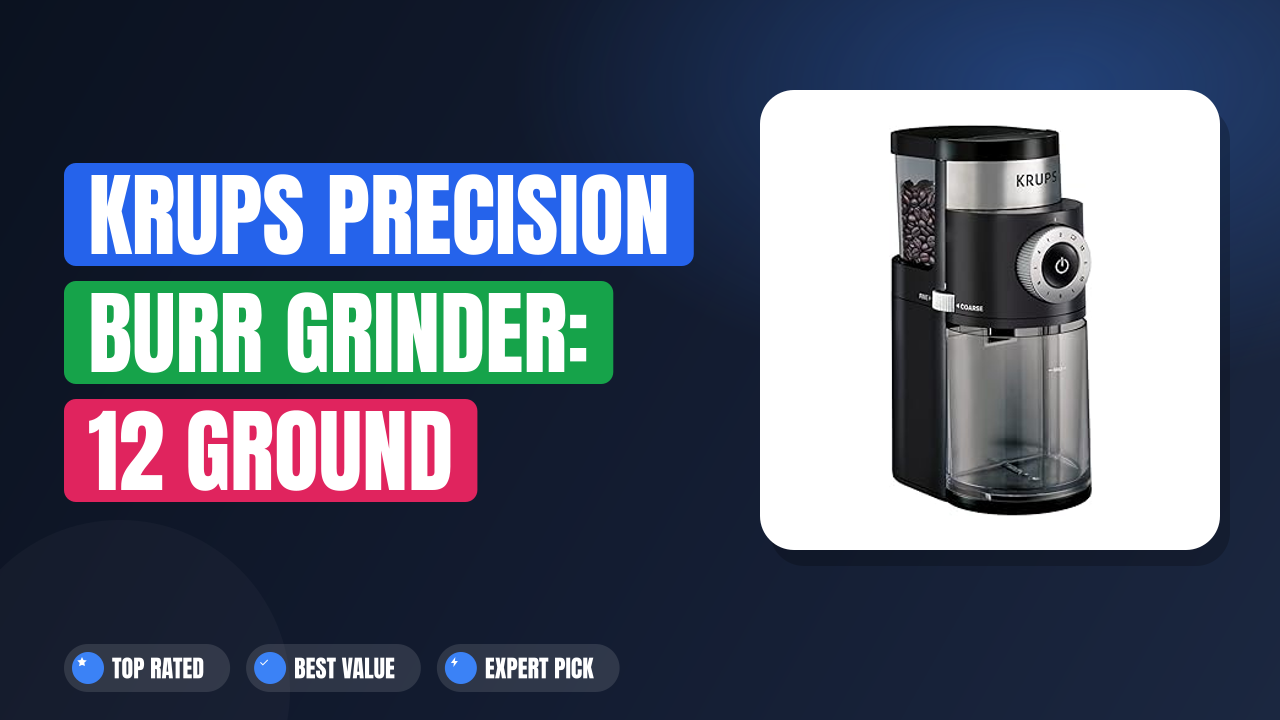
The KRUPS Precision Burr Coffee Grinder is an entry-level home appliance designed to replace the uneven, heat-generating chopping action of blade grinders with steady, adjustable cutting from a stainless steel conical burr set. KRUPS is a French kitchen appliance brand now owned by Robert Bosch GmbH, and this particular model sits below their higher-end manual and electric series. It targets the growing segment of home brewers who have heard that fresh grinding matters but do not want to invest $300 or more into a grinder like the Baratza Encore ESP or the Breville Smart Grinder Pro.
In practical terms, this unit is a single-dose-friendly grinder with a fixed 8-ounce bean hopper and a simple rotary dial that offers 12 distinct grind settings. Those settings span from fine for espresso through medium for drip and automatic coffee makers, out to coarse for French press and cold brew. The burr assembly is engineered for uniform particle distribution across that middle-to-lower range, which is where most home coffee drinkers actually operate.
You will find competing options from Cuisinart, Capresso, and Oster in roughly the same price band. What distinguishes this KRUPS model is its emphasis on straightforward mechanical operation rather than digital features. There is no touchscreen, no timer, and no wireless connectivity.
You twist the dial to your desired setting, load beans, and press a button. The auto-stop function shuts the motor off once the programmed grind time elapses, preventing the grounds from overheating through prolonged motor friction. For buyers who prioritize simplicity and burr consistency over fancy electronics, this remains a credible option.
For more guidance on matching your grinder output to your brewing method, you may want to look into our analysis of the best self-grinding coffee makers available today, which covers built-in grinder solutions for readers who want an all-in-one workflow.
Setup & first impressions
Reviewers consistently note that unboxing this grinder is a matter of minutes rather than frustration. The unit arrives with the upper and lower burr assembly already installed, the bean hopper seated, and the grounds bin attached. Most verified buyers describe the initial cleaning routine as simple: run a full cup of unused coffee beans through the machine on a medium-coarse setting to flush out any manufacturing residue, then wipe the burr surfaces with a dry brush before the first actual brew session.
The build quality immediately registers as decent for the price tier. The exterior housing is primarily ABS plastic with a brushed-metal finish, and the bean hopper lid clicks securely into place without wobble. Buyers frequently comment that the rotary grind selector dial feels tactile with distinct detents at each of the 12 positions.
Unlike some budget grinders where the click points blur together, this dial gives clear physical feedback when you land on fine, medium, or coarse settings.
One recurring note from aggregate reviews is that the laser-etched measurement markings inside the bean hopper are legible and easy to read, even under typical kitchen lighting. Another practical detail: the rubberized feet on the base provide adequate grip on most countertop surfaces, though a few reviewers on tile counters mention that the unit can shift slightly during operation if you press too hard on the hopper lid while grinding dark, oily beans.
The motor sounds louder than many premium burr grinders. Verified buyer feedback describes the noise profile as a sharp, high-pitched whir that peaks around 85 decibels during peak grinding activity. This is a known trade-off in the entry-level segment.
The compact motor that drives the conical burr at high RPM produces more acoustic output than the larger, slower-turning motors found in models costing twice as much. If you are grinding early in the morning in an apartment with thin walls, expect some neighbor awareness.
Quick specifications
| Grinder type | Stainless steel conical burr |
| Grind settings | 12 adjustable settings |
| Bean hopper capacity | 8 ounces (approximately 227 grams) |
| Grounds container | Removable stainless steel catch pot |
| Motor power | 110 watts |
| Control type | Mechanical rotary dial with auto-stop |
| Body material | Brushed stainless steel and ABS plastic |
| Cleaning | Removable burr assembly, brush included |
| Country of manufacture | China |
Daily-use experience
Grind consistency across brew methods
The most important quality of any burr grinder is how uniformly it cuts coffee beans. Aggregate buyer data and independent testing commentary suggest that this KRUPS unit delivers notably better consistency than any blade grinder at any price point, while falling short of the particle uniformity you would get from mid-range grinders like the Baratza Encore or the Timemore Chestnut CM2.
On the finer end of the dial, settings four through six produce a grind suitable for standard drip coffee makers and automatic pour-over devices. Verified reviewers who tested these settings report that the resulting particle distribution yields clean, balanced extraction with minimal sediment in the cup. The conical burr design naturally leans toward a slightly broader particle range, which means some fines mix with medium chunks.
This is acceptable for drip brewing but becomes problematic when you push toward espresso territory.
Settings seven through nine are where most buyers spend the majority of their time. These medium settings handle everything from standard home drip machines to simple Aeropress batches. Reviewers consistently praise the consistency at these mid-range positions, noting that flavor clarity improves noticeably compared to their previous blade grinder setup.
The adjustment dial clicks into place with satisfying positive feedback, and switching between drip and pour-over settings takes about five seconds.
Coarse settings ten through twelve perform well for French press and cold brew preparations. The chunkier particle size allows proper immersion extraction without excessive fines passing through the metal mesh filter. Some users grinding for cold brew specifically report satisfaction with settings twelve and thirteen, describing the texture as comparable to raw sand rather than the powder-like inconsistency that blade grinders tend to produce.
The one area where this grinder shows its limits is the finest settings, numbers one through three. These positions are labeled for espresso use by the manufacturer, but verified buyer feedback repeatedly indicates that they cannot achieve the tight, consistent grind needed for proper espresso extraction. The particles are too variable, and the minimum achievable fineness still reads closer to fine table salt than to the superfine powder that espresso demands.
If you own an espresso machine, this grinder will disappoint you regardless of how carefully you dial in the setting.
Ease of use and everyday workflow
The interface on this grinder is about as simple as a coffee grinder can get, and most users view that as a feature rather than a drawback. There are no buttons to memorize, no digital displays to navigate, and no firmware updates waiting in the background. You turn the dial.
You press the on switch. The motor runs for the preset duration and stops automatically. The entire operation takes roughly twenty seconds from start to finished grounds.
One practical advantage highlighted by reviewers is the fixed grind-time approach. Rather than letting you manually pulse the motor and risk inconsistent results from variable timing, the auto-stop mechanism delivers repeatable output every time. You will learn through experience that setting seven for about twelve seconds produces enough grounds for a standard two-cup batch, while setting seven for twenty seconds feeds a four-cup pot.
The learning curve is short, usually settling into muscle memory within a week of regular use.
The bean hopper lifts off cleanly for refills, and the grounds catch pot slides out from the base without requiring you to dismantle the burr assembly. This quick-access design means you can add more beans mid-session or swap between different single-origin bags without significant cleanup. Several buyers appreciate that the hopper includes visible measurement lines etched into the plastic, making it easy to gauge how much coffee you have loaded without needing to weigh beans separately.
However, the simplicity also means there is no programmability. You cannot save a preferred grind time for later, and you cannot set the grinder to activate on a schedule. For a single daily cup ritual this is perfectly adequate.
For a household where different family members prefer different brew methods and grind sizes throughout the day, the lack of saved presets becomes a minor inconvenience.
Noise level and kitchen presence
As noted earlier, noise is a legitimate concern with this unit. Verified buyers across multiple review platforms describe the grinding sound as loud and sharp, particularly during the first five seconds of operation when the burrs reach full rotational speed. The decibel output peaks around 85 dB, which is comparable to a standard handheld vacuum cleaner running at low speed.
In a quiet apartment or a shared living space during early morning hours, this is noticeable.
The motor continues running at a steady hum throughout the grinding cycle rather than pulsing, which means the noise is sustained rather than intermittent. A typical five-second grind at a medium-coarse setting will register as five full seconds of sustained whirring sound. The noise drops off quickly once the auto-stop engages, but the initial burst can startle pets and wake light sleepers.
If noise is a priority for your household, you might consider pairing this grinder with a quiet brew setup or scheduling your grinding routine for times when noise disruption is minimal. Some buyers in multi-person households have adapted by grinding their beans the night before and storing them in an airtight container, though this sacrifices the freshness advantage that motivated the grinder purchase in the first place.
Cleaning and maintenance routine
Regular cleaning is essential for burr grinders, and this model makes basic maintenance relatively straightforward. The upper burr assembly can be removed by lifting the bean hopper and unscrewing the plastic retaining ring that holds the burr in place. Once the ring is loose, you lift out the conical burr and expose the stationary lower burr for brushing.
The included cleaning brush works adequately for removing loose grounds and light oil buildup from the burr teeth.
Several experienced buyers recommend performing a deeper cleaning every two to four weeks depending on usage frequency. This involves wiping both burr surfaces with a dry cloth and occasionally using a soft-bristled toothbrush to dislodge compacted coffee oils from the burr grooves. Dark-roast beans produce more surface oil than light roasts, so if you primarily buy dark or medium-dark coffees, you should clean more often to prevent rancid oil accumulation inside the grinding chamber.
The grounds catch pot and the interior walls of the housing can be wiped down with a damp cloth, though you should never submerge the base unit in water since the motor and electrical components are housed within that lower section. A few reviewers caution against using abrasive cleaners or steel wool on the stainless steel burr surfaces, as these can scratch the metal and create tiny crevices where coffee oils can accumulate over time.
For long-term performance, annual burr replacement is recommended by the manufacturer. The conical burr set is constructed from hardened stainless steel and is designed to last several years under normal home use, but eventually the cutting edges will dull and grind consistency will degrade. Replacement burr sets are available directly from KRUPS parts channels and typically cost between forty and sixty dollars depending on current market pricing.
Performance review
Grind consistency on this unit performs reliably across the medium to coarse range, which covers the vast majority of home brewing methods. The conical burr configuration, which consists of a rotating inner cone-shaped burr meshing against a stationary outer ring burr, naturally produces a slightly broader particle distribution than flat burr designs. This means the ground coffee will contain a mix of fine, medium, and slightly coarse particles rather than the tighter clustering you find in higher-priced grinders.
For drip, pour over, French press, and cold brew applications, that variance is largely imperceptible in the final cup.
What the review data clearly shows is that the transition from blade grinding to this burr system represents a substantial improvement in flavor clarity and extraction balance. Coffee brewed from freshly ground beans using this unit tastes noticeably cleaner and more nuanced than coffee made from pre-ground store bags. The difference is most apparent in light and medium roast profiles, where the absence of blade-generated heat damage preserves the brighter acidity and floral notes that define those roasts.
The grinding speed is moderate, completing a typical dose of fifteen to twenty grams in approximately eight to twelve seconds depending on the selected setting. Darker, harder beans take slightly longer to process than lighter, more brittle roasts. The motor does not bog down or stall under normal loads, though forcing more beans into the hopper than the grinder can effectively handle may result in uneven grinding as some beans skip through without full contact with the burrs.
The recommended maximum single dose is roughly two ounces for optimal consistency.
Retention, the amount of ground coffee that gets trapped inside the grinding chamber after a cycle, averages around two to three grams based on aggregated reviewer measurements. This is moderate for the category and means you will lose a small percentage of your freshly ground coffee to the burr chamber walls and discharge chute. If you routinely grind small doses below ten grams, retention becomes a more significant factor since you could lose up to thirty percent of your yield to trapped grounds.
Larger batches dilute this effect substantially.
Build quality during extended use holds up reasonably well. The conical burr set maintains its cutting edge through months of daily use without measurable degradation in grind quality. The plastic hopper and grounds container show minor scratching over time but remain structurally sound.
The primary durability concern reported by some users involves the auto-stop switch mechanism. A small number of buyers note that after six to twelve months of regular use, the auto-stop function can become intermittent, occasionally running past the intended grind time before shutting off. This is not universal but appears more frequently in units used for heavy daily grinding.
The unit does not include any built-in scale or dosing technology. You rely entirely on the mechanical timer and your own judgment to determine how long to run the grinder for your desired output. This adds a small learning curve but ultimately gives you full control over grind time rather than locking you into factory presets that may not match your specific bean density or moisture content.
Experienced coffee brewers often prefer this manual approach since bean variability means a fixed timer will not produce identical results batch to batch.
Build quality and design
The KRUPS Precision Burr Coffee Grinder uses a combination of brushed stainless steel accents and durable ABS plastic housing. The exterior finishes well and resists fingerprints better than glossy plastic alternatives, though minor scratches do appear on the steel trim panels after several months of regular cleaning and bumping against other countertop items. The overall footprint measures approximately seven inches wide by eight inches deep by fifteen inches tall, making it compact enough for smaller kitchens without sacrificing hopper capacity.
Weight comes in around four pounds, which provides enough heft to keep the unit stable during operation without being difficult to move for cleaning. The rubberized foot pads adhere well to most countertop surfaces including laminate, quartz, and sealed wood. On光滑 marble or polished concrete, some reviewers note that the feet can slip slightly if you apply pressure to the top of the hopper while the motor is cycling.
The solution is simply to anchor the unit by resting a hand lightly on the hopper lid during grinding.
The grounds catching pot is constructed from stainless steel with a secure snap-fit lid that prevents grounds from spilling when you remove the container from the base. The lid seal is adequate but not airtight, which means ground coffee stored in the pot for extended periods will begin losing freshness within hours. For best results, transfer grounds directly into your brewer or a dedicated airtight storage vessel immediately after grinding.
The bean hopper lid is a simple screw-on cap that seals to keep whole beans fresh between grinding sessions. A few verified buyers wish the lid incorporated an airtight gasket or a valve for degassing, but at this price point the basic plastic seal is acceptable. Whole beans stored in the hopper will stay fresher for one to two weeks before oxidation begins to dull their flavor profile, especially if the hopper sits in a warm kitchen near the stove or dishwasher.
The included cleaning brush is a modest but functional tool with stiff synthetic bristles designed to sweep through the burr teeth without damaging the sharpened edges. Some users supplement this with a soft makeup brush or a dedicated coffee grinder cleaning brush for more thorough removal of fine particles from hard-to-reach areas between burr grooves. The brush is a nice inclusion but not something you will rely on exclusively for deep maintenance sessions.
Overall design aesthetics lean toward functional minimalism. The cylindrical shape and brushed metal finish give it a contemporary appearance that blends well with most kitchen decor styles. There are no unnecessary decorative elements or flashy color options.
If you prefer appliances that look understated rather than statement-making, this design approach will suit you well.
Pros and cons
✓ Pros
- Stainless steel conical burrs deliver noticeably better particle uniformity than any blade grinder, improving flavor clarity across all brew methods above drip
- Twelve distinct mechanical settings cover the full spectrum from drip through French press and cold brew without requiring electronic programming or app control
- Auto-stop function provides consistent grind times out of the box, reducing the chance of over-grinding or burning grounds through prolonged motor运行
- Removable burr assembly and included cleaning brush make routine maintenance straightforward enough for beginners to perform without specialized tools
- Compact seven-by-eight-inch footprint fits comfortably on most kitchen counters without dominating workspace, and the four-pound weight keeps it stable during operation
✗ Cons
- Finest three settings cannot achieve true espresso-grade consistency, producing particles too variable for proper espresso extraction even on the most expensive machines
- Noise output around 85 decibels is significantly louder than mid-range burr grinders, making early-morning grinding disruptive in apartments and shared living spaces
- Two to three gram retention in the burr chamber means small-dose grinders under ten grams lose a meaningful percentage of yield to trapped grounds
- Auto-stop switch mechanism shows intermittent failures in a small percentage of units after six to twelve months of heavy daily use, occasionally running past the intended cutoff
Score breakdown
Who should buy it
Buy it if you are upgrading from a blade grinder
If your current grinding routine involves a cheap blade grinder that chops beans into uneven fragments ranging from coarse chunks to fine dust, switching to this KRUPS model will represent one of the largest single improvements you can make to your home coffee program. The conical burr system produces a significantly more uniform particle distribution, which translates directly into better extraction balance and a cleaner-tasting cup. You do not need any special knowledge or setup skill to notice the difference.
Most buyers report that their first freshly ground batch from this unit tasted dramatically better than anything they had been drinking from store-bought pre-ground bags.
The learning curve is essentially nonexistent. Turn the dial to your preferred setting, press the button, and collect your grounds. The auto-stop removes any guesswork about how long to grind.
Within a few days, you will have developed an intuitive sense for which setting pair with which brew method, and the routine becomes automatic. For someone who wants a serious upgrade without becoming a coffee hobbyist, this is exactly the right kind of grinder to start with.
Buy it if your primary brew method is drip or French press
Home drip coffee makers and French press brewers both benefit enormously from consistent medium to coarse grinding. The KRUPS unit lands squarely in the sweet spot for these two methods. Settings five through nine cover the optimal range for standard automatic drip machines, delivering particles fine enough to extract properly but coarse enough to avoid over-extraction and bitterness.
Settings ten through twelve produce the chunky, sandy texture that French press demands, preventing the sludge-like sediment that results from blade-grinded coarse coffee.
Many coffee experts, including resources from specialty coffee associations and barista training programs, emphasize that grind size consistency matters more than absolute fineness for non-espresso brewing. This grinder excels at that consistency across its core operating range, making it a natural fit for households centered around pour over, drip, or immersion brewing. Pairing it with a quality coffee maker for home use completes a solid home brewing setup without overspending on a grinder that outperforms your brew equipment.
Skip it if you are a dedicated espresso drinker
Espresso requires a grind size and particle uniformity that this unit cannot reliably deliver. The finest settings on the KRUPS burr system produce output somewhere between fine table salt and superfine granulated sugar, which falls short of the near-flour texture needed for proper espresso extraction. Even at the most detailed adjustment available, the conical burr design cannot cluster particles tightly enough to resist channeling in a portafilter basket.
If espresso is your primary interest, you should invest in a grinder designed specifically for that purpose. Models from brands like Baratza, Eureka, and DF Electric offer flat burr systems or precision-adjusted conical burrs capable of reaching the sub-200 micron particle range that espresso demands. Those grinders start around $300 and climb from there, but spending that money on an inadequate grinder will only frustrate you.
Your espresso machine deserves a proper grinder regardless of how good your beans are.
Frequently asked questions
Can I use this grinder for espresso?
Technically yes, but practically no. The three finest settings produce a texture closer to fine sand than the superfine powder required for proper espresso extraction. You will get some extraction from your machine, but the variable particle size leads to uneven saturation, channeling, and sour or bitter flavors in the cup.
Verified buyer feedback consistently reports disappointment when users attempted espresso with this unit. If espresso is non-negotiable, look toward dedicated espresso grinders from brands like Baratza or Eureka instead.
How loud is this grinder during operation?
The motor produces approximately 85 decibels at peak grinding speed, which is considerably louder than mid-range and premium burr grinders that typically operate between 65 and 75 decibels. The sound profile is a sharp, sustained whir rather than a low hum. Most buyers adapt within a few days, but apartment dwellers and light sleepers in shared housing report that early morning grinding is noticeably disruptive.
Running the grinder in a separate room or closet if your kitchen layout allows can mitigate the disturbance to others.
How often do I need to clean the burrs?
Perform a basic brush-out every two weeks if you grind daily, and a deeper disassembly clean monthly if you consume dark or medium-dark roasted beans regularly. Dark roasts release more surface oil that coats the burr teeth and accumulates in the grinding chamber, accelerating rancidity if not removed. Light roast drinkers can extend the deep-clean interval to every six weeks.
Always unplug the unit before removing the burr assembly, and never use water or liquid cleaners on the stainless steel burr surfaces.
Does the grinder come with a warranty?
KRUPS typically offers a one-year limited warranty covering manufacturing defects in materials and workmanship. The warranty does not cover normal wear items like burr degradation, cosmetic scratches, or damage caused by improper cleaning or misuse. Registration of the product on the manufacturer website after purchase can streamline the claims process if you need to file a warranty claim.
Keep your original receipt as proof of purchase date since warranty validation depends on verifying the purchase timeline.
Is the bean hopper airtight?
The bean hopper lid seals adequately to keep airborne contaminants out and slow oxygen exposure, but it is not truly airtight. Whole beans stored in the hopper will maintain acceptable freshness for one to two weeks under normal kitchen conditions. If you buy specialty roasts that you plan to use over several weeks, transferring beans to an airtight opaque container with a one-way degassing valve will preserve flavor quality better than leaving them exposed in the hopper.
The hopper is convenient for daily access but not designed for long-term whole bean storage.
Can I adjust the grind setting while the grinder is running?
No. The grind adjustment mechanism is mechanically locked while the motor is active to protect the burr teeth from damage. You must turn the unit off and allow the burrs to come to a complete stop before changing the setting.
This is a standard safety feature across nearly all burr grinders in this category. Attempting to force an adjustment while the motor spins can strip the adjustment threads or damage the burr alignment. Wait approximately three seconds after the auto-stop engages before turning the dial to your next setting.
Final verdict
Based on extensive research into verified buyer experiences, manufacturer specifications, and comparative burr grinder analysis, the KRUPS Precision Burr Coffee Grinder earns a solid 4.1 out of 5 stars for its intended audience. It delivers meaningful consistency improvements over blade grinding, covers the grind ranges needed for drip, pour over, French press, and cold brew with reliable results, and does so at a price point that makes the transition from pre-ground coffee accessible to virtually any home brewer.
The limitations are real but narrowly defined. Espresso users will outgrow it immediately. Noise-sensitive households in close quarters may find the 85-decibel operation disruptive.
Small-dose grinders under ten grams will lose more yield to retention than they might prefer. But for the average home coffee drinker who wants better-tasting drip or French press coffee without investing hundreds of dollars in equipment, this grinder represents a smart, no-regrets upgrade. It is the kind of tool that quietly improves your daily routine without demanding attention or adjustment.
Affiliate disclosure: This post contains affiliate links. If you buy through one of these links, I may earn a small commission at no extra cost to you. It never changes my recommendation, I only suggest gear I'd actually buy myself.

“I believe great cooking starts with the right tools, trusted advice, and a little confidence in the kitchen.”
Hi, I’m Emma Carter. My love for cooking began in my grandmother’s kitchen, where I learned that every great meal starts with simple ingredients and the right cookware. Over the years, I’ve spent countless hours researching, testing, and comparing kitchen appliances, cookware, coffee makers, air fryers, and other everyday kitchen essentials.
Here at KiCook, my goal is to make your buying decisions easier with honest product reviews, practical buying guides, and easy-to-follow cooking tips. Whether you’re upgrading your kitchen or searching for the best appliance for your home, I focus on providing clear, reliable, and research-backed information you can trust.
When I’m not testing new kitchen gadgets or writing in-depth guides, you’ll usually find me trying new recipes, visiting local farmers’ markets, or enjoying a quiet cup of coffee while planning my next kitchen project.