
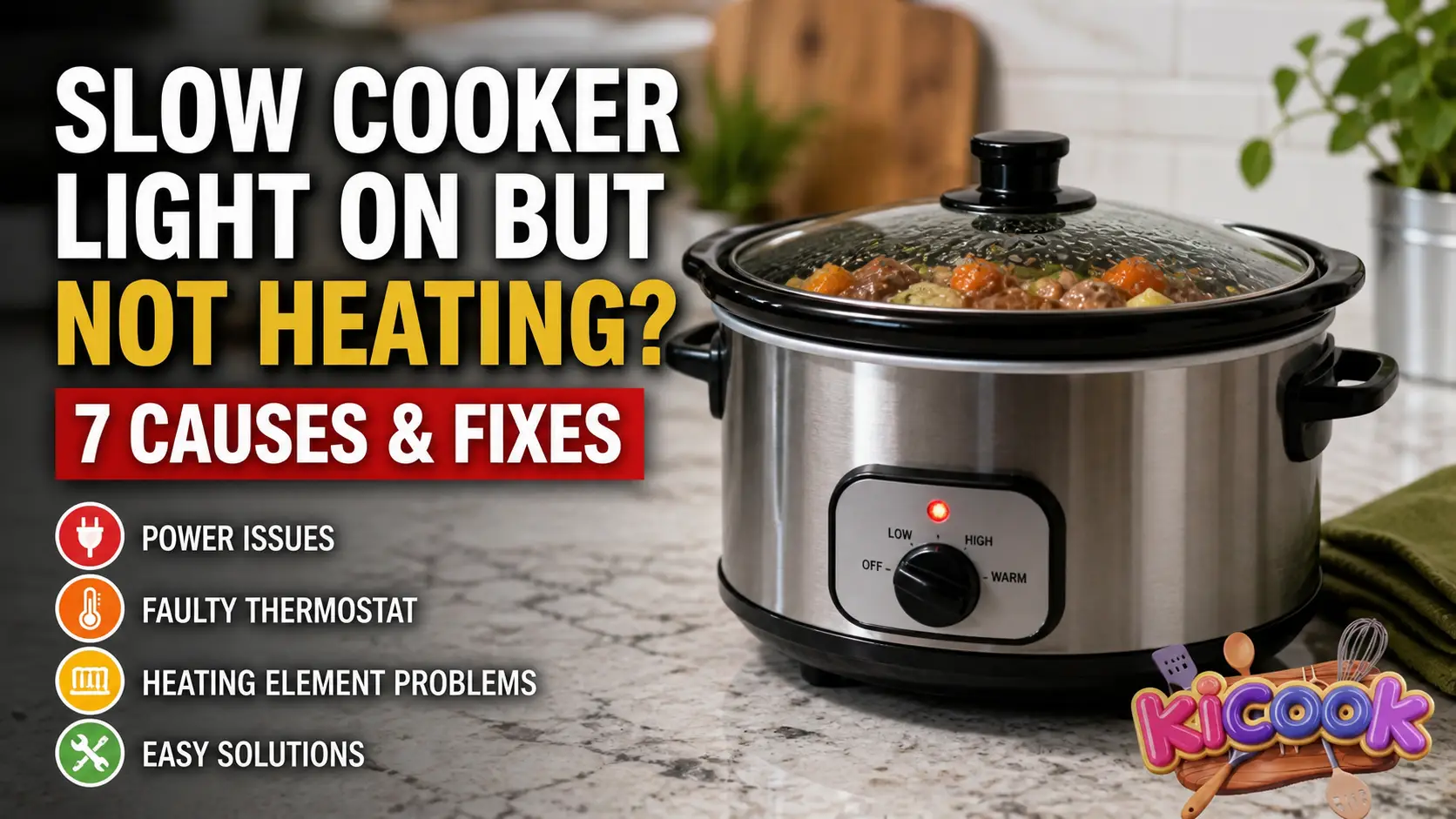
If your slow cooker’s power light is on but it’s producing no heat, the appliance is receiving electricity but something inside is preventing it from generating warmth. The most common causes are a blown thermal fuse, a failed heating element, a faulty thermostat, or a damaged control board. The good news: most of these problems are diagnosable at home in under 15 minutes.
This guide walks you through every cause, how to test for it, and exactly what to do next — whether that’s a $5 fix or knowing when to replace the unit.
Why Your Slow Cooker Has Power But No Heat
When a slow cooker’s light turns on, it confirms the cord, plug, and basic electrical circuit are working. The heating failure sits downstream — inside the appliance itself. Slow cookers heat through a resistive heating element wrapped around the ceramic insert cavity.
For that element to activate, power must flow through a chain of components: the power switch → thermal fuse → thermostat → heating element. A failure anywhere in that chain kills the heat while leaving the indicator light alive.
Understanding this chain is what makes diagnosis fast. You don’t need to guess — you work through the chain one component at a time.
Safety first: Always unplug your slow cooker before opening or inspecting any internal components. Never probe a live appliance.
Cause 1: Blown Thermal Fuse
This is the #1 cause of a slow cooker with power but no heat.
A thermal fuse is a one-time safety device. If your slow cooker overheated — even once, years ago — the thermal fuse likely tripped and permanently broke the circuit to the heating element. It doesn’t reset like a circuit breaker. Once blown, it stays broken forever.
How to identify it:
- The unit ran fine, then one day stopped heating entirely
- The power light is on, the display works, but zero warmth after 30+ minutes
- You may recall a time it was accidentally left on high for an extended period
How to test it:
- Unplug the unit and let it cool completely
- Remove the base screws (usually Phillips #2) to open the bottom panel
- Locate the small cylindrical component with two wire leads — usually near the heating element
- Set a multimeter to continuity mode and probe both terminals
- No continuity = blown fuse = confirmed diagnosis
Fix: Replace the thermal fuse. These typically cost $3–$8 USD on Amazon or at appliance parts stores like RepairClinic or AppliancePartsPros. Match the temperature rating printed on the original fuse (commonly 167°F / 75°C or 192°F / 89°C for slow cookers).
Cause 2: Failed Heating Element
The heating element is the resistive coil that actually generates heat. Like any resistive element, it can burn out — especially in units used heavily over several years. A failed element produces zero heat regardless of settings.
Signs of a failed heating element:
- No warmth at any setting (Warm, Low, or High)
- Visible burn marks or discoloration inside the base when you open it
- Strong electrical burning smell when you last used it
How to test it:
- With the unit unplugged and opened, locate the element (the flat coiled strip wrapping the interior cavity)
- Use a multimeter on resistance (Ohms) mode — probe each terminal
- A working element reads between 20–100 Ohms depending on the model
- An open circuit reading (OL / infinite resistance) = dead element
Fix: Heating element replacement costs $10–$25 USD for parts. However, labor to replace it often makes professional repair uneconomical on budget cookers. See the Repair vs. Replace section below.
Cause 3: Faulty Thermostat
The thermostat regulates temperature by cycling the heating element on and off. A stuck-open thermostat never completes the circuit, so the element never activates — the light stays on, but no heat builds.
Signs of a thermostat fault:
- The unit gets slightly warm (to the touch on the base) but never actually cooks
- Temperature seems to plateau far below the expected Low setting (~190°F) or High (~300°F)
- The cooker worked intermittently before stopping completely
How to test it: Probe the thermostat terminals for continuity at room temperature. A functioning thermostat should show continuity when cold (the circuit is closed, calling for heat). If you read no continuity at room temperature, the thermostat is stuck open and faulty.
Fix: Replacement thermostats cost $5–$15 USD. This is one of the more repair-friendly components — it’s usually accessible and straightforward to swap with basic soldering or spade-terminal connectors.
Cause 4: Damaged Control Board
Digital slow cookers with LCD displays and programmable timers have a control board that sends signals to the heating element. A failed board can leave the display and indicator light functional while breaking the heating output signal entirely.
Signs of a control board issue:
- Digital display shows settings correctly but no heat is produced
- Buttons or dial respond normally but cooking never starts
- Visible burn marks or bulging capacitors on the board (visible after opening the unit)
Fix: Control board replacement costs $20–$45 USD for parts — often approaching the cost of a new entry-level slow cooker. For mid-range or premium models (Instant Pot Duo, All-Clad, Breville), board replacement is economically justified. For basic Crock-Pot models under $40 USD, replacement usually isn’t worth it.
Cause 5: Loose or Burned Internal Wiring
Heat, vibration, and years of use can loosen wire connectors or corrode terminals inside the base. A single disconnected wire in the heating circuit breaks the chain completely.
How to check: After unplugging and opening the base, visually inspect every wire connection. Look for:
- Spade connectors that have pulled off their terminals
- Wires with melted or cracked insulation
- Corroded or blackened terminal points
Fix: Reseating a loose spade connector is a free fix and takes under a minute. Replacing a burned wire costs under $2 USD in parts. This is always worth checking before assuming a more expensive component has failed.
Cause 6: Lid or Insert Sensor Fault
Some newer slow cooker models include a safety interlock — a sensor that detects whether the ceramic insert and lid are properly seated. If the sensor malfunctions, the appliance refuses to activate heating even though the power light is on.
Signs of a sensor fault:
- The problem started after you dropped or roughly handled the insert or lid
- The unit works normally when you press down firmly on the lid during startup
- You recently replaced the insert with a third-party compatible model
Fix: Check that you’re using the original manufacturer’s insert. Third-party inserts sometimes don’t trigger proprietary sensors correctly. If the sensor itself is faulty, consult the manufacturer — this is often covered under warranty on units under 1–2 years old.
Appliance repair technician with 10+ years of experience servicing small kitchen appliances — recommended quote topic: most common reasons slow cookers fail to heat and the #1 mistake homeowners make when troubleshooting]
Cause 7: Defective Power Switch or Dial
A cracked or internally broken power switch or rotary dial can fail to make proper electrical contact even when it appears to be in the correct position. The indicator light may still illuminate (it draws very little current) while the heating circuit remains open.
How to test it: Probe across the switch terminals with a multimeter in continuity mode while manually toggling the switch. You should hear a beep (continuity) when the switch is in the ON position. Silence = failed switch.
Fix: Switches and dials cost $4–$12 USD and are among the simpler repairs if the component is accessible on your model.
How to Test Your Slow Cooker with a Multimeter
A basic digital multimeter ($10–$20 USD at any hardware store or Amazon) lets you confirm any of the above diagnoses in minutes. You don’t need electrical experience — just two skills: continuity testing and resistance testing.
Quick testing workflow:
- Unplug the unit completely
- Open the base (remove screws from the bottom panel)
- Photograph the wiring before touching anything
- Test thermal fuse → continuity mode → both terminals → should beep
- Test heating element → resistance mode → 20–100 Ohms expected
- Test thermostat → continuity mode → should show continuity when cold
- Inspect all wiring → look for disconnections, burns, or corrosion
- Reassemble and replace the first failed component found
Work through this list in order — the thermal fuse is cheapest and most common, so start there.
Repair vs. Replace: The Smart Decision Guide
Use this framework to decide whether fixing your slow cooker is worth it:
Repair makes sense when:
- The repair part costs less than 30% of a new unit’s price
- The cooker is a premium model (All-Clad, Breville, Instant Pot Pro) worth $80–$200+ USD
- The fix is a thermal fuse, loose wire, or thermostat — all simple, low-cost repairs
- The unit is less than 3 years old
Replace makes sense when:
- It’s a budget model that originally cost under $30–$40 USD
- The heating element or control board has failed (repair cost approaches new unit price)
- The unit is 6+ years old (other components likely nearing failure too)
- You can’t source replacement parts for the specific model
Repair vs. Replace
| Repair | Replace | |
|---|---|---|
| Cost | $3–$45 USD (parts only) | $25–$200+ USD (new unit) |
| Time | 30–90 minutes DIY | Immediate use |
| Skill needed | Basic (multimeter + screwdriver) | None |
| Environmental impact | Better — less waste | Adds to landfill |
| Risk | May find additional faults | None |
| Best for | Premium or newer units | Budget models, old units |
| Warranty | None on repair | Full manufacturer warranty |
Frequently Asked Questions
Why is my slow cooker light on but not heating?
Your slow cooker’s power light confirms it’s receiving electricity, but the heating circuit has failed internally. The most common cause is a blown thermal fuse a one-time safety component that permanently breaks if the unit ever overheated. Other causes include a failed heating element, faulty thermostat, or damaged control board.
Can I still use my slow cooker if it’s not heating?
No. If your slow cooker isn’t reaching safe cooking temperatures, food will sit in the “danger zone” (40°F–140°F / 4°C–60°C) where bacteria multiply rapidly. Do not attempt to use it for cooking until the heating issue is resolved.
How do I know if my slow cooker’s thermal fuse is blown?
Unplug the unit, open the base, locate the small cylindrical fuse near the heating element, and test it with a multimeter on continuity mode. If the multimeter shows no continuity (no beep), the fuse is blown and needs to be replaced.
How much does it cost to fix a slow cooker that won’t heat?
The cost depends on the cause. A thermal fuse replacement costs $3–$8 USD. A thermostat costs $5–$15. A heating element costs $10–$25. A control board costs $20–$45. If the repair cost exceeds 30–40% of the unit’s replacement price, buying new is usually the smarter choice.
Is it worth repairing a Crock-Pot that won’t heat?
It depends on the model’s value. For budget Crock-Pot models under $40 USD, replacement is usually more practical. For mid-range and premium slow cookers ($70+), repair is almost always worth attempting — especially for low-cost fixes like a thermal fuse or thermostat.
What’s the lifespan of a slow cooker?
A well-made slow cooker typically lasts 6–10 years with regular use. Budget models may last 3–5 years. If your unit is approaching the end of that range and has a major component failure, replacement is the better investment.
Can a slow cooker be repaired without professional help?
Yes — most slow cooker heating failures can be diagnosed and repaired at home with a multimeter and basic screwdrivers. Thermal fuse, thermostat, and wiring repairs require no special skills. Control board replacement is more advanced but still achievable for a confident DIYer.

“I believe great cooking starts with the right tools, trusted advice, and a little confidence in the kitchen.”
Hi, I’m Emma Carter. My love for cooking began in my grandmother’s kitchen, where I learned that every great meal starts with simple ingredients and the right cookware. Over the years, I’ve spent countless hours researching, testing, and comparing kitchen appliances, cookware, coffee makers, air fryers, and other everyday kitchen essentials.
Here at KiCook, my goal is to make your buying decisions easier with honest product reviews, practical buying guides, and easy-to-follow cooking tips. Whether you’re upgrading your kitchen or searching for the best appliance for your home, I focus on providing clear, reliable, and research-backed information you can trust.
When I’m not testing new kitchen gadgets or writing in-depth guides, you’ll usually find me trying new recipes, visiting local farmers’ markets, or enjoying a quiet cup of coffee while planning my next kitchen project.