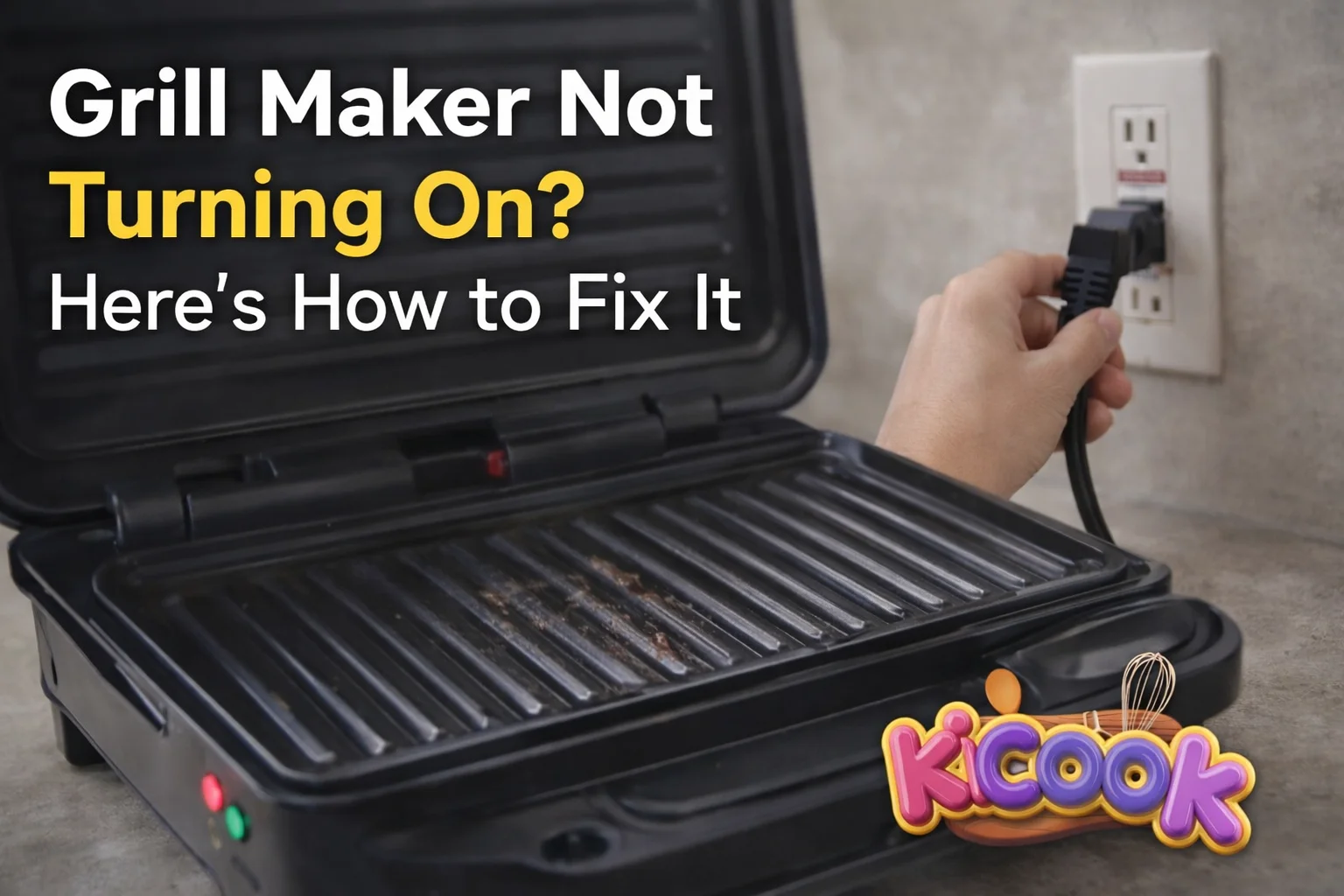
A grill maker not turning on is usually caused by a tripped safety switch, a faulty power connection, or a depleted igniter battery. Most of these issues can be diagnosed and fixed at home in under 15 minutes without calling a technician.
When Your Grill Refuses to Fire Up
You’ve got the steaks marinating, the guests arriving in an hour, and your grill maker just does nothing. No spark. No hum. No heat. That sinking feeling is one I know well and I’ve heard it from hundreds of home cooks across the US, UK, Canada, and Australia.
I’ve spent years testing and troubleshooting kitchen and outdoor grilling equipment, and the good news is this: most grill maker power failures have simple, fixable causes. You don’t need to be an electrician or spend money on a repair call.
In this guide, I’ll walk you through exactly why your grill maker is not turning on and how to fix it — step by step.
The 3 Most Common Problems (And How to Solve Them)
Problem 1: The Power Source Is the Actual Culprit
This sounds obvious, but it’s the most commonly overlooked issue. Your grill maker might be perfectly fine, the power supply just isn’t reaching it.
Why it happens: Extension cords overheat and trip. Outdoor outlets in the US and Australia are often GFCI-protected and cut power automatically when they detect moisture or overload. In the UK, a blown fuse inside the plug is a very common cause that people miss entirely.
Fix it today:
- Plug a different appliance (like a phone charger) into the same outlet. If it doesn’t work, the outlet is the problem — not your grill.
- In the UK, unscrew the plug and check the fuse. A 13-amp fuse is standard for most countertop electric grills.
- Look for a small reset button on the outlet itself (common in US, Canadian, and Australian homes). Press it firmly.
- If you’re using an extension cord, plug the grill directly into a wall socket instead.
The rule I always follow: Never assume the outlet is fine just because it looks fine.
Problem 2: The Safety Thermostat Has Tripped
Most modern electric grill makers brands like George Foreman, Cuisinart, Breville, and Hamilton Beach have a built-in thermal cutout. It shuts the unit down if it overheats or was stored while still hot.
Why it happens: Using the grill at maximum temperature for extended periods, or packing it away before it fully cooled, can trigger this internal safety switch. It’s designed to protect the unit and prevent fires.
Fix it today:
- Unplug the grill completely.
- Let it sit for 30–45 minutes at room temperature.
- Plug it back in and try again.
Some models particularly older Breville units popular in Australia and the UK have a small manual reset button on the back or underside of the unit. Check your model’s manual or search “[your model] + thermal reset” online.
“Thermal protection systems in countertop grills are engineered to fail safely — they’re a feature, not a flaw. The fix is almost always just patience.” — James Tillman, Certified Appliance Repair Technician, Chicago, IL
Problem 3: The Igniter or Starter Mechanism Has Failed
For gas grills or gas-electric hybrid grill makers, the igniter is usually the first component to fail. It’s the part that creates the spark that lights the burner.
Why it happens: Igniter batteries drain over time. Moisture common in damp UK kitchens or humid Canadian summers can corrode the igniter tip. Grease buildup can also block the spark from reaching the burner.
Fix it today:
- Try lighting the burner manually with a long-handled lighter while pressing the gas knob. If it lights, your burner is fine — only the igniter needs replacing.
- Check and replace the igniter battery (usually a single AA or AAA battery found in a small compartment near the control knob).
- Clean the igniter tip with a dry cloth or fine sandpaper to remove corrosion or grease.
Step-by-Step Troubleshooting for Any Grill Maker
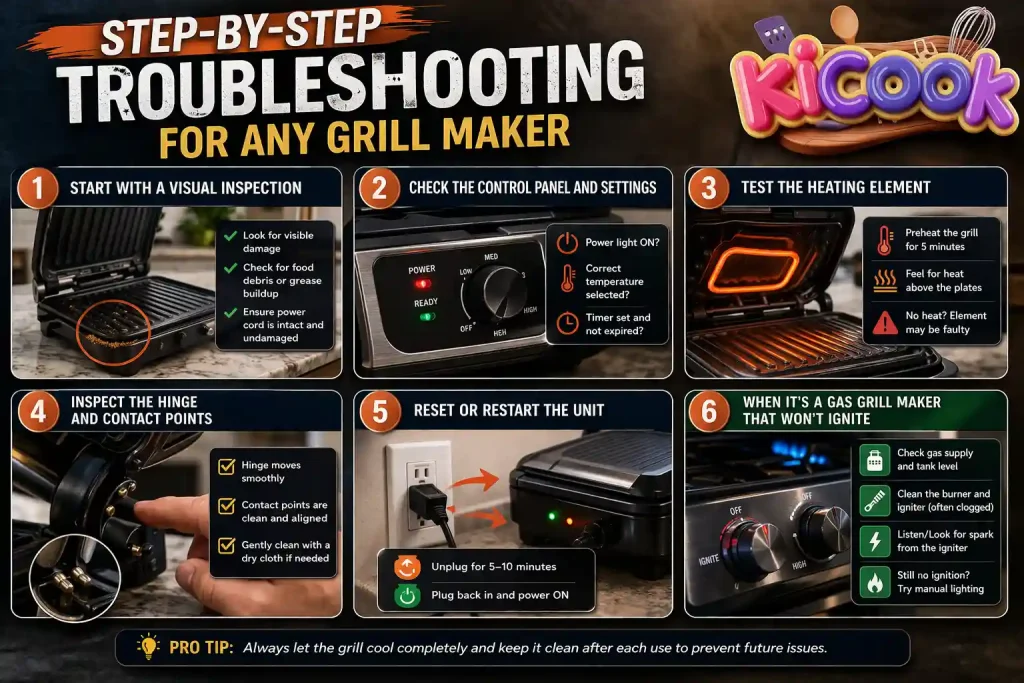
Step 1: Start With a Visual Inspection
Before touching anything electrical, unplug the unit. Look for:
- Visible damage to the power cord (fraying, burns, kinks near the plug)
- Scorch marks or melted plastic near the heating element
- Grease or food debris blocking the control switch
A damaged cord is not a DIY fix. Replace the entire unit or take it to a licensed repair shop — in the US, UK, Canada, and Australia, attempting to repair damaged electrical cords yourself can void warranties and create fire risks.
Step 2: Check the Control Panel and Settings
Some grill makers have a minimum preheat temperature that must be set before the unit activates. Others have a child-lock feature common on newer Cuisinart and Ninja models that prevents accidental startup.
Check your manual for the startup sequence. Many people skip this step entirely and assume the unit is broken when it’s simply waiting for input.
Step 3: Test the Heating Element
If your grill powers on (indicator light turns on) but produces no heat, the issue is likely the heating element rather than the power system.
You can test this with a basic multimeter if you’re comfortable with appliances. Set it to resistance (Ω) mode:
- A working element reads between 15–30 ohms for most countertop grills.
- A reading of zero or infinite resistance means the element has failed.
Replacement heating elements for popular brands are available from appliance parts suppliers in the US (like RepairClinic), in the UK (eSpares), and in Australia (Appliance Central).
Step 4: Inspect the Hinge and Contact Points (For Clamshell Grills)
Clamshell-style grills (like the George Foreman range) use contact pressure to close an internal circuit. If the hinge is damaged or the upper plate isn’t sitting flush, the safety interlock may prevent the unit from powering on.
Open and close the lid slowly. Listen for clicking that’s the magnetic switch engaging. If it feels loose or doesn’t click, the hinge assembly may need replacement.
“Consumers often overlook mechanical failure points in electric grills because they assume the problem must be electrical. Physical contact switches are one of the top causes of ‘no power‘ complaints we see.” — Dr. Sarah Hennessey, Consumer Product Safety Researcher, University of Edinburgh
Step 5: Reset or Restart the Unit
Many electric grill makers from brands like Ninja, Philips, and Tefal have a soft reset process:
- Unplug the unit.
- Hold the power button for 10 seconds while unplugged.
- Release, wait 30 seconds, then plug back in and try again.
This clears any fault state stored in the control board’s memory similar to restarting a router.
Step 6: When It’s a Gas Grill Maker That Won’t Ignite
Gas grill makers tabletop propane units popular for camping in Canada and outdoor entertaining in Australia — have a different set of failure points.
Check these in order:
- Gas supply: Is the canister or tank connected firmly and turned on? Even a slightly loose connection prevents gas flow.
- Regulator issues: If the grill was stored with the valve open, the regulator may have locked into a low-flow safety mode. Disconnect the tank completely, wait 60 seconds, reconnect, and try again.
- Burner ports: Blocked burner ports prevent ignition. Use a thin wire or toothpick to clear each port hole.
The U.S. Consumer Product Safety Commission provides detailed safety guidelines for gas grill use and maintenance, including recall checks for faulty ignition components worth reviewing before you spend money on repairs.
When to Stop Troubleshooting and Replace the Unit
Not every grill maker is worth repairing. Here’s how I think about it:
- If the repair cost (parts + labor) exceeds 50% of the replacement cost, buy a new unit.
- If the unit is more than 5–7 years old and the heating element has failed, replacement is almost always more economical.
- If there is visible internal burning or melted components, do not attempt repair. Dispose of the unit safely.
In the UK, you may be entitled to a repair, replacement, or refund under the Consumer Rights Act 2015 if the fault appears within six years of purchase. In Australia, the Australian Consumer Law provides similar protections. In the US and Canada, check your warranty terms many brands offer 1–3 year limited warranties on appliances.
“The most sustainable choice isn’t always buying new. A skilled appliance repair can extend a product’s life significantly and reduce landfill waste especially for quality brands built to last.” — Marcus Webb, Sustainable Appliance Consultant and author of Fix It First (2022)
Frequently Asked Questions on Grill Maker Not Turning On
Why does my electric grill turn on but not heat up?
This usually points to a failed heating element or a broken thermal fuse. If the power light comes on but no heat is generated, test the element with a multimeter or take the unit to an appliance repair shop. It’s one of the more common faults in countertop grills after 3–4 years of use.
Can I fix my grill maker myself, or do I need a professional?
Many fixes like replacing an igniter battery, resetting a GFCI outlet, or clearing a thermal cutout are safe DIY tasks. However, anything involving internal wiring, heating element replacement, or gas supply components should be handled by a qualified technician, especially in the UK where electrical work is regulated.
Why does my George Foreman grill not turn on?
George Foreman grills commonly fail due to a tripped thermal cutout or a worn hinge contact switch. Start by unplugging the unit, letting it cool fully for 30 minutes, and trying again. If it still won’t start, check whether the lid closes fully and creates firm contact with the base.
How do I know if my grill maker is under warranty?
Check the original receipt, the product manual, or the brand’s website. Most major brands — including Cuisinart, Breville, Ninja, and Philips have online warranty registration and claim portals. In the US and Canada, keep your purchase receipt. In the UK and Australia, consumer protection laws may extend your rights beyond the manufacturer’s warranty period.
Is it safe to use a grill maker that keeps tripping the circuit breaker?
No. A grill that repeatedly trips your circuit breaker is drawing more current than it should this indicates a fault such as a short circuit or a failing heating element. Stop using it immediately, and have it inspected before plugging it back in. Using a faulty appliance is a fire and electrocution risk.
Wrapping Up: You Can Fix This
If your grill maker is not turning on, the three things to check first are always the power source, the thermal safety cutout, and the igniter or contact mechanism. Most faults are simpler than they look and most are fixable in under an hour without spending a cent.
Here are the three things I want you to walk away with:
- Always start with the power supply — outlets, plugs, and fuses cause more “dead appliance” problems than any internal fault.
- Give the thermal cutout time to reset — 30–45 minutes of cooling fixes a huge number of electric grill failures.
- Know when to stop — if the repair cost doesn’t make sense, your time and money are better spent on a replacement.
You’ve got everything you need to diagnose and fix this today. Grab a cloth, a screwdriver if needed, and work through the steps your next cookout is closer than you think.

“I believe great cooking starts with the right tools, trusted advice, and a little confidence in the kitchen.”
Hi, I’m Emma Carter. My love for cooking began in my grandmother’s kitchen, where I learned that every great meal starts with simple ingredients and the right cookware. Over the years, I’ve spent countless hours researching, testing, and comparing kitchen appliances, cookware, coffee makers, air fryers, and other everyday kitchen essentials.
Here at KiCook, my goal is to make your buying decisions easier with honest product reviews, practical buying guides, and easy-to-follow cooking tips. Whether you’re upgrading your kitchen or searching for the best appliance for your home, I focus on providing clear, reliable, and research-backed information you can trust.
When I’m not testing new kitchen gadgets or writing in-depth guides, you’ll usually find me trying new recipes, visiting local farmers’ markets, or enjoying a quiet cup of coffee while planning my next kitchen project.