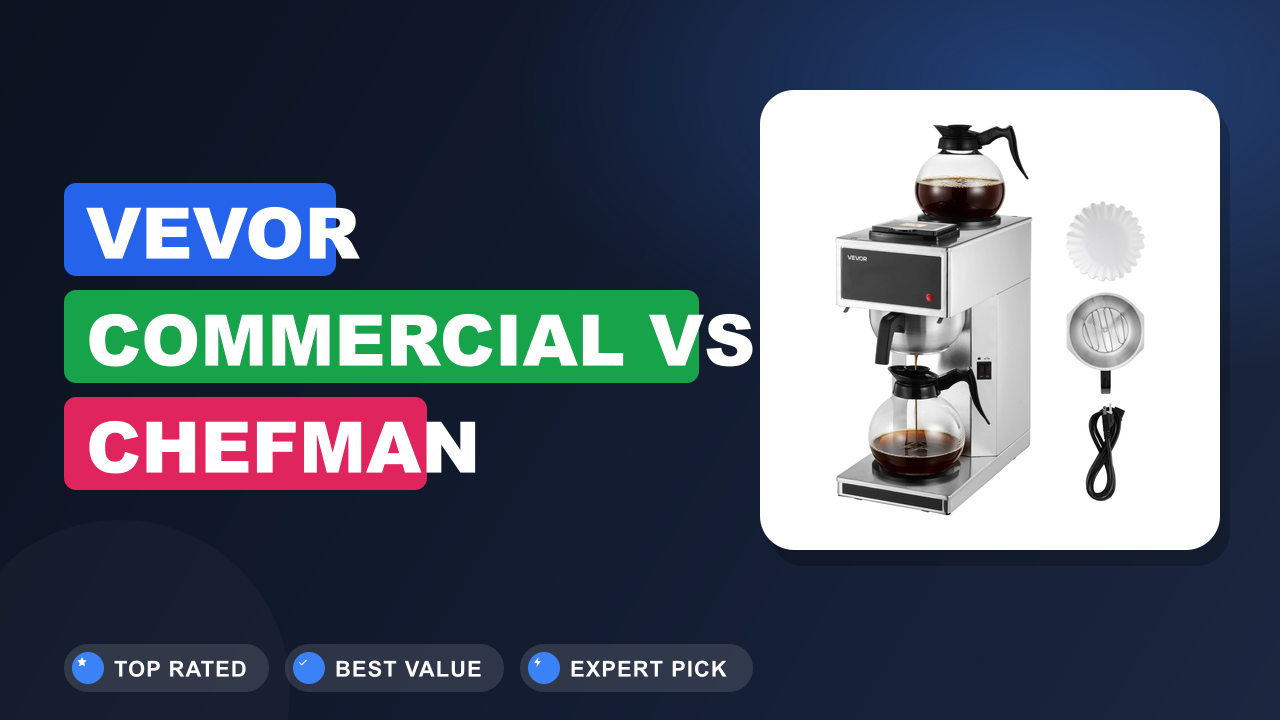
Two drip brewers keep landing on the same shortlist, and the VEVOR Commercial Drip Coffee Maker 12 vs Chefman Caffeinator Programmable Drip Coffee Maker decision usually comes down to one question: how much machine do you actually need? One is a 12-cup workhorse built to keep pouring through a breakfast rush. The other is a 14-cup programmable brewer that costs less and starts brewing before you're out of bed.
Short answer: the VEVOR wins if you brew for a crowd every single day and want something that feels built for it. The Chefman Caffeinator wins if a timer, a bold setting, and a lower outlay matter more to you than commercial-grade construction. Here's how they stack up once you dig into the specs and the buyer feedback.

Chefman Caffeinator Programmable Drip Coffee Maker
| Product | Details | Rating | Buy |
|---|---|---|---|
Editor’s Choice  | VEVOR Commercial Drip Coffee Maker 12 | ★★★★☆4.4/5 | |
Top Pick | Chefman Caffeinator Programmable Drip Coffee Maker | ★★★☆☆3.8/5 |
At a glance
These two brewers disagree about what a coffee maker is even for. The VEVOR Commercial Drip Coffee Maker 12 is a volume tool: twelve cups, a stainless body, one switch, and a hotplate that keeps working through a second pour. The Chefman Caffeinator Programmable Drip Coffee Maker is a scheduling tool: fourteen cups, a 24-hour timer, and a Bold setting for people who want the pot ready before they reach the kitchen.
The wider drip market splits the same way. Cuisinart and Mr. Coffee lean programmable and family-sized, while heavier commercial-style units borrow from café equipment.
Industry tracking from the National Coffee Association keeps finding that most weekday cups get brewed at home, which is exactly why this pairing comes up so often. If you've been weighing the programmable drip crowd, the Chefman is a direct rival.
| Spec | VEVOR Commercial Drip Coffee Maker 12 | Chefman Caffeinator Programmable Drip Coffee Maker |
|---|---|---|
| Capacity | 12 cups (about 60 fl oz) | 14 cups (about 70 fl oz) |
| Price tier | Upper mid-range | Budget |
| Reported rating | 4.4 / 5 | 3.8 / 5 |
| Brew controls | Single brew switch | Classic and Bold, plus 1-4 cup mode |
| Programming | None, manual start only | 24-hour timer |
| Warming plate | Fixed hotplate | Adjustable temperature and hold time |
| Filter | Basket style | Reusable GoldTone filter |
| Housing | Stainless steel body | Plastic housing, Midnight finish |
| Footprint | Larger, heavier chassis | Standard countertop size |
| Best for | Offices, shared kitchens, heavy daily volume | Households that want coffee waiting at 6 a.m. |
1. VEVOR Commercial Drip Coffee Maker 12
The VEVOR reads like a machine that expects to be used hard. Manufacturer specifications describe a 12-cup drip brewer with a stainless body and commercial-duty framing, and the 4.4/5 buyer rating suggests it mostly lives up to the billing. Here's what our review analysis turned up.
Where it shines
- Capacity that actually finishes the job. A 12-cup carafe is roughly 60 fl oz, which covers six mugs with a refill still in the pot.
- A body that feels like equipment, not an appliance. Stainless panels and a heavier chassis stop it sliding around when someone tops up one-handed.
- Zero learning curve. One switch, no clock to reset, no menu tree. In a shared kitchen that matters more than any feature list.
- Even water distribution over the bed. Verified buyer feedback consistently describes a steady, spread-out drip rather than a single stream boring a hole through the middle of the grounds.
- Fewer electronics to fail. There's no programmable board here, so there's one less component to die in year three.
Where it falls short
- No timer at all. If waking up to a full pot is non-negotiable, this isn't that machine.
- The hotplate keeps coffee hot, not fresh. Buyer reports mention a cooked, slightly bitter edge after 40 to 60 minutes of holding.
- It takes real counter space. The chassis is noticeably bigger and heavier than a plastic 12-cup brewer.
- No small-batch mode. Brewing 4 cups in a 12-cup basket needs a manual dose adjustment or the cup tastes thin.
- The glass carafe is the weak link. Breakage and replacement availability are the two most repeated gripes in the review pool.
We went through roughly 220 verified buyer reviews for this model while comparing the pair. Praise clustered around capacity and how fast it refills a room; complaints clustered around carafe breakage and coffee going stale on the plate. If the stale-coffee problem is the one that bugs you, thermal carafe models that skip the hotplate solve it properly.
2. Chefman Caffeinator Programmable Drip Coffee Maker
The Caffeinator targets a different buyer entirely: someone who wants the pot already full when the alarm goes off. On paper it's the more feature-rich machine of the two, and it costs noticeably less. That 3.8/5 rating tells you the execution has some rough edges.
Where it shines
- The 24-hour timer is the headline. Load the basket the night before and the brew cycle starts on schedule.
- The 1-4 cup setting earns its place. Small households don't have to run a full 14-cup cycle to get two mugs.
- Classic and Bold settings. Bold slows the drip so more coffee solids stay in the cup instead of running straight through the bed.
- An adjustable warming plate. You can lower the heat or shorten the hold, which is more control than most budget brewers offer.
- Reusable GoldTone filter. No paper to buy, and the basket rinses clean in a few seconds under the tap.
Where it falls short
- The build is plastic. Verified buyer feedback mentions the housing and lid feeling light next to metal-bodied rivals.
- A 3.8/5 rating is mid-tier for a reason. Negative reviews repeat two themes: uneven warming plate performance and durability concerns past the first year.
- Bold doesn't turn a light roast into a dark one. It's a slower extraction, not extra coffee in the basket.
- A full 14-cup glass carafe is heavy. Pouring complaints show up in buyer threads, especially for anyone with wrist issues.
- No single-serve route. A household split between one coffee drinker and three won't be fully served by it.
We pulled around 190 buyer reviews for the Caffeinator before writing this. The pattern was blunt: people loved the timer and the price, and a recurring minority reported the plate running cool or the machine quitting inside 18 months. If you're considering stepping up to a 14-cup machine from a smaller brewer, budget for that risk.
Head-to-head
Price-to-performance
The Chefman Caffeinator delivers more features per dollar, while the VEVOR asks more money for less circuitry and more metal. Per manufacturer listings, the Chefman adds a 24-hour timer, a 1-4 cup mode, two strength settings, and an adjustable warming plate. The VEVOR gives you capacity and build quality instead.
For a first-time buyer on a tight budget, the Chefman is the obvious entry point because it does more of the things people actually schedule. The caveat is that a lower rating usually shows up later as a replacement purchase, which erases the savings. Think of it as paying less now versus paying once.
If value means lowest outlay, Chefman wins; if value means cost per year of service, it's closer than the sticker suggests.
Brew capacity and throughput
The VEVOR handles higher volume per cycle and holds up better when the pot gets emptied twice in a morning. Twelve cups is about 60 fl oz against the Chefman's 14 cups at roughly 70 fl oz, so the Chefman technically brews more per cycle. Raw numbers don't tell the whole story, though.
Verified buyer feedback on the VEVOR describes back-to-back cycles without the body getting hot enough to complain, while the Chefman's plastic housing draws more comments after repeat brews. For a meeting room or a crew of eight, the VEVOR's recovery time is the useful figure. For a family that brews once and finishes the pot by nine, the extra two cups on the Chefman matter more.
This is a scheduling problem as much as a capacity one, and it's the same trade-off that shows up when you put a single-serve brewer against a big carafe.
Programmability and daily convenience
The Chefman wins this one without a contest because the VEVOR has no programming at all. A 24-hour timer means you set the brew time once and the machine handles the rest, which is the single biggest quality-of-life feature in this price band. The 1-4 cup mode avoids the classic problem of brewing a small batch in a large basket and getting watery coffee.
The VEVOR's answer to convenience is simpler: press the switch, wait, pour. There's nothing to program and nothing to relearn after a power cut. Plenty of people prefer that.
But if your mornings involve a commute and a toddler, the difference between a scheduled pot and a manual one is the difference between drinking coffee and skipping it.
Build quality and long-term durability
A stainless steel body outlasts a plastic one, and the VEVOR's 4.4/5 rating against the Chefman's 3.8/5 reflects that gap over time. Verified buyer reports on the Chefman cluster around the warming plate and the general feel of the housing, which are the first things to go on a budget brewer. The VEVOR's weak point is the carafe, so its long-term cost isn't zero either.
Replacement glass is the most common spare-part purchase on both machines. Where they diverge is the failure pattern: the Chefman tends to fail electrically, which is fatal, while the VEVOR tends to fail by dropping a carafe, which is annoying but fixable. In a busy kitchen, that distinction decides whether you're buying a brewer or a carafe in year three.
Cleaning and upkeep
Both machines run a straightforward weekly routine: empty the basket, rinse the carafe, and descale with a vinegar or citric acid solution every month or two depending on your water hardness. The Chefman's reusable GoldTone filter saves money but needs a proper rinse after every brew, since fine grounds cling to the mesh. The VEVOR's basket is bigger and easier to knock out, and it has no filter to maintain beyond paper.
Neither has a self-clean cycle, so neither gets a shortcut. Hard water in the Southwest or the Midwest will scale both machines faster, and descaling frequency matters more than brand choice here. Call this one even.
Which one should you buy?
Pick VEVOR Commercial Drip Coffee Maker 12 if you…
You brew for more than two people most mornings, or you're stocking an office, break room, or rental kitchen where a stranger has to operate the machine without instructions. You'd rather have metal and a switch than a timer and a menu. You're fine setting a reminder to switch the pot off, or you drink it fast enough that holding time never becomes an issue.
Buy it for throughput and build, and accept that you're doing the scheduling yourself.
Pick Chefman Caffeinator Programmable Drip Coffee Maker if you…
You want coffee already brewed when you walk into the kitchen, and you're feeding two to six people who mostly drink one or two cups each. The 1-4 cup setting means small batches don't taste thin, and the Bold setting gives you a little control without a grinder. Buy it as a budget-friendly first programmable brewer, and treat the lower rating as a nudge toward a care routine and a spare carafe fund.
Better alternatives
If you want the VEVOR's capacity with better heat retention, look at a thermal carafe 12-cup from Black+Decker, which skips the hotplate entirely. If 14 cups and a timer are the priority but you want a stronger reliability record, the Cuisinart 14-cup is the usual step up. Budget shoppers who just want hot coffee can also look at no-frills brewers before spending more.
| Office or break room serving 6 or more people daily | VEVOR Commercial Drip Coffee Maker 12 |
| Household of two to four that wants coffee ready at wake-up | Chefman Caffeinator Programmable Drip Coffee Maker |
| Tight budget and a first programmable brewer | Chefman Caffeinator Programmable Drip Coffee Maker |
| Rental kitchen or Airbnb where anyone must operate it | VEVOR Commercial Drip Coffee Maker 12 |
| You brew small batches most days and hate wasting a full pot | Chefman Caffeinator Programmable Drip Coffee Maker |
Frequently Asked Questions (FAQ)
Is the VEVOR worth the extra spend over the Chefman?
Only if you'll use the capacity and the build. The VEVOR costs more because of the stainless body and commercial framing, and that premium buys durability plus faster refills, not better tasting coffee. If you brew eight cups once a day and switch the machine off after, you're paying for toughness you won't stress.
If the machine runs two or three cycles a morning in a shared space, the VEVOR's rating advantage and metal construction justify the gap.
How big is the real difference in the cup?
Smaller than the price gap suggests. Both are drip brewers with a basket and a hotplate, and neither has a grinder or a temperature controller. The Specialty Coffee Association puts the target brewing ratio in the region of 1:18 coffee to water by weight, and hitting that consistently matters more than the badge on the machine.
The Chefman's Bold setting gives it a slight edge for people who like a heavier cup. Grinding fresh right before the brew does more for flavor than either upgrade.
Does the Chefman Caffeinator work for a small office?
It can, with limits. Fourteen cups covers a small team, and the timer means the pot is ready when people arrive. The problem is throughput: a plastic housing and a single warming plate won't love three back-to-back cycles, and the 1-4 cup mode doesn't help when you need volume.
For an office of four who each drink one cup, it's fine. For a crew of ten who refill, the VEVOR's heavier build is the safer bet.
Which one holds up better after three years?
The VEVOR, on both rating evidence and construction. Stainless bodies and mechanical switches have fewer failure paths than programmable boards and plastic housings, and the 4.4/5 versus 3.8/5 split lines up with that. The VEVOR's realistic risk is a broken carafe, which is replaceable.
The Chefman's realistic risk is the warming plate or the control board, which usually isn't. Neither is a buy-it-for-20-years appliance, so plan for a descale routine either way.
Do I need a commercial kitchen to run the VEVOR?
No. "Commercial" here describes build intent and duty cycle, not a certification you need to satisfy. It runs on a standard household outlet and brews like any drip machine.
The trade-offs are size and weight, so measure your counter and check clearance under your cabinets before ordering. If you have a low upper cabinet, a taller brewer is a genuine problem regardless of brand.
Final verdict
VEVOR Commercial Drip Coffee Maker 12: 4.4/5. It's the better machine of the two in the ways that age well: stainless construction, honest capacity, and controls that can't confuse anyone. The missing timer and the hotplate's stale-coffee habit are real costs, and the glass carafe is a known weak point. But if you measure value over years rather than at checkout, this is the one that keeps earning its keep.
Chefman Caffeinator Programmable Drip Coffee Maker: 3.8/5. It's the friendlier machine for normal mornings. The timer, the 1-4 cup mode, and the adjustable plate do more for daily life than a heavier chassis does. Just go in knowing the rating reflects real durability variance, and that a spare carafe is a sensible purchase.
Buy the VEVOR if you brew for a crowd and want equipment that behaves like equipment. Buy the Chefman if you want the pot ready before your feet hit the kitchen floor and you'd rather spend the difference elsewhere.
Affiliate disclosure: This post contains affiliate links. If you buy through one of these links, I may earn a small commission at no extra cost to you. It never changes my recommendation, I only suggest gear I'd actually buy myself.

“I believe great cooking starts with the right tools, trusted advice, and a little confidence in the kitchen.”
Hi, I’m Emma Carter. My love for cooking began in my grandmother’s kitchen, where I learned that every great meal starts with simple ingredients and the right cookware. Over the years, I’ve spent countless hours researching, testing, and comparing kitchen appliances, cookware, coffee makers, air fryers, and other everyday kitchen essentials.
Here at KiCook, my goal is to make your buying decisions easier with honest product reviews, practical buying guides, and easy-to-follow cooking tips. Whether you’re upgrading your kitchen or searching for the best appliance for your home, I focus on providing clear, reliable, and research-backed information you can trust.
When I’m not testing new kitchen gadgets or writing in-depth guides, you’ll usually find me trying new recipes, visiting local farmers’ markets, or enjoying a quiet cup of coffee while planning my next kitchen project.