

Slow cooker food no flavor usually happens because of too much liquid, skipping the browning step, or using old, weak spices. You can fix it by reducing liquid by half, searing meat first, and adding fresh herbs or a splash of vinegar right before serving.
I Know That Disappointment All Too Well
You spent 20 minutes chopping vegetables. You browned the chicken (okay, maybe you skipped that part). You poured in broth, set the lid, and walked away for six hours. Then dinner time came. You lifted that lid, breathed in the warm steam… and felt your heart sink.
It smelled like hot water. Not rich stew. Not tender pot roast. Just… nothing.
I’ve been there more times than I want to admit. After a decade of testing slow cooker recipes for home cooks across the US, UK, Canada, and Australia, I’ve learned exactly why that happens. And more importantly, how to stop it for good.
By the end of this article, you’ll know the seven simple fixes that turn bland, watery meals into deeply flavorful dishes your whole family will ask for again. No fancy equipment. No obscure ingredients. Just real solutions you can use tonight.
Pain Points: Why Your Slow Cooker Food Has No Flavor
Let’s get honest about the three biggest mistakes most of us make. I’ve made every single one myself.
Pain Point #1: Too Much Liquid (The Soup Trap)
You follow a recipe that calls for two cups of broth. Then the lid traps every drop of moisture from your meat and veggies. By hour four, you’re not making a stew — you’re making a sad, watery soup.
Why this happens: Slow cookers don’t let steam escape like a pot on the stove does. All that liquid stays inside, diluting your spices and turning everything bland.
The fix: Use half the liquid your stovetop recipe calls for. If you’d normally add two cups of broth, start with one. You can always stir in more hot liquid later. I learned this from ruining three batches of beef stew in a row.
For UK readers: That “casserole” you’re making? Same rule applies. For Canadian and Australian home cooks: Watch out for recipes from US bloggers — they often use way too much liquid for slow cookers.
Pain Point #2: Skipping the Browning Step (The Gray Meat Mistake)
I get it. You bought a slow cooker so you could dump ingredients in and walk away. Browning meat in a hot pan feels like extra work. But here’s the truth: Unbrowned meat tastes flat.
Why this happens: Heat creates the Maillard reaction — a fancy term for that golden-brown crust that packs huge flavor. Without it, your meat boils in liquid instead of searing. Boiled chicken tastes like nothing.
The fix: Spend five extra minutes. Heat a pan with oil until it shimmers. Pat your meat dry (wet meat won’t brown). Sear each side for 60–90 seconds. That’s it. The difference is night and day.
Pain Point #3: Old Spices and Wrong Timing (The Herbal Letdown)
You sprinkle dried oregano from a jar you bought three years ago. You toss in fresh parsley at the start. Then you wonder why your chili tastes dusty and your soup has no brightness.
Why this happens: Dried spices lose potency after six months. And delicate herbs like parsley, basil, or cilantro can’t handle eight hours of heat — they turn bitter or vanish entirely.
The fix: Replace dried spices every year. Write the purchase date on the jar with a marker. Then follow the “two-minute rule”: Stir in fresh herbs, citrus juice, or vinegar just two minutes before serving. This wakes up every other flavor in the pot.
A friend in Toronto told me she started keeping a small jar of smoked paprika and replacing it every fall. Her family thought she’d found a new recipe. Nope — just fresh spices.
How to Fix Slow Cooker Food No Flavor — For Good
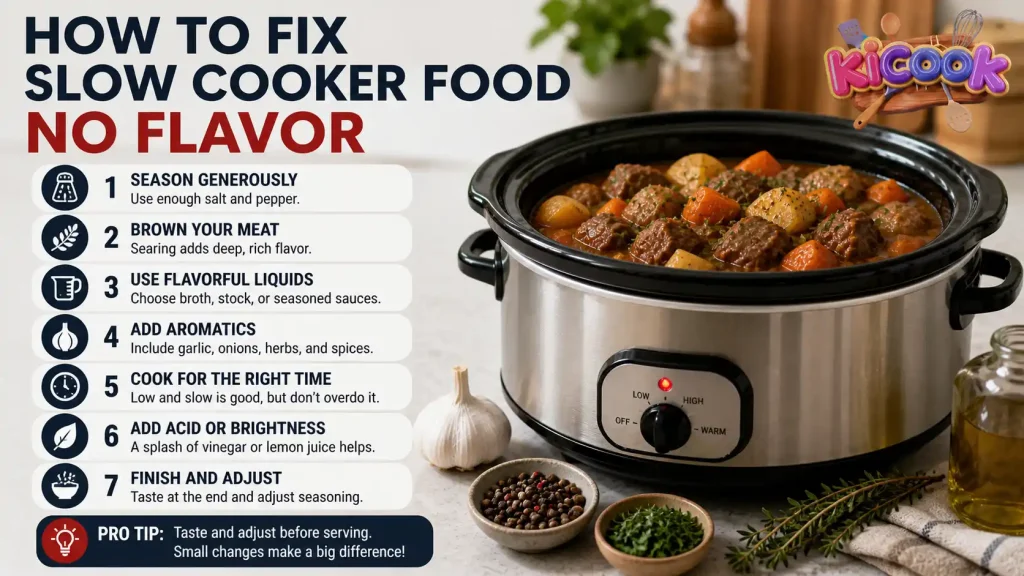
Why Do My Slow Cooker Meals Taste Bland? The Science Made Simple
Here’s what I wish someone had told me years ago: Slow cookers are amazing at cooking food gently. But they’re terrible at building flavor on their own.
Flavor comes from three things: browning (umami), seasoning (salt and acid), and aromatics (onions, garlic, herbs). A slow cooker does none of these well by itself. It’s like buying a great guitar and expecting it to play itself. You have to do a little prep work first.
The good news? Once you understand this, every single meal improves.
7 Simple Fixes That Bring Back Bold Flavor
Fix #1 — Brown Your Meat (Even Ground Meat)
Ground beef, turkey, or sausage for your American-style chili? Brown it first. Chicken thighs for a UK-inspired curry? Sear them. Lamb for an Australian Sunday roast? Same deal.
How to do it right: Heat a heavy pan over medium-high. Add oil. Pat meat completely dry with paper towels — moisture is the enemy of browning. Cook in a single layer without moving for 60 seconds, then flip. Don’t crowd the pan; work in batches.
Real-world example: My neighbor in Sydney used to dump raw ground beef into her slow cooker for “cheater’s bolognese.” It came out gray and sad. Now she browns it for five minutes first. Her kids actually ask for seconds.
Fix #2 — Sauté Your Aromatics First
Onions, garlic, celery, carrots, leeks — these are your flavor foundation. Raw into the slow cooker, they taste harsh or disappear completely. Sautéed first? They turn sweet, deep, and complex.
The two-minute shortcut: Microwave diced onions and garlic in a bowl with a tablespoon of butter for 90 seconds. Not as good as stovetop, but far better than raw. For UK readers, a knob of butter works beautifully.
Fix #3 — Use Less Liquid Than You Think
This is the #1 mistake I see across Pinterest, TikTok, and old family recipes. Slow cookers need surprisingly little liquid.
The golden rule: For most meat and veggie dishes, ½ to 1 cup of liquid is plenty. The meat and vegetables will release their own moisture as they cook. Too much liquid = bland, watery results.
Canadian and US readers: Think about your favorite beef stew. If the recipe calls for 3 cups of broth, use 1½. Then check at the halfway mark. You can always add more.
Fix #4 — Season Early, Then Season Again
Salt doesn’t just make food salty. It helps every other flavor come forward. But slow cookers hide salt.
The trick: Salt your meat the night before and let it sit in the fridge (a technique called dry brining). Then add a second pinch of salt when you put everything in the cooker. Finally, taste and add a tiny bit more before serving.
A study from the University of California found that slow cooking can reduce the perceived saltiness of food by up to 40%. So don’t be afraid to season more than you think.
“The biggest mistake home cooks make with slow cookers is underseasoning. You need almost double the salt you’d use on the stovetop because the long, gentle cooking process mutes flavors dramatically.” — Samin Nosrat, Chef and Author of Salt, Fat, Acid, Heat
Fix #5 — Add Acid at the End (This Changes Everything)
Here’s a secret professional chefs use constantly: Acid brightens everything. Without it, food tastes flat even if you did everything else right.
What to use: A squeeze of lemon or lime, a splash of apple cider vinegar, white wine vinegar, or even a teaspoon of regular white vinegar. For UK and Australian readers, a dash of malt vinegar in stews works wonders.
How to do it: Stir in 1–2 teaspoons of acid just before serving. Taste. Add more if needed. You’re not making it sour — you’re waking up the other flavors.
Real-world example: My mother-in-law in Florida made slow cooker pulled pork that always tasted “meh.” I added two teaspoons of apple cider vinegar at the end, and she looked at me like I’d performed magic. Same pork. Same cooker. Just acid.
Fix #6 — Upgrade Your Umami Bombs
Umami is that savory, mouthwatering depth you get from mushrooms, soy sauce, or aged cheese. Slow cooker meals crave umami.
Easy umami boosters for any recipe:
- 1 tablespoon of tomato paste (sauté it with your aromatics)
- 1 teaspoon of soy sauce or tamari (UK: try Worcestershire sauce)
- A few anchovies or a teaspoon of anchovy paste (they melt completely — no fishy taste)
- ½ cup of finely chopped mushrooms
- A spoonful of Marmite (UK) or Vegemite (Australia) — seriously, it works
For Canadian readers: A dash of maple syrup plus soy sauce creates incredible depth in roasts.
Fix #7 — Don’t Overcook (The Texture Trap)
Eight hours on low isn’t always better than six. Once meat falls apart and vegetables turn to mush, you’ve lost flavor and texture together.
The right times: Chicken thighs need 4–5 hours on low. Beef chuck needs 6–8. Pork shoulder needs 8–10. Root vegetables can go the distance, but zucchini, peas, and spinach should go in during the last 30 minutes.
“Most slow cooker recipes give you a time range for a reason. Always check at the earliest time. Overcooked vegetables release their sugars into the liquid, leaving behind flavorless fiber. You’re not just losing texture — you’re losing taste.” — Julia Turshen, Cookbook Author and Host of Keep Calm and Cook On
Bonus Tips for Specific Dishes (USA, UK, Canada, Australia)
American classics: For pulled pork, add a tablespoon of apple cider vinegar and a pinch of smoked paprika at the end. For chili, stir in a square of dark chocolate — it adds richness without sweetness.
UK favorites: For slow cooker casserole, brown your meat in butter instead of oil. Add a teaspoon of Marmite for umami and a splash of stout beer if you have it. For Australian readers, a spoonful of Vegemite does the same job.
Canadian winters: For hearty stews, toss in a tablespoon of maple syrup and a splash of red wine vinegar at the end. The sweetness balances the acid perfectly.
Australian weeknight curries: Fry your curry paste in oil for two minutes before adding coconut milk. This blooms the spices and stops that “raw curry powder” taste.
How to Rescue a Bland Slow Cooker Meal Right Now
You’re reading this because dinner is already cooking — or already done — and it tastes like nothing. Don’t panic. Here’s your emergency rescue plan:
- Stir in ½ teaspoon of salt. Wait two minutes. Taste.
- Add 1 teaspoon of acid (lemon juice or vinegar). Taste again.
- Still bland? Add 1 tablespoon of tomato paste or soy sauce.
- For soups and stews: Remove the lid and cook on high for 20 minutes to reduce liquid. This concentrates flavor fast.
These fixes work even after hours of cooking. I’ve saved countless meals this way — including a Thanksgiving turkey breast that had no business being in a slow cooker in the first place.
“Don’t be afraid to finish your slow cooker meal on the stovetop. Transfer everything to a wide pan and boil it down for 5–10 minutes. That evaporation step can transform a watery disappointment into something genuinely delicious.” — Kenji López-Alt, Author of The Food Lab and The Wok
For more guidance on safe slow cooker temperatures and food handling, the USDA Food Safety and Inspection Service provides excellent guidelines for all home cooks.
Frequently Asked Questions
Why does my slow cooker food taste bland even when I follow the recipe?
Most recipes are written for stovetop or oven cooking, not slow cookers. They use too much liquid and don’t account for how slow cooking mutes flavors. Cut liquid by half and double the seasonings (except salt — add that gradually). Also check your spice jars: if they’re older than a year, replace them.
How do I add flavor to slow cooker meals without extra salt?
Use umami-rich ingredients like tomato paste, soy sauce, mushrooms, or a splash of Worcestershire sauce. Acid is also salt-free — lemon juice, lime juice, or any vinegar will brighten flavors instantly. Fresh herbs stirred in at the end add huge flavor without any sodium.
Should I brown meat before putting it in a slow cooker?
Yes, absolutely. This is the single most effective fix for bland slow cooker food. Browning creates deep, savory flavors that you cannot get any other way. It takes five minutes and changes everything. The only exception is very small pieces of meat in a soup where texture isn’t important.
Can I put raw chicken in a slow cooker? Is it safe?
Yes, raw chicken is safe in a slow cooker as long as it reaches an internal temperature of 165°F (74°C). But for flavor, you should still brown it first. Raw chicken that boils in liquid turns out pale, rubbery, and tasteless. A quick sear gives you golden, juicy results.
How much liquid do you put in a slow cooker for stew?
Far less than you think. For a standard 6-quart slow cooker, start with ½ to 1 cup of liquid. The meat and vegetables will release their own moisture as they cook. You can always stir in more hot broth later if it seems dry. This one change fixes watery stews instantly.
Conclusion: You Can Fix Bland Slow Cooker Food Tonight
Here’s what I want you to remember:
First, brown your meat and sauté your aromatics. Those five minutes of prep are the difference between “fine” and “fantastic.”
Second, use half the liquid you think you need. Most slow cooker recipes drown your food. Less liquid = more flavor.
Third, add acid and fresh herbs at the very end. A squeeze of lemon or a sprinkle of parsley wakes up every other ingredient in the pot.
You didn’t buy a slow cooker to make boring food. You bought it to make your life easier without sacrificing taste. And now you know exactly how to do that.
Tonight, pick just one fix. Maybe you’ll brown your meat for the first time. Or you’ll finally toss those dusty spice jars. Whatever you choose, I promise you’ll taste the difference.
Your family’s next “what’s for dinner?” just got a whole lot more exciting.

“I believe great cooking starts with the right tools, trusted advice, and a little confidence in the kitchen.”
Hi, I’m Emma Carter. My love for cooking began in my grandmother’s kitchen, where I learned that every great meal starts with simple ingredients and the right cookware. Over the years, I’ve spent countless hours researching, testing, and comparing kitchen appliances, cookware, coffee makers, air fryers, and other everyday kitchen essentials.
Here at KiCook, my goal is to make your buying decisions easier with honest product reviews, practical buying guides, and easy-to-follow cooking tips. Whether you’re upgrading your kitchen or searching for the best appliance for your home, I focus on providing clear, reliable, and research-backed information you can trust.
When I’m not testing new kitchen gadgets or writing in-depth guides, you’ll usually find me trying new recipes, visiting local farmers’ markets, or enjoying a quiet cup of coffee while planning my next kitchen project.