
Choosing between Scrub Daddy and Scotch-Brite is not as simple as deciding which sponge removes food faster. The two brands approach cleaning differently, and the better choice depends on what you clean, how you wash dishes, and whether you value scrubbing power, absorbency, surface safety, or long-term cost.
Scrub Daddy Original is a temperature-responsive scrubber. It becomes firm in cool water for stronger scrubbing and soft in warm water for gentler cleaning. Scotch-Brite, meanwhile, offers several different sponges and scrubbing pads, ranging from aggressive heavy-duty products to non-scratch everyday sponges.
That distinction matters. Comparing Scrub Daddy with Scotch-Brite Heavy Duty produces a different result from comparing it with Scotch-Brite Zero Scratch.
For this guide, the main Scrub Daddy vs Scotch-Brite comparison focuses on:
- Scrub Daddy Original
- Scotch-Brite Heavy Duty Sponge
- Scotch-Brite Zero Scratch Sponge
We will also explain where Scotch-Brite Dobie, Scotch-Brite Odor Resist, and Scrub Mommy fit into the decision.
Quick Verdict: Scrub Daddy or Scotch-Brite?
For most kitchens, Scrub Daddy is the better all-around scrubber. It is versatile, easy to rinse, quick to dry, and suitable for a wider range of cleaning jobs.
However, it does not win every category.
Choose Scrub Daddy when you want:
- One scrubber for several surface types
- Adjustable firmness
- Faster drying
- Easier food release
- Better access around utensils and curved items
- Less moisture sitting beside your sink
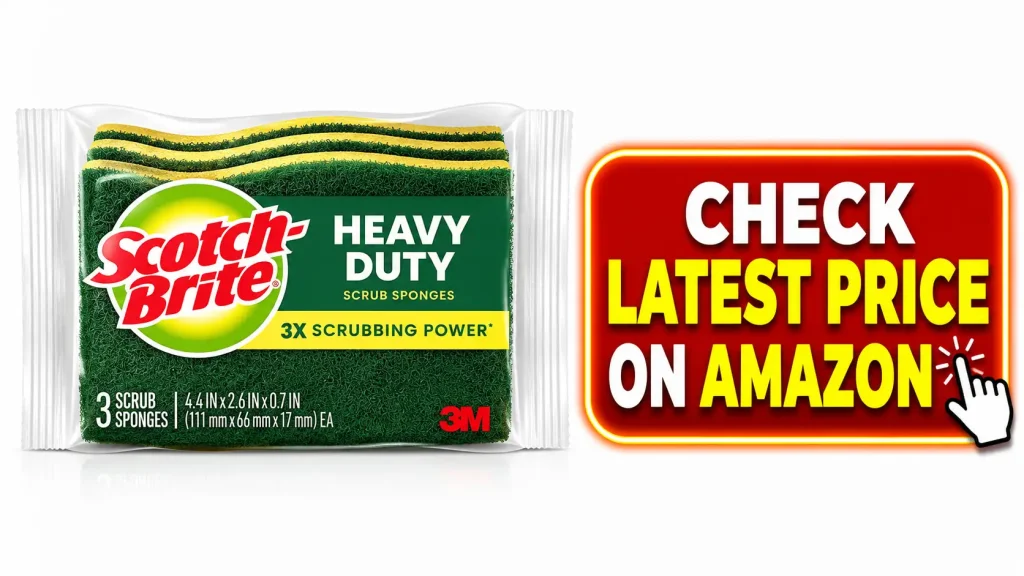
Choose Scotch-Brite Heavy Duty when you want:
- Maximum scrubbing power on durable surfaces
- A sponge for grill grates and oven racks
- Strong performance on baked-on food
- Better water and soap absorption
- A lower upfront cost
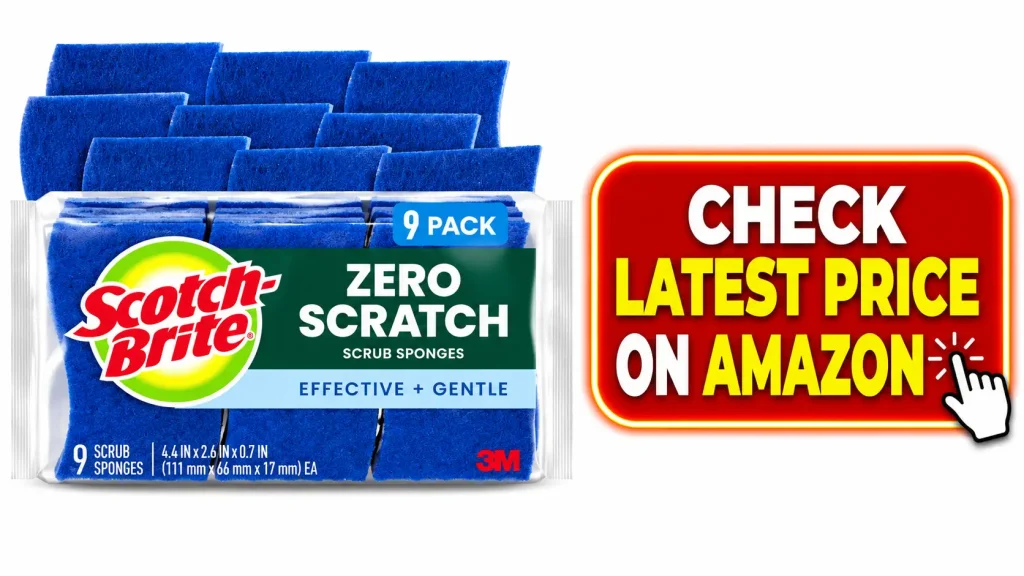
Choose Scotch-Brite Zero Scratch when you want:
- A traditional absorbent kitchen sponge
- A non-scratch option for everyday dishes
- A safer Scotch-Brite product for non-stick cookware
- A familiar rectangular or S-shaped sponge
- Better wiping performance than Scrub Daddy Original
Overall winner: Scrub Daddy
Best for aggressive scrubbing: Scotch-Brite Heavy Duty
Best traditional non-scratch sponge: Scotch-Brite Zero Scratch
Best for wiping and absorbing spills: Scotch-Brite
Best for quick drying and easy rinsing: Scrub Daddy
Scrub Daddy vs Scotch-Brite at a Glance
| Feature | Scrub Daddy Original | Scotch-Brite Heavy Duty | Scotch-Brite Zero Scratch |
|---|---|---|---|
| Product type | Temperature-responsive scrubber | Heavy-duty scrub sponge | Non-scratch scrub sponge |
| Best use | Versatile everyday cleaning | Baked-on food and durable surfaces | Everyday dishes and delicate cookware |
| Texture | Changes with water temperature | Fixed aggressive texture | Fixed gentle texture |
| Absorbency | Low | High | High |
| Non-stick cookware | Suitable when used correctly | Not the preferred option | Designed for non-stick cookware |
| Drying speed | Fast | Moderate to slow | Moderate to slow |
| Food release | Very good | Depends on model | Moderate |
| Tough grime | Very good | Excellent | Good |
| Wiping spills | Limited | Very good | Very good |
| Shape | Round smiley-face design | Traditional sponge design | Traditional or S-shaped design |
| Dishwasher cleaning | Top-rack safe | Selected models support it | Selected models support it |
| Typical price position | Premium | Budget to mid-range | Budget to mid-range |
| Best buyer | Wants versatility | Wants maximum abrasion | Wants a familiar non-scratch sponge |
Which Scotch-Brite Sponge Are We Comparing?
“Scotch-Brite” is a brand, not one specific sponge. This is one of the most important details to understand before making a purchase.
The product you choose determines whether Scotch-Brite feels gentle, absorbent, aggressive, flexible, or fast-drying.
Scrub Daddy vs Scotch-Brite Heavy Duty
Scotch-Brite Heavy Duty is the most aggressive option in this comparison. It is designed for difficult messes on durable surfaces.
The current Scotch-Brite Odor Resist Heavy Duty Sponge is promoted for uncoated cookware, oven racks, stovetop grates, grill grates, tools, concrete, and similar hard-wearing surfaces. The manufacturer also says its Scrub Dots surface rinses clean more easily than a traditional fibre pad.
This is the product to consider when your main problem is:
- Burnt food on uncoated cookware
- Grease on grill grates
- Residue on oven racks
- Tough grime on durable surfaces
- Food that requires aggressive scrubbing
It should not be treated as the default option for delicate coatings.
Scrub Daddy vs Scotch-Brite Zero Scratch
Scotch-Brite Zero Scratch is a closer everyday competitor to Scrub Daddy.
It is designed for dishes, non-stick cookware, glassware, countertops, and other common household cleaning tasks. Some current versions can also be cleaned repeatedly on the top rack of a dishwasher.
Choose this version instead of Heavy Duty when you frequently clean:
- Non-stick frying pans
- Glass baking dishes
- Plates and bowls
- Countertops
- Everyday cookware
- Delicate kitchen items
Scrub Daddy vs Scotch-Brite Dobie
Scotch-Brite Dobie is a flexible, non-scratch cleaning pad rather than a thick absorbent sponge.
It deserves attention because it shares several Scrub Daddy advantages. It dries relatively quickly, bends into corners, lathers well, and is intended to scour without removing protective cookware coatings. Scotch-Brite also says Dobie pads can be cleaned in the dishwasher multiple times.
Dobie may be the better Scotch-Brite alternative when your priorities are:
- Flexibility
- Quick drying
- Non-scratch scrubbing
- Cleaning inside microwaves and refrigerators
- Reaching corners
- Avoiding a thick, wet sponge
What About Scotch-Brite Odor Resist?
Scotch-Brite sells both heavy-duty and non-scratch Odor Resist products.
The non-scratch version is promoted as resisting bacterial odors for up to three weeks when properly rinsed and dried. However, this treatment protects the product from odor-producing bacteria. It does not make the sponge germ-free or protect users from foodborne illness.
That difference is important. “Odor resistant” does not mean “self-sanitizing.”
What Is Scrub Daddy?
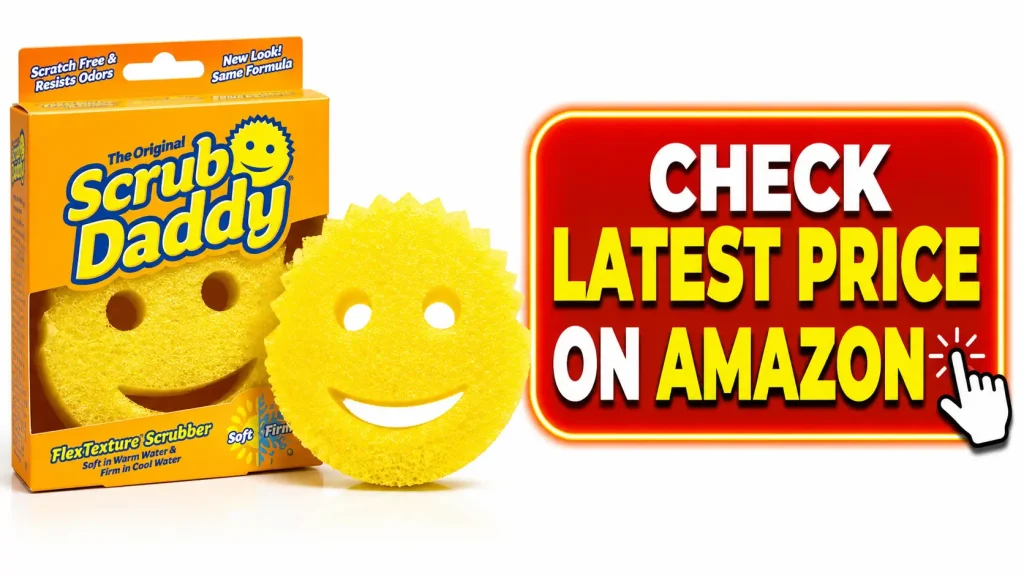
Scrub Daddy Original is a reusable cleaning scrubber made with the brand’s FlexTexture material.
Its defining feature is temperature-controlled firmness:
- In cool water, it becomes firmer for stronger scrubbing.
- In warm water, it becomes softer and more flexible.
The manufacturer also promotes Scrub Daddy as scratch-free on numerous common household surfaces and resistant to odors for up to 12 weeks when used as directed. These are manufacturer claims, so real lifespan and odor performance will depend on what you clean, how often you use it, and how well you rinse and dry it.
The Smiley-Face Design Is Functional
The recognizable face is not only a branding feature.
The design can help with several cleaning tasks:
- The eye holes provide finger grip.
- The mouth can clean spoons, forks, knives, and spatula edges.
- The round shape wraps around cups and bowls.
- The open structure allows water and food particles to pass through.
This makes Scrub Daddy feel more like a specialised scrubber than a conventional rectangular sponge.
Scrub Daddy Pros
- Changes firmness with water temperature
- Rinses relatively easily
- Dries quickly
- Holds less water than a traditional sponge
- Useful for cutlery and curved items
- Suitable for many common surfaces
- Does not have layers that can separate
- Comfortable for short cleaning jobs
Scrub Daddy Cons
- More expensive per piece than many traditional sponges
- Not very absorbent
- Poor choice for wiping large spills
- Can feel excessively firm in cold water
- May soften or break down with extended heavy use
- Round shape is not always ideal for flat surfaces
- Requires warm water when a softer texture is needed
What Is a Scotch-Brite Sponge?
Scotch-Brite offers traditional sponges, scouring pads, dishwands, foam scrubbers, and specialty cleaning tools.
A typical Scotch-Brite scrub sponge combines two functions:
- An absorbent sponge for water, soap, and wiping
- A textured surface for scrubbing food and grime
This design is familiar and practical. It allows you to wash dishes, absorb water, create suds, and scrub with one tool.
However, different Scotch-Brite surfaces have different levels of abrasiveness. A green Heavy Duty sponge and a blue Zero Scratch sponge should not be treated as interchangeable.
Scotch-Brite Pros
- Strong scrubbing options
- Good water absorption
- Holds and distributes dish soap well
- Familiar shape
- Effective for large dish loads
- Available in gentle and heavy-duty versions
- Usually sold in value-oriented multipacks
- Easy to find in supermarkets and general retailers
Scotch-Brite Cons
- Heavy-duty versions may damage delicate finishes
- Thick sponges can stay wet longer
- Food may become trapped in the sponge
- Traditional fibre layers can wear or separate
- The different colours and variants may confuse buyers
- Absorbent material can develop odor without proper drying
Material and Construction: Why They Clean Differently
Scrub Daddy and Scotch-Brite feel different because they are built for different cleaning behaviours.
Scrub Daddy FlexTexture
FlexTexture is an open, foam-like material that changes firmness according to water temperature.
It does not behave like a cellulose sponge. It absorbs relatively little water, which helps it rinse and dry faster. That also means it is not particularly effective for soaking up spills.
Its main job is scrubbing rather than wiping.
Scotch-Brite Sponge and Scouring Layers
Many Scotch-Brite products combine an absorbent sponge with a textured scrubbing surface.
The sponge holds:
- Water
- Dish soap
- Loose liquid
- Suds
- Small food particles
The scouring layer provides the mechanical cleaning action.
This combination is useful when moving quickly through a sink full of dishes. You can wash, scrub, and wipe without switching tools.
The disadvantage is moisture retention. A wet sponge left flat in a sink or container can take longer to dry.
Which Material Releases Food More Easily?
Scrub Daddy’s open structure generally gives sticky food fewer deep sponge pores in which to settle. Rice, oatmeal, egg, and cheese can still cling to it, but the material is often easier to flush under running water.
A traditional sponge can hold small food particles inside its pores. The scrubbing layer may also trap stringy or sticky residue.
Some modern Scotch-Brite products attempt to solve this problem. The brand’s current Heavy Duty Scrub Dots model, for example, is specifically promoted as rinsing clean even after contact with foods such as egg and cheese.
Scrub Daddy vs Scotch-Brite: Detailed Comparison
Scrubbing Power
Scotch-Brite Heavy Duty has the advantage when maximum aggression is the priority.
Its fixed scouring surface is designed to attack burnt food, grease, and stubborn residue on surfaces that can tolerate abrasion. It does not require cold water to remain aggressive.
Scrub Daddy is less specialised but more adaptable. In cool water, it becomes firm enough for dried food and moderate buildup. In warm water, it becomes soft enough for general dishwashing.
Winner for extreme grime: Scotch-Brite Heavy Duty
Winner for balanced everyday scrubbing: Scrub Daddy
Non-Stick Cookware Safety
Scrub Daddy is the more convenient option when you want one scrubber for both ordinary dishes and non-stick cookware.
The manufacturer identifies non-stick pans among the common surfaces on which Scrub Daddy Original can be used. Scotch-Brite identifies its Zero Scratch sponge—not its Heavy Duty product—as the appropriate option for non-stick cookware and glassware.
Even with a product labelled non-scratch, sensible precautions are still necessary:
- Allow cookware to cool before cleaning.
- Remove loose grit before scrubbing.
- Do not combine aggressive pressure with abrasive cleaning powders.
- Test an inconspicuous area on expensive or unusual finishes.
- Follow the cookware manufacturer’s instructions.
Winner: Scrub Daddy or Scotch-Brite Zero Scratch
Avoid as the default choice: Scotch-Brite Heavy Duty
Absorbency
Scotch-Brite wins this category clearly.
A traditional sponge can absorb water, wipe counters, spread soap, and collect loose liquid. Scrub Daddy Original is primarily a scrubber and holds much less water.
Choose Scotch-Brite when you frequently:
- Wipe water around the sink
- Clean large countertops
- Wash many plates consecutively
- Need a sponge to carry soap
- Absorb small spills during dishwashing
Choose Scrub Daddy when you dislike the heavy, waterlogged feeling of a traditional sponge.
Winner: Scotch-Brite
Soap Retention and Suds
Traditional Scotch-Brite sponges generally create and hold suds more easily because of their absorbent centres.
Scrub Daddy can be used with dish soap, but soap and water pass through it more quickly. You may need to reapply soap during a long dishwashing session.
The difference becomes less important when you:
- Apply soap directly to dishes
- Use a soap-dispensing wand
- Fill the sink with soapy water
- Clean only a few items at a time
Winner: Scotch-Brite
Grip and Comfort
This category depends on your hand size and cleaning style.
Scrub Daddy offers:
- Finger holes
- A rounded shape
- A mouth opening for utensils
- Good control around curves
Scotch-Brite offers:
- A larger flat surface
- Familiar rectangular or S-shaped designs
- Easy folding
- Better coverage on baking trays and counters
Scrub Daddy is often more convenient for cups, bowls, cutlery, and small pans. Scotch-Brite may feel faster when cleaning large flat surfaces.
Winner for utensils and curved items: Scrub Daddy
Winner for large flat areas: Scotch-Brite
Cleaning Speed
Scotch-Brite Heavy Duty may clean faster when the surface is durable and the residue is severe.
Scrub Daddy may clean faster when a task requires switching between gentle and firm scrubbing. You can change the texture with water instead of changing products.
Scotch-Brite Zero Scratch is effective for everyday messes, but it may require more effort than Heavy Duty on burnt food.
The fastest option therefore depends on the task:
- Burnt stainless-steel pot: Scotch-Brite Heavy Duty
- Everyday non-stick pan: Scrub Daddy or Zero Scratch
- Cutlery: Scrub Daddy
- Large countertop: Scotch-Brite
- Mixed sink of cookware: Scrub Daddy
- Grill grate: Heavy Duty
Rinsing and Food Release
Scrub Daddy usually has the advantage over a standard absorbent sponge.
Its open structure allows running water to move through the scrubber. It can release food without requiring extensive squeezing.
Traditional sponges may retain:
- Rice
- Oatmeal
- Egg
- Cheese
- Flour-based mixtures
- Small vegetable fragments
Scotch-Brite Scrub Dots models are designed to improve food release, making them more competitive in this category.
Winner over a traditional sponge: Scrub Daddy
Closer comparison: Scrub Daddy vs Scotch-Brite Scrub Dots
Drying Speed
Scrub Daddy generally dries faster because it holds less water and has an open structure.
Scotch-Brite Dobie is also a strong fast-drying option. Its flexible pad design is specifically promoted as drying quickly after use.
A conventional thick Scotch-Brite sponge takes longer to dry, especially when:
- Left flat
- Stored in a closed container
- Placed at the bottom of the sink
- Not squeezed after use
- Used continuously throughout the day
Winner: Scrub Daddy
Best Scotch-Brite alternative: Dobie
Odor Resistance
Scrub Daddy has a practical advantage because it dries faster and retains less food and moisture than a conventional sponge.
The manufacturer currently claims that Scrub Daddy Original can resist odors for up to 12 weeks when used as directed. That claim should not be confused with a guaranteed 12-week physical lifespan. A heavily used scrubber may wear out before that point.
Selected Scotch-Brite Odor Resist products are promoted as resisting bacterial odors for up to three weeks when rinsed and dried correctly. Again, that does not mean the product is free from harmful microorganisms.
Winner for naturally fast drying: Scrub Daddy
Best treated traditional sponge: Scotch-Brite Odor Resist
Durability and Lifespan
There is no universal lifespan for either product.
Longevity depends on:
- Cleaning frequency
- Pressure
- Water temperature
- Surface roughness
- Exposure to sharp edges
- Cleaning chemicals
- Whether the product is rinsed and dried
Scrub Daddy has no glued scrubbing layer that can peel away. However, its foam can soften, tear, or lose structure over time.
Traditional Scotch-Brite sponges can become compressed, discoloured, torn, or separated between layers. Heavy-duty fibres can also become less effective as they wear.
Instead of relying only on the calendar, replace either product when it:
- Develops a persistent odor
- Stops rinsing clean
- Tears or crumbles
- Loses scrubbing performance
- Separates into layers
- Remains permanently greasy
- Becomes contaminated by raw meat juices or another high-risk mess
Winner: Depends on usage
More predictable structure: Scrub Daddy
Lower replacement cost: Scotch-Brite
Scrub Daddy vs a Regular Sponge
Scrub Daddy is not simply a brightly coloured version of a regular kitchen sponge.
A regular sponge is usually better for:
- Absorbing water
- Holding soap
- Wiping counters
- Washing many dishes
- Cleaning with warm soapy water
Scrub Daddy is usually better for:
- Scrubbing
- Quick rinsing
- Fast drying
- Curved objects
- Cutlery
- Switching between soft and firm cleaning
- Reducing the wet-sponge feeling beside the sink
The biggest question is whether you need a sponge or a scrubber.
When wiping and absorbency are your priorities, choose a traditional sponge. When scrubbing and quick drying matter more, choose Scrub Daddy.
For many households, the most practical setup is not choosing only one. A Scrub Daddy can handle stuck-on food while a cloth or sponge handles wiping and spills.
Is Scrub Daddy Worth It or Just Hype?
Scrub Daddy is more expensive than many basic kitchen sponges, but its value is not based only on cleaning strength.
You are paying for:
- Temperature-responsive firmness
- A functional shape
- Fast drying
- Easy rinsing
- Multi-surface versatility
- Odor resistance
- A reusable structure
These benefits are meaningful when they solve a problem you actually have.
Scrub Daddy is probably worth it when:
- Your traditional sponges develop odor quickly.
- You regularly scrub dried food.
- You own several types of cookware.
- You dislike food becoming trapped in sponges.
- You clean utensils and curved items frequently.
- You want one scrubber that can change firmness.
It may not be worth the premium when:
- You primarily wipe counters.
- You need strong absorbency.
- You replace sponges very frequently.
- You only wash lightly soiled dishes.
- You already use separate brushes and scouring pads.
- Your main cleaning task is heavy grill or oven-rack buildup.
Scrub Daddy is not merely hype, but it is also not a universal replacement for every sponge, cloth, brush, and scouring pad.
Which Sponge Is More Hygienic?
No reusable kitchen sponge should be assumed to be hygienic simply because it looks clean or has no noticeable odor.
Moisture, trapped food, storage conditions, and cross-contamination all matter.
Scrub Daddy Hygiene Advantages
- Holds less water
- Dries relatively quickly
- Rinses easily
- Has fewer deep sponge pores
- Can be cleaned on the top rack of a dishwasher
- Can be sanitised according to the manufacturer’s instructions
Scrub Daddy advises cleaning the product under warm running water and says most of its products are top-rack dishwasher safe. Its FAQ also provides microwave sanitising instructions, although users should follow those instructions precisely and never microwave a dry cleaning product.
Scotch-Brite Hygiene Advantages
- Selected products are dishwasher cleanable
- Odor Resist versions help control product odor
- Replaceable multipacks make regular replacement affordable
- Scrub Dots models are designed to release sticky food more easily
Scotch-Brite says selected Zero Scratch, Dobie, and Odor Resist products can be cleaned repeatedly on the dishwasher’s top rack. Product-specific instructions should always be checked because the Scotch-Brite range includes many different materials and constructions.
Important Hygiene Rule
Do not use your everyday dish sponge to clean raw meat juices and then return it to ordinary dishes.
Use disposable paper, a dedicated washable cloth, or another appropriate cleaning method for high-risk contamination. Clean and disinfect the affected surface separately.
Overall hygiene advantage: Scrub Daddy, mainly because it rinses and dries quickly
Best traditional option: A properly maintained Scotch-Brite Odor Resist or fast-drying Dobie pad
Scrub Daddy vs Scotch-Brite for Specific Cleaning Jobs
Best for Non-Stick Pans
Winner: Scrub Daddy or Scotch-Brite Zero Scratch
Both are positioned for gentler cleaning. Avoid automatically using Scotch-Brite Heavy Duty on non-stick coatings.
Remove loose grit first and avoid excessive pressure.
Best for Burnt Pots and Pans
Winner: Scotch-Brite Heavy Duty for durable, uncoated cookware
Its more aggressive scouring action is better suited to severe buildup.
For coated or enamel cookware, check the manufacturer’s care guidance before using an abrasive scrubber.
Best for Stainless-Steel Cookware
Winner: Depends on the finish and residue
Scrub Daddy is the more versatile starting point. Scotch-Brite Heavy Duty may work faster on uncoated, durable cookware, but aggressive scrubbing can affect some finishes.
Scrub with the direction of the grain where applicable and test a small area first.
Best for Stainless-Steel Appliances
Winner: A soft cloth or product approved by the appliance manufacturer
Do not assume that a sponge safe for stainless-steel cookware is automatically safe for a polished refrigerator or dishwasher door.
Some current Scotch-Brite non-scratch product pages specifically advise against use on stainless-steel appliances.
Best for Cast Iron
Winner: Depends on your cast-iron care method
A firm Scrub Daddy can remove residue without holding much water. Scotch-Brite Heavy Duty offers stronger abrasion but may also affect seasoning more aggressively.
Avoid leaving cast iron wet, and dry it immediately after cleaning.
Best for Glass Cooktops
Winner: Scotch-Brite Zero Scratch or a cooktop-approved pad
Use only a product approved for the cooktop surface. Remove loose particles before scrubbing because trapped grit can scratch even when the sponge itself is labelled non-scratch.
Best for Air Fryer Baskets
Winner: Scrub Daddy or Scotch-Brite Zero Scratch
Most air fryer baskets have non-stick coatings. Heavy abrasion can shorten the coating’s lifespan.
Soak dried residue first, use warm soapy water, and scrub gently.
Best for Enameled Dutch Ovens
Winner: Scrub Daddy in warm water or a gentle Scotch-Brite product
Avoid aggressive Heavy Duty scouring unless the cookware manufacturer specifically approves it.
Enameled surfaces can develop dull areas or visible marks from overly abrasive cleaning.
Best for Baking Trays
Winner: Depends on the tray
- Coated baking tray: Scrub Daddy or Zero Scratch
- Uncoated durable tray: Scotch-Brite Heavy Duty
- Heavily burnt tray: Soak first, then choose the safest effective scrubber
Best for Oven Racks and Grill Grates
Winner: Scotch-Brite Heavy Duty
This is one of the tasks for which Heavy Duty products are specifically designed.
Scrub Daddy can handle light and moderate residue, but Scotch-Brite Heavy Duty provides more aggressive fixed abrasion.
Best for Glassware
Winner: Scrub Daddy in warm water or Scotch-Brite Zero Scratch
Scrub Daddy’s mouth is useful for cleaning thin utensil edges, while its flexible warm-water texture can wrap around glassware.
For fragile stemware, use minimal pressure.
Best for Plastic Food Containers
Winner: Scrub Daddy in warm water
Its softer warm-water texture works well for corners and curved surfaces.
Avoid aggressive scouring that may leave micro-scratches where stains and odors can collect.
Best for Cutlery
Winner: Scrub Daddy
The smile-shaped mouth can grip both sides of a spoon, fork, or utensil.
Handle knives carefully. Pull the sponge from the back of the blade toward the edge rather than wrapping your fingers around a sharp blade.
Best for Countertops
Winner: Scotch-Brite for wiping; Scrub Daddy for stuck-on residue
A traditional sponge absorbs and spreads cleaning solution more effectively. Scrub Daddy provides better targeted scrubbing.
Always check the care requirements for stone, laminate, quartz, wood, and specialty finishes.
Best for Bathroom Cleaning
Winner: Tie
Scrub Daddy is useful for:
- Faucets
- Sink edges
- Soap residue
- Curved fixtures
- Tile details
Scotch-Brite is useful for:
- Tub surfaces
- Shower walls
- Larger areas
- Wiping
- Holding cleaning solution
Use a non-scratch variant on delicate bathroom finishes.
Price and Value in the USA, UK, Canada, and Australia
Retail prices vary considerably by country, retailer, pack size, promotion, and import status.
Scrub Daddy is commonly positioned as a premium cleaning product, while Scotch-Brite is often available in larger value packs. However, shelf price alone does not determine which option costs less over time.
Use this formula:
Cost per week = Pack price ÷ Number of sponges ÷ Average lifespan in weeks
For example, a cheaper sponge replaced every week may cost more annually than a premium scrubber used safely for several weeks.
When comparing prices in the USA, UK, Canada, or Australia, check:
- Number of items in the pack
- Exact product variant
- Shipping cost
- Imported versus locally distributed stock
- Estimated replacement frequency
- Whether one product replaces several cleaning tools
- Whether the sponge will be used for wiping, scrubbing, or both
Do not compare a single Scrub Daddy with a multi-pack of Scotch-Brite without calculating the cost per item and expected cost per week.
Which Sponge Should You Buy?
Choose Scrub Daddy If:
- You want the best all-around scrubber.
- You clean several surface types.
- You own non-stick cookware.
- You dislike wet traditional sponges.
- You want a product that rinses quickly.
- You regularly clean cutlery and curved items.
- You value temperature-controlled firmness.
- You are willing to pay more for versatility.
Choose Scotch-Brite Heavy Duty If:
- Your main problem is burnt or baked-on food.
- You regularly clean oven racks.
- You clean grill grates.
- You use durable uncoated cookware.
- You want stronger fixed abrasion.
- You prefer a lower upfront price.
- You can keep it away from delicate surfaces.
Choose Scotch-Brite Zero Scratch If:
- You want a traditional absorbent sponge.
- You wash many dishes at once.
- You need a gentler product for non-stick pans.
- You want strong soap retention.
- You wipe counters with the same sponge.
- You prefer a familiar sponge design.
Choose Scotch-Brite Dobie If:
- You want a thin, flexible pad.
- You want faster drying than a thick sponge.
- You clean corners and tight areas.
- You want non-scratch scrubbing without Scrub Daddy’s round shape.
- You do not need much absorbency.
Is Scrub Mommy a Better Scotch-Brite Alternative?
Scrub Mommy may be a more direct alternative to a traditional Scotch-Brite sponge than Scrub Daddy Original.
It combines:
- A FlexTexture scrubbing side
- An absorbent ResoFoam side
- Temperature-responsive firmness
- Wiping and sudsing capability
The manufacturer describes Scrub Mommy as a dual-sided product combining FlexTexture with an absorbent foam side.
Choose Scrub Mommy instead of Scrub Daddy when you want:
- Scrubbing and wiping in one product
- Better soap retention
- More absorbency
- A closer replacement for a dual-sided kitchen sponge
Choose Scrub Daddy Original when you prefer:
- Faster drying
- Less water retention
- A simpler single-material scrubber
- Easier rinsing
- Less sponge-like behaviour
Can Scrub Daddy Replace Scotch-Brite?
Scrub Daddy can replace Scotch-Brite for many everyday cleaning jobs, but it cannot replace every Scotch-Brite product.
It can replace a standard non-scratch scrubber for:
- Everyday dishes
- Non-stick pans
- Cups and bowls
- Cutlery
- Countertop residue
- Bathroom fixtures
It may not fully replace:
- An absorbent wiping sponge
- A heavy-duty grill pad
- A specialised oven-rack scrubber
- A large sponge for washing many dishes
- A disposable sponge used for high-risk contamination
The best decision is based on the cleaning task, not brand loyalty.
A practical kitchen may use:
- Scrub Daddy for scrubbing
- A washable cloth for wiping
- Scotch-Brite Heavy Duty for durable grill and oven parts
How to Clean and Maintain Scrub Daddy
After each use:
- Rinse it thoroughly under warm running water.
- Massage the material to release food.
- Add mild dish soap if grease remains.
- Shake or squeeze out excess water.
- Store it upright or in a ventilated holder.
- Allow it to dry before the next use.
Scrub Daddy says most of its products are top-rack dishwasher safe. Its official FAQ also provides a microwave sanitising method for damp Scrub Daddy products. Follow the manufacturer’s latest instructions rather than improvising with heat.
Never microwave a dry scrubber or a product containing metal.
How to Clean and Maintain Scotch-Brite
After each use:
- Remove visible food.
- Rinse from both sides.
- Squeeze out as much water as possible.
- Store the sponge where air can circulate.
- Do not leave it submerged in dirty dishwater.
- Replace it when odor or structural damage remains after cleaning.
Selected Scotch-Brite products can be cleaned on the top rack of a dishwasher, but instructions differ by model. Check the packaging or official product page for your exact sponge.
Common Mistakes to Avoid
Using Heavy Duty Scotch-Brite on Every Surface
Heavy Duty does not mean universally better. Greater abrasion can increase the risk of damaging coatings and polished finishes.
Treating “Non-Scratch” as an Absolute Guarantee
A non-scratch scrubber can still carry trapped grit. The particle between the sponge and the surface may cause the scratch.
Rinse both the surface and scrubber before cleaning delicate items.
Leaving the Sponge Wet
A wet sponge stored flat dries slowly. Use a rack, holder, or ventilated area.
Using One Sponge for Every Type of Mess
Keep food-contact cleaning separate from floors, pet areas, bins, toilets, and raw meat cleanup.
Applying Too Much Pressure
Allow water, soaking time, dish soap, and repeated light passes to do part of the work.
Excessive pressure can damage both the surface and the cleaning tool.
Assuming No Odor Means No Contamination
Odor is not a reliable hygiene test. A sponge may require cleaning or replacement even when it does not smell.
Keeping a Damaged Sponge Too Long
A cheap replacement is less costly than damaged cookware or cross-contaminated dishes.
Scrub Daddy vs Scotch-Brite: Final Verdict
Scrub Daddy is the better overall choice for shoppers who want a versatile, quick-drying scrubber that works across a variety of ordinary household cleaning tasks.
Its temperature-responsive material, easy-rinsing structure, and functional shape give it advantages that a standard kitchen sponge cannot fully match.
Scotch-Brite remains the better choice in several important situations.
Scotch-Brite Heavy Duty is better for aggressive cleaning on durable surfaces. Scotch-Brite Zero Scratch is better for people who want a conventional absorbent sponge for everyday dishes and non-stick cookware. Scotch-Brite Dobie is a strong option for buyers who want a flexible, fast-drying, non-scratch pad.
The final decision is straightforward:
- Buy Scrub Daddy for the best overall versatility.
- Buy Scotch-Brite Heavy Duty for grills, racks, and severe buildup.
- Buy Scotch-Brite Zero Scratch for affordable everyday dishwashing.
- Buy Scrub Mommy when you want Scrub Daddy’s scrubbing texture with traditional sponge absorbency.
For most mixed-surface kitchens, Scrub Daddy is the strongest single-product choice. For the most complete cleaning setup, pair it with an absorbent cloth or sponge and keep a separate heavy-duty pad for surfaces that can safely handle aggressive scrubbing.
Frequently Asked Questions
Is Scrub Daddy better than Scotch-Brite?
Scrub Daddy is better for versatility, quick drying, easy rinsing, and temperature-controlled scrubbing. Scotch-Brite is better for absorbency, soap retention, wiping, and specialised heavy-duty cleaning.
Is Scotch-Brite stronger than Scrub Daddy?
Scotch-Brite Heavy Duty is generally more aggressive than Scrub Daddy, especially on durable surfaces. Scotch-Brite Zero Scratch is gentler and designed for everyday dishes and non-stick cookware.
Which lasts longer, Scrub Daddy or Scotch-Brite?
Lifespan depends on usage. Scrub Daddy does not have layers that can separate, while Scotch-Brite is usually cheaper to replace. Rough surfaces, sharp edges, strong chemicals, and poor maintenance shorten the life of both.
How long does Scrub Daddy last?
There is no fixed lifespan. Replace it when it tears, loses performance, remains greasy, or develops persistent odor. The manufacturer’s odor-resistance claim should not be interpreted as a guaranteed physical lifespan.
How long does a Scotch-Brite sponge last?
It depends on how often it is used and what it cleans. Replace it when the sponge becomes compressed, the layers separate, the surface wears down, or odor remains after cleaning.
Is Scrub Daddy safe for non-stick pans?
The manufacturer promotes Scrub Daddy Original for common surfaces including non-stick pans. Use moderate pressure, remove loose grit first, and follow the cookware manufacturer’s cleaning instructions.
Can Scotch-Brite scratch non-stick cookware?
Heavy-duty Scotch-Brite products are not the best choice for non-stick coatings. Use a Scotch-Brite Zero Scratch product intended for non-stick cookware instead.
Which sponge smells less?
Scrub Daddy usually has an advantage because it holds less water and dries quickly. Scotch-Brite Odor Resist is the better traditional sponge for people concerned about odor.
Which sponge is more absorbent?
Scotch-Brite is more absorbent. Scrub Daddy Original is a scrubber rather than a traditional wiping sponge.
Does Scrub Daddy hold dish soap?
Yes, but it does not retain soap as long as an absorbent sponge. You may need to reapply soap during longer cleaning sessions.
Can Scrub Daddy go in the dishwasher?
Scrub Daddy says most of its products are top-rack dishwasher safe, with specific exceptions listed in its care guidance.
Can Scotch-Brite go in the dishwasher?
Selected Scotch-Brite products can be cleaned on the top rack of a dishwasher. Check the instructions for the exact model because the brand sells products made from different materials.
Is Scrub Daddy more hygienic than a regular sponge?
It can be easier to maintain because it rinses and dries quickly. However, it still needs regular cleaning, proper storage, and timely replacement.
Is Scrub Daddy worth the money?
It is worth considering when you value adjustable firmness, fast drying, easy rinsing, and multi-surface cleaning. It offers less value when absorbency and wiping are your primary needs.
Is Scrub Daddy good for burnt food?
A firm Scrub Daddy can remove moderate burnt or dried residue. Scotch-Brite Heavy Duty may work faster on severe buildup when the cookware surface can tolerate stronger abrasion.
Which is better for an air fryer?
Scrub Daddy in warm water or Scotch-Brite Zero Scratch is the safer starting point for most coated air fryer baskets. Avoid aggressive heavy-duty pads unless the appliance manufacturer approves them.
Which is better for cast iron?
Scrub Daddy provides controllable scrubbing and holds relatively little water. Scotch-Brite Heavy Duty provides more abrasion but may remove more seasoning. Follow your cookware manufacturer’s recommendations.
Is Scrub Mommy better than Scrub Daddy?
Scrub Mommy is better for wiping, soap retention, and absorbency. Scrub Daddy Original is better for quick drying and buyers who want a dedicated scrubber rather than a dual-sided sponge.
Should I buy Scotch-Brite Heavy Duty or Zero Scratch?
Buy Heavy Duty for durable uncoated cookware, grill grates, oven racks, and severe buildup. Buy Zero Scratch for non-stick cookware, glassware, dishes, and everyday cleaning.
Can I use the same sponge in the kitchen and bathroom?
It is better to keep separate cleaning tools for different areas. This reduces the risk of transferring contamination between surfaces.

“I believe great cooking starts with the right tools, trusted advice, and a little confidence in the kitchen.”
Hi, I’m Emma Carter. My love for cooking began in my grandmother’s kitchen, where I learned that every great meal starts with simple ingredients and the right cookware. Over the years, I’ve spent countless hours researching, testing, and comparing kitchen appliances, cookware, coffee makers, air fryers, and other everyday kitchen essentials.
Here at KiCook, my goal is to make your buying decisions easier with honest product reviews, practical buying guides, and easy-to-follow cooking tips. Whether you’re upgrading your kitchen or searching for the best appliance for your home, I focus on providing clear, reliable, and research-backed information you can trust.
When I’m not testing new kitchen gadgets or writing in-depth guides, you’ll usually find me trying new recipes, visiting local farmers’ markets, or enjoying a quiet cup of coffee while planning my next kitchen project.