

An indoor grill lets you cook perfectly charred vegetables, juicy chicken, and even frozen foods year-round — no backyard, no charcoal, no weather worries required. With the right temperatures and a few simple techniques, you can get real grill flavour from your kitchen countertop.
You Deserve Great Grilled Food Any Day of the Week
You want that smoky, charred flavour on a Tuesday night in January. But it’s freezing outside in Manchester, raining in Vancouver, or you’re in a high-rise flat in Sydney with no balcony. The outdoor grill isn’t an option and a frying pan just doesn’t cut it.
I’ve helped hundreds of home cooks make the most of their indoor grills, from compact electric contact grills to open-plate countertop models. Over the years, I’ve learned what actually works and what wastes your time and dries out your food.
By the end of this guide, you’ll know exactly how to grill vegetables that stay crisp, chicken that’s juicy and safe to eat, and frozen foods that come out tasting like they were made fresh. No guesswork, no rubbery results.
The 3 Biggest Problems With Indoor Grilling (And How to Fix Them)
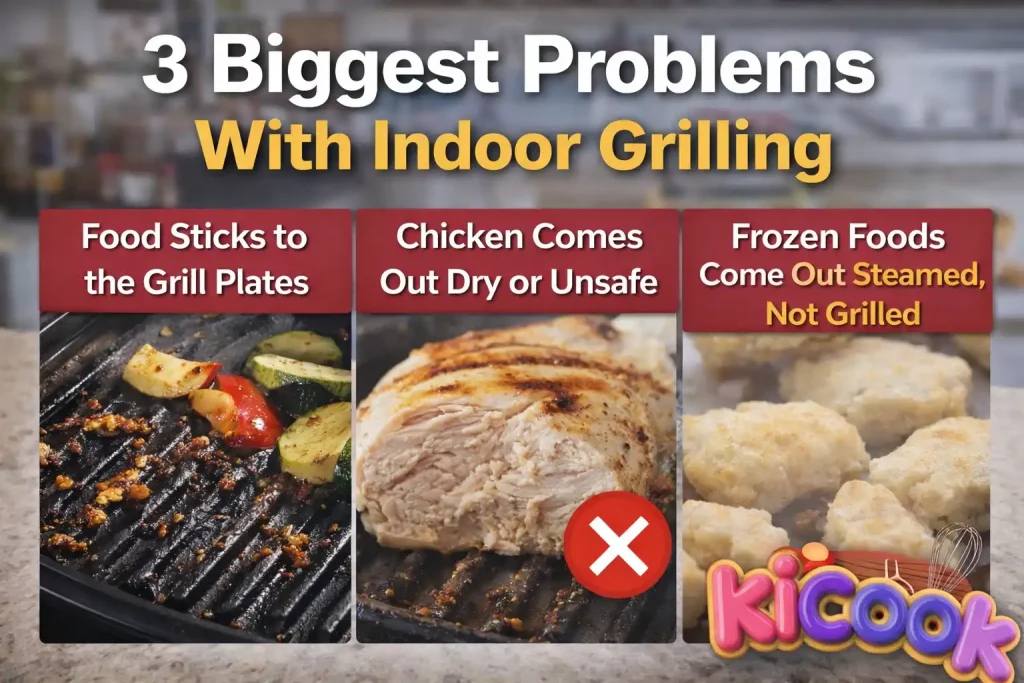
Problem 1: Food Sticks to the Grill Plates
This is the complaint I hear most often. You open the lid and half your chicken breast is glued to the ridged surface. Frustrating and it wastes good food.
Why it happens: Most people either skip preheating or skip oiling, or both. Cold plates grab onto proteins immediately. Once food bonds to a cool surface, it won’t release cleanly.
What to do today: Always preheat your indoor grill for at least 5 minutes before adding food. Then lightly brush or spray the plates with a high-smoke-point oil avocado oil, vegetable oil, or refined coconut oil all work well. Canola oil is cheap and widely available across the US, UK, Canada, and Australia. Don’t use butter or extra-virgin olive oil directly on the plates both burn at grill temperatures and create bitterness.
Problem 2: Chicken Comes Out Dry or Unsafe
Undercooked chicken is a food safety risk. Overcooked chicken is a waste of a good meal. Most people experience one or the other rarely the perfect middle.
Why it happens: Chicken breast thickness varies wildly. A thick supermarket breast in the US might be twice the size of a thin free-range breast from a UK farmers’ market. Cooking time by the clock alone doesn’t account for that.
What to do today: Use a meat thermometer every single time. The safe internal temperature for chicken is 165°F (74°C) in the US and Canada, which aligns with the UK Food Standards Agency and Food Standards Australia New Zealand (FSANZ) recommendations. Pound thick chicken breasts to an even thickness before grilling this is the single biggest step you can take for even cooking. Aim for about 3/4 inch (2 cm) thick.
Problem 3: Frozen Foods Come Out Steamed, Not Grilled
You put a frozen burger on the indoor grill and it comes out pale and soggy more steamed than seared. The grill marks are there, but the texture and flavour are off.
Why it happens: Frozen food releases a lot of moisture as it thaws on the grill. On a contact grill (the kind with a lid that closes over the food), that steam gets trapped between the plates and cooks the food by steam rather than direct heat.
What to do today: For contact grills, leave the lid propped slightly open for the first 3–4 minutes while the food thaws and the excess moisture escapes. Then close the lid for the remainder of the cook. For open-plate grills, pat frozen foods as dry as possible before placing them on and don’t crowd the grill surface. Give every piece space to breathe.
Grilling Vegetables Indoors: What Actually Works
Which Vegetables Grill Best?
Not every vegetable suits an indoor grill equally. The ones that work best have enough natural water content to stay moist but enough structure to hold up to direct heat. My go-to list:
- Zucchini (courgette in the UK and Australia) — sliced lengthways at about 1/3 inch thick
- Bell peppers — cut into flat planks, seeds removed
- Corn on the cob — halved lengthways for a contact grill, or left whole for an open-plate model
- Asparagus — left whole, woody ends snapped off
- Portobello mushrooms — whole caps, brushed with olive oil
- Red onion — sliced into thick rings, secured with a toothpick
The key rule: cut flat. Vegetables need maximum contact with the grill surface to pick up those char marks and that smoky flavour. Thick, uneven pieces steam in the middle and burn on the edges.
Temperature and Timing for Grilled Vegetables
Set your indoor grill to medium-high around 375–400°F (190–200°C) if your grill has a temperature dial. If it only has a heat level (low, medium, high), use medium-high.
Season vegetables just before grilling, not hours ahead. Salt draws moisture out of vegetables, and too much surface moisture prevents proper caramelisation. A light drizzle of oil, a pinch of salt, cracked pepper, and garlic powder goes a long way.
A real-life example: my neighbour in Brisbane tried grilling capsicum (bell pepper) at low heat for 20 minutes. They were soft but pale and bland. The fix was simple higher heat, shorter time (8 minutes at 400°F), and a result she described as “completely different food.”
Grilling Chicken Indoors Without Drying It Out
Preparing Chicken for the Indoor Grill
The preparation stage matters more than the cooking stage for chicken. Here’s a simple process that works every time:
- Take chicken out of the fridge 15–20 minutes before cooking. Cold chicken straight from the fridge seizes up on the grill and cooks unevenly.
- Pound breasts to an even thickness with a rolling pin or the bottom of a heavy pan. Even thickness means even cooking.
- Marinate if you have time even 20 minutes in olive oil, lemon juice, garlic, and herbs makes a real difference. If you’re short on time, a simple dry rub of paprika, garlic powder, salt, and pepper applied just before grilling works brilliantly.
- Pat the surface dry before placing on the grill. A dry surface sears; a wet surface steams.
Cooking Times and Temperature for Chicken
For a contact grill (both plates touching the food), a 3/4-inch chicken breast takes roughly 12–14 minutes at 400°F (200°C). The dual-sided heat cuts cooking time nearly in half compared to a frying pan or open grill.
For an open-plate grill, add 4–6 minutes and flip halfway.
Always verify with a thermometer. Pull the chicken at exactly 165°F (74°C) not higher. Every extra degree dries it out faster than you’d expect.
“Moisture loss in poultry accelerates significantly above 165°F. Cooking to 180°F or higher is one of the most common causes of dry chicken, despite the meat being technically safe at 165°F.” — Harold McGee, Food Science Author, On Food and Cooking
Indoor Grilling for Frozen Foods: The Real Story
Can You Grill Straight From Frozen?
Yes — and for some foods, it’s actually preferable. Frozen fish fillets, veggie patties, and even some chicken strips hold together better when grilled from frozen, because the exterior sears before the interior has a chance to become fragile.
For frozen burgers (beef, turkey, or plant-based), grilling from frozen is entirely safe and widely recommended by food safety authorities. The USDA Food Safety and Inspection Service confirms that frozen ground beef patties can be cooked safely from frozen as long as they reach an internal temperature of 160°F (71°C).
Cooking times for frozen foods run roughly 50–75% longer than their thawed equivalents. Plan ahead.
Frozen Foods That Work Well on an Indoor Grill
- Frozen beef or plant-based burger patties — 16–20 minutes at 400°F on a contact grill
- Frozen fish fillets — 10–14 minutes at 375°F
- Frozen chicken strips — 10–12 minutes at 375°F (always verify internal temp)
- Frozen vegetable patties (falafel, hash browns, corn fritters) — 8–12 minutes at 375°F
Never use your indoor grill for frozen foods that are breaded with a wet batter — things like beer-battered fish. The batter runs, smokes, and makes a mess of the plates. Dry-crumbed items (panko-crumbed schnitzel, crumbed calamari) work fine.
“Cooking frozen protein foods from a solid state is often safer than partially thawed products, because the controlled temperature gradient reduces the window for bacterial growth in the danger zone.” — Dr. Benjamin Chapman, Food Safety Specialist, North Carolina State University
Cleaning and Caring for Your Indoor Grill
This section doesn’t get enough attention, but it matters a lot. A dirty grill burns flavours from your last meal into your current one and creates smoke that fills your kitchen.
After Every Use
Let the grill cool for 5 minutes not all the way, just enough that you won’t burn yourself. Wipe the plates with a folded damp paper towel while they’re still warm. Baked-on residue comes off far more easily at this stage than when fully cold.
If your grill has removable plates, wash them in warm soapy water. Most are dishwasher-safe, but check your manual some non-stick coatings degrade faster in the dishwasher.
For fixed plates, use a soft silicone brush or a damp cloth. Never use metal scourers on non-stick surfaces — you’ll scratch the coating and end up with both sticking problems and flaking non-stick material in your food.
“Maintaining non-stick cooking surfaces correctly extends their useful life by years and prevents the degradation that causes sticking and uneven heating.” — America’s Test Kitchen, The Complete Cooking for Two Cookbook
Frequently Asked Questions on Indoor Grilling Made Easy
Is indoor grilling as healthy as outdoor grilling?
Indoor grilling is comparable to outdoor grilling in terms of nutritional outcome. Both methods allow excess fat to drip away from meat, which reduces overall fat content compared to pan-frying. The main difference is that outdoor charcoal grilling can produce more polycyclic aromatic hydrocarbons (PAHs) from flare-ups and smoke. Indoor electric grills produce little to no smoke under normal use, making them a cleaner option for everyday cooking.
What is the best indoor grill for small kitchens?
A compact contact grill sometimes called a clamshell grill is the best choice for small kitchens. It takes up minimal counter space, cooks from both sides simultaneously (cutting cooking time roughly in half), and is easy to store upright. Popular options are available in major retail chains across the US, UK, Canada, and Australia, usually in the $30–$100 / £25–£80 price range.
Can I use an indoor grill without oil?
Technically yes, especially on well-maintained non-stick surfaces. But a light coating of oil serves two purposes: it helps achieve better browning (the Maillard reaction needs fat to develop properly) and it protects the non-stick coating over time. For very lean proteins like skinless chicken breast, skipping oil entirely often leads to sticking even on non-stick plates.
How do I stop my indoor grill from smoking?
The most common cause of smoke is food residue burning on the plates so keep them clean. The second most common cause is oil choice. Oils with a low smoke point, like extra-virgin olive oil or butter, smoke heavily at grill temperatures. Switch to a refined oil with a higher smoke point: avocado oil (520°F / 270°C), vegetable oil (400–450°F / 205–230°C), or grapeseed oil (420°F / 215°C). Also avoid over-oiling — a light coat is all you need.
Can I grill marinated chicken on an indoor grill without burning the marinade?
Yes, with one important step: shake or scrape off excess marinade before placing the chicken on the grill. Thick, sugar-heavy marinades (teriyaki, BBQ sauce, honey-based glazes) burn quickly at high heat. The solution is to grill the chicken plain and brush the glaze on during the last 2–3 minutes of cooking, or serve it on the side as a dipping sauce. Herb and oil-based marinades (lemon, garlic, herbs) handle grill heat much better and can stay on throughout cooking.
Three Things Worth Remembering
Indoor grilling made easy comes down to three non-negotiable habits. Preheat the grill every time — five minutes is all it takes and it changes everything about how food cooks and releases. Use a meat thermometer for chicken guessing is how you end up with dry, overcooked meat or food that isn’t safe to eat. And manage moisture pat food dry before it goes on, give pieces space, and let frozen foods vent their steam before you close the lid.
These aren’t complicated rules. They’re small habits that stack up into genuinely great results.
Whether you’re in a flat in London, a condo in Toronto, a house in suburban Chicago, or an apartment in Melbourne your indoor grill can produce food worth looking forward to. Start with one of the foods from this guide tonight. You’ve got everything you need.

“I believe great cooking starts with the right tools, trusted advice, and a little confidence in the kitchen.”
Hi, I’m Emma Carter. My love for cooking began in my grandmother’s kitchen, where I learned that every great meal starts with simple ingredients and the right cookware. Over the years, I’ve spent countless hours researching, testing, and comparing kitchen appliances, cookware, coffee makers, air fryers, and other everyday kitchen essentials.
Here at KiCook, my goal is to make your buying decisions easier with honest product reviews, practical buying guides, and easy-to-follow cooking tips. Whether you’re upgrading your kitchen or searching for the best appliance for your home, I focus on providing clear, reliable, and research-backed information you can trust.
When I’m not testing new kitchen gadgets or writing in-depth guides, you’ll usually find me trying new recipes, visiting local farmers’ markets, or enjoying a quiet cup of coffee while planning my next kitchen project.