
Have you cleaned your coffee maker, brewed a fresh cup, and then noticed a sharp vinegar taste? It can be frustrating, especially when you cleaned the machine to make your coffee taste better.
The good news is that your coffee maker may not be damaged. In many cases, the taste comes from leftover vinegar or descaling solution inside the machine, a carafe that still smells of vinegar, or removable parts that need another wash.
The solution is usually straightforward: follow your coffee maker’s cleaning instructions, run the required fresh-water rinse cycles, and clean the parts that come into contact with your coffee.
In this guide, you will learn why coffee tastes like vinegar after cleaning, how to remove the unwanted taste, and what to do if the problem continues after rinsing.
Quick Answer: Why Does Coffee Taste Like Vinegar After Cleaning?
Coffee may taste like vinegar after cleaning because some vinegar or descaling solution remains inside the water reservoir, brewing system, carafe, or filter basket. The machine may need additional fresh-water rinse cycles according to the manufacturer’s instructions.
Start by emptying the reservoir, washing the removable parts, and running the recommended water-only cycles. If the taste or smell remains, check your cleaning method and water filter before brewing another cup.
Do not drink coffee that still tastes like cleaning solution. Discard it and finish the recommended cleaning and rinsing process before using the machine normally.
Why Does Coffee Taste Like Vinegar After Cleaning the Coffee Maker?

Several things can cause this problem. Finding the actual cause will help you avoid repeating the entire cleaning process unnecessarily.
1. Vinegar Is Still Inside the Coffee Maker
White vinegar is sometimes used to remove mineral deposits from coffee makers. However, it has a strong smell and acidic taste.
If the vinegar is not rinsed out properly, some may remain in the internal water pathways. When you brew coffee, that residue can affect the smell and flavour of the finished drink.
This is one of the first things to investigate if your coffee tasted normal before cleaning but became sharp or vinegary immediately afterward.
2. You Have Not Completed Enough Rinse Cycles
One rinse cycle may not remove every trace of vinegar from every coffee maker.
Different machines have different cleaning procedures. Some require two fresh-water brewing cycles, while others require more.
For example, KitchenAid’s official coffee maker descaling instructions recommend two brewing cycles with fresh, cool water for the models covered by that guide.
Always follow the instructions for your particular model rather than assuming that the same number of cycles works for every machine.
3. The Carafe or Filter Basket Still Smells Like Vinegar
You may have rinsed the internal system properly but forgotten to clean the removable parts.
Vinegar residue can remain in the glass carafe, filter basket, reusable filter, or lid. Even a small amount of leftover residue can affect the smell of freshly brewed coffee.
Remove the parts that your manufacturer allows you to wash. Clean them with dish soap and water if the instructions permit it, then rinse them thoroughly.
Pay particular attention to corners, lids, and areas where old coffee residue may collect.
4. Your Descaling Solution Has Not Been Rinsed Out
Not everyone uses vinegar to clean a coffee maker. Some machines require a commercial descaler or a manufacturer-approved cleaning product.
These products can also leave an unwanted smell or taste if the cleaning procedure is incomplete.
For example, Philips provides model-specific coffee maker descaling instructions. Its guidance explains the rinsing procedure for the models covered by that page.
If you used a commercial descaler, check the product label and your coffee maker’s manual. Do not assume that a vinegar-cleaning procedure is suitable for another product.
5. Your Water Filter Needs Attention
Some coffee makers have a removable or replaceable water filter.
During cleaning, the filter may need to be removed, replaced, or reinstalled according to the manufacturer’s instructions. If it was left in place when it should have been removed, the cleaning process may not have gone as intended.
An old filter or one that was incorrectly installed may also affect water quality and coffee flavour.
Check the manual before removing or replacing it. Do not automatically discard a filter that is still suitable for use.
6. Your Coffee Is Sour, but Not Actually Vinegary
Sometimes the problem is not leftover vinegar at all.
Coffee naturally contains acids, and its flavour depends on the beans, roast, grind, water temperature, and brewing method. Coffee that is under-extracted may taste sharp, thin, or unpleasantly sour.
If the coffee has no vinegar smell and the taste continues after you have completed the required rinsing, read our guide on why coffee tastes sour from a coffee machine.
Understanding the difference can save you from repeatedly cleaning a machine that is already clean.
How to Get the Vinegar Taste Out of Your Coffee Maker

Follow these steps in order. You do not need to start another vinegar-cleaning cycle immediately.
Step 1: Stop Brewing Coffee for Now
If your coffee tastes strongly of vinegar or another cleaning product, discard the drink.
Do not try to cover up the taste by adding milk, sugar, or more coffee. Those ingredients will not remove cleaning residue from the machine.
Turn off the coffee maker and allow it to cool if required before handling removable parts.
If you notice electrical problems, smoke, leaking near electrical components, or a persistent burning smell, stop using the machine and contact the manufacturer.
Step 2: Empty and Rinse the Water Reservoir
Empty any remaining cleaning solution from the reservoir.
If the reservoir is removable, take it out according to the manual. Rinse it thoroughly with fresh water.
Wash it only with the cleaning method permitted by the manufacturer. Some reservoirs should not be washed with ordinary dish soap or placed in a dishwasher.
Avoid pouring water directly over electrical components. Never immerse the main coffee maker in water unless the manufacturer specifically states that it is safe.
Step 3: Clean the Carafe and Filter Basket
Remove the carafe, filter basket, lid, and other washable parts.
Wash them with warm water and dish soap if permitted. Rinse each part thoroughly to remove both vinegar and soap residue.
If you use a reusable coffee filter, clean it according to its care instructions. Coffee oils and old grounds can also affect the flavour of your next brew.
If you have not cleaned your machine regularly, our guide on how often to clean your coffee maker explains which parts need attention and how often to clean them.
Step 4: Run a Fresh-Water Rinse Cycle
Fill the reservoir with fresh, cool water.
Run the coffee maker through a complete water-only cycle, following the instructions for your model. Do not add coffee grounds, a coffee pod, vinegar, or another cleaning product.
Empty the collected water after the cycle finishes.
If the manufacturer requires additional rinse cycles, repeat the process using fresh water each time.
The number of cycles depends on the machine. KitchenAid recommends two fresh-water brewing cycles for the models covered by its descaling guide, while certain Philips models have a different procedure.
You can read the official KitchenAid descaling instructions for an example of a model-specific rinse process.
Step 5: Check the Water Filter
If your machine uses a removable water filter, consult the manual to determine whether it should be reinstalled or replaced after cleaning.
Make sure it is positioned correctly.
Do not run the machine without a required filter or reinstall a filter in a way that conflicts with the manufacturer’s instructions.
Step 6: Check Whether the Vinegar Smell Has Disappeared
After completing the required rinse cycles, check whether the machine and its removable parts still have a strong vinegar smell.
Discard the rinse water rather than drinking it. Follow the manufacturer’s procedure for confirming that rinsing is complete.
If the smell remains, do not assume the machine is ready for normal brewing. Check whether the reservoir, carafe, filter basket, or other accessible parts need further cleaning.
Step 7: Brew a Fresh Cup
Once you have completed the manufacturer’s cleaning and rinsing instructions, make a fresh cup using clean water and fresh coffee grounds.
If the coffee tastes normal again, the problem was likely related to the cleaning process.
If the vinegar taste remains, stop and investigate further instead of repeatedly adding vinegar or another cleaning product.
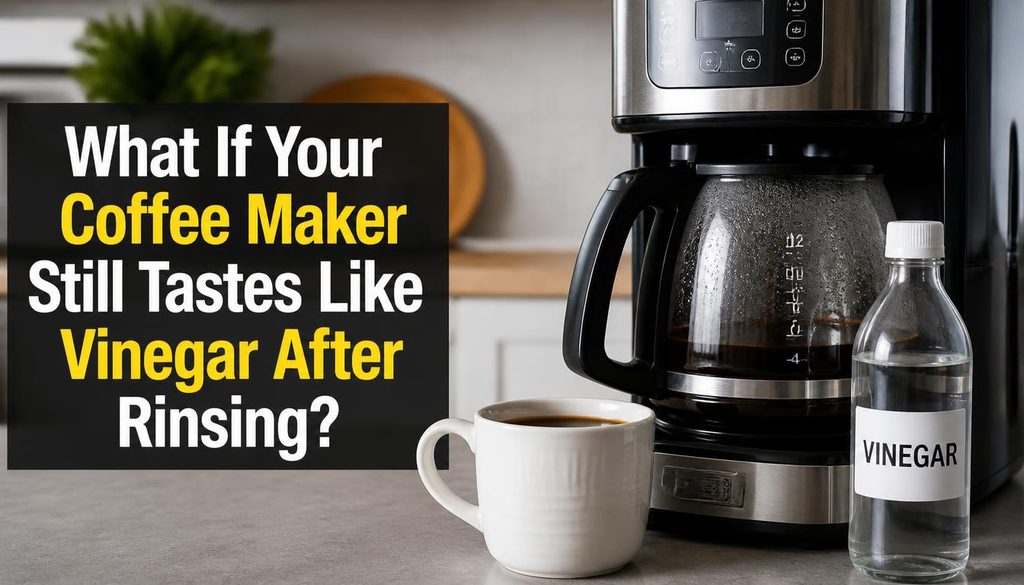
What If Your Coffee Maker Still Tastes Like Vinegar After Rinsing?
If you have already run several rinse cycles and the taste has not disappeared, check the following possibilities.
Check the Cleaning Instructions Again
You may have missed a step in the original cleaning process.
Some machines have dedicated cleaning or descaling modes. Others require particular amounts of water or a specific sequence of operations.
Follow the instructions for your exact model. Do not repeat a full descaling treatment simply because the coffee tastes unusual.
Reclean the Removable Parts
A lingering smell may come from the carafe, lid, removable filter basket, or reusable filter rather than the internal brewing system.
Wash the parts that are safe to wash, rinse them thoroughly, and allow them to dry as directed.
Check the Reservoir and Filter
Inspect the reservoir for residue and confirm that the water filter is correctly installed.
If your machine uses a replaceable filter, check whether it has reached the end of its recommended service life.
Investigate Other Brewing Problems
If the vinegar smell has disappeared but the coffee still tastes sour, the cause may be unrelated to cleaning.
Old coffee grounds, brewing temperature, coffee-to-water ratio, and bean freshness can all influence flavour.
If the machine also runs slowly, makes unusual noises, or fails to dispense water properly, it may have another issue.
Our guide on coffee maker problems after descaling explains what to check if a machine stops working normally after a cleaning cycle.
If the machine develops a leak during the process, see our guide to fixing a coffee maker that leaks after descaling.
Contact the manufacturer if the unusual taste persists despite following the correct cleaning procedure, especially if it comes with poor water flow, warning lights, or other signs of malfunction.
Why Does Coffee Taste Like Chemicals After Descaling?
Coffee that tastes like chemicals after descaling may contain traces of the cleaning solution used to remove mineral deposits.
However, the precise cause depends on the product and the machine.
A commercial descaler may have different ingredients and instructions from ordinary white vinegar. Some espresso machines require a dedicated descaling product, and vinegar may not be permitted.
To investigate the problem:
- Check the product label to confirm that it is suitable for your coffee maker.
- Review the machine’s cleaning instructions.
- Complete the specified fresh-water rinse procedure.
- Clean the removable parts as directed.
- Avoid making coffee until the cleaning and rinsing procedure is complete.
Never mix vinegar with bleach, ammonia, or other cleaning products. Mixing chemicals can produce dangerous fumes or reactions.
If you accidentally used an unapproved chemical or a product in the wrong concentration, stop using the machine and contact the manufacturer for specific guidance.
Does Vinegar Damage a Coffee Maker?
Vinegar can be suitable for certain coffee makers, but it is not recommended for every model.
Some manufacturers permit white vinegar for descaling. Others specifically recommend a dedicated descaling product because different machines have different internal components and maintenance requirements.
For example, Philips’ guidance for certain traditional coffee makers permits white household vinegar, while instructions for some espresso machines specify an approved descaler instead.
The important point is to check the instructions for your exact model before using vinegar.
If you have already used vinegar and the machine tastes unpleasant afterward, do not try to solve the problem by using a stronger vinegar mixture. Complete the recommended rinsing process first.
How to Prevent Vinegar Taste After Cleaning
A few simple habits can help prevent this problem the next time you clean your coffee maker.
Follow the Correct Descaling Procedure
Read the owner’s manual before starting. Confirm which cleaning product is permitted, how much to use, and how to run the cleaning cycle.
Complete Every Required Rinse Cycle
Do not assume that one rinse is enough. Use fresh water and complete the prescribed number of cycles.
Clean Removable Parts Regularly
Wash the carafe, filter basket, lid, and other coffee-contact parts as recommended.
Regular cleaning also helps prevent old coffee oils and grounds from affecting the taste of fresh coffee.
Replace Water Filters When Needed
Follow the manufacturer’s recommended replacement schedule. A properly maintained filter helps keep the water system working as intended.
Do Not Overuse Cleaning Products
Using more vinegar or descaler than recommended will not necessarily clean the machine better.
Follow the product instructions and do not combine different cleaning products.
For a practical maintenance routine, see our guide to cleaning a coffee maker on the right schedule.
Vinegar Taste vs. Sour Coffee: How to Tell the Difference
Not every unpleasant cup of coffee has the same cause. Use the following table to narrow down the problem.
| What you notice | Possible cause | What to do |
|---|---|---|
| Strong vinegar smell and taste immediately after cleaning | Remaining vinegar residue | Complete the recommended rinse cycles |
| Chemical taste after using a commercial descaler | Cleaning solution may not have been rinsed out | Check the product and machine instructions |
| Sour coffee without a vinegar smell | Coffee beans or brewing conditions | Check grind, freshness, and brewing settings |
| Stale or bitter coffee | Old coffee oils or grounds | Clean the carafe and filter basket |
| White or chalky particles | Possible mineral deposits | Inspect the reservoir and follow descaling instructions |
| Vinegar taste that remains after rinsing | Residue in the system or removable parts, or another issue | Recheck cleaning steps and contact the manufacturer if needed |
These are possible explanations, not guaranteed diagnoses. If the taste appeared immediately after cleaning, leftover cleaning solution is a sensible first thing to investigate.
Frequently Asked Questions
Why does my coffee taste like vinegar after cleaning?
The most common possibility is that vinegar remains inside the coffee maker, carafe, filter basket, or another part that comes into contact with water or coffee. Complete the manufacturer’s recommended fresh-water rinse procedure and wash the removable parts as directed.
How do I get the vinegar taste out of my coffee maker quickly?
Empty the reservoir, clean the removable parts, and run the required fresh-water rinse cycles. The exact number depends on your machine. Do not add stronger vinegar or other cleaning chemicals to speed up the process.
How many times should I rinse my coffee maker after using vinegar?
There is no universal number for every coffee maker. Some KitchenAid drip coffee makers require two fresh-water brewing cycles, while certain Philips models require a different sequence. Check your owner’s manual and repeat the rinse process if the manufacturer instructs you to do so.
Can I drink coffee that tastes like vinegar after cleaning?
It is best not to drink coffee that still tastes strongly of vinegar or another cleaning product. Discard it and finish the manufacturer’s cleaning and rinsing instructions before brewing another cup.
Why does my coffee still smell like vinegar after several rinse cycles?
Vinegar may remain in the internal water pathways, reservoir, carafe, or filter basket. The rinse procedure may also be incomplete. Review the instructions for your exact model, clean the permitted removable parts, and contact the manufacturer if the smell persists.
Why does my coffee taste sour if I did not use vinegar?
Sour coffee can result from under-extraction, naturally acidic beans, unsuitable brewing settings, or other factors. If there is no vinegar smell and the machine has been cleaned correctly, read our guide to why coffee tastes sour from a coffee machine.
Can I use a descaling solution instead of vinegar?
Only use a descaling product approved for your particular coffee maker. Some machines permit vinegar, while others require a specific descaler. Check the owner’s manual before switching products.
Can a Keurig coffee maker taste like vinegar after descaling?
Yes. A Keurig may retain an unwanted vinegar taste if the required fresh-water rinsing is incomplete. Follow the instructions for your exact brewer and clean the removable parts as directed. Our guide on how to clean a Keurig coffee maker covers routine cleaning and descaling.
Final Thoughts
If your coffee tastes like vinegar after cleaning the coffee maker, do not assume that the machine is broken.
Start by checking for leftover vinegar or descaling solution. Empty and rinse the reservoir, wash the removable parts, and complete the fresh-water rinse procedure recommended for your model.
If the taste remains, check the water filter and cleaning instructions before investigating other brewing problems.
Most importantly, do not keep adding cleaning products in an attempt to remove the smell. The right solution is to follow the correct cleaning procedure and rinse the machine as directed.
Once the cleaning process is complete and the vinegar smell has disappeared, you should be able to return to brewing coffee without that unwanted flavour.

“I believe great cooking starts with the right tools, trusted advice, and a little confidence in the kitchen.”
Hi, I’m Emma Carter. My love for cooking began in my grandmother’s kitchen, where I learned that every great meal starts with simple ingredients and the right cookware. Over the years, I’ve spent countless hours researching, testing, and comparing kitchen appliances, cookware, coffee makers, air fryers, and other everyday kitchen essentials.
Here at KiCook, my goal is to make your buying decisions easier with honest product reviews, practical buying guides, and easy-to-follow cooking tips. Whether you’re upgrading your kitchen or searching for the best appliance for your home, I focus on providing clear, reliable, and research-backed information you can trust.
When I’m not testing new kitchen gadgets or writing in-depth guides, you’ll usually find me trying new recipes, visiting local farmers’ markets, or enjoying a quiet cup of coffee while planning my next kitchen project.