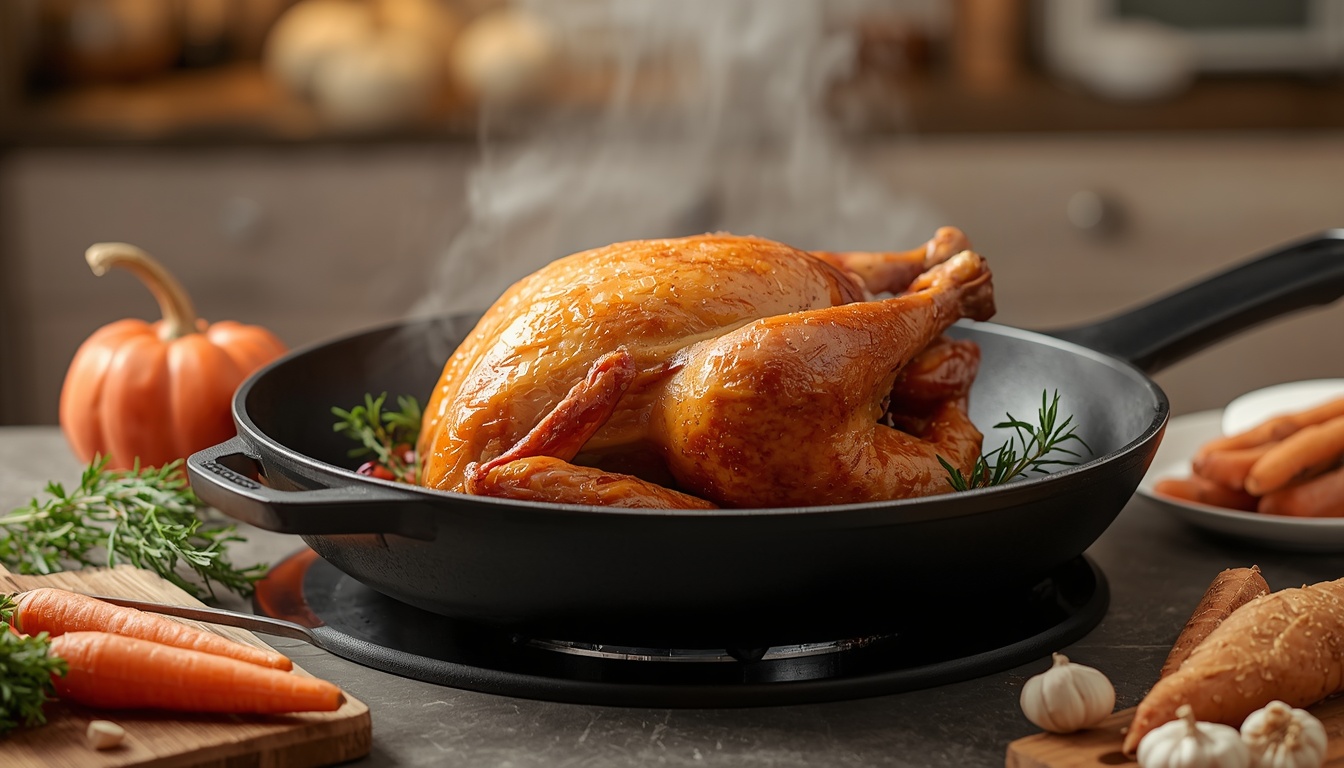
Yes, you can cook a turkey in an electric skillet, but the size of the turkey matters.
For most home electric skillets, a turkey breast, tenderloin, thighs, drumsticks, wings, or another smaller cut is far more practical than a full-size Thanksgiving turkey. A very small whole turkey may work in a large, deep skillet if it fits comfortably and the lid closes properly, but you should never force an oversized bird into the appliance.
The real advantage of an electric skillet is controlled heat. You can brown the turkey first, lower the temperature, cover the skillet, and finish it slowly without using your oven. This makes it especially useful during the holidays when oven space is limited.
If you are still exploring what this appliance can handle, KiCook’s guide to what you can cook in an electric skillet covers everything from poultry and beef to pasta, casseroles, vegetables, and desserts.
In this guide, you will learn which turkey cuts work best, how to prepare and cook them, what temperature to use, how long cooking may take, and how to make sure your turkey is safely cooked without drying it out.
Can You Really Cook a Turkey in an Electric Skillet?
Yes. An electric skillet can cook turkey successfully as long as the turkey fits safely inside the pan and you use the right cooking technique.
The easiest choices are:
- Turkey breast
- Turkey tenderloin
- Turkey thighs
- Turkey drumsticks
- Turkey wings
- Turkey cutlets
- Small turkey portions
A standard electric skillet is not the same as a full-size oven. Most of its heat comes from underneath the food, while the lid traps hot air and moisture around it. That makes an electric skillet especially good for browning followed by covered roasting, braising, or gentle cooking.
Presto’s electric-skillet instructions, for example, describe browning meat at roughly 325–350°F (163–177°C) before reducing the heat for braising or pot-roasting.
KiCook also explains this heating difference in its guide to whether an electric skillet can be used as an oven.
Electric Skillet vs Electric Roaster: They Are Not the Same

This distinction is important because many turkey recipes online use the terms interchangeably.
An electric skillet, also called an electric frying pan or electric frypan, is relatively shallow and has a heating element beneath its cooking surface.
An electric roaster oven is much deeper and is specifically designed to hold large roasts and whole birds.
That means a recipe written for a 20-quart electric roaster should not automatically be followed in a 12- or 16-inch electric skillet.
For a normal electric skillet, turkey breast and smaller turkey cuts are usually the better choice.
What Type of Turkey Works Best in an Electric Skillet?
Boneless Turkey Breast
A boneless turkey breast is one of the easiest choices because it is compact and cooks relatively evenly.
It also fits easily into most medium and large electric skillets.
The main concern is overcooking. Turkey breast is lean, so check its internal temperature early rather than leaving it on the heat simply because a recipe’s estimated cooking time has not finished.
Bone-In Turkey Breast
Bone-in turkey breast usually stays juicy and develops excellent flavor.
It does, however, require more vertical space. Before cooking, place the raw breast in the unplugged skillet and check whether the lid closes normally.
Do not press the lid down over an oversized piece of turkey.
Turkey Tenderloin
Turkey tenderloin is ideal if you want a faster meal.
It is small enough for almost any electric skillet and works well with browning followed by lower-temperature covered cooking.
Turkey Thighs
Turkey thighs are forgiving because dark meat contains more fat than breast meat.
They are a good choice if you are worried about dry turkey and work especially well with herbs, onions, garlic, and a small amount of broth.
Turkey Drumsticks
Drumsticks also work well. Brown them on several sides before lowering the heat and covering the skillet.
Turkey Wings
Turkey wings can be browned and then cooked gently with a little liquid.
Keep enough room between them for relatively even heating.
Turkey Cutlets
Thin turkey cutlets are the fastest option. They can be pan-cooked much like chicken breast cutlets.
Because they are thin, they can dry out quickly, so start checking their internal temperature early.
Small Whole Turkey
A small whole turkey is possible only if your skillet is sufficiently large and deep.
The bird needs enough room for:
- The lid to close completely
- Heat and steam to circulate
- Safe turning or positioning
- Liquid to remain below the skillet’s maximum capacity
- The turkey to stay away from electrical controls
For most households, cooking a turkey breast instead is much easier.
Can You Cook a Whole Turkey in an Electric Skillet?
Technically, yes, but for most standard electric skillets it is not the most practical method.
Saladmaster has published an electric-skillet turkey-breast method and specifically notes that turkey breast was selected partly because it fits the skillet well. The company suggests moving to a larger roaster when cooking a whole turkey.
That is good general advice.
If the turkey is so tall that the lid rests directly on it, or if the bird almost fills the entire pan, use another appliance.
A conventional oven or electric roaster is usually the better choice for a large Thanksgiving or Christmas turkey.
What Size Turkey Can You Cook in an Electric Skillet?
There is no universal turkey weight that fits every electric skillet.
Skillet diameter alone does not tell the whole story. Depth and lid clearance matter just as much.
A practical guide is:
| Electric Skillet Size | Best Turkey Choice |
|---|---|
| 10–12 inches | Cutlets, tenderloin, small breast portions |
| 12–14 inches | Turkey breast, thighs, wings, drumsticks |
| 15–16 inches | Larger breast or several turkey pieces |
| Large deep skillet | Large breast or possibly a very small whole turkey |
Treat this as a capacity guide rather than a guarantee.
If the lid cannot close normally, the turkey is too large.
What Temperature Should You Cook Turkey in an Electric Skillet?
There is no single skillet setting that works for every turkey cut or electric-skillet model.
For a traditional covered method, a useful approach is:
- Preheat the skillet to approximately 325–350°F (163–177°C) for browning.
- Brown the turkey on the appropriate sides.
- Add a small amount of broth or water if your recipe needs it.
- Cover the skillet.
- Reduce the temperature enough to maintain gentle cooking rather than aggressive frying.
- Cook until the proper internal temperature is reached.
Presto’s electric-skillet instructions list approximately 325–350°F for browning during braising and pot-roasting, followed by lower heat for simmering.
If terms such as low, medium, and medium-high seem confusing on your appliance, KiCook’s electric skillet medium-heat temperature guide explains how skillet dial temperatures compare.
Your own appliance manual should always take priority because thermostat behaviour varies considerably between models.
What Internal Temperature Should Turkey Reach?
This requires a little extra explanation because official recommendations vary by country.
For readers in the United States, USDA guidance says turkey and turkey parts should reach at least 165°F (74°C). For a whole bird, temperature should be checked in the thickest part of the breast and the innermost parts of the thigh and wing without touching bone.
For readers in Canada, Health Canada recommends 74°C (165°F) for poultry pieces and 82°C (180°F) for whole poultry.
For readers in Australia, Food Standards Australia New Zealand recommends cooking poultry to at least 75°C (167°F) in the centre.
For readers in the UK, the Food Standards Agency provides safe time-and-temperature combinations, including 70°C for 2 minutes or 75°C for 30 seconds.
If you are unsure which standard applies, follow your local food-safety authority and the instructions supplied with the turkey.
How Long Does Turkey Take to Cook in an Electric Skillet?
Cooking time depends on much more than weight.
Important factors include:
- Bone-in or boneless meat
- Thickness
- Turkey cut
- Starting temperature
- Skillet size
- Skillet wattage
- Thermostat accuracy
- Whether the lid stays closed
- Amount of liquid
- Whether you use a rack
This is why cooking strictly by minutes per pound is unreliable in an electric skillet.
A Saladmaster turkey-breast recipe gives approximately 15 minutes per pound for its particular electric-skillet method, but that figure applies to its cookware and cooking procedure rather than every electric skillet.
Use time to decide when to start checking the turkey. Use a thermometer to decide when to stop cooking.
Electric Skillet Turkey Cooking Time Chart
The following ranges are best treated as checking windows, not guarantees.
| Turkey Cut | Approximate Checking Window | Final Doneness |
|---|---|---|
| Thin turkey cutlets | 10–15 minutes | Verify with thermometer |
| Turkey tenderloin | 25–40 minutes | Verify with thermometer |
| Boneless breast | 45–75 minutes | Verify with thermometer |
| Bone-in breast | 60–120 minutes | Verify with thermometer |
| Turkey thighs | 30–50 minutes | Verify with thermometer |
| Drumsticks | 35–60 minutes | Verify with thermometer |
| Turkey wings | 30–50 minutes | Verify with thermometer |
Large pieces can take considerably longer.
Do not remove turkey simply because it has reached the end of an estimated time range.
How to Cook Turkey in an Electric Skillet Step by Step
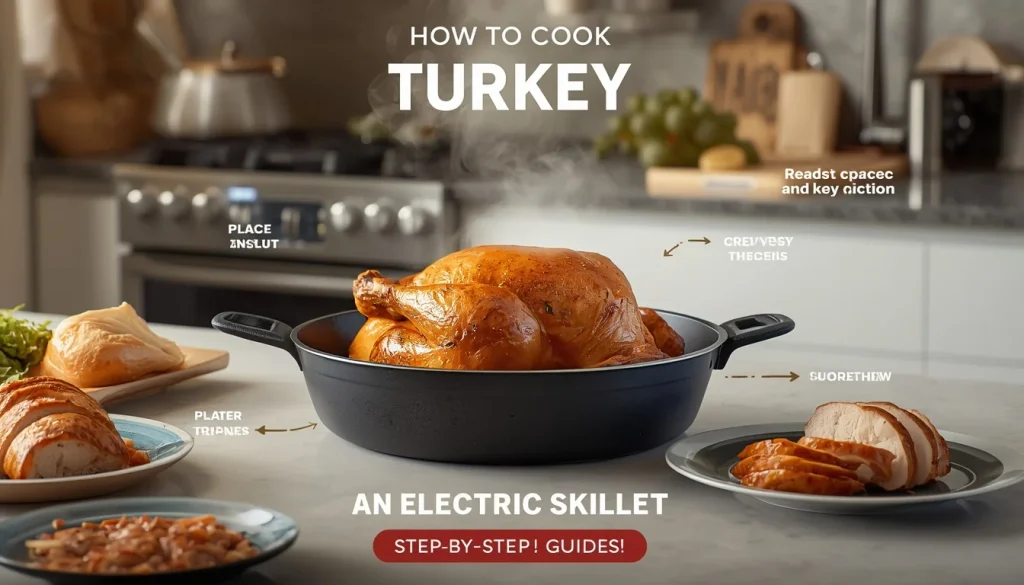
Turkey breast is the most practical example for this method, although the same general principles can be adapted for thighs, tenderloins, and other pieces.
What You Will Need
For a simple electric-skillet turkey, gather:
- 1 turkey breast that comfortably fits your skillet
- 1–2 tablespoons cooking oil or softened butter
- Salt
- Black pepper
- Garlic powder
- Onion powder
- Dried thyme
- Rosemary
- Sage or poultry seasoning
- ½–1 cup chicken or turkey broth, as needed
- 1 onion, sliced
- 1–2 celery stalks, optional
- Electric skillet with lid
- Kitchen tongs
- Food thermometer
- Cooking rack, if appropriate for your skillet
You can adjust the seasonings to suit your taste.
Step 1: Thaw the Turkey Safely
If the turkey is frozen, thaw it before using this method.
USDA guidance lists three safe thawing methods:
- Refrigerator
- Cold water
- Microwave
For refrigerator thawing, allow approximately 24 hours for every 4–5 pounds (1.8–2.3 kg) of turkey.
Do not thaw raw turkey on the kitchen counter.
Step 2: Pat the Turkey Dry
Remove the turkey from its packaging and pat the exterior dry with paper towels.
A drier surface browns more effectively than a wet one.
You do not need to wash raw turkey. Cooking to a safe internal temperature is what destroys harmful bacteria.
Step 3: Season the Turkey
Rub the turkey lightly with oil or softened butter.
Season it with salt, black pepper, garlic, onion powder, thyme, sage, rosemary, or your preferred poultry seasoning.
If the turkey breast has skin, you can carefully work some seasoning beneath the skin for better flavor.
Step 4: Preheat the Electric Skillet
Set the skillet to approximately 325–350°F (163–177°C) unless the manufacturer’s instructions for your model recommend something different.
Let the skillet preheat before adding the turkey.
Electric skillets do not always maintain the exact temperature printed on the dial, so learn how your particular appliance behaves.
Step 5: Brown the Turkey
Add a small amount of cooking oil if needed.
Place the turkey in the skillet and let it develop some colour before moving it.
For breast pieces, brown the skin side first.
For tenderloins, thighs, drumsticks, and wings, turn the meat so several surfaces get contact with the hot pan.
You are building flavor here, not trying to cook the turkey completely at high heat.
If you are comfortable cooking poultry in an electric skillet, the browning principles are similar to techniques used in KiCook’s guide to frying chicken in an electric skillet, although this turkey method finishes with gentler covered cooking instead of frying.
Step 6: Add Aromatics and a Little Liquid
Once the turkey is browned, add sliced onion, celery, garlic, or herbs if desired.
Pour in a small amount of broth.
You usually do not need enough liquid to submerge the turkey. The goal is to provide moisture for gentle covered cooking while still allowing the turkey to retain a roasted or braised character.
Step 7: Cover and Reduce the Heat
Put the lid on the skillet.
Reduce the temperature so the liquid maintains a gentle simmer rather than a rapid boil.
Avoid leaving the skillet at its high browning temperature for the entire cooking period. That is one of the easiest ways to end up with meat that is overcooked outside and undercooked near the centre.
Step 8: Turn or Rotate if Necessary
Turkey tenderloins, thighs, legs, and wings may benefit from being turned once during cooking.
A larger turkey breast may not need frequent flipping.
If one area of your electric skillet runs hotter than another, rotating the turkey can also improve even cooking.
Do not keep opening the lid every few minutes. Each time you remove it, trapped heat escapes.
Step 9: Check the Internal Temperature
Near the expected end of cooking, insert a clean food thermometer into the thickest portion of the turkey.
Avoid bone.
For a whole bird, check several areas rather than only one.
The thermometer is much more reliable than:
- Skin colour
- Cooking time
- Clear-looking juices
- How firm the meat feels
Step 10: Rest Before Slicing
Move the turkey to a clean platter or cutting board and let it rest before carving.
For a large turkey breast, roughly 10–20 minutes is usually comfortable.
USDA guidance recommends about 20 minutes of resting time before carving a whole turkey.
Resting also gives you time to turn the skillet drippings into gravy.
Do You Put Water in an Electric Skillet When Cooking Turkey?
You can add liquid, but you usually do not need much.
A small quantity of water, turkey stock, or chicken broth can help create steam and prevent drippings from burning during covered cooking.
Too much liquid changes the method from roasting or braising into something closer to poaching.
Start with a modest amount and add more only if the pan becomes dry.
Presto’s skillet instructions for braising similarly describe browning food first and then finishing it with a small amount of liquid over lower heat.
Should Turkey Be Covered or Uncovered in an Electric Skillet?
Use both approaches at different stages.
During browning: Keep the turkey uncovered so moisture can escape and the surface can develop colour.
During the main cooking period: Cover the skillet to trap heat and moisture.
The lid is especially important because an electric skillet does not surround food with dry heat the way a conventional oven does.
KiCook’s guide to using an electric skillet as an oven explains why the lid plays such an important role in oven-style skillet cooking.
Do You Need to Flip Turkey in an Electric Skillet?
It depends on the cut.
Turkey cutlets, tenderloins, drumsticks, thighs, and wings usually benefit from turning.
A large bone-in turkey breast may only need one repositioning, or none at all if it is cooking evenly on a rack.
Do not flip the turkey repeatedly. Frequent handling releases heat and can damage browned skin.
Do You Need to Baste Turkey in an Electric Skillet?
Usually not.
Because the lid traps moisture, electric-skillet turkey can remain surprisingly juicy without constant basting.
Opening the lid repeatedly to baste also allows heat to escape.
If you want extra flavour, spoon a little cooking liquid over the turkey once or twice, but do not feel that you must baste every 15 minutes.
How to Keep Turkey Moist in an Electric Skillet
Dry turkey usually comes from overcooking rather than a lack of broth.
For juicy turkey:
Choose the Right Cut
Turkey thighs are particularly forgiving.
Turkey breast can also stay juicy, but it needs closer temperature monitoring.
Brown First, Then Lower the Heat
High heat is useful for browning. It is not ideal for cooking a thick turkey breast all the way through.
Keep the Lid Closed
A covered skillet traps moisture around the turkey.
Use a Small Amount of Broth
Broth adds moisture and gives you flavorful drippings for gravy.
Use a Thermometer
Stop cooking when the turkey reaches the appropriate safe temperature rather than adding another 20 minutes “just to be sure.”
Rest the Meat
Do not immediately slice into the turkey the moment it leaves the skillet.
How to Get Crispy Turkey Skin in an Electric Skillet
This is one area where an oven has an advantage.
An electric skillet heats primarily from underneath, so it cannot provide the same all-around dry heat as an oven.
You can still improve browning.
Pat the skin very dry before seasoning. Use only a light coating of oil, brown the skin directly against the skillet at the beginning, and avoid adding excessive liquid.
Do not expect the entire surface to become deeply crisp while it is covered.
If crisp skin is your highest priority, an oven is usually the better cooking appliance.
Where Should You Put the Meat Thermometer in Turkey?
For turkey pieces, insert the thermometer into the thickest portion without touching bone.
For a whole turkey, USDA guidance recommends checking:
- The thickest part of the breast
- The innermost part of the thigh
- The innermost part of the wing
Avoid bone because it can distort the reading.
Check more than one area when the meat is unusually thick or irregularly shaped.
How Do You Know When Turkey Is Done?
A food thermometer gives you the answer.
Do not rely only on appearance.
Turkey can look beautifully browned while still being undercooked in the centre. The opposite is also possible: turkey may have a slightly pink colour even after reaching a safe internal temperature.
USDA notes that properly cooked turkey can sometimes remain pink because colour is affected by factors other than doneness.
Temperature is the better test.
Can Turkey Still Be Pink When Fully Cooked?
Yes.
Pink turkey does not automatically mean it is raw.
Likewise, white-looking turkey is not automatically safe.
If the turkey has met the food-safety temperature standard that applies in your country, a small amount of pink coloration can still occur.
That is one more reason every turkey cook should own a reliable food thermometer.
Can You Cook Frozen Turkey in an Electric Skillet?
I would not recommend putting a large frozen turkey directly into a standard electric skillet.
USDA guidance does allow whole turkey to be oven-roasted from frozen, but it requires considerably more cooking time.
An electric skillet is different. Its limited depth, bottom-focused heat, and smaller cooking chamber make a thick frozen bird much harder to cook predictably.
For electric-skillet turkey, thawing first is the simpler and more controllable approach unless the manufacturer of your particular skillet and turkey product provides specific frozen-cooking instructions.
Can You Cook Stuffed Turkey in an Electric Skillet?
Cooking stuffing separately is the better option.
Stuffing inside poultry heats slowly and introduces another temperature that must be checked.
USDA recommends cooking stuffing outside a whole bird for optimum safety. If poultry is stuffed, the centre of the stuffing must also reach at least 165°F (74°C).
Health Canada similarly describes separately cooked stuffing as the safest option.
With the limited space inside an electric skillet, keeping the turkey unstuffed also improves heat circulation.
How to Cook Turkey Breast in an Electric Skillet
Turkey breast is probably the best answer to the question, “Can you cook turkey in an electric skillet?”
A basic method is:
- Thaw the breast completely.
- Pat it dry.
- Season with oil, herbs, salt, and pepper.
- Preheat the skillet to about 325–350°F.
- Brown the breast.
- Add onion and a small amount of broth.
- Cover.
- Reduce to a gentle cooking temperature.
- Continue until the correct internal temperature is reached.
- Rest before slicing.
A published Saladmaster electric-skillet recipe uses a somewhat different temperature sequence designed for that manufacturer’s cookware, which is a useful reminder that skillet-specific instructions matter.
Bone-In vs Boneless Turkey Breast
Bone-In
Bone-in turkey breast:
- Usually has excellent flavour
- Tends to remain juicy
- Takes longer to cook
- Needs a deeper skillet
Boneless
Boneless turkey breast:
- Fits more easily
- Cooks faster
- Is easier to slice
- Can dry out more quickly
Neither is automatically better. Choose the one that fits your skillet and meal.
How to Cook Turkey Tenderloin in an Electric Skillet
Turkey tenderloin works especially well for weeknight cooking.
Season the tenderloin, brown it on several sides, add a splash of broth, lower the heat, and cover.
Turn once if needed.
Begin checking the thickest section early because tenderloin is much smaller than a full breast.
Once it reaches your locally recommended safe internal temperature, remove it and let it rest briefly before slicing.
How to Cook Turkey Thighs, Legs, and Wings
Dark-meat cuts are excellent in an electric skillet.
Brown them first to build flavour, then reduce the temperature and cook covered with a little broth.
Onions, garlic, rosemary, thyme, sage, black pepper, paprika, and lemon all pair well with turkey.
Arrange the pieces in a single layer when possible instead of stacking them.
Turn them occasionally for more even browning.
How to Make Turkey Gravy in the Electric Skillet
Do not throw away those drippings.
After removing the turkey:
- Pour off excessive fat if necessary.
- Leave the flavorful cooking juices in the skillet.
- Set the skillet to low or medium-low heat.
- Stir in a little flour and fat to make a roux, or use a cornstarch slurry.
- Slowly add turkey or chicken stock.
- Whisk until smooth.
- Simmer until thickened.
- Taste and adjust the seasoning.
If the gravy becomes too thick, add more broth.
If it is too thin, simmer a little longer or add a small additional amount of slurry.
Common Electric Skillet Turkey Problems and Fixes
Turkey Is Browning Too Fast
Reduce the temperature.
If the outside darkens long before the centre is cooked, the skillet is too hot.
Cover the turkey and continue at gentler heat.
Turkey Is Cooked Outside but Raw Inside
This usually means the heat was too high.
Lower the skillet temperature, cover it, and continue cooking gradually.
Do not serve until the centre reaches the appropriate safe temperature.
Turkey Breast Is Dry
The most likely cause is overcooking.
Next time, begin checking the temperature earlier.
Turkey Is Taking Much Longer Than Expected
Possible causes include:
- Turkey was still partly frozen
- Turkey is unusually thick
- Skillet thermostat runs cool
- Lid was opened frequently
- Skillet is overcrowded
If your electric skillet regularly struggles to maintain temperature, KiCook’s guide to common electric skillet problems and fixes may help identify a thermostat or heating issue.
Turkey Skin Is Soggy
Too much steam or liquid can soften skin.
Brown the skin properly at the beginning and avoid excessive broth.
Turkey Is Sticking
Make sure the skillet is fully preheated and lightly greased if necessary.
Do not try to force turkey away from the surface before a browned crust has formed.
The Lid Will Not Close
Stop.
Your turkey is too large for the skillet.
Use a smaller turkey cut or a larger cooking appliance.
Electric Skillet vs Electric Roaster vs Oven for Turkey
| Feature | Electric Skillet | Electric Roaster | Conventional Oven |
|---|---|---|---|
| Turkey breast | Excellent | Excellent | Excellent |
| Turkey tenderloin | Excellent | Good | Excellent |
| Thighs and legs | Excellent | Good | Excellent |
| Large whole turkey | Limited | Excellent | Excellent |
| Crispy skin | Moderate | Moderate | Best |
| Moist covered cooking | Excellent | Excellent | Good |
| Holiday overflow | Excellent | Excellent | — |
| Small meal efficiency | Excellent | Moderate | Less practical |
| Same-pan gravy | Easy | Possible | Depends on roasting pan |
For one breast or several turkey pieces, an electric skillet makes a lot of sense.
For a 15- to 20-pound holiday bird, an oven or dedicated roaster is more practical.
How to Store Leftover Turkey Safely
Do not leave cooked turkey sitting out for the entire afternoon after dinner.
USDA advises refrigerating perishable leftovers promptly and using most cooked leftovers within 3–4 days. Leftovers should be reheated to 165°F (74°C) under USDA guidance.
Store turkey in shallow airtight containers so it cools efficiently.
For larger leftovers, remove meat from the carcass and divide it into smaller portions before refrigerating.
How to Clean the Electric Skillet After Cooking Turkey
Let the skillet cool and unplug it before cleaning.
Remove the temperature control if the manufacturer designed it to be detachable.
Do not automatically submerge the electrical base in water.
Wipe out grease and drippings first, then wash the cooking surface according to your appliance manual.
For model-specific cleaning considerations, see KiCook’s step-by-step guide to cleaning an electric skillet safely.
Frequently Asked Questions About Can You Cook a Turkey in an Electric Skillet
Can you cook a whole turkey in an electric skillet?
A very small whole turkey may fit in a large, deep electric skillet, but most standard skillets are better suited to turkey breast or smaller pieces. The lid must close normally and the bird must fit without overcrowding the pan.
Can you roast a turkey in an electric skillet?
Yes, particularly turkey breast and smaller cuts. The method is closer to covered skillet roasting or braising than conventional dry oven roasting.
How long does turkey take in an electric skillet?
It depends on the cut, thickness, weight, skillet temperature, bone content, and appliance. Small pieces may cook in well under an hour, while large turkey breasts can take considerably longer. Use a food thermometer rather than cooking time alone.
How long should you cook turkey per pound in an electric skillet?
There is no universal per-pound formula for all electric skillets. One Saladmaster skillet recipe uses roughly 15 minutes per pound for turkey breast, but that method is specific to its cookware. Follow your skillet instructions and confirm doneness with a thermometer.
What temperature should I set an electric skillet for turkey?
For many standard skillet methods, around 325–350°F (163–177°C) is useful for initial browning. Reduce the heat afterward for gentle covered cooking. Follow your appliance manual because temperature controls vary.
Can you cook turkey breast in an electric skillet?
Yes. Turkey breast is one of the best turkey cuts for an electric skillet because it fits more easily than a whole bird and responds well to browning followed by covered cooking.
Can you cook boneless turkey breast in an electric skillet?
Yes. Boneless turkey breast is compact, cooks relatively quickly, and fits easily in most electric skillets.
Can you cook turkey tenderloin in an electric skillet?
Yes. Brown it first, lower the heat, cover the skillet, and cook until the centre reaches the appropriate safe temperature.
Can you cook turkey legs in an electric skillet?
Yes. Drumsticks are well suited to browning followed by covered cooking with a small amount of broth.
Can you cook turkey wings in an electric skillet?
Yes. Arrange them in a single layer, brown both sides, then finish them covered at a lower temperature.
Do you put water in an electric skillet when cooking turkey?
You can add a small amount of water or broth, especially during covered cooking. Avoid completely submerging the turkey unless you are intentionally using a different cooking method.
Should turkey be covered or uncovered?
Brown the turkey uncovered, then cover it for the main cooking period. The lid traps moisture and heat around the meat.
Should you flip turkey in an electric skillet?
Smaller cuts usually benefit from turning. A large turkey breast may need only one turn or may cook without flipping depending on the method.
Do you need to baste turkey in an electric skillet?
Not necessarily. Because a covered electric skillet retains moisture, frequent basting usually is not required.
Can you cook frozen turkey in an electric skillet?
Thawing first is the better choice for a standard electric-skillet method. Large frozen poultry can heat unevenly, and there is no universal skillet procedure that applies to every appliance.
How do you keep turkey from drying out?
Use moderate heat after browning, keep the lid closed, add a little broth if needed, check the internal temperature early, and rest the meat before slicing.
Can you get crispy turkey skin in an electric skillet?
You can brown the skin well where it contacts the skillet, but achieving uniformly crisp skin is harder than in an oven because an electric skillet does not provide strong dry heat from above.
Is an electric skillet the same as an electric frying pan?
In everyday usage, yes. “Electric skillet,” “electric frying pan,” and “electric frypan” generally describe the same type of countertop appliance, although individual designs vary.
Is an electric skillet the same as an electric roaster?
No. An electric roaster has a much deeper cooking chamber and is better suited to large whole turkeys. An electric skillet is shallower and works best for turkey breast and smaller cuts.
Final Verdict
So, can you cook a turkey in an electric skillet?
Absolutely.
For the best results, choose a turkey breast, tenderloin, thigh, drumstick, wing, or another cut that comfortably fits beneath the lid. Brown the meat first, reduce the temperature, add a little liquid when needed, and finish cooking with the skillet covered.
A standard electric skillet is not the ideal appliance for a large whole Thanksgiving turkey, but it can be an excellent alternative when you are cooking a smaller portion, your oven is already full, or you simply want a convenient countertop method.
The biggest mistake is treating cooking time as proof that turkey is finished. Turkey size, skillet design, temperature accuracy, and thickness all affect how quickly the meat cooks.
Use the clock to know when to start checking.
Use a food thermometer to know when dinner is ready.

“I believe great cooking starts with the right tools, trusted advice, and a little confidence in the kitchen.”
Hi, I’m Emma Carter. My love for cooking began in my grandmother’s kitchen, where I learned that every great meal starts with simple ingredients and the right cookware. Over the years, I’ve spent countless hours researching, testing, and comparing kitchen appliances, cookware, coffee makers, air fryers, and other everyday kitchen essentials.
Here at KiCook, my goal is to make your buying decisions easier with honest product reviews, practical buying guides, and easy-to-follow cooking tips. Whether you’re upgrading your kitchen or searching for the best appliance for your home, I focus on providing clear, reliable, and research-backed information you can trust.
When I’m not testing new kitchen gadgets or writing in-depth guides, you’ll usually find me trying new recipes, visiting local farmers’ markets, or enjoying a quiet cup of coffee while planning my next kitchen project.