
Yes, you can bake biscuits in an electric skillet, even when you do not have access to a conventional oven. The trick is understanding that an electric skillet heats differently from an oven. Most of the heat comes from below, so controlling the temperature, keeping the lid closed, and preventing the bottoms from browning too quickly are more important than simply copying the directions from an oven recipe.
For canned or refrigerated biscuits, one of the easiest methods is to cook them directly in a lightly greased skillet at moderate heat, covered, and flip them partway through. For homemade biscuits, a small baking pan placed on a suitable rack or trivet inside the skillet can produce a more oven-like result.
KiCook’s broader guide to using an electric skillet as an oven explains why covered electric skillets can handle certain baked foods even though their heat distribution is different from a conventional oven.
For readers in the UK and Australia, a quick note: this guide uses the American meaning of “biscuits”—the soft, savory quick breads commonly served with butter, gravy, or breakfast. If you mean what Americans call cookies, the cooking method will be different.
Can You Really Bake Biscuits in an Electric Skillet?
You can, but the result may not look exactly like an oven-baked biscuit.
A conventional oven surrounds the dough with hot air. An electric skillet concentrates most of its heat underneath the food. Putting the lid on traps heat above the biscuits, creating a small enclosed cooking chamber.
That is enough to cook many types of biscuit dough, but there are two common differences:
- The bottoms may brown faster than the tops.
- The tops may remain relatively pale even when the centers are fully cooked.
This is not unique to biscuits. Kansas State University Research and Extension demonstrates baking muffins in an electric skillet by placing a muffin pan on a rack, covering the skillet, and cooking at 375°F. Their instructions specifically note that the muffins will not brown the same way they would in an oven. See the K-State electric skillet baking example
So the goal is not to make your electric skillet behave exactly like an oven. The goal is to use its strengths while managing the extra bottom heat.
Baking vs. Cooking vs. Frying Biscuits in an Electric Skillet
Before choosing a method, it helps to separate three different techniques that are often called “electric skillet biscuits.”
| Method | How It Works | Texture | Flip Needed? | Best For |
|---|---|---|---|---|
| Rack-and-pan baking | Biscuits sit in a baking pan elevated above the skillet surface | Most oven-like | Usually no | Homemade biscuits |
| Direct skillet cooking | Biscuits sit directly on a lightly greased surface | Browned on both sides | Usually yes | Canned or refrigerated biscuits |
| Frying | Biscuit dough cooks in a larger amount of hot oil | Crispy, fried exterior | Yes | Fried biscuits |
These methods are not interchangeable.
For example, some recipes labeled “electric skillet biscuits” are actually deep-fried. One published version uses several cups of oil and cooks the biscuit dough at 400°F, which produces a very different result from baking.
If your goal is soft, fluffy biscuits similar to oven-baked biscuits, use either the covered direct method or the rack-and-pan method rather than deep-frying.
What You Need to Bake Biscuits in an Electric Skillet
The exact equipment depends on the method you choose, but you may need:
- An electric skillet with adjustable temperature control
- A tight-fitting lid
- Biscuit dough
- A small amount of butter or neutral cooking oil
- A heat-safe spatula or tongs
- A small metal baking pan for the rack method
- A suitable rack or trivet if your skillet manufacturer allows one
- Oven mitts
Before putting a rack, baking pan, silicone mold, foil, or other accessory inside your skillet, check the manufacturer’s instructions. Electric skillets vary considerably in construction and allowable accessories.
The Best Way to Bake Biscuits in an Electric Skillet
There are two reliable approaches. Which one is better depends on the type of biscuit you are making.
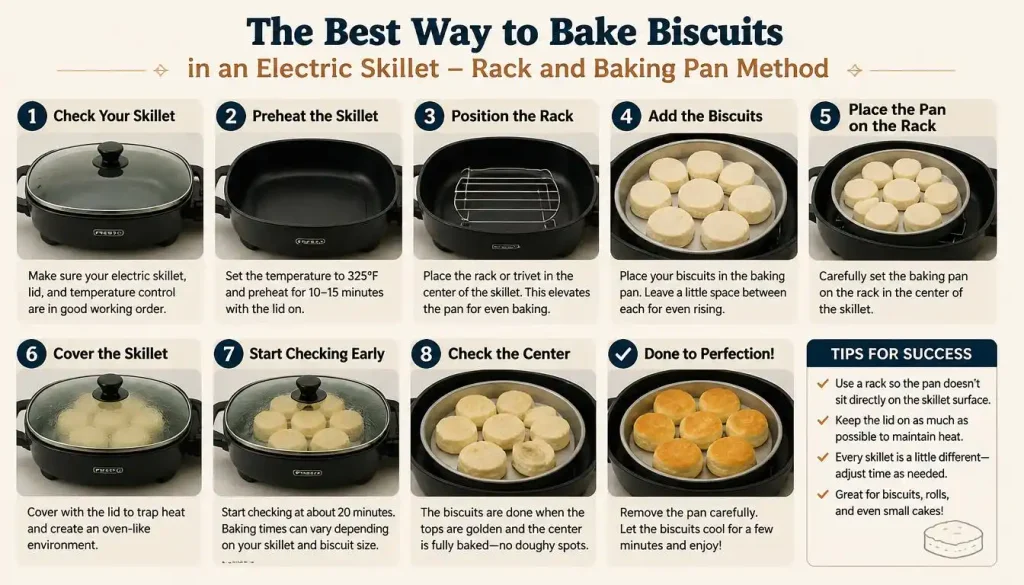
Method 1: Rack and Baking Pan Method
This is the method I would choose when trying to get as close as possible to traditional baked biscuits.
Elevating the baking pan reduces direct exposure to the skillet’s hottest surface. That gives the center more time to cook before the bottom becomes too dark.
Step 1: Check Your Skillet
Confirm that your electric skillet can safely accommodate a rack or trivet and a small heat-safe baking pan.
The lid must still close completely after the pan is added.
Step 2: Preheat the Skillet
A reasonable starting range is about 350°F to 375°F (177°C to 190°C) for this elevated baking method.
Do not assume that the number on the dial is perfectly accurate. Thermostatic skillets cycle on and off, and two models set to the same temperature may cook differently.
For a detailed breakdown of skillet temperatures in both Fahrenheit and Celsius, see KiCook’s electric skillet medium-heat and temperature guide.
Step 3: Position the Rack
Place a low, stable, heat-safe rack or trivet in the skillet if your manufacturer permits it.
The purpose is simple: create some distance between the baking pan and the electric skillet’s hottest surface.
Step 4: Add the Biscuits
Arrange the biscuits in your small baking pan with a little space between them.
If you are making traditional cut biscuits, they can sit fairly close together for softer sides, but they should not be packed so tightly that they cannot expand.
Step 5: Place the Pan on the Rack
Carefully position the baking pan inside the skillet.
Make sure it sits flat and does not touch or interfere with the lid.
Step 6: Cover the Skillet
Put the lid on and leave it closed as much as possible.
This matters because every time you lift the lid, accumulated heat escapes.
Step 7: Start Checking Early
Depending on biscuit size, dough temperature, skillet design, and pan material, cooking may take roughly 10 to 18 minutes.
Treat that as a starting window, not a guarantee.
Check earlier than you think you need to. If the bottoms are browning rapidly but the centers are still doughy, reduce the temperature.
Step 8: Check the Center
Do not judge the biscuits only by top color.
A biscuit may remain pale on top while being completely cooked inside.
Break open one biscuit or gently test the center. It should look fluffy and set rather than wet, gummy, or doughy.
Method 2: Cooking Biscuits Directly in the Electric Skillet
For canned biscuits, this is usually the simplest method.
Published electric-skillet methods commonly use moderate heat, a covered skillet, and flipping to compensate for the lack of top heat. One canned-biscuit method, for example, recommends 350°F and flipping midway through cooking.
Step 1: Preheat to About 325°F to 350°F
Start toward the lower end if:
- Your skillet runs hot
- The biscuits are thick
- You are using a dark nonstick surface
- You have burned biscuits in this skillet before
You can increase the heat slightly if the first batch cooks too slowly.
Step 2: Lightly Grease the Surface
A small amount of butter or oil is enough.
You are trying to prevent sticking and encourage light browning—not fry the biscuits.
Step 3: Arrange the Biscuits
Set them in a single layer and leave space between each one.
Do not overcrowd the skillet. Biscuits expand as they cook, and some open space helps heat move around them.
Step 4: Cover Immediately
Put the lid on.
The covered environment helps the centers cook while the bottoms are in contact with the hot surface.
Step 5: Cook the First Side
Start checking after about 4 to 6 minutes.
The exact timing varies significantly with biscuit size.
Step 6: Flip Gently
Once the bottom is golden and structurally firm enough to move, turn each biscuit carefully.
Avoid smashing or pressing the biscuit with your spatula.
Step 7: Cover and Finish Cooking
Cook the second side until golden and check that the center is completely cooked.
A typical small canned biscuit may finish relatively quickly, while a thick Grands-style biscuit can require considerably longer.
If the outside is getting dark before the middle sets, lower the temperature rather than continuing at the same heat.
What Temperature Should You Use for Electric Skillet Biscuits?
There is no single perfect temperature for every electric skillet and every biscuit.
Use this as a practical starting guide:
| Biscuit Method | Starting Temperature | Approximate Time | Flip? |
|---|---|---|---|
| Small canned biscuits, direct | 325–350°F / 163–177°C | 8–14 minutes | Yes |
| Large refrigerated biscuits, direct | 300–325°F / 149–163°C | 12–20+ minutes | Yes |
| Homemade biscuits on rack/pan | 350–375°F / 177–190°C | 10–18 minutes | Usually no |
| Drop biscuits | 325–350°F / 163–177°C | Varies by size | Method dependent |
| Frozen biscuits | Start conservatively | Longer than refrigerated | Method dependent |
These numbers are starting points rather than manufacturer directions.
The thermostat, skillet depth, wattage, biscuit thickness, lid fit, dough temperature, and cooking surface can all change the result.
KiCook’s temperature guide notes that medium heat on many electric skillets falls around 300°F to 350°F, although dial markings and actual surface temperature do not always match perfectly.
How Long Do Biscuits Take in an Electric Skillet?
Most electric skillet biscuits will take somewhere between roughly 8 and 20 minutes, depending on the method and the size of the biscuit.
Small refrigerated biscuits cook much faster than thick homemade biscuits.
Small Canned Biscuits
Begin checking around 4 to 5 minutes per side when using the direct method.
Large Refrigerated Biscuits
Thicker biscuits need more time at gentler heat.
If you cook them too aggressively, the exterior can turn dark while the center remains doughy.
Homemade Biscuits
Expect approximately 10 to 18 minutes when using an elevated baking-pan setup, but use appearance and center texture rather than the clock alone.
Frozen Biscuits
Frozen dough takes longer because the center must first thaw and then cook.
For branded frozen biscuits, check the manufacturer’s package instructions first. Those instructions may be written specifically for an oven, so do not assume the stated oven time transfers directly to an electric skillet.
How Can You Tell When Electric Skillet Biscuits Are Done?
Look for several signs together:
- The sides appear dry and set.
- The biscuit feels light rather than heavy and doughy.
- The bottom is golden, not dark brown or black.
- The center separates into cooked layers rather than sticky raw dough.
- A toothpick inserted into a thick homemade biscuit comes out without wet dough.
Do not keep cooking simply because the top is pale.
Electric skillets do not provide the same strong top heat as an oven, so a perfectly cooked biscuit may never develop the deeply golden top you expect from conventional baking. KiCook’s oven-substitute guide discusses the same limitation for biscuits, muffins, cakes, and other baked foods.
How to Cook Canned Biscuits in an Electric Skillet
Canned biscuits are probably the easiest place to start.
Quick Method
- Preheat the electric skillet to approximately 325°F to 350°F.
- Lightly grease the surface.
- Place the biscuits in a single layer.
- Leave space between them.
- Cover with the lid.
- Cook until the bottoms begin to brown.
- Flip gently.
- Cover again.
- Continue cooking until the centers are fully set.
- Remove promptly so the bottoms do not continue darkening.
This method is particularly convenient in an RV, small apartment, temporary kitchen, holiday cooking setup, or anywhere else where an oven is unavailable.
If you are exploring other meals that work with the same appliance, KiCook has a useful list of 45+ foods you can cook in an electric skillet.
Can You Cook Pillsbury Biscuits in an Electric Skillet?
Yes, refrigerated Pillsbury-style biscuits can be adapted to an electric skillet, but there is an important distinction.
Pillsbury’s official directions are written for conventional oven baking. For example, its Grands! Flaky Layers Original biscuits list an oven temperature of 375°F, or 350°F for a nonstick baking sheet, with a baking time of 14 to 17 minutes. See Pillsbury’s official biscuit directions
Those numbers should not automatically be copied to direct skillet cooking.
In an electric skillet, the dough is much closer to the heating element. Start with moderate heat, cover the skillet, and monitor the bottoms carefully.
Large Grands-style biscuits are especially easy to over-brown before the center cooks, so lowering the temperature and extending the cooking time is often more successful than trying to cook them quickly.
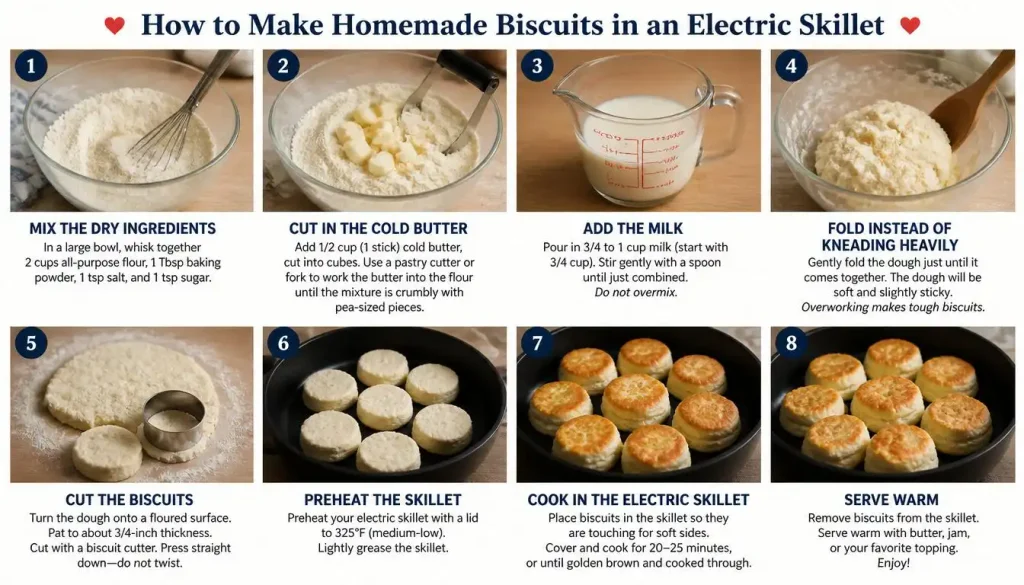
How to Make Homemade Biscuits in an Electric Skillet
Homemade biscuit dough can work very well, particularly with the rack-and-pan method.
Here is a simple batch designed for about six to eight biscuits.
Ingredients
- 2 cups all-purpose flour
- 1 tablespoon baking powder
- 1 teaspoon sugar, optional
- 1/2 teaspoon salt
- 6 tablespoons very cold butter
- About 3/4 cup cold milk or buttermilk
Step 1: Mix the Dry Ingredients
Combine the flour, baking powder, sugar, and salt in a bowl.
Step 2: Cut in the Cold Butter
Cut the butter into small pieces and work it into the flour until you have a mixture containing small flakes and pea-sized pieces.
Cold butter matters.
King Arthur Baking recommends using cold ingredients for flaky biscuits and explains that excessive mixing develops more gluten, which can make biscuits tougher. Read King Arthur’s biscuit-making tips
Step 3: Add the Milk
Pour in most of the milk or buttermilk and stir gently.
Add just enough additional liquid to bring the dough together.
It should look slightly shaggy rather than perfectly smooth.
Step 4: Fold Instead of Kneading Heavily
Turn the dough onto a lightly floured surface.
Pat it into a rectangle, fold it over, and repeat the process a couple of times.
This helps create layers without aggressively working the dough.
Step 5: Cut the Biscuits
Pat the dough about 3/4 to 1 inch thick.
Cut straight down with a biscuit cutter or drinking glass.
Avoid twisting the cutter aggressively because that can compress the edges.
Step 6: Cook in the Electric Skillet
For the most oven-like result:
- Preheat the skillet to approximately 350°F.
- Place a permitted rack or trivet inside.
- Put the biscuits into a suitable baking pan.
- Set the pan on the rack.
- Cover the skillet.
- Begin checking around 10 minutes.
- Continue until the centers are completely cooked.
If your skillet heats particularly gently, you may need to move closer to 375°F. If the bottoms brown too quickly, reduce the heat.
Can You Make Bisquick Biscuits in an Electric Skillet?
Yes.
Prepare your Bisquick biscuit dough according to the package or recipe directions, then use either the direct or rack-and-pan method.
For drop-style Bisquick biscuits, a small baking pan is easier because the soft dough does not need to be flipped.
For shaped Bisquick biscuits cooked directly on the skillet surface, keep the biscuits reasonably thin and use moderate heat so the centers can cook before the exterior becomes too dark.
Can You Make Drop Biscuits in an Electric Skillet?
Yes, and drop biscuits can actually be easier than traditional cut biscuits because you do not need to roll or shape the dough.
The rack-and-pan method is usually the better choice.
Drop equal portions of dough into a lightly greased baking pan, place the pan on the permitted rack, cover the skillet, and cook until the centers are set.
Keep the portions reasonably small and uniform. One giant drop biscuit will take much longer to cook through than six smaller ones.
Can You Cook Frozen Biscuits in an Electric Skillet?
It is possible, but frozen biscuits are less forgiving than refrigerated dough.
The outside begins cooking while the center is still frozen, which increases the risk of an over-browned exterior and a cold or doughy middle.
For better results:
- Use moderate rather than very high heat.
- Keep the skillet covered.
- Allow extra cooking time.
- Avoid overcrowding.
- Check the center of the thickest biscuit.
- Follow package-specific storage and handling directions.
If the manufacturer provides only oven directions, treat those as information about the product rather than an exact electric-skillet conversion.
How to Bake Biscuits Without a Wire Rack
You do not necessarily need a rack.
Canned biscuits can be cooked directly on the skillet surface, and some homemade biscuits can also be cooked this way if they are not excessively thick.
If you want to use a separate baking pan but do not have a rack, do not improvise with random household objects that may not be designed for high heat.
Check your skillet’s instruction manual for approved accessories or cooking configurations.
Direct cooking at a slightly lower temperature is usually safer than placing an unknown material inside a hot electrical appliance.
Can You Bake Biscuits in an Electric Frying Pan?
Yes.
“Electric skillet” and “electric frying pan” usually describe the same general type of appliance: a pan with its own heating element, temperature controller, raised sides, and often a fitted lid.
The term “electric skillet” is common in the United States and Canada, while “electric frying pan” is frequently used in the UK and Australia.
What matters more than the name is whether your specific model:
- Has controllable heat
- Has a lid
- Heats evenly
- Provides enough depth
- Is approved for the cooking method you plan to use
How to Keep Biscuits From Burning on the Bottom
Burned bottoms are probably the most common problem when baking in an electric skillet.
Lower the Temperature
If the bottom browns long before the center cooks, your skillet is too hot for that biscuit.
Drop the temperature by 25°F and extend the cooking time.
Use a Rack When Appropriate
For homemade biscuits in a baking pan, elevating the pan reduces direct exposure to the heating surface.
Know Your Skillet
A dial reading of 350°F does not necessarily mean the cooking surface is exactly 350°F.
Older thermostats and inexpensive controls can run hot or cycle widely.
Check for Hot Spots
If only the biscuits in one particular area burn, your skillet may heat unevenly.
Rotating the baking pan can help with mild hot spots. If the appliance consistently overheats or behaves unpredictably, consult KiCook’s electric skillet troubleshooting guide before blaming the recipe.
Do Not Chase a Brown Top
This is a surprisingly common mistake.
The top can stay pale because the skillet has no overhead heating element. Increasing the temperature until the top turns brown may simply burn the bottom.
Why Are My Biscuits Brown Outside but Raw Inside?
This usually means heat is reaching the exterior faster than it can travel through the dough.
Common causes include:
- Temperature set too high
- Biscuits too thick
- Large refrigerated biscuits cooked like small biscuits
- Direct contact with a very hot surface
- A skillet that runs hotter than its thermostat indicates
The fix is usually straightforward: reduce the heat and give the center more time.
For very thick biscuits, switch to the rack-and-pan method.
Why Aren’t My Electric Skillet Biscuits Browning on Top?
Because the skillet is heating from below.
A conventional oven surrounds the biscuit with hot air and may also provide heat from an upper element. Your electric skillet cannot reproduce that environment perfectly.
K-State’s electric-skillet muffin instructions demonstrate the same effect: the muffins cook through but do not brown like oven-baked muffins.
For direct-cooked biscuits, flipping solves the problem by putting both sides in contact with the cooking surface.
For rack-baked biscuits, accept that a pale top can still mean a properly cooked biscuit.
Do not sacrifice the soft center just to get more color.
Why Are My Biscuits Soggy on Top?
A little moisture under the lid is normal. Too much moisture, however, can leave the upper surface damp.
Possible causes include:
- Excess condensation under the lid
- Overcrowding
- Very low cooking temperature
- Dough that contains too much liquid
- Biscuits that are excessively thick
Avoid repeatedly removing the lid during the first part of cooking, but if the biscuits are nearly done and condensation is excessive, briefly venting the lid may help some moisture escape.
Be careful when lifting the lid because trapped steam can cause burns.
Why Didn’t My Biscuits Rise?
Several things can lead to flat biscuits.
Old Baking Powder
Baking powder loses effectiveness over time. If homemade biscuits repeatedly fail to rise, check the age of your leavening.
Warm Butter
For flaky homemade biscuits, keep the butter and milk cold until the dough is ready to cook.
Overworked Dough
Too much kneading develops gluten and can make biscuits dense.
King Arthur specifically recommends handling biscuit dough gently for this reason.
Low Heat
If the skillet never gets warm enough, the biscuits may spread or cook slowly instead of rising properly.
Repeatedly Opening the Lid
Opening the lid releases the hot air that is helping cook the upper portion of the biscuit.
Electric Skillet vs. Oven: Which Makes Better Biscuits?
| Feature | Electric Skillet | Conventional Oven |
|---|---|---|
| Works without an oven | Excellent | No |
| Small batches | Excellent | Good |
| Portable | Yes | No |
| Top browning | Limited | Excellent |
| Bottom-burn risk | Higher | Lower |
| Traditional biscuit rise | Good with proper method | Usually better |
| Temperature adjustment | Easy | Easy |
| RV/small kitchen use | Excellent | Often impractical |
| Large batches | Limited | Better |
A conventional oven still wins when your goal is the classic tall biscuit with an evenly browned top.
But if you need six warm biscuits for breakfast and your oven is unavailable—or you simply do not want to heat the whole kitchen—the electric skillet is a practical alternative.
Tips for Fluffy, Golden Electric Skillet Biscuits
A few small habits make a noticeable difference.
Keep homemade ingredients cold. Cold butter helps create flaky layers.
Do not overmix. Stop once the dough comes together.
Make biscuits similar in size. Uneven biscuits finish at different times.
Preheat the skillet. Starting on a cold surface makes timing much harder to predict.
Use moderate heat. High heat is not a shortcut when the dough is thick.
Keep the lid closed. Trapped heat helps cook the top and center.
Leave enough room for expansion. Do not pack the skillet completely full.
Watch the first batch closely. Once you learn how your particular skillet behaves, later batches become much easier.
Write down the successful setting. If 325°F for 13 minutes works perfectly in your skillet, that personal reference is more useful than a generic chart.
Common Electric Skillet Biscuit Mistakes
Avoid these common errors:
- Treating an electric skillet exactly like an oven.
- Turning the temperature too high to speed up cooking.
- Forgetting to use the lid.
- Opening the lid every minute.
- Overcrowding the cooking surface.
- Making direct-cooked biscuits excessively thick.
- Adding too much oil and accidentally frying the dough.
- Pressing biscuits down with the spatula.
- Assuming every skillet’s thermostat is equally accurate.
- Cooking longer only because the tops look pale.
- Following oven package timing minute-for-minute.
- Using an unapproved rack or baking dish inside the appliance.
How to Store and Reheat Leftover Biscuits
Let cooked biscuits cool before storing them so trapped steam does not make them soggy.
Place them in an airtight container or resealable food-storage bag.
For short-term storage, room-temperature storage may be appropriate for plain biscuits, while refrigeration is better for biscuits containing highly perishable fillings or toppings. Always handle filled biscuits according to the most perishable ingredient.
To reheat a plain biscuit in an electric skillet:
- Set the skillet to low heat.
- Add the biscuit.
- Cover loosely.
- Warm for a few minutes.
- Turn once if necessary.
Avoid using high heat. You want to warm the interior, not cook the biscuit a second time.
What to Serve With Electric Skillet Biscuits
Fresh biscuits work with far more than breakfast.
Try them with:
- Butter
- Honey
- Fruit preserves
- Sausage gravy
- Scrambled eggs
- Fried eggs
- Breakfast sausage
- Bacon
- Chicken
- Soup
- Beef stew
- Chili
- Ham
- Breakfast sandwiches
They are especially useful when you are already preparing the rest of the meal in the electric skillet and want a simple bread on the side.
Frequently Asked Questions About Can You Bake Biscuits in an Electric Skillet
Can you bake canned biscuits in an electric skillet?
Yes. Preheat the skillet to moderate heat, lightly grease it, arrange the biscuits with space between them, cover, and flip them partway through cooking. Check the centers before serving.
Can you bake Pillsbury biscuits in an electric skillet?
Yes, although Pillsbury’s package instructions are designed for conventional ovens. When adapting the dough to an electric skillet, use controlled heat and watch the bottoms carefully rather than simply copying the oven time and temperature.
Can you make Bisquick biscuits in an electric skillet?
Yes. You can cook shaped Bisquick biscuits directly or place drop biscuits in a small baking pan on a permitted rack. Keep the skillet covered while they cook.
Can you bake biscuits without an oven?
Absolutely. An electric skillet is one option. Biscuits can also be adapted to certain stovetop pans, countertop ovens, camp-cooking setups, and other suitable appliances.
What temperature do you cook biscuits in an electric skillet?
Around 325°F to 350°F is a useful starting range for biscuits cooked directly on the surface. For a baking pan elevated on a rack, roughly 350°F to 375°F can work. Your skillet model and biscuit size may require adjustment.
How long do biscuits take in an electric skillet?
Most take roughly 8 to 20 minutes. Small canned biscuits cook faster than large refrigerated, frozen, or thick homemade biscuits.
Should you preheat an electric skillet for biscuits?
Yes, in most cases. Preheating creates a more predictable cooking environment and makes timing easier. Follow your skillet manufacturer’s instructions for the recommended preheating procedure.
Do you need a lid?
A lid is strongly recommended. It traps heat around the biscuits and helps cook the centers and upper portions. Without a lid, the bottoms can finish long before the tops.
Do you have to flip biscuits in an electric skillet?
If you are cooking directly on the skillet surface, usually yes. Flipping exposes both sides to direct heat. Biscuits baked in a pan on a rack generally do not need to be flipped.
Can you bake biscuits directly on the bottom of an electric skillet?
Yes. This method works particularly well for canned biscuits, but use moderate heat and flip them so both sides cook evenly.
Do you need a wire rack?
No. A rack is useful for oven-style baking in a separate pan, but direct skillet biscuits do not require one.
Can you cook frozen biscuits in an electric skillet?
Yes, but expect a longer cooking time and use moderate heat. Check that the center is completely cooked before serving.
Why are my electric skillet biscuits raw in the middle?
The heat is probably too high, the biscuits are too thick, or both. Reduce the temperature and extend the cooking time.
Why do biscuit bottoms burn in an electric skillet?
Electric skillets heat primarily from underneath. Excessive temperature, hot spots, direct contact, or an inaccurate thermostat can brown the bottom before the center cooks.
Why don’t my biscuits brown on top?
Electric skillets normally have no upper heating element. The tops may therefore remain light even after the biscuits are completely cooked.
Can I cook biscuits in an electric frying pan?
Yes. An electric frying pan is essentially the same type of appliance for this purpose. The terminology is simply more common in regions such as the UK and Australia.
Final Verdict: Is an Electric Skillet Good for Baking Biscuits?
Yes, you can bake biscuits in an electric skillet, and it is a genuinely useful method when a conventional oven is unavailable.
For canned or refrigerated biscuits, the simplest approach is to cook them directly on a lightly greased skillet at moderate heat, keep the lid on, and flip them partway through.
For homemade biscuits, using a small baking pan elevated on a manufacturer-approved rack or trivet gives you a more oven-like cooking environment and reduces the risk of scorching the bottoms.
The most important thing to remember is that electric skillets heat from below. Do not chase a dark golden top by continually increasing the temperature. Watch the bottom, keep the skillet covered, and judge the biscuit by whether the center is fully cooked.
Once you learn the temperature that works with your specific skillet, making warm biscuits without an oven becomes surprisingly straightforward.

“I believe great cooking starts with the right tools, trusted advice, and a little confidence in the kitchen.”
Hi, I’m Emma Carter. My love for cooking began in my grandmother’s kitchen, where I learned that every great meal starts with simple ingredients and the right cookware. Over the years, I’ve spent countless hours researching, testing, and comparing kitchen appliances, cookware, coffee makers, air fryers, and other everyday kitchen essentials.
Here at KiCook, my goal is to make your buying decisions easier with honest product reviews, practical buying guides, and easy-to-follow cooking tips. Whether you’re upgrading your kitchen or searching for the best appliance for your home, I focus on providing clear, reliable, and research-backed information you can trust.
When I’m not testing new kitchen gadgets or writing in-depth guides, you’ll usually find me trying new recipes, visiting local farmers’ markets, or enjoying a quiet cup of coffee while planning my next kitchen project.