

Yes, you can boil eggs in an electric skillet. If your skillet is deep enough to hold water safely and has a fitted lid, it can cook soft-, medium-, or hard-boiled eggs without a stovetop.
The trick is to treat the electric skillet a little differently from a regular saucepan. Electric skillets vary in depth, wattage, thermostat accuracy, and lid design, so the exact cooking time can change from one model to another.
For a deep electric skillet, you can cover the eggs with water and boil them much as you would in a saucepan. With a shallow skillet, a covered steam-style method may work better if your manufacturer allows it.
This guide walks you through both approaches, including how much water to use, what temperature to set, how long to cook the eggs, and how to keep them from cracking or overcooking.
Can You Really Boil Eggs in an Electric Skillet?
Yes. Many electric skillets can heat water to boiling temperature, so there is no fundamental reason you cannot cook eggs in one.
In fact, some electric skillet manufacturers specifically provide hard-boiled egg recipes. One compact electric skillet manual, for example, instructs users to cook four large eggs with 3/4 cup of water under the lid for about 14 minutes. That does not mean every electric skillet should use the same amount of water or cooking time, but it confirms that covered egg cooking is a legitimate use for some models.
Larger, deeper skillets give you another option: adding enough water to cover the eggs completely and using a more traditional boiling method.
If you are still learning what your appliance can handle, Kicook’s guide to what you can cook in an electric skillet covers frying, simmering, steaming, one-pan meals, eggs, pasta, vegetables, meat, and other common uses. What Can You Cook in an Electric Skillet?
Quick Answer: Time, Temperature, and Water
Here is a useful starting point for large eggs.
| Doneness | Approximate Time After Water Begins Boiling/Steaming | Yolk |
|---|---|---|
| Soft-boiled | 6–7 minutes | Runny |
| Medium-boiled | 8–9 minutes | Jammy or partly set |
| Hard-boiled | 10–12 minutes | Firm |
| Covered shallow-water method | About 12–14 minutes for some models | Firm |
These are starting points rather than guarantees. Electric skillet temperature cycling, egg size, starting temperature, water quantity, and skillet design can all change the result.
For hard-cooked eggs using a conventional covered-hot-water method, the American Egg Board recommends about 12 minutes for large eggs, 9 minutes for medium eggs, and 15 minutes for extra-large eggs after the water has reached boiling and the pan has been removed from heat.
Their full hard-boiled egg method is available here: American Egg Board hard-boiled egg guide
What You Need
You do not need any special equipment beyond what you probably already have.
You will need:
- An electric skillet or electric frying pan
- A fitted lid
- Eggs
- Water
- Tongs or a slotted spoon
- A bowl
- Ice and cold water
- A timer
Use eggs that are free from visible cracks.
Does Your Electric Skillet Need a Lid?
A lid is strongly recommended.
The lid traps heat and steam inside the skillet, which helps maintain a more stable cooking environment. It is particularly important when using a shallow-water method because steam does part of the cooking.
Without a lid, water evaporates faster and the eggs may cook less evenly.
How Deep Should the Skillet Be?
If you want to use a traditional boiling method, the skillet should be deep enough to hold the eggs in a single layer with roughly an inch of water above them without creating an overflow risk.
If the skillet is too shallow for that, do not overfill it just to cover the eggs. A covered steaming method is safer if the appliance is designed for that type of cooking.
How to Boil Eggs in an Electric Skillet Step by Step
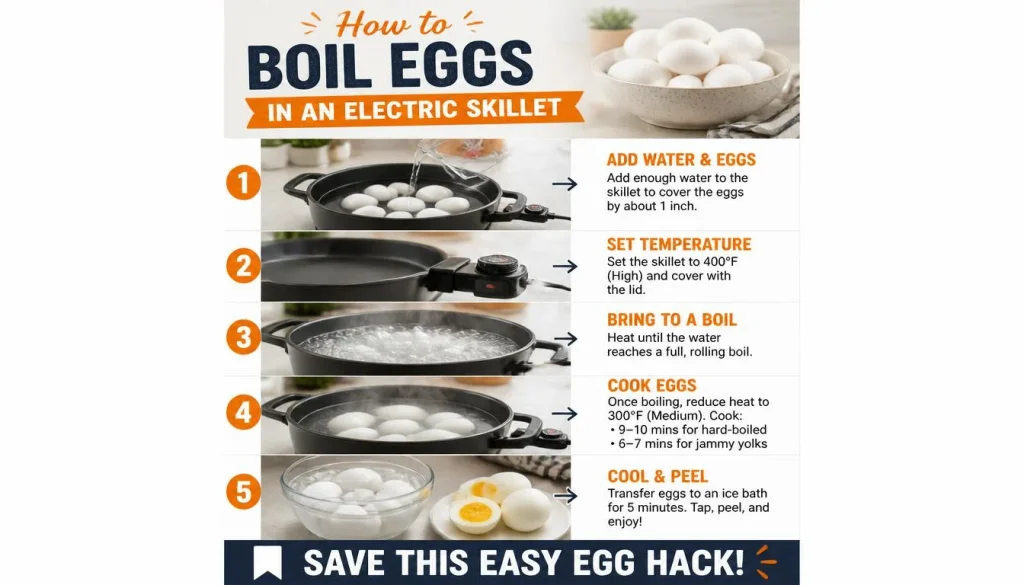
For most full-size electric skillets, the following method is an easy place to start.
Step 1: Arrange the Eggs in a Single Layer
Place the eggs gently in the bottom of the skillet.
Do not stack them. A single layer allows water and heat to circulate more evenly and reduces the chance of eggs knocking against one another.
Step 2: Add Cold Water
Add enough cold water to cover the eggs by approximately 1 inch if the skillet is deep enough.
The American Egg Board also uses about an inch of water above the eggs for its conventional hard-cooked egg method.
Do not fill the skillet close to the rim. Boiling water needs room to move without spilling onto the counter or electrical components.
Step 3: Set the Temperature
Place the lid on the skillet and set the temperature high enough to bring the water to a boil.
A useful starting point on many adjustable electric skillets is around 350°F (177°C).
For example, Presto’s electric skillet instructions recommend heating at 350°F until food or liquid boils, then reducing the setting for simmering.
Your model may behave differently, so follow its manual if it gives specific boiling instructions.
For more help understanding electric skillet heat levels, see Kicook’s guide to medium heat on an electric skillet. What Is Medium Heat on an Electric Skillet?
Step 4: Reduce the Heat and Start Timing
Once the water reaches a steady boil, reduce the temperature so the water continues bubbling gently rather than violently.
Then start your timer.
As a practical starting point for large eggs:
- 6–7 minutes: soft center
- 8–9 minutes: medium or jammy center
- 10–12 minutes: firm hard-boiled center
Because electric skillets cycle their heating elements on and off, your first batch may need a small adjustment.
If you regularly use the same skillet and the same size eggs, make a note of the timing that produces the texture you like.
Step 5: Move the Eggs to an Ice Bath
When the eggs are done, lift them out with tongs or a slotted spoon and immediately place them in a bowl of ice water.
Let them cool for approximately 10 minutes.
Rapid cooling stops most carryover cooking and makes the eggs much easier to handle. The compact electric skillet recipe mentioned earlier also instructs users to cool the cooked eggs in ice water for about 10 minutes.
Step 6: Peel and Serve
Once completely cool, gently tap the egg on a firm surface.
Roll it lightly to create small cracks all around the shell, then begin peeling from the larger end.
Running a little cold water between the egg and shell can help loosen stubborn pieces.
What Temperature Should You Use to Boil Eggs in an Electric Skillet?
Water itself boils at approximately 212°F (100°C) at sea level, but that does not mean you should set the electric skillet dial to 212°F.
The dial controls the appliance’s heating surface, not the exact temperature of the water.
A setting around 350°F (177°C) is a reasonable starting point for bringing water to a boil on many adjustable electric skillets. Presto specifically recommends 350°F when bringing foods or liquids to a boil before reducing the temperature for simmering.
Once boiling begins, turn the temperature down enough to maintain gentle bubbling.
You do not need a violent rolling boil. Excessive movement can make the eggs bump into the skillet or each other and increase the chance of cracked shells.
Should You Preheat the Electric Skillet First?
For the full-water method, preheating is usually unnecessary. You can place the eggs and cold water in the skillet and heat them together.
However, some shallow-water manufacturer recipes specifically instruct users to preheat the appliance first. The correct approach therefore depends on the method and your skillet model.
When your owner’s manual provides instructions, follow those before using a generic recipe.
How Long Do You Boil Eggs in an Electric Skillet?
Cooking time depends mainly on the yolk texture you want.
Soft-Boiled Eggs
Start with approximately 6–7 minutes after the water reaches a controlled boil.
The white should be mostly set while the yolk remains soft or runny.
Because lightly cooked eggs carry a greater food-safety risk than fully cooked eggs, people at higher risk of foodborne illness should use extra caution with undercooked eggs.
Medium-Boiled Eggs
Try approximately 8–9 minutes.
The white should be set while the yolk becomes thicker and creamy rather than completely liquid.
Hard-Boiled Eggs
For large eggs, approximately 10–12 minutes of controlled boiling or steaming is a practical starting point.
Another option is the hot-water method: bring the water to boiling, switch the heat off, keep the skillet covered, and allow the eggs to sit in the hot water. The American Egg Board’s conventional method uses approximately 12 minutes for large eggs.
Since an electric skillet may lose heat differently from a saucepan, test one egg before relying on that exact timing for future batches.
Does Egg Size Affect Cooking Time?
Yes.
A larger egg takes slightly longer for heat to reach the center.
The American Egg Board’s hard-cooked method illustrates the difference clearly:
- Medium eggs: about 9 minutes
- Large eggs: about 12 minutes
- Extra-large eggs: about 15 minutes
Those times apply to its covered hot-water method rather than every electric skillet method.
Should You Start With Cold Water or Boiling Water?
Both methods can work, but consistency matters more than choosing one universal approach.
Starting the eggs in cold water is gentle and easy. The eggs and water heat together, reducing the sudden temperature change that sometimes causes shells to crack.
The American Egg Board’s hard-boiled method starts eggs in cold water, brings the water just to boiling, covers the pan, and then lets the eggs cook in the retained heat.
Starting directly in boiling water can also work, especially for steaming methods, but lower refrigerated eggs carefully with tongs or a spoon.
Whichever approach you choose, use the same method each time so your timing stays predictable.
Do Eggs Need to Be Completely Covered With Water?
Not always.
For traditional boiling, covering the eggs with water is the easiest method because the entire shell receives consistent heat.
For covered steaming, the eggs do not need to be submerged.
The American Egg Board’s easy-peel steaming method uses only about 1/2 to 1 inch of boiling water and cooks large eggs under a lid for around 12 minutes.
That is useful if your electric skillet is too shallow to completely submerge an egg.
However, do not automatically use a steaming technique in every electric skillet. Check that your model is designed to handle covered cooking with water.
How Much Water Should You Add?
For a traditional boiling method, add enough water to cover the eggs by about an inch.
For a shallow covered method, much less water may be needed.
There is no universal number of cups that works for every electric skillet.
For example, one small electric skillet recipe uses four large eggs with 3/4 cup water and a 14-minute covered cooking period.
That amount makes sense for that particular compact skillet, but it should not be copied blindly into a large 12- or 16-inch appliance.
Boiling vs Steaming Eggs in an Electric Skillet
Both methods can produce good results.
| Method | Best For | Water Needed | Lid |
|---|---|---|---|
| Full-water boiling | Deep electric skillets | Enough to cover eggs | Recommended |
| Covered steaming | Shallower skillets | Small amount | Essential |
Fully Submerged Method
Choose this approach if your skillet comfortably holds enough water to cover the eggs without becoming dangerously full.
It is familiar, predictable, and easy for beginners.
Shallow-Water Covered Method
Choose this method when the skillet is shallower but has a reliable fitted lid.
The small quantity of water creates steam under the cover, which surrounds and cooks the eggs.
This method also means you do not have to heat a large skillet full of water.
Can You Boil Eggs Straight From the Refrigerator?
Yes.
You do not have to bring eggs to room temperature before cooking them.
In fact, the American Egg Board notes that the timing in its steaming method is based on eggs used directly from the refrigerator.
Handle cold eggs carefully, especially if adding them to already-boiling water, because sudden temperature changes and impact can encourage cracking.
How Do You Know When the Eggs Are Done?
You cannot reliably judge the inside of an uncracked boiled egg by looking at its shell.
Timing is the simplest method.
If you are using an unfamiliar electric skillet, cook one extra egg during the first batch. Cool it, cut it open, and check the yolk.
If it is softer than you prefer, increase the cooking time slightly on the next batch.
Once you find the right timing for your appliance, future batches become much easier.
Why Cooking Time Varies Between Electric Skillets
Two electric skillets set to the same number can behave differently.
Cooking time may change because of:
- Skillet wattage
- Thermostat calibration
- Skillet size and depth
- Lid fit
- Amount of water
- Number of eggs
- Egg size
- Starting egg temperature
- Starting water temperature
- Elevation
Electric skillet thermostats also cycle the heating element on and off. That is normal, but it means the water temperature may fluctuate slightly rather than staying perfectly constant.
How to Prevent Eggs From Cracking
Cracking usually happens because of impact, rapid temperature changes, or aggressive boiling.
To reduce the chance of broken shells:
- Arrange eggs gently rather than dropping them into the skillet.
- Keep them in a single layer.
- Avoid a violent rolling boil.
- Lower eggs with tongs or a spoon if the water is already hot.
- Avoid overcrowding.
- Do not use eggs that already have visible cracks.
If a small crack develops while cooking, the egg may still cook, although some white may leak into the water.
Why Do Boiled Egg Yolks Turn Green or Gray?
That greenish-gray ring around a hard-boiled yolk usually means the egg was exposed to heat for too long or cooled too slowly.
It is not normally a sign that the egg is spoiled.
The easiest prevention is to avoid excessive cooking and move the eggs into cold or ice water as soon as they are finished.
How to Make Hard-Boiled Eggs Easier to Peel
A few simple habits can make peeling much less frustrating.
First, cool the eggs thoroughly.
Then:
- Tap the large end of the egg.
- Crack the shell gently around the entire surface.
- Roll it lightly between your hand and the counter.
- Begin peeling at the wider end.
- Use cold running water if pieces of shell stick.
The American Egg Board also recommends starting at the large end and notes that peeling under cold running water can help release the shell.
Common Electric Skillet Egg-Boiling Mistakes
Most disappointing batches come down to a few simple mistakes.
Using Too Much Water
Do not fill a shallow electric skillet dangerously close to the rim.
Using Too Little Water for the Chosen Method
If you are using traditional boiling, the eggs should stay covered. If you are steaming, make sure there is enough water to generate steam throughout the cooking period.
Keeping the Heat Too High
Once boiling starts, you usually need only enough heat to maintain a controlled boil or steam.
Starting the Timer Too Early
Decide whether your recipe’s timing begins when the appliance turns on or when the water starts boiling. Mixing these two approaches can produce inconsistent results.
Overcooking
Extra cooking time makes the yolk dry and increases the chance of a green-gray ring.
Skipping the Cooling Step
Leaving hot eggs sitting in the skillet allows residual heat to continue cooking them.
Copying Another Skillet’s Settings Exactly
Your skillet may be larger, shallower, more powerful, or controlled differently.
Use another recipe as a starting point, then adjust.
Is It Safe to Boil Eggs in an Electric Skillet?
It can be safe when the appliance is designed to cook with liquids and you follow its instructions.
A few precautions matter:
- Read your model’s manual first.
- Place the skillet on a stable, dry surface.
- Keep electrical connections and the temperature-control probe dry.
- Do not overfill the pan.
- Keep the cord away from water.
- Open the lid away from your face to avoid steam burns.
- Do not carry a skillet filled with boiling water unless necessary.
- Allow the skillet to cool before cleaning.
Cleaning rules also vary considerably between models. Some removable pans or lids can go in a dishwasher while other electrical components must stay completely dry. Kicook’s guide to whether electric skillets are dishwasher safe explains the differences. Are Electric Skillets Dishwasher Safe?
Can You Boil Eggs in an Electric Frying Pan?
Yes. In everyday cooking, the terms electric skillet, electric frying pan, and electric frypan often describe the same basic type of countertop appliance.
The terminology varies by country and manufacturer.
So if you are in the UK or Australia and wondering whether you can boil eggs in an electric frying pan, the same rules apply: check the depth, use a lid, avoid overfilling, and follow the manufacturer’s instructions.
Can You Boil Eggs Without a Stove?
Absolutely.
That is one of the situations where an electric skillet can be particularly useful.
You might use one when:
- Your stovetop is already occupied
- Your regular stove is temporarily unavailable
- You are cooking in an RV
- You have a small kitchenette
- You need an additional cooking surface
Always make sure the location permits the appliance and has a suitable electrical outlet.
How Many Eggs Can You Boil at Once?
There is no universal maximum.
The number depends on the size and depth of your skillet.
The best rule is to keep the eggs in one uncrowded layer.
A compact skillet might comfortably hold only four eggs, while a wide family-size electric skillet could hold considerably more.
Do not add so many eggs that you cannot maintain a safe water level or place the lid correctly.
Electric Skillet vs. Saucepan for Boiling Eggs
A saucepan is usually the simplest tool if you already have a working stovetop, but an electric skillet can be a useful alternative.
| Feature | Electric Skillet | Saucepan |
|---|---|---|
| Needs stovetop | No | Yes |
| Temperature dial | Usually | No |
| Wide cooking area | Yes | Usually smaller |
| Deep water capacity | Depends on model | Usually good |
| Portability | Good | Requires heat source |
| Covered steaming | Good with suitable lid | Good |
For boiling only a few eggs, a saucepan may heat a smaller quantity of water more efficiently.
The electric skillet becomes especially useful when you need another cooking surface or do not have convenient access to a stove.
How to Store Hard-Boiled Eggs Safely
Once the eggs have cooled, refrigerate them promptly.
The FDA recommends using hard-cooked eggs, whether peeled or still in the shell, within one week after cooking. It also recommends keeping refrigerated eggs at 40°F (4°C) or below.
You can read the complete food-safety guidance here: FDA egg safety guidance
The USDA likewise states that hard-cooked eggs can be refrigerated for up to seven days and should be refrigerated within two hours after cooking.
Keep cooked eggs in a covered container so they do not pick up odors from other foods in the refrigerator.
Frequently Asked Questions About Can You Boil Eggs in an Electric Skillet
Can you hard boil eggs in an electric skillet?
Yes. A deep electric skillet can use a traditional water method, while some shallower models can cook hard-boiled eggs using a small amount of water and a fitted lid.
How long does it take to boil eggs in an electric skillet?
For large hard-boiled eggs, around 10–12 minutes after the water reaches a controlled boil is a useful starting point. Some covered shallow-water electric skillet recipes take around 14 minutes. Your model may require adjustment.
What temperature should I set my electric skillet for boiling eggs?
Around 350°F (177°C) is a practical starting setting for bringing water to a boil on many adjustable skillets. Once the water boils, reduce the heat enough to maintain gentle bubbling.
Can you boil water in an electric skillet?
Many electric skillets can boil modest quantities of water. Make sure your particular model is suitable for liquid cooking and do not overfill it.
Do eggs have to be fully submerged?
Not if you are deliberately using a covered steaming method. For traditional boiling, covering the eggs with water gives more consistent heating.
Can you boil eggs without a lid?
You may be able to, but a lid makes heat control easier, reduces evaporation, and is particularly important for steaming.
Can you make soft-boiled eggs in an electric skillet?
Yes. Start checking large eggs at around six to seven minutes after the water reaches a controlled boil. Keep in mind that undercooked eggs present a greater food-safety risk than fully cooked eggs.
Can you use cold eggs straight from the refrigerator?
Yes. You do not need to warm them to room temperature first.
How much water should you use?
For traditional boiling, use enough water to cover the eggs by about an inch. For steaming, use enough to continuously produce steam without allowing the skillet to boil dry. Follow the appliance manual whenever it specifies an amount.
Can you boil a dozen eggs at once?
Possibly, if your electric skillet is wide enough to hold them in one layer and deep enough to contain the required water safely. Avoid overcrowding.
How long should boiled eggs stay in an ice bath?
About 10 minutes is usually enough to cool large eggs thoroughly and stop most carryover cooking.
Can you leave eggs in the hot skillet after turning it off?
You can if you are intentionally using a covered hot-water cooking method, but leaving already cooked eggs in hot water longer than intended may overcook them. Transfer finished eggs to ice water promptly.
Final Verdict
So, can you boil eggs in an electric skillet? Yes, you can, and it is surprisingly straightforward once you understand how your particular skillet handles water and temperature.
For a deep electric skillet, place the eggs in a single layer, cover them with water, bring the water to a boil, then lower the heat and cook until they reach your preferred doneness.
If your skillet is too shallow to completely cover the eggs, a covered steaming method can also work, provided the manufacturer allows it.
For large eggs, roughly 6–7 minutes for soft, 8–9 minutes for medium, and 10–12 minutes for firm eggs provides a reasonable starting point once the water is boiling. After cooking, transfer the eggs straight to an ice bath.
Most importantly, do not assume every electric skillet behaves the same. Water capacity, thermostat cycling, wattage, egg size, and lid design all affect cooking time. Once you find the right timing for your own appliance, an electric skillet becomes an easy way to prepare boiled eggs even when a stovetop is unavailable.

“I believe great cooking starts with the right tools, trusted advice, and a little confidence in the kitchen.”
Hi, I’m Emma Carter. My love for cooking began in my grandmother’s kitchen, where I learned that every great meal starts with simple ingredients and the right cookware. Over the years, I’ve spent countless hours researching, testing, and comparing kitchen appliances, cookware, coffee makers, air fryers, and other everyday kitchen essentials.
Here at KiCook, my goal is to make your buying decisions easier with honest product reviews, practical buying guides, and easy-to-follow cooking tips. Whether you’re upgrading your kitchen or searching for the best appliance for your home, I focus on providing clear, reliable, and research-backed information you can trust.
When I’m not testing new kitchen gadgets or writing in-depth guides, you’ll usually find me trying new recipes, visiting local farmers’ markets, or enjoying a quiet cup of coffee while planning my next kitchen project.