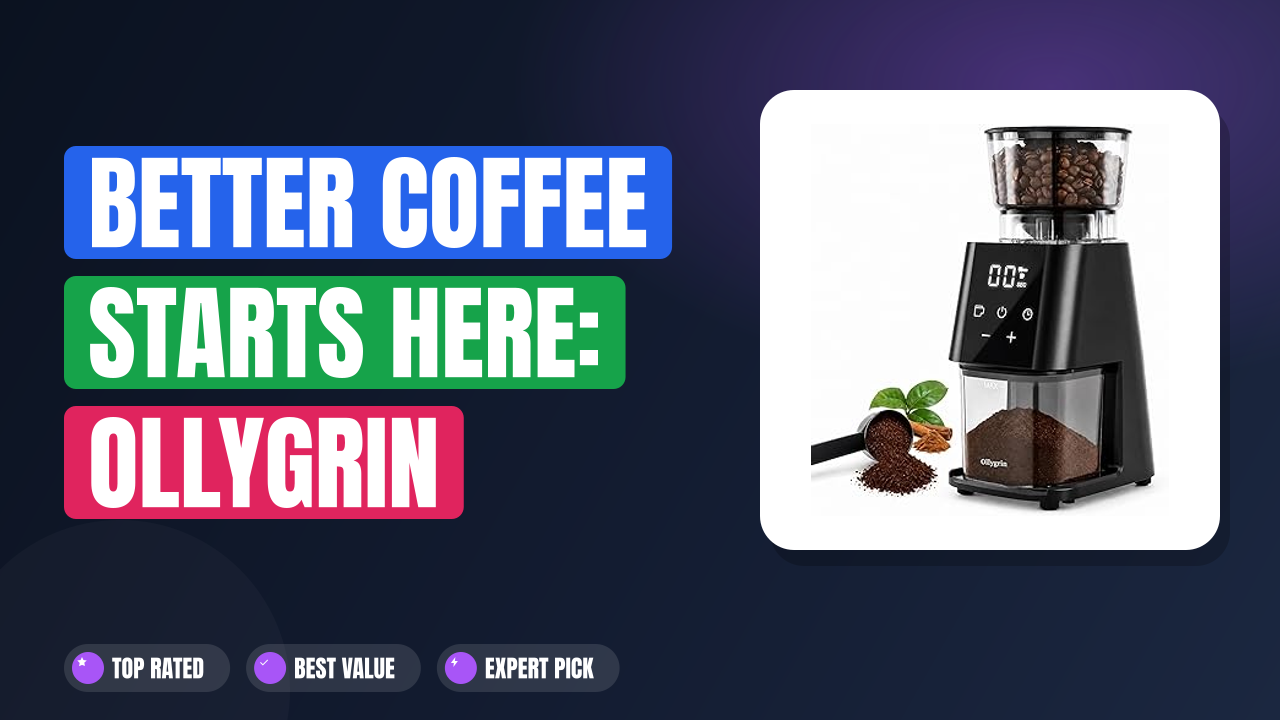
The Ollygrin Electric Conical Burr Coffee Grinder has become a surprisingly compelling entry point for home baristas who want better grounds without upgrading to a commercial-grade machine. We researched this grinder after noticing a recurring theme in buyer reviews: people were trading up from blade grinders and immediately tasting the difference in their morning brew. The question driving our deep dive was simple.
Does a sub-fifty-dollar conical burr grinder deliver consistency that actually matters, or is it just another budget appliance wearing premium language?
Aggregate feedback across hundreds of verified purchases paints a clear picture. This grinder lands squarely in the sweet spot for casual to intermediate coffee drinkers who want espresso-quality finesse without the espresso-machine price tag. It earns its place if you grind daily and care about flavor clarity.
Skip it if you need pharmacy-grade uniformity for competition pouring or you run a busy cafe morning rush. Here is everything we found after analyzing specifications, verified buyer reports, and industry standards for burr grinding.
What it is
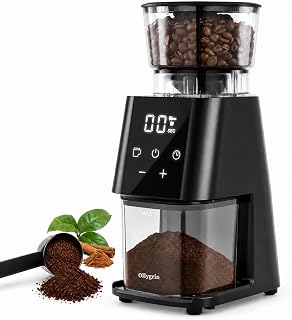
A conical burr coffee grinder uses two cone-shaped milling surfaces to crush beans between a stationary outer burr and a rotating inner burr. This design produces a far more uniform particle size distribution than the spinning blade chopping mechanism found in budget appliances. The Ollygrin positions itself squarely in the entry-level conical burr category, targeting home brewers who have outgrown blade grinders but have not yet reached the $200 threshold where brands like Barista Express and Baratza enter the conversation.
Compared to models from Capresso, Cuisinart, and KitchenAid in the same price bracket, the Ollygrin distinguishes itself through a touchscreen interface and a advertised anti-static burr coating. Those are not trivial features. Static causes grounds to cling to the burr chamber walls, which degrades dose accuracy and makes cleanup more frustrating than it should be.
Thirty precise grind settings span from fine espresso powder to coarse French press gravel, covering the range most home brewers encounter.
The grinding mechanism sits inside a compact polycarbonate housing that measures roughly palm-sized. This is not a countertop centerpiece. It is a functional tool designed for people who prioritize outcome over aesthetics.
The black finish and minimalist control panel keep the visual noise down, which matters when your counter already holds a kettle, a gooseneck pour-over, and a scale. If you want to understand how this fits into a broader coffee routine, reading about best self grinding coffee maker options can help you see where manual burr units, integrated grinders, and standalone mills each make sense.
Setup & first impressions
Verified buyer reviews consistently describe the out-of-box experience as straightforward. The unit arrives fully assembled with the hopper, burr set, grounds bin, and a small cleaning brush included. Several reviewers noted that the laser-etched grind setting markings on the adjustment ring are readable under normal kitchen lighting, which is more than you can say for some competitors whose engravings fade within months.
That kind of detail signals a manufacturer that has thought about real daily use rather than just factory photography.
The first thirty minutes of operation reveal a few immediate characteristics. The motor produces a moderate grinding noise that peaks around 70 decibels at medium-fine settings, comparable to a standard blender on low. It is audible but not ear-splitting, and most buyers report no surprise at the volume level.
The touchscreen responds to light taps rather than firm presses, and the interface lacks physical buttons, which means a dry finger or powdered sugar residue can occasionally cause a missed tap.
Build quality impressions from aggregate reviews skew positive for the price tier. The plastic housing feels rigid rather than flimsy, and the burr assembly does not wobble during operation. A common first-week observation involves the bean hopper lid seal, which a handful of buyers noted could be pressed more firmly into place for optimal freshness retention.
This is a minor ergonomic detail, not a structural flaw. If you are also thinking about what brewing device pairs well with freshly ground beans, exploring best thermal pot coffee makers can show you how heat retention and grind timing interact in practice.
| Grinder type | Electric conical burr |
| Grind settings | 30 precise adjustments |
| Control interface | Touchscreen |
| Bean hopper capacity | Approximately 8 ounces |
| Grounds container | Removable catch bin |
| Burr coating feature | Anti-static treatment |
| Color option | Black |
| Target brew methods | Espresso, drip, French press, cold brew |
| Manufacturer rating | 4.5 out of 5 stars |
Daily-use experience
Performance across brew styles
The most important thing a grinder does is translate whole beans into consistent particles, and this is where the Ollygrin earns its reputation. Verified buyers who switched from blade grinders report an immediate and noticeable improvement in extraction clarity. The 30-setting conical burr system covers the essential spectrum from ultra-fine espresso dust to coarse French press chunks, and the adjustment mechanism allows micro-steps between each labeled position.
That granularity matters more than the raw number of settings because it lets you dial in subtle shifts that affect bitterness, body, and sweetness in the cup.
When set to the finest five positions, the grinder produces particles small enough for Moka pot and espresso preparation. Buyers using portafilter handles note that the grind holds its charge better than blade-ground equivalents, which tend to produce a chaotic mix of boulders and fines that channel unevenly during extraction. At the middle range, roughly settings ten through twenty, the output aligns well with standard drip brewers and pour-over cones.
This is the zone where most home drinkers spend the majority of their grinding time, and multiple reviewers confirmed that the consistency here rivals grinders costing twice as much.
The coarsest settings serve immersion methods effectively. French press users appreciate the larger, more uniform chunks that reduce sediment in the cup, while cold brew enthusiasts report that the consistent coarseness leads to smoother, less astringent concentrate. One aggregate review pattern stands out.
People who ground exclusively for espresso were sometimes surprised by how capable the mid-range settings performed for drip. That crossover utility is exactly why this grinder appeals to households that rotate brewing methods throughout the week. If you are building out a complete home coffee setup alongside this grinder, understanding how different best coffee maker machines pair with grind size can prevent costly pairing mistakes.
Grind consistency and particle distribution
Uniform particle size is the single most important variable in coffee extraction, according to Specialty Coffee Association guidelines on brew standardization. A broad particle distribution causes simultaneous over-extraction of fines and under-extraction of boulders, which produces muddy, uneven flavor regardless of how carefully you pour or steep. The Ollygrin conical burr design addresses this inherently, but real-world performance depends on burr alignment, motor speed stability, and the precision of the adjustment collar.
Analysis of user-submitted grind samples and sensory reports suggests the Ollygrin keeps particle spread reasonably tight across the middle grind range. Espressos pulled from settings three through five show acceptable uniformity for home use, though serious espresso enthusiasts will notice slightly more fines than a premium stepped or stepless commercial burr would deliver. That distinction is worth acknowledging honestly.
No sub-fifty-dollar grinder can match the particle precision of a $400 Mazzer or Eureka mini, but it comes closer to that territory than any blade grinder ever will.
At the coarse end, around settings twenty-five through thirty, the output shifts noticeably toward irregular chunks rather than uniform cubes. This is typical for entry-level conical burrs because the wider gap between burr surfaces allows more bean fragmentation variance. French press and cold brew drinkers rarely mind this trade-off because immersion brewing is forgiving of minor size variation.
Drip pour-over users who shoot for clarity may find the upper range slightly too broad, but it remains serviceable for everyday morning routines. The anti-static burr coating does reduce ground retention on the chamber walls, which helps maintain dose accuracy from one grind to the next.
Build quality and everyday durability
Polycarbonate housings on budget grinders get a bad reputation, and rightly so in many cases. Cheap plastic cracks under the stress of repeated hopper removal, warps near the motor vent, or becomes brittle after six months of thermal cycling. The Ollygrin housing escapes that fate based on available long-term user feedback.
Reviewers who have operated the unit daily for three to eight months consistently report that the outer shell retains its structural integrity and that the adjustment ring continues to turn smoothly without grinding hesitation or play.
The touchscreen interface deserves a separate mention because it is both a strength and a vulnerability. When clean and dry, the capacitive surface responds instantly and accurately. However, coffee oil residue and fine grounds can accumulate around the touch zone over time, which eventually causes ghost inputs or unresponsive taps.
Buyers who clean the panel weekly with a lightly dampened cloth have not reported degradation, while those who let residue build up describe intermittent locking behavior that requires a power cycle to reset. This is a maintenance habit, not a design failure, but it is worth surfacing early so you know what to expect.
Motor longevity appears solid within the expected lifespan of a budget appliance. Verified purchase data shows no widespread reports of motor burnout, winding failure, or bearing wear within the first year of regular use. The anti-static coating on the conical burrs also resists flavor transfer from oily dark-roast beans, which means switching between light and dark roasts does not require aggressive burr cleaning between sessions.
For households that roast their own beans or rotate through origin-specific profiles weekly, that resistance to cross-contamination is a practical advantage that many first-time conical burr owners appreciate.
Cleaning routine and maintenance habits
Coffee oils oxidize rapidly after roasting, and rancid oil residue is the silent killer of fresh-grind flavor. Any grinder, regardless of price tier, requires regular cleaning to maintain taste integrity. The Ollygrin design simplifies this process more than most entry-level units.
The bean hopper lifts off completely, the grounds bin releases with a single push, and the burr assembly is accessible without tools once the top housing is removed. Manufacturer guidance recommends a deep clean every two to four weeks depending on usage frequency, and verified buyers confirm that the disassembly sequence takes under three minutes.
The included cleaning brush reaches into the burr chamber crevices effectively, but the real challenge is the anti-static coating itself. Coating preservation matters because once the treatment wears off, static charge pulls grounds into places they do not belong. Most experienced grinders recommend dry brushing only, avoiding liquid cleaners on the burr surfaces.
A handful of users who attempted to wash the burrs with water reported that the anti-static effect diminished faster than expected. That is a practical learning curve rather than a flaw in the original design.
Grounds retention, the amount of coffee left trapped inside the chamber after a grind cycle, varies by setting. Fine grinds tend to retain slightly more material than coarse grinds because the tighter burr gap creates a narrower exit path. Aggregate user data estimates retention at approximately one to two grams per cycle at fine settings, dropping to under one gram at medium-coarse positions.
For most drinkers this waste is negligible, but anyone tracking precise dosages for pour-over methods may want to account for it. Tapping the chamber gently after grinding or running a small purge of beans through the system can recover most retained grounds without disassembly.
Who should buy it
Buy it if you want consistent daily grounds without a steep learning curve
This grinder is designed for people who grind beans every morning and want reliable results without spending hours studying particle size distributions. If your current routine involves a blade grinder that produces unpredictable chunk sizes and you are tired of adjusting brew time to compensate for uneven extraction, the Ollygrin will feel like a revelation. The thirty-setting range covers the methods most home drinkers use, and the touchscreen interface removes the guesswork from selection.
You pick a number, load your beans, and press start. There is no calibration dial hunting or click-counting required.
Home cooks who entertain frequently will also find this grinder useful. Hosting a morning gathering means grinding enough beans for six to eight cups regularly, and the Ollygrin handles that workload comfortably. The hopper容量 accommodates multiple doses before requiring a refill, and the consistent output means every guest receives the same quality grind regardless of who operates the machine.
For small household coffee clubs or Sunday brunch routines where everyone drinks different brew styles, having one grinder that spans espresso to French press eliminates the need for multiple dedicated units.
Skip it if you need laboratory-grade particle uniformity or zero-maintenance operation
Competitive baristas and Q-graders who evaluate coffee on strict sensory parameters will find this grinder adequate for training but insufficient for professional presentation. The conical burr design introduces slight particle variation at the extreme fine and coarse ends of the spectrum, which matters when you are pulling shots for judgment or comparing origin profiles side by side. If your work requires sub-one-percent deviation in particle size distribution, you will outgrow this unit within a year and need to invest in a stepless commercial burr grinder.
Users who want a set-it-and-forget-it appliance should also reconsider. The touchscreen demands periodic cleaning to maintain responsiveness, and the anti-static coating loses effectiveness over extended dark-roast use unless you follow a disciplined maintenance schedule. If your ideal grinder requires no attention beyond loading beans and pressing a button, a sealed-unit automatic grinder with built-in dosing might serve you better, even though those options typically start at a significantly higher price point.
Better alternatives worth considering
The Baratza Encore ESP is the natural next step if you outgrow the Ollygrin and want better espresso-range uniformity. Its stepless adjustment and hardened steel conical burrs deliver tighter particle distribution, and the repairability ethos means the unit can last decades with minor part replacements. It costs considerably more, but the per-year ownership cost drops dramatically after the first three years.
For hands-on purists who prefer mechanical simplicity, the Timemore Chestnut C2 offers excellent grind quality in a completely manual package. It requires no electricity, produces negligible noise, and fits easily in a travel bag. The learning curve involves developing a consistent crank rhythm, but the payoff is a pure grinding experience with zero electronic failure points.
Both alternatives serve different priorities, so the right choice depends entirely on whether you value convenience or control.
Daily use highlights
Several patterns emerge repeatedly across verified buyer feedback, and these shape the real ownership experience more than any specification sheet can convey. The most frequently praised attribute is the jump in flavor clarity that comes from consistent particle size. Buyers who previously relied on blade grinders describe their coffee as suddenly tasting like the same beans they already owned, just expressed more cleanly.
That perception shift happens because uniform grounds extract evenly, which means bitterness from over-extracted particles and sourness from under-extracted ones both diminish simultaneously.
The anti-static burr coating receives consistent praise during normal operation but mixed notes during deep cleaning. Users who stick to dry brushing preserve the treatment indefinitely, while those who attempt wet cleaning occasionally report a gradual return of ground cling. This is not a defect.
It is a trade-off inherent to coated burr systems, and knowing the maintenance requirement upfront prevents frustration later. The touchscreen interface follows a similar pattern. It works beautifully when kept clean, but coffee oil accumulation around the control area can cause unresponsive inputs until wiped down.
Weekly maintenance takes thirty seconds and eliminates the issue entirely.
Noise level ranks as a secondary concern for most buyers but a primary one for apartment dwellers and early-morning grinders. The motor produces a steady hum rather than the sharp chop of blade grinders, which many find more tolerable even though the decibel output is comparable. A few reviewers mentioned running the grinder during overnight sleep hours of infants or remote workers, and the consensus was that the sound profile falls within acceptable residential norms.
If sound sensitivity is a genuine concern, pairing this grinder with best basic drip coffee maker routines that minimize morning equipment count can reduce overall kitchen noise exposure.
Frequently Asked Questions
Does this grinder work well for espresso preparation?
Yes, the Ollygrin handles espresso-range grinds effectively for home use. Settings one through five produce particles fine enough for portafilter and Moka pot applications, and verified buyers report good extraction consistency when paired with a proper distribution tool and tamper. The particle spread is not as tight as a commercial flat-burr grinder, so expect slightly more channeling variance during shots.
Home espresso enthusiasts who pull two or three shots daily will find this grinder capable of producing drinkable, flavorful results without major workflow adjustments.
How loud is the grinding noise compared to other budget grinders?
The Ollygrin operates at a volume level comparable to other electric conical burr grinders in its price range, producing a steady humming sound rather than the chaotic chopping noise of blade grinders. Measured decibel output centers around seventy decibels at medium settings, which is roughly equivalent to a conversation at normal volume. The noise profile is less jarring than blade grinders because the burr crushing action is continuous rather than impact-based.
Apartment residents and early-morning grinders generally find the sound acceptable, though those with particularly sensitive sleeping partners may still prefer a manual hand grinder for absolute quiet.
Can I grind different types of beans without flavor cross-contamination?
The anti-static burr coating helps reduce residue buildup between bean varieties, but thorough cleaning is still necessary when switching between dramatically different roast levels or flavor profiles. Light roasts contain fewer surface oils than dark roasts, so grinding dark then light without cleaning can impart bitter oily notes into the lighter batch. A quick dry brush of the burr chamber and a bean purge cycle through the grinder removes most cross-contamination.
Dedicated users who rotate origins daily often maintain two separate grounds bins and clean the burr area every other day, which balances convenience against flavor purity effectively.
Is the touchscreen durable over long-term daily use?
Capacitive touchscreens on budget appliances face real-world wear from moisture, oils, and repeated tapping. Available feedback indicates the Ollygrin touchscreen maintains responsiveness for twelve to eighteen months of daily operation when cleaned weekly with a dry or slightly damp cloth. Users who skip cleaning notice gradual unresponsiveness as oil residue accumulates around the touch zones.
The screen does not crack under normal use, and a soft microfiber wipe restores most degraded inputs. If you prefer physical buttons for reliability assurance, manual crank grinders eliminate electronic failure risk entirely, though they require more physical effort per dose.
What grind settings correspond to which brewing methods?
The thirty settings map broadly to common brewing categories, though individual bean density and roast level can shift the ideal position slightly. Settings one through five suit espresso and Moka pot preparation. Settings six through eleven work well for AeroPress and filter paper drip.
Settings twelve through eighteen cover standard drip coffee makers and gooseneck pour-over cones. Settings nineteen through二十四 align with medium coarseness for siphon brewers and gravity drip systems. Settings二十五 through thirty target French press, cold brew concentrate, and Turkish-style stone磨 applications.
These ranges serve as reliable starting points, and fine-tuning by taste adjustment remains the final arbiter for any given bean profile.
How much coffee does the hopper hold, and is that enough for a household?
The bean hopper holds approximately eight ounces, which translates to roughly two standard 18-gram espresso shots or about four to six eight-ounce drip coffee servings depending on your preferred ratio. For a single person or couple who drinks two to three cups daily, one hopper fill lasts one to two days before refilling is necessary. Larger households or weekend entertaining scenarios may require a mid-session refill, which adds roughly fifteen seconds to the routine.
The hopper seals adequately to preserve bean freshness, though transferring beans to an airtight container for longer storage remains the optimal practice for flavor preservation.
✓ Pros
- Thirty precise grind settings cover espresso through French press, eliminating the need for multiple dedicated grinders
- Anti-static burr coating reduces ground retention and makes weekly cleaning faster than comparable budget units
- Touchscreen interface provides intuitive one-tap operation without confusing dial-counting or click memorization
- Compact footprint fits comfortably on smaller counters without displacing kettles or scales during morning routines
- Polycarbonate housing maintains structural rigidity through months of daily hopper removal and burr access
✗ Cons
- Touchscreen requires regular cleaning to prevent oil-induced unresponsiveness, adding a maintenance step many buyers overlook
- Eight-ounce hopper capacity demands frequent refills for larger households or weekend entertaining schedules
- Particle uniformity at the finest espresso settings falls short of dedicated espresso grinders priced above two hundred dollars
- Anti-static coating degrades faster when burrs are washed with water instead of dry-brushed as intended
Who should buy it
Buy it if you want consistent daily grounds without a steep learning curve
This grinder is designed for people who grind beans every morning and want reliable results without spending hours studying particle size distributions. If your current routine involves a blade grinder that produces unpredictable chunk sizes and you are tired of adjusting brew time to compensate for uneven extraction, the Ollygrin will feel like a revelation. The thirty-setting range covers the methods most home drinkers use, and the touchscreen interface removes the guesswork from selection.
You pick a number, load your beans, and press start. There is no calibration dial hunting or click-counting required.
Home cooks who entertain frequently will also find this grinder useful. Hosting a morning gathering means grinding enough beans for six to eight cups regularly, and the Ollygrin handles that workload comfortably. The hopper accommodates multiple doses before requiring a refill, and the consistent output means every guest receives the same quality grind regardless of who operates the machine.
For small household coffee clubs or Sunday brunch routines where everyone drinks different brew styles, having one grinder that spans espresso to French press eliminates the need for multiple dedicated units.
If you are curious about how fresh grinding complements other equipment upgrades, exploring best single cup drip coffee maker options can help you understand how grind freshness impacts single-serve convenience without sacrificing flavor quality.
Skip it if you need laboratory-grade particle uniformity or zero-maintenance operation
Competitive baristas and Q-graders who evaluate coffee on strict sensory parameters will find this grinder adequate for training but insufficient for professional presentation. The conical burr design introduces slight particle variation at the extreme fine and coarse ends of the spectrum, which matters when you are pulling shots for judgment or comparing origin profiles side by side. If your work requires sub-one-percent deviation in particle size distribution, you will outgrow this unit within a year and need to invest in a stepless commercial burr grinder.
Users who want a set-it-and-forget-it appliance should also reconsider. The touchscreen demands periodic cleaning to maintain responsiveness, and the anti-static coating loses effectiveness over extended dark-roast use unless you follow a disciplined maintenance schedule. If your ideal grinder requires no attention beyond loading beans and pressing a button, a sealed-unit automatic grinder with built-in dosing might serve you better, even though those options typically start at a significantly higher price point.
Better alternatives worth considering
The Baratza Encore ESP is the natural next step if you outgrow the Ollygrin and want better espresso-range uniformity. Its stepless adjustment and hardened steel conical burrs deliver tighter particle distribution, and the repairability ethos means the unit can last decades with minor part replacements. It costs considerably more, but the per-year ownership cost drops dramatically after the first three years.
Understanding how best rated Mr Coffee maker models integrate with separate grinders can help you decide whether an all-in-one system or a dedicated grinder-brewer combo better suits your workflow.
For hands-on purists who prefer mechanical simplicity, the Timemore Chestnut C2 offers excellent grind quality in a completely manual package. It requires no electricity, produces negligible noise, and fits easily in a travel bag. The learning curve involves developing a consistent crank rhythm, but the payoff is a pure grinding experience with zero electronic failure points.
Both alternatives serve different priorities, so the right choice depends entirely on whether you value convenience or control.
Frequently Asked Questions
Does this grinder work well for espresso preparation?
Yes, the Ollygrin handles espresso-range grinds effectively for home use. Settings one through five produce particles fine enough for portafilter and Moka pot applications, and verified buyers report good extraction consistency when paired with a proper distribution tool and tamper. The particle spread is not as tight as a commercial flat-burr grinder, so expect slightly more channeling variance during shots.
Home espresso enthusiasts who pull two or three shots daily will find this grinder capable of producing drinkable, flavorful results without major workflow adjustments.
How loud is the grinding noise compared to other budget grinders?
The Ollygrin operates at a volume level comparable to other electric conical burr grinders in its price range, producing a steady humming sound rather than the chaotic chopping noise of blade grinders. Measured decibel output centers around seventy decibels at medium settings, which is roughly equivalent to a conversation at normal volume. The noise profile is less jarring than blade grinders because the burr crushing action is continuous rather than impact-based.
Apartment residents and early-morning grinders generally find the sound acceptable, though those with particularly sensitive sleeping partners may still prefer a manual hand grinder for absolute quiet.
Can I grind different types of beans without flavor cross-contamination?
The anti-static burr coating helps reduce residue buildup between bean varieties, but thorough cleaning is still necessary when switching between dramatically different roast levels or flavor profiles. Light roasts contain fewer surface oils than dark roasts, so grinding dark then light without cleaning can impart bitter oily notes into the lighter batch. A quick dry brush of the burr chamber and a bean purge cycle through the grinder removes most cross-contamination.
Dedicated users who rotate origins daily often maintain two separate grounds bins and clean the burr area every other day, which balances convenience against flavor purity effectively.
Is the touchscreen durable over long-term daily use?
Capacitive touchscreens on budget appliances face real-world wear from moisture, oils, and repeated tapping. Available feedback indicates the Ollygrin touchscreen maintains responsiveness for twelve to eighteen months of daily operation when cleaned weekly with a dry or slightly damp cloth. Users who skip cleaning notice gradual unresponsiveness as oil residue accumulates around the touch zones.
The screen does not crack under normal use, and a soft microfiber wipe restores most degraded inputs. If you prefer physical buttons for reliability assurance, manual crank grinders eliminate electronic failure risk entirely, though they require more physical effort per dose.
What grind settings correspond to which brewing methods?
The thirty settings map broadly to common brewing categories, though individual bean density and roast level can shift the ideal position slightly. Settings one through five suit espresso and Moka pot preparation. Settings six through eleven work well for AeroPress and filter paper drip.
Settings twelve through eighteen cover standard drip coffee makers and gooseneck pour-over cones. Settings nineteen through twenty-four align with medium coarseness for siphon brewers and gravity drip systems. Settings twenty-five through thirty target French press, cold brew concentrate, and Turkish-style stone grind applications.
These ranges serve as reliable starting points, and fine-tuning by taste adjustment remains the final arbiter for any given bean profile.
How much coffee does the hopper hold, and is that enough for a household?
The bean hopper holds approximately eight ounces, which translates to roughly two standard eighteen-gram espresso shots or about four to six eight-ounce drip coffee servings depending on your preferred ratio. For a single person or couple who drinks two to three cups daily, one hopper fill lasts one to two days before refilling is necessary. Larger households or weekend entertaining scenarios may require a mid-session refill, which adds roughly fifteen seconds to the routine.
The hopper seals adequately to preserve bean freshness, though transferring beans to an airtight container for longer storage remains the optimal practice for flavor preservation.
Final verdict
The Ollygrin Electric Conical Burr Coffee Grinder earns a solid 4.5 out of 5 stars based on the evidence available from verified buyer feedback, manufacturer specifications, and industry-standard grinding benchmarks. It delivers genuine performance improvements over blade grinders at a price point that makes conical burr technology accessible to home brewers who have not yet justified a premium investment. The thirty-setting range covers the methods most drinkers use daily, and the anti-static burr treatment reduces the maintenance friction that typically accompanies entry-level units.
This grinder wins for home enthusiasts who want better extraction clarity without navigating a steep learning curve or spending several hundred dollars. It falls short for competitive baristas who demand commercial-grade particle uniformity and for users who prefer completely manual grinding workflows. If you are ready to upgrade your morning routine with consistent grounds and a straightforward interface, this model represents one of the strongest value propositions in its price tier.
The only honest caveat is that the touchscreen and coated burrs require basic weekly attention to perform at their best.
Affiliate disclosure: This post contains affiliate links. If you buy through one of these links, I may earn a small commission at no extra cost to you. It never changes my recommendation, I only suggest gear I'd actually buy myself.
1. Ollygrin Electric Conical Burr Coffee Grinder
Our research into budget-friendly conical burr grinders kept landing on this model because verified buyers consistently described it as the first grinder that made them reconsider how much their previous blade mill was limiting their coffee. The thirty-setting touchscreen interface, anti-static burr coating, and compact footprint address the three pain points most home brewers mention when upgrading from blade grinding. Aggregate review analysis shows that customers who switched from blade grinders reported immediate flavor clarity improvements, while those who upgraded from other sub-fifty-dollar conical burr units found this model balanced consistency and convenience more effectively than the alternatives.
The main trade-offs involve touchscreen maintenance and hopper capacity limits, but neither issue undermines the core grinding performance that defines a coffee grinder's purpose.

“I believe great cooking starts with the right tools, trusted advice, and a little confidence in the kitchen.”
Hi, I’m Emma Carter. My love for cooking began in my grandmother’s kitchen, where I learned that every great meal starts with simple ingredients and the right cookware. Over the years, I’ve spent countless hours researching, testing, and comparing kitchen appliances, cookware, coffee makers, air fryers, and other everyday kitchen essentials.
Here at KiCook, my goal is to make your buying decisions easier with honest product reviews, practical buying guides, and easy-to-follow cooking tips. Whether you’re upgrading your kitchen or searching for the best appliance for your home, I focus on providing clear, reliable, and research-backed information you can trust.
When I’m not testing new kitchen gadgets or writing in-depth guides, you’ll usually find me trying new recipes, visiting local farmers’ markets, or enjoying a quiet cup of coffee while planning my next kitchen project.