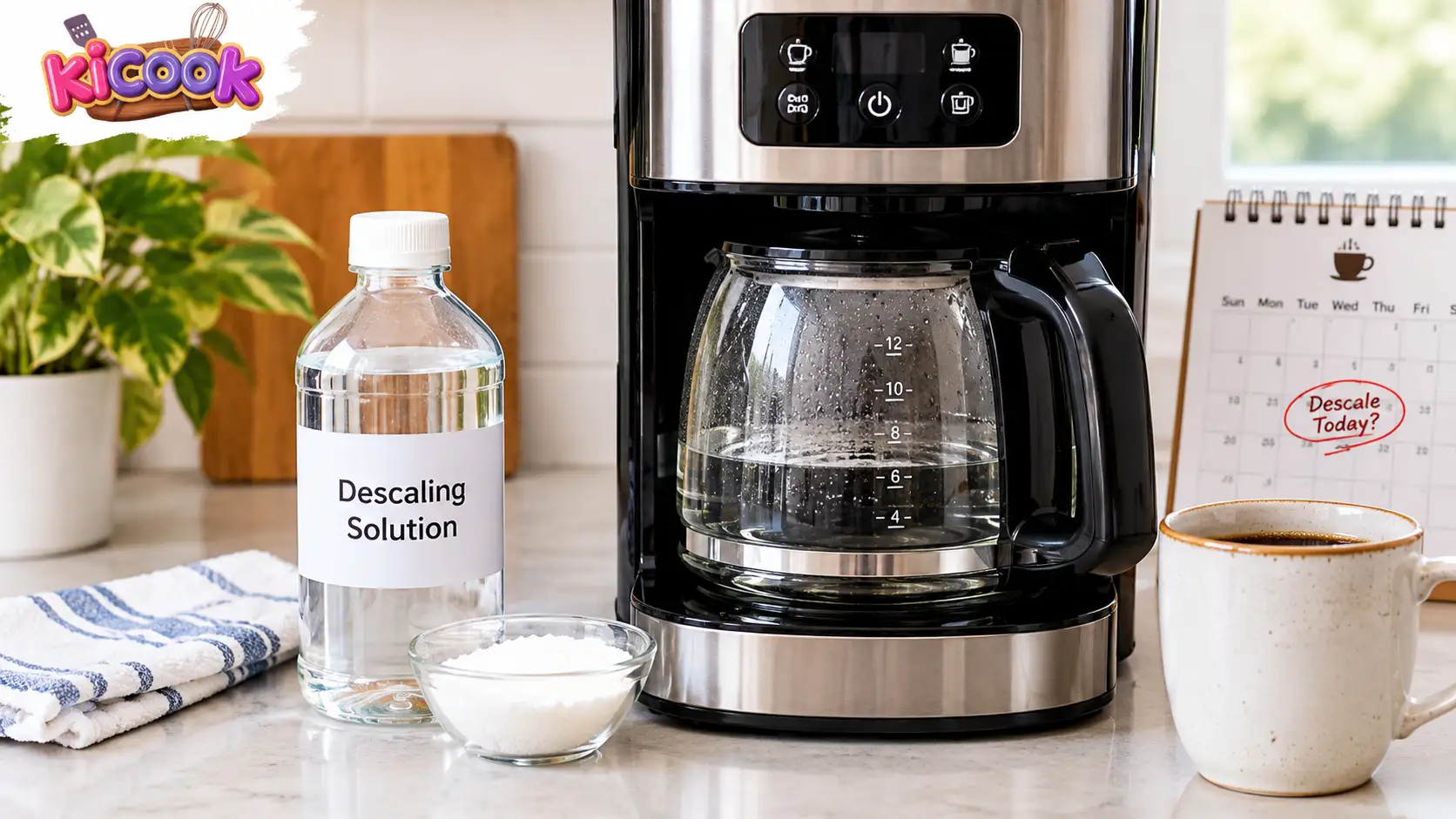
Quick Answer: How often you should descale your coffee maker depends on the model, water hardness, and how often you use it. Many Keurig brewers need descaling every 3–6 months, while Nespresso UK recommends every 3–4 months or after 300 capsules, whichever comes first. Some Breville drip coffee makers have shorter recommended intervals. Always follow your specific machine’s instructions first.
If your coffee maker takes longer to brew, makes unusual gurgling noises, or produces coffee that tastes different, mineral buildup could be part of the problem. Descaling removes this buildup from the machine’s internal water system.
However, you do not need to wait until your coffee maker starts having problems. A regular maintenance schedule can help keep it working as intended.
In this guide, you will learn how often to descale different coffee makers, how water hardness affects the schedule, and what to do if your machine shows signs of scale buildup earlier than expected.
How Often Should You Descale a Coffee Maker?
There is no single descaling schedule that works for every coffee maker. The correct interval depends on the manufacturer’s recommendations, the minerals in your water, and your machine’s design.
For example, Keurig recommends descaling its brewers every 3–6 months. On the other hand, Nespresso UK recommends descaling every 3–4 months or every 300 capsules, whichever comes first.
These differences matter. Following a schedule made for another brand could mean descaling too early or waiting too long.
General Coffee Maker Descaling Schedule
Use this table as a starting point for understanding the maintenance requirements of different coffee makers.
| Coffee maker type | Descaling guidance |
|---|---|
| Standard drip coffee maker | Follow the manufacturer’s recommended interval |
| Keurig coffee maker | Generally every 3–6 months, depending on the model |
| Nespresso Original or Vertuo | UK guidance recommends every 3–4 months or 300 capsules, whichever comes first |
| Espresso machine | Follow the machine’s maintenance alerts, water-hardness settings, and manual |
| Fully automatic coffee machine | Follow its programmed maintenance schedule and water-hardness settings |
| Coffee maker used in hard-water areas | Check for scale buildup more frequently and follow the model’s guidance |
These are examples, not universal rules. Some machines need more frequent descaling than others, even when they appear similar.
For instance, a Breville drip coffee maker manual recommends descaling once per month in soft-water environments and more frequently in hard-water environments. That advice applies to the specified model, not every Breville coffee machine.
How Often Should You Descale a Coffee Maker Used Daily?
Daily use can increase the amount of water passing through your coffee maker. This may lead to faster mineral accumulation, especially if your tap water contains high levels of calcium and magnesium.
However, daily use alone does not determine the correct schedule.
If you brew several cups every day, check your machine’s maintenance instructions and pay attention to its descale indicator. If your model uses water-hardness settings, make sure they match the water you use.
Do not automatically descale every month simply because you make coffee daily. Some manufacturers recommend that interval, while others specify a longer period.
How Often Should You Descale a Coffee Maker Used Occasionally?
Using your coffee maker only a few times each week does not automatically mean you can ignore descaling for a year.
Mineral deposits can still develop whenever water passes through the machine and is heated.
Follow the recommended maintenance interval even if you use the machine occasionally. Clean removable parts as instructed, empty the reservoir when appropriate, and avoid leaving old water in the machine for long periods.
How Water Hardness Affects Descaling Frequency
Water hardness is one of the main factors that can affect mineral buildup inside a coffee maker.
Hard water contains more dissolved calcium and magnesium than soft water. When water is repeatedly heated, these minerals can form deposits known as limescale.
Over time, limescale may affect water flow, heating performance, and brewing consistency.
Descaling in Soft-Water Areas
Soft water generally contains fewer scale-forming minerals, so mineral deposits may develop more slowly.
However, soft water does not eliminate the need for descaling. Your coffee maker may still require periodic maintenance according to its manufacturer’s instructions.
Do not extend the recommended interval without checking whether your model allows it.
Descaling in Moderately Hard-Water Areas
Moderately hard water can still contribute to mineral buildup over time.
If your coffee maker uses tap water, follow its recommended schedule and check for changes in brewing speed or water flow.
A water filter may help reduce some minerals, depending on the filtration system. However, not every filter removes the minerals responsible for hardness.
Descaling in Hard-Water Areas
Hard water can cause scale to accumulate faster inside some coffee makers.
You may notice longer brewing times, unusual bubbling noises, or chalky deposits around parts that come into contact with water.
If you live in an area with hard water, check your machine more frequently and follow any specific recommendations for hard-water use.
Do not assume that a monthly schedule is right for every machine. Use the manufacturer’s instructions to decide when descaling is needed.
How to Check Your Water Hardness
There are two simple ways to learn more about your water.
1. Check your local water report.
In the United States and parts of Canada, water suppliers may publish information about water hardness and mineral content. In the UK and Australia, you can check your local water supplier’s information or contact the provider.
2. Use a water-hardness test kit.
A suitable test strip can help estimate the hardness of your tap water. Some coffee machines include test strips and allow you to enter the result into the settings.
For reference, the USGS water hardness guide classifies water as soft at 0–60 mg/L, moderately hard at 61–120 mg/L, hard at 121–180 mg/L, and very hard above 180 mg/L, expressed as calcium carbonate.
These categories help explain water hardness, but they do not determine a universal descaling interval. Your coffee maker’s instructions still come first.
How Often Should You Descale Different Coffee Maker Types?

Different coffee makers use different heating systems, water pathways, and maintenance reminders. Here is what to consider for the most common types.
Drip Coffee Makers
Drip coffee makers heat water and move it through internal passages before it flows over the coffee grounds.
Mineral buildup can interfere with this process over time.
Check your owner’s manual for the recommended descaling interval. Some drip coffee makers have a cleaning or descaling program, while others require a specific procedure described in the manual.
If your machine brews more slowly than usual, inspect the removable parts first. If the problem continues and scale is possible, follow the recommended descaling procedure.
Keurig Coffee Makers
Keurig recommends descaling its brewers every 3–6 months. Some models also have a descale indicator that tells you when maintenance is due.
Do not ignore the indicator or assume every Keurig model uses the same controls.
If you need help cleaning the reservoir, brew needles, removable parts, and internal water system, follow this detailed guide on how to clean a Keurig coffee maker.
Remember that cleaning the needles and descaling the machine serve different purposes. A clogged needle may cause poor water flow even when mineral buildup is not the main problem.
Nespresso Machines
Nespresso Original and Vertuo machines have model-specific maintenance procedures.
According to Nespresso UK’s descaling guidance, the recommended interval is every 3–4 months or after 300 capsules, whichever comes first. Its guidance also says to descale regularly regardless of whether you live in a soft-water or hard-water area.
Some models display a maintenance alert. Check your machine’s manual for the precise procedure and reminder system.
Nespresso also advises against household remedies such as vinegar for its Original and Vertuo machines. Use a compatible descaling kit and follow the manufacturer’s directions.
Espresso Machines
Espresso machines need particular care because their water systems and maintenance requirements can vary widely.
Some models use water-hardness settings to help determine maintenance timing. Others display a descaling alert or specify an interval in the manual.
For example, Breville’s official water guidance explains how water hardness affects mineral buildup and machine performance.
Check the instructions for your exact model before choosing a schedule. Do not assume that a descaling interval intended for a basic drip coffee maker is suitable for an espresso machine.
Fully Automatic and Bean-to-Cup Machines
Fully automatic coffee machines may have built-in water filters, water-hardness settings, and automatic maintenance reminders.
Make sure the water-hardness setting matches your water when the machine supports this feature. Replace the filter according to its recommended schedule, and complete any required descaling cycle.
A water filter does not automatically remove the need for descaling. Follow the machine’s instructions even if you regularly replace its filter.
Does Filtered Water Reduce the Need for Descaling?
Filtered water may reduce mineral buildup if the filtration system removes some of the minerals responsible for scale. However, the result depends on the type of filter and the machine.
A standard water filter may improve taste without removing enough calcium and magnesium to prevent limescale.
Does a Water Filter Eliminate Limescale?
Not necessarily.
Some filters reduce hardness more effectively than others. Others mainly target chlorine, odours, or particles.
If your coffee maker has a built-in water filter, follow the filter replacement schedule and the separate descaling instructions.
For more specific advice, check the water recommendations in your machine’s manual.
Can You Skip Descaling After Replacing the Water Filter?
No, not unless the manufacturer specifically says your model does not require a particular descaling procedure under your conditions.
Replacing a water filter and descaling are different maintenance tasks. A new filter may reduce mineral buildup, but it does not remove existing scale from the machine’s internal water pathways.
Continue following the required maintenance schedule.
Should You Use Distilled or Reverse-Osmosis Water?
Do not switch to distilled or reverse-osmosis water without checking your coffee maker’s instructions.
Some espresso machines require water with a suitable mineral content. Water that has had nearly all its minerals removed may affect taste or machine operation.
Breville’s official water guidance explains why water recommendations differ by model and why some machines should not use water with very low mineral content.
Choose water that matches your machine’s requirements rather than assuming that the purest water is always best.
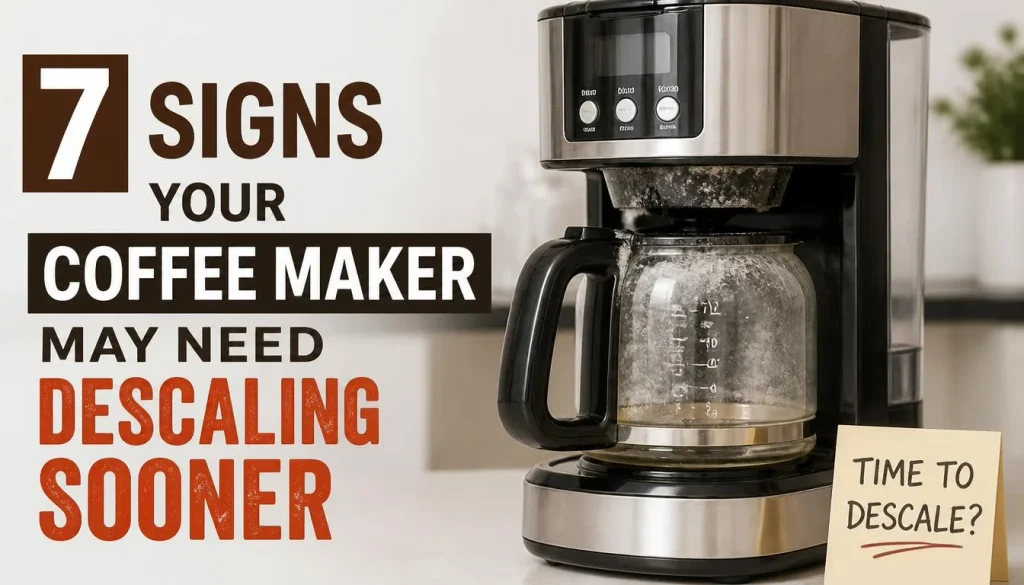
You do not always need to wait until the next scheduled date if your machine develops symptoms of mineral buildup.
These signs can help you decide whether to inspect the machine and check its maintenance instructions.
1. Coffee Takes Longer to Brew
If the brewing cycle has gradually become slower, mineral buildup may be restricting water flow.
First, inspect the removable parts and check for blockages. If scale is a likely cause, descale according to the manufacturer’s instructions.
If the problem remains afterward, another issue may be responsible.
2. Your Coffee Maker Makes Loud Gurgling Noises
Some bubbling and gurgling sounds are normal during brewing. A sudden change in noise, especially with slower water flow, deserves attention.
Scale is one possible cause, but trapped air, a blocked outlet, or a poorly positioned reservoir can also create unusual sounds.
Read this guide on why a coffee maker gurgles or sputters to learn how to check the likely causes.
3. Coffee Comes Out Cooler Than Usual
Mineral deposits may affect the heating performance of some coffee makers.
However, a cold cup, a cold carafe, a temperature setting, or a faulty component can also make coffee seem cooler.
Check the manual and inspect the machine before assuming descaling will solve the issue.
4. The Descale Light Turns On
If your coffee maker displays a descale alert, follow the model’s instructions.
Some reminders operate according to a programmed maintenance schedule rather than directly measuring mineral deposits. Even so, do not assume the reminder can safely be ignored.
If you have already completed the descale cycle but the light remains on, check whether your machine requires a separate reset procedure.
5. You Notice White or Chalky Deposits
White deposits around a reservoir, water outlet, or other water-contact area may indicate mineral buildup.
Visible deposits can help you spot a maintenance problem, but they do not show exactly how much scale has collected inside the machine.
Clean accessible parts according to the instructions and descale the internal system when required.
6. Your Coffee Tastes Different
Mineral buildup can affect water flow and brewing temperature, potentially changing the taste of your coffee.
Still, a different taste can have many other causes, including old grounds, dirty coffee oils, incorrect measurements, or changes in water quality.
If your coffee tastes weak or watery, start with these common causes of weak coffee and their fixes.
If the coffee tastes unusually bitter, this guide to why a coffee maker makes bitter coffee may help you identify the real problem.
7. The Machine Brews Less Coffee Than Expected
If your coffee maker suddenly produces less coffee than usual, check the reservoir, filter, and accessible water outlets.
Mineral buildup may be restricting the water pathway, but a loose reservoir, blockage, or internal fault can cause similar symptoms.
Do not repeatedly force the brewing cycle if little or no water comes out. Follow the machine’s troubleshooting instructions and seek support if the problem continues.
Should You Wait Until the Descale Light Turns On?
Not always.
If your machine provides a descaling reminder, use it together with the manufacturer’s maintenance instructions. Some models use programmed reminders, while others let you adjust settings based on water hardness.
If your machine does not have a descale light, follow the interval stated in the owner’s manual.
Also, do not wait for an alert if your machine develops signs that suggest restricted water flow. Investigate the cause first, then decide whether descaling is appropriate.
How to Set the Correct Water Hardness
If your machine has a water-hardness setting, use a test strip or the method recommended by its manufacturer.
Enter the result as instructed. A suitable setting can help the machine provide maintenance reminders at the right time.
If you change your water source or filtration system, review the settings and instructions again.
What Happens If You Never Descale Your Coffee Maker?
Leaving mineral buildup untreated can affect how some coffee makers operate.
Possible problems include:
- Slower or restricted water flow.
- Changes in heating and brewing performance.
- Inconsistent coffee quality.
- Increased difficulty maintaining normal operation.
- A greater chance that scale-related problems will require attention.
The exact consequences depend on the machine and the extent of the buildup. Not every coffee maker will develop all these problems.
Descaling is also not a repair for every fault. If the machine still fails to heat, leaks, or stops brewing after proper maintenance, consult the manufacturer’s troubleshooting guide or contact its support team.
How to Descale a Coffee Maker Safely
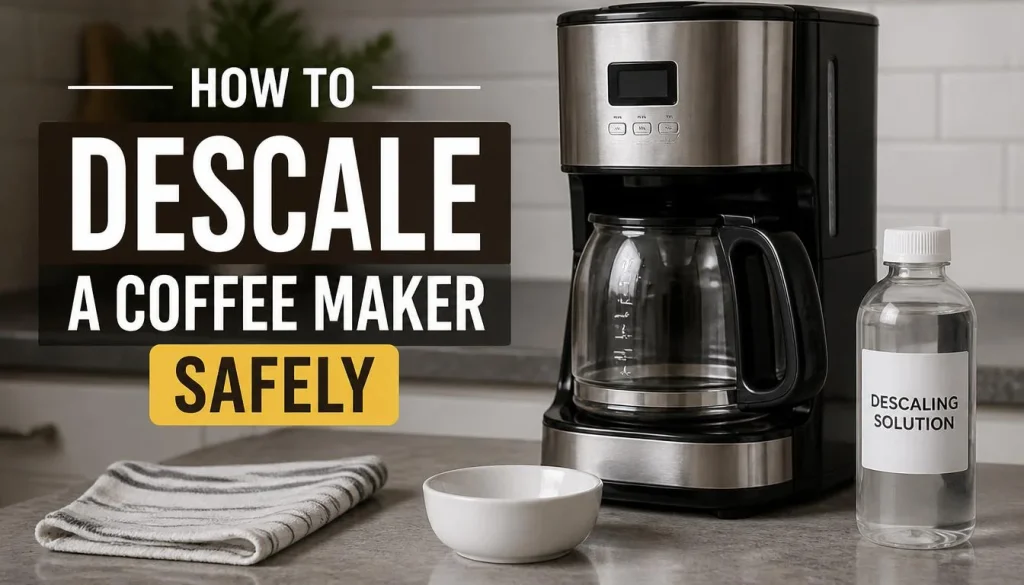
The exact procedure depends on your coffee maker, so always read the model’s instructions before starting.
In most cases, the process involves the following steps.
Step 1: Choose a Compatible Descaling Solution
Use the descaling product recommended or approved for your machine.
Do not assume that vinegar is safe for every model. For example, Nespresso advises against vinegar for its Original and Vertuo machines, while some other coffee makers have different instructions.
Never mix cleaning chemicals or combine different descaling products.
Step 2: Follow the Machine’s Descaling Cycle
Prepare the water reservoir and solution according to the product directions and your machine’s manual.
Run the specified descaling cycle. Do not use a random button combination or another brand’s procedure.
Step 3: Complete the Recommended Rinse Cycle
After the descaling solution has passed through the machine, rinse the reservoir and run the fresh-water cycles required by the manufacturer.
Do not rush this step. Residual descaling solution can affect the taste of your next brew.
Step 4: Reset the Descaling Indicator if Required
Some coffee makers clear the indicator automatically after a completed cycle. Others require a particular reset procedure.
Follow your model’s instructions rather than assuming the same buttons work on every machine.
Common Descaling Mistakes to Avoid
A few simple mistakes can make maintenance less effective.
Ignoring the manufacturer’s schedule: Another brand’s interval may not suit your machine.
Assuming filtered water eliminates scale: The effect depends on the filtration system and the water you use.
Using an unapproved cleaning product: Some manufacturers warn against vinegar or other household remedies.
Skipping the rinse cycle: Residual solution can leave an unpleasant taste.
Confusing cleaning with descaling: Washing the carafe and filter basket does not necessarily remove scale from internal water pathways.
Ignoring continuing problems: If slow brewing, unusual sounds, or low water flow remain after maintenance, investigate other possible causes.
Frequently Asked Questions
How often should I descale my coffee maker?
There is no universal interval. Keurig generally recommends every 3–6 months, while Nespresso UK recommends every 3–4 months or after 300 capsules, whichever comes first. Other machines may have shorter or longer schedules, so check your model’s manual.
Is descaling every three months enough?
Three months may be suitable for some machines, but it is not right for all models. Your machine may require more frequent maintenance, a different schedule, or a manufacturer-defined alert system.
Can I descale my coffee maker every month?
Some manufacturers recommend monthly descaling for particular models or water conditions. However, monthly descaling is not necessary for every coffee maker. Follow your machine’s maintenance instructions instead of using a one-size-fits-all schedule.
How often should I descale a coffee maker with hard water?
Hard water can increase the rate of mineral buildup, so your machine may need more frequent attention. Check the manual for hard-water guidance, use the correct water-hardness setting if available, and do not shorten the interval beyond the manufacturer’s recommendations without appropriate guidance.
Do I need to descale my coffee maker if I use filtered water?
Usually, you should continue following your machine’s descaling instructions. Some filters reduce scale-forming minerals, but others mainly improve taste or remove particles. Replacing a filter does not automatically remove existing scale.
Should I wait for the descale light?
Follow the indicator instructions, but do not rely on a light as your only maintenance guide. Some models use programmed reminders. Check the manual, and investigate unusual brewing behaviour even if the light is off.
What happens if I never descale my coffee maker?
Mineral buildup may restrict water flow and affect heating or brewing performance. Over time, the machine may become harder to maintain. The effect depends on the model and the water you use.
Can you descale a coffee maker too often?
Yes, unnecessary descaling means exposing the machine to a maintenance process more often than the manufacturer recommends. Use the correct product and schedule. Do not assume more frequent descaling is always better.
Does descaling improve coffee taste?
It can help if mineral buildup has affected water flow or heating performance. However, it will not fix every taste problem. Old coffee, dirty parts, incorrect measurements, and unsuitable brewing settings can also affect flavour.
How often should I descale a coffee maker without a reminder light?
Use the schedule in the owner’s manual. If the manual specifies a water-hardness test or a particular maintenance interval, follow it. Check for changes in brewing speed and performance rather than relying on a visual indicator alone.
Can descaling fix a slow coffee maker?
It may help if mineral deposits are restricting water flow. However, a clogged filter, blocked outlet, incorrectly positioned reservoir, or mechanical problem can also slow brewing. If proper descaling does not solve the problem, follow the manufacturer’s troubleshooting instructions.
Final Answer: How Often Should You Descale Your Coffee Maker?
For many home coffee makers, descaling every few months is a useful starting point, but the correct schedule depends on the exact machine. Keurig recommends every 3–6 months, Nespresso UK recommends every 3–4 months or 300 capsules, and some other models require more frequent care.
The most reliable approach is to check your owner’s manual, consider your water hardness, follow the machine’s maintenance alerts, and use a compatible descaling solution.
Do not wait until your coffee maker stops working properly. Check your model’s instructions today, find out when you last descaled it, and set a reminder for the next recommended maintenance date. A simple schedule can help you maintain consistent brewing performance without doing unnecessary work.

“I believe great cooking starts with the right tools, trusted advice, and a little confidence in the kitchen.”
Hi, I’m Emma Carter. My love for cooking began in my grandmother’s kitchen, where I learned that every great meal starts with simple ingredients and the right cookware. Over the years, I’ve spent countless hours researching, testing, and comparing kitchen appliances, cookware, coffee makers, air fryers, and other everyday kitchen essentials.
Here at KiCook, my goal is to make your buying decisions easier with honest product reviews, practical buying guides, and easy-to-follow cooking tips. Whether you’re upgrading your kitchen or searching for the best appliance for your home, I focus on providing clear, reliable, and research-backed information you can trust.
When I’m not testing new kitchen gadgets or writing in-depth guides, you’ll usually find me trying new recipes, visiting local farmers’ markets, or enjoying a quiet cup of coffee while planning my next kitchen project.