

There is nothing more disappointing than waiting for your morning coffee only to take the first sip and find it thin, weak, or almost like flavored water.
The good news is that a coffee maker that produces weak or watery coffee is not necessarily broken.
In many cases, the problem comes down to the coffee-to-water ratio, grind size, stale coffee, poor water flow, low brewing temperature, or mineral buildup inside the machine. Single-serve brewers can also make watery coffee when the cup size is too large for the amount of coffee in the pod.
Start with the simple fixes before assuming you need a new machine. A small change in dose, grind, or cleaning routine can make a surprisingly big difference.
Quick Answer: Why Does My Coffee Maker Make Weak or Watery Coffee?
If your coffee maker makes weak or watery coffee, check these things first:
- Use enough coffee for the amount of water.
- Make sure the grind is not too coarse.
- Use fresh coffee rather than old or stale grounds.
- Check whether the brewer is running unusually fast.
- Make sure all the grounds are getting wet during brewing.
- Clean the brew basket, showerhead, or pod needle.
- Descale the coffee maker if mineral buildup is present.
- Try a smaller cup size on a single-serve machine.
- Use the Strong or Bold setting if your machine has one.
- Check the water quality.
- Make sure the brewer is getting hot enough.
- Consider a mechanical problem only after the simpler causes have been ruled out.
If the coffee suddenly became weak after tasting fine for months, focus first on cleaning, scale buildup, water flow, and brewing temperature.
If it has always tasted weak, start with your coffee dose, water amount, grind size, and brew settings.
Weak Coffee Troubleshooting at a Glance
| What You Notice | Most Likely Cause | What to Try First |
|---|---|---|
| Coffee tastes thin but not especially sour | Too much water or too little coffee | Increase the coffee dose |
| Coffee tastes weak and sour | Under-extraction | Grind slightly finer |
| Coffee suddenly became watery | Scale, clog, or temperature problem | Clean and descale the brewer |
| Coffee finishes brewing unusually fast | Water is passing through too quickly | Check grind, basket, and water distribution |
| Some grounds remain dry after brewing | Uneven saturation | Inspect the showerhead or water outlet |
| Keurig coffee tastes watery | Brew size is too large | Select a smaller cup size |
| Coffee tastes flat or dull | Stale coffee | Use fresher beans or grounds |
| Coffee is weak and lukewarm | Low brewing temperature | Descale and test the brewer |
| Water flow is slow or uneven | Scale or blockage | Clean the outlet, needle, or showerhead |
| Coffee quality changes depending on tap water | Water quality problem | Try filtered water |
Why Is My Coffee Maker Making Weak or Watery Coffee?
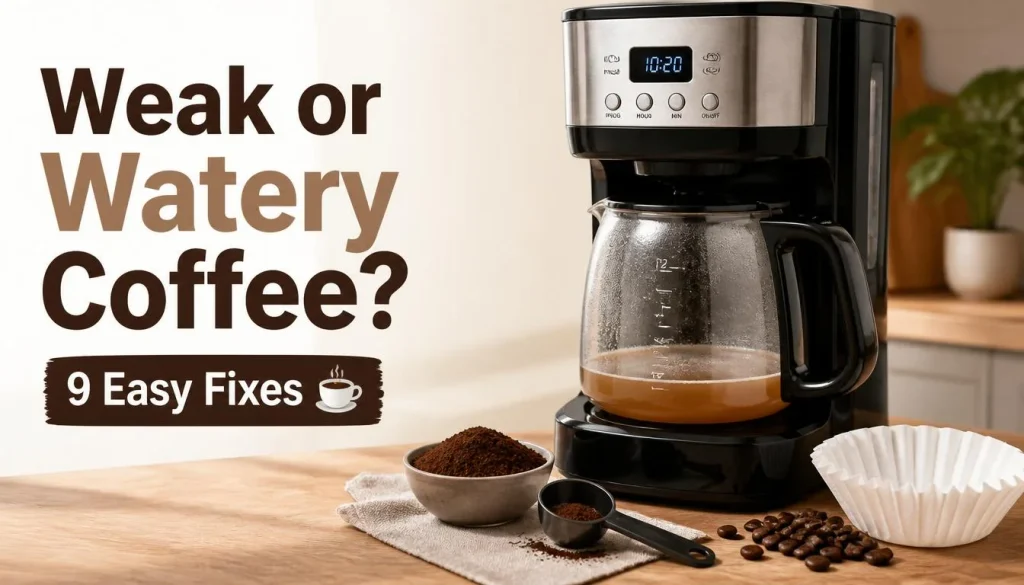
Several different problems can lead to the same disappointing cup. The easiest way to fix it is to change one variable at a time instead of changing everything at once.
1. You Are Using Too Much Water or Too Little Coffee
The simplest cause of watery coffee is also one of the most common: there is simply not enough coffee for the amount of water going through it.
Adding more water does not make the same dose of coffee go further without affecting flavor. It dilutes the finished drink.
For drip coffee, a useful starting point is roughly 55 to 60 grams of coffee for 1 liter of water. You do not need to treat that number as a strict rule. Some people prefer a lighter cup, while others want noticeably more strength.
The important thing is consistency.
If you normally scoop coffee without measuring and fill the reservoir to a different level every morning, it becomes difficult to diagnose why one pot tastes good and the next tastes weak.
Try measuring both your coffee and water for a few brews.
If the coffee is balanced but simply too thin, add a little more ground coffee or use slightly less water.
Be careful with the markings on your coffee maker, too. A brewer’s “cup” measurement is not always the same as the mug you drink from.
Coffee-to-Water Ratio Chart for Stronger Coffee
Use this as a practical starting point rather than an unbreakable formula.
| Water | Ground Coffee |
|---|---|
| 6 fl oz / 180 mL | 10–11 g |
| 8 fl oz / 240 mL | 13–15 g |
| 12 fl oz / 355 mL | 20–22 g |
| 16 fl oz / 475 mL | 26–29 g |
| 34 fl oz / 1 liter | 55–60 g |
If your current brew tastes weak, move toward the higher end of the coffee range before making more complicated adjustments.
2. Your Coffee Grind Is Too Coarse or Inconsistent
Grind size determines how easily water can extract flavor from coffee.
When coffee is ground too coarsely for a drip brewer, water can move through the bed of coffee too easily. The result may taste light, hollow, sour, or watery.
For most automatic drip coffee makers, a medium grind is a sensible starting point.
Hamilton Beach’s brewing guidance also notes that weak or watery coffee can often be improved by making the grind slightly finer. Hamilton Beach’s coffee brewing guide
The key word is slightly.
Do not jump from very coarse coffee to powder-fine grounds. Coffee that is too fine can slow drainage, add bitterness, create sediment, or even cause the basket to overflow.
If you grind at home, adjust one setting finer and brew again.
Grind consistency matters as well. A grinder that produces a mixture of large chunks and powder makes extraction harder to control. If you frequently brew whole beans and want a machine that handles grinding and brewing together, KiCook’s coverage of coffee makers with grinding options can help when you are comparing replacement options.
3. Your Coffee Maker Is Brewing Too Fast
If a full pot seems to finish noticeably faster than it used to, pay attention.
Coffee needs enough contact time with hot water for soluble flavor compounds to move from the grounds into the brew. When water races through too quickly, extraction can be incomplete.
A fast brew can be related to:
- Grounds that are too coarse
- Too little coffee in the basket
- Incorrect filter placement
- Water bypassing part of the coffee bed
- A damaged or poorly fitting brew basket
- Unusual water-flow behavior inside the machine
Do not judge brewing time by one universal number because different machines are designed to operate at different speeds.
Instead, compare the machine with its own normal behavior.
If your brewer suddenly starts finishing much faster and the coffee becomes noticeably weaker at the same time, that change is worth investigating.
4. Your Coffee Beans or Grounds Are Stale
Coffee does not need to smell “bad” to be past its best.
As roasted coffee sits exposed to air, it gradually loses aroma and flavor. Pre-ground coffee changes faster because much more surface area is exposed.
Old coffee can still produce a brown drink that looks normal, but it may taste flat, dull, papery, or surprisingly weak.
If everything about your brewing method seems correct, try a fresher bag before blaming the machine.
Store coffee in a sealed container away from heat, direct sunlight, and moisture. Buying an amount you can reasonably use while it is fresh is usually better than keeping a huge opened bag for months.
5. Your Coffee Maker Is Not Getting Hot Enough
Brewing temperature affects how quickly coffee extracts.
If the water reaching the grounds is not hot enough, the brew may come out weak, sour, or underdeveloped even when the dose and grind look correct.
The Specialty Coffee Association’s home brewer requirements specify that qualifying brewers should reach at least 92°C at the coffee bed during brewing and remain below 96°C. See the SCA brewer temperature requirements
That does not mean you need to obsess over measuring every brew. It simply explains why a failing heating system can change the taste dramatically.
A practical clue is temperature at the cup.
If the coffee has become both weaker and noticeably cooler than it used to be, the machine may not be heating properly.
Before replacing it, descale the brewer. Mineral deposits around internal heating components can interfere with performance.
Research discussed by the Specialty Coffee Association also shows that temperature interacts with grind, brew time, strength, and extraction rather than operating as an isolated variable.
6. Your Coffee Maker Needs Cleaning or Descaling
A coffee maker can look clean on the outside while the inside is coated with mineral scale and coffee residue.
Hard water leaves calcium and magnesium deposits as water is heated repeatedly. Over time, these deposits can restrict water pathways and affect how the brewer operates.
Coffee oils and fine particles can also build up in the brew basket, showerhead, or pod system.
Signs that cleaning may help include:
- The machine has become slower
- Water flow sputters
- Coffee tastes different despite using the same beans
- The brew is cooler than normal
- The machine makes unusual pumping noises
- Only part of the expected water reaches the cup
- You can see white or chalky mineral deposits
Follow the cleaning instructions for your exact model rather than assuming every coffee maker should be descaled the same way.
For Keurig owners, KiCook has a complete step-by-step guide to cleaning and descaling a Keurig coffee maker.
Keurig also states in its own care instructions that descaling removes calcium deposits that can affect brewer performance. Keurig’s official descaling guidance
If hard water is a regular problem where you live, KiCook’s guide to the best coffee makers for hard water may also be useful if you eventually decide to replace your current machine.
7. Your Coffee Maker Is Not Saturating All the Grounds
After your next brew, open the filter basket and look at the used coffee bed.
Is everything evenly wet?
If one side is soaked while another area remains surprisingly dry, water is not reaching all of the coffee.
That means you may be using enough grounds, but part of the dose is barely participating in the brew.
Uneven saturation may be caused by:
- A blocked showerhead
- Mineral buildup around water outlets
- Grounds piled unevenly in the filter
- A badly positioned filter
- Water taking an easier path around the coffee
- A damaged brew basket
- Problems with the brewer’s water distribution system
Start by leveling the grounds gently before brewing. You do not need to compact them.
Then clean any accessible water outlets according to the manufacturer’s instructions.
If a water-only cycle produces a noticeably uneven stream or spray pattern, you may have found the problem.
8. The Coffee Filter or Brew Basket Is Causing Poor Extraction
The filter is easy to overlook because it seems passive, but poor filter placement can affect how water moves through the grounds.
Hamilton Beach troubleshooting guidance lists improperly positioned paper filters, coffee grounds between the filter and basket, and incorrect grind as potential brewing problems. See the manufacturer’s coffee maker troubleshooting information
Check for these common mistakes:
- The paper filter has folded over
- The filter is too small for the basket
- The filter is not fully open
- Grounds are trapped between the filter and basket wall
- A reusable filter is blocked with coffee oils
- The basket is not seated properly
- Water is bypassing the grounds
- You are accidentally using multiple filters when the brewer does not require them
If you use a permanent mesh filter, clean it thoroughly. A filter may look rinsed while still holding a layer of oil or fine particles in the mesh.
When replacing a filter, use the size and shape recommended for your machine.
If your current brewer continually struggles with basket or extraction problems and you prefer a straightforward setup, KiCook’s guide to basic drip coffee makers covers simpler machines designed around traditional drip brewing.
9. You Are Using the Wrong Brew Size or Strength Setting
This matters most with single-serve coffee makers.
A pod contains a fixed amount of coffee. If you push considerably more water through the same amount of grounds, the resulting drink will usually taste lighter.
That is why a 12-ounce cup from one pod may taste noticeably weaker than a 6- or 8-ounce brew.
If your Keurig or similar single-serve machine makes watery coffee:
- Try the smallest practical brew size.
- Use the Strong or Bold setting if available.
- Test a fresh pod.
- Make sure the pod is being punctured correctly.
- Clean the needle if flow looks unusual.
Keurig’s K-Select, for example, offers several cup sizes along with a Strong Brew option designed to increase coffee strength and intensity. Keurig’s K-Select brewing options
If your coffee improves immediately when you select a smaller size, the machine may be working normally. You simply prefer a stronger coffee-to-water balance.
10. Your Water Quality Is Affecting the Brew
Coffee is mostly water, so water quality matters more than many people realize.
Very hard water can leave mineral scale inside a machine. Water with noticeable chlorine or other strong tastes can change the flavor in the cup.
On the other hand, extremely soft or highly purified water can behave differently during extraction.
Hamilton Beach includes poor water quality among the possible causes of bad-tasting coffee and recommends trying filtered or bottled water in some troubleshooting situations. Hamilton Beach coffee maker troubleshooting guidance
You do not need to turn this into a chemistry experiment.
A simple test is enough:
Brew one batch using the same coffee, same grind, and same ratio, but use good-quality filtered water instead of your usual tap water.
If the cup improves noticeably, water is likely part of the problem.
11. Your Coffee Roast May Taste Lighter Than You Expect
Not every coffee that tastes “weak” is actually under-extracted.
A light roast can have a more delicate, bright, or tea-like flavor profile than the dark, smoky coffee some drinkers associate with strength.
If you recently changed beans and the machine otherwise behaves normally, consider the coffee itself.
Ask yourself:
- Did you switch from dark roast to light roast?
- Is the new coffee naturally brighter or fruitier?
- Are you comparing a medium roast with a very dark supermarket blend?
- Does the cup taste clean but simply less intense?
Before changing the machine, try another familiar coffee at the same settings.
If the familiar coffee tastes normal again, the brewer was probably not the issue.
12. The Coffee Maker May Have a Mechanical Problem
Most weak-coffee complaints can be solved without replacing the brewer.
However, a hardware problem becomes more likely when:
- The brewer cannot get properly hot
- Water output has changed dramatically
- Brew time has changed for no obvious reason
- The pump sounds abnormal
- Cleaning and descaling do not improve performance
- The machine repeatedly produces partial brews
- Water leaks internally or externally
- Error messages keep returning
If the appliance has an electrical smell, damaged wiring, sparking, or leaking water near electrical components, stop using it.
Do not open electrical components unless you are qualified to work on the appliance.
If the machine is old and repair does not make financial sense, compare replacement models rather than continuing to compensate with extra coffee. KiCook’s coffee maker section includes current buying guides for drip, single-serve, espresso, hard-water, and other types of brewers.
How to Fix Weak Coffee From a Coffee Maker Step by Step
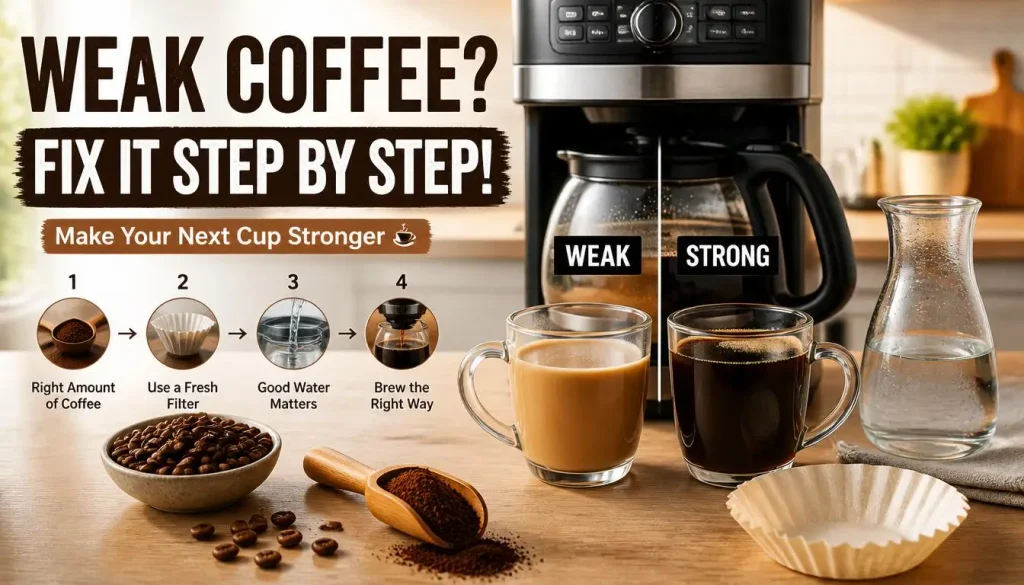
If you do not know which cause applies to you, use this order. It starts with the easiest and cheapest fixes.
Step 1: Measure the Coffee and Water
For one or two brews, stop estimating.
Measure your water and weigh your coffee if you have a kitchen scale.
This gives you a reliable baseline.
If weighing coffee feels like too much effort for everyday use, that is fine. Once you know how much your usual scoop holds, you can return to a simpler routine.
Step 2: Increase the Coffee Dose Slightly
If the coffee tastes clean but thin, add a little more coffee.
Do not double the dose immediately.
A modest adjustment often makes more sense than turning a balanced brew into an overly concentrated one.
Step 3: Grind Slightly Finer
If the coffee tastes watery, sharp, sour, or hollow, move the grinder one small step finer.
Keep everything else the same.
Then compare the next cup.
Step 4: Try Fresh Coffee
Use a recently opened bag from a brand or roast you already know.
This quickly eliminates stale coffee as a variable.
Step 5: Inspect the Used Coffee Bed
After brewing, look at the grounds.
They should generally appear evenly wet.
Large dry patches suggest that the brewer is not distributing water properly.
Step 6: Check the Filter and Basket
Make sure the filter is fully open, correctly sized, and seated properly.
Rinse reusable filters carefully.
Clean the basket if coffee oils or fine sediment are visible.
Step 7: Clean and Descale the Machine
Use the procedure recommended by the manufacturer.
Do not assume vinegar is appropriate for every coffee maker. Some manufacturers recommend a specific descaling product or procedure.
Step 8: Test a Smaller Brew Size
This is especially useful for pod brewers.
If an 8-ounce brew tastes good while a 12-ounce brew tastes watery, the coffee-to-water balance is the main issue.
Step 9: Test the Strong or Bold Setting
If your machine provides strength control, compare the same coffee and cup size with the feature on and off.
Step 10: Change Only One Thing at a Time
This is the step people often skip.
If you change the beans, grind, dose, water, and machine settings at the same time, you may get a better cup but have no idea what solved the problem.
Change one variable. Taste. Then adjust again.
What If the Coffee Suddenly Became Weak?
A sudden change deserves a different troubleshooting approach.
If your coffee maker produced satisfying coffee last week using the same coffee, water amount, and settings, your ratio is unlikely to have changed by itself.
Focus on the machine first.
Check:
- Whether the showerhead or needle is clogged
- Whether mineral scale has accumulated
- Whether the brew takes longer or shorter than before
- Whether the coffee is cooler
- Whether the full amount of water is reaching the carafe or cup
- Whether the filter basket is seated properly
- Whether the brewer needs descaling
A gradual decline over several months often points toward maintenance.
A sudden dramatic change may point toward a blockage, component problem, or accidental settings change.
Fixes by Coffee Maker Type
Drip Coffee Maker Makes Weak Coffee
For a standard drip machine, check these in order:
- Coffee-to-water ratio
- Medium grind size
- Coffee freshness
- Filter placement
- Even saturation
- Showerhead cleanliness
- Descaling
- Water temperature
If you are using a basic brewer and want to compare how other straightforward machines handle brewing, see KiCook’s guide to the best basic drip coffee makers.
Keurig Makes Weak or Watery Coffee
For a Keurig, try:
- Selecting a smaller cup size
- Activating Strong Brew if your model includes it
- Trying a different pod
- Cleaning the entrance and exit needles
- Running a water-only test
- Descaling the machine
- Checking whether the brewer is dispensing the correct amount of water
Keurig’s own troubleshooting materials list clogged needles and scale among the possible causes of partial-brew problems. See Keurig’s official care guidance
For detailed maintenance instructions, use KiCook’s Keurig cleaning guide.
Single-Serve Coffee Maker Makes Weak Coffee
If you use loose grounds in a reusable single-serve basket:
- Add enough coffee without overfilling
- Use the recommended grind
- Check the maximum water amount
- Make sure the basket is correctly installed
- Clean the filter after every use
- Try a smaller serving size
Manufacturer guidance for single-serve machines commonly points to coffee quantity and water amount as major variables. Hamilton Beach single-serve troubleshooting reference
Bean-to-Cup or Grind-and-Brew Machine Makes Watery Coffee
For an automatic machine with a built-in grinder:
- Increase the coffee strength setting
- Make the grind slightly finer
- Check whether enough beans are entering the grinder
- Clean the grinder path
- Clean the brew group if your machine has a removable one
- Descale the machine
- Check the manufacturer’s calibration instructions
Do not make large grind adjustments while a grinder mechanism is stationary if your machine manual tells you to adjust only while grinding.
Weak Coffee vs. Under-Extracted Coffee
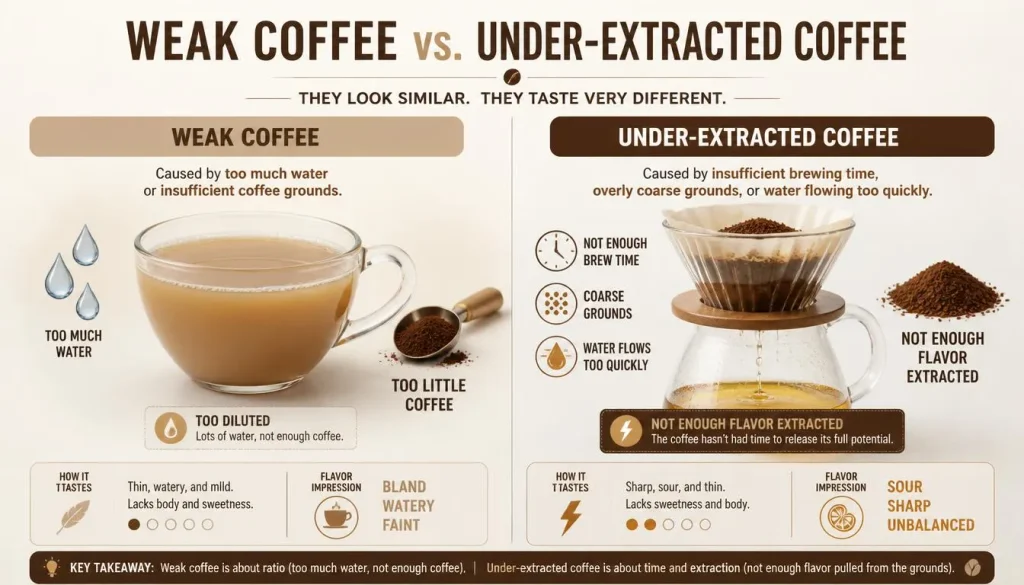
These terms are related, but they do not always mean the same thing.
Weak Coffee
Weak coffee usually means the concentration is too low.
It may taste reasonably balanced but lack body and intensity.
Common fixes include:
- More ground coffee
- Less water
- A smaller pod brew size
Under-Extracted Coffee
Under-extracted coffee means the water did not remove enough soluble material from the grounds.
It often tastes:
- Sour
- Sharp
- Hollow
- Thin
- Short on sweetness
Common fixes include:
- Grinding finer
- Improving water contact
- Increasing appropriate brew time
- Improving brewing temperature
- Ensuring even saturation
This distinction matters because simply adding more coffee does not always solve under-extraction.
Can a Finer Grind Make Coffee Stronger?
Often, yes, but only to a point.
A slightly finer grind creates more surface area and can help water extract more from the coffee during the available brew time.
But finer is not always better.
If you go too fine, the coffee can become bitter or astringent. Water flow may slow too much, and some drip machines may overflow.
Adjust in small steps.
Can a Dirty Coffee Maker Make Coffee Taste Weak?
Yes.
A dirty coffee maker can affect water flow, temperature, and flavor.
Mineral scale can interfere with internal water pathways. Coffee residue can clog small openings and change how evenly the grounds are saturated.
If your coffee gradually became weaker without any change to the beans or recipe, cleaning and descaling should be high on your troubleshooting list.
Why Are Some Coffee Grounds Still Dry After Brewing?
Dry grounds usually mean the water is not reaching the entire coffee bed.
Possible causes include:
- A blocked showerhead
- Uneven water distribution
- Grounds piled heavily to one side
- Incorrect filter placement
- A flow problem inside the brewer
Level the grounds before brewing and inspect the water outlet.
If cleaning does not restore even saturation, consult the manufacturer’s troubleshooting instructions.
Can the Wrong Coffee Filter Make Coffee Weak?
It can contribute to the problem.
A collapsed or poorly fitted filter may allow water to bypass part of the coffee bed.
A clogged reusable filter can also alter normal water flow.
Use the filter shape and size recommended by the brewer manufacturer, and make sure it sits correctly inside the basket before adding coffee.
Can Hard Water Make Coffee Taste Weak?
Hard water does not always make the coffee itself weak immediately, but it can create scale inside the coffee maker over time.
That buildup can affect water flow and machine performance.
If you live in an area with hard water and regularly see white mineral deposits in kettles or faucets, keep a closer eye on descaling.
You can also read KiCook’s guide to coffee makers designed with hard-water concerns in mind.
How to Prevent Weak or Watery Coffee
Once the coffee tastes right again, a few habits can prevent the problem from returning.
- Measure your coffee and water consistently.
- Use fresh beans or grounds.
- Keep coffee stored in a sealed container.
- Use a suitable grind for your brewing method.
- Keep filters and brew baskets clean.
- Descale according to the manufacturer’s instructions.
- Keep pod needles and showerheads free of debris.
- Avoid automatically selecting the largest cup size on pod brewers.
- Use filtered water if your tap water tastes strongly of chlorine or causes heavy scale.
- Pay attention when brew speed or temperature suddenly changes.
Consistency is more valuable than chasing a supposedly perfect coffee recipe.
Once you find the ratio, grind, and settings that work for your taste, keep them as your baseline.
When Should You Replace the Coffee Maker?
Do not replace a coffee maker just because one batch tastes watery.
Try the inexpensive fixes first.
Replacement becomes more reasonable when the machine consistently:
- Fails to heat properly
- Produces incomplete brews
- Leaks
- Has severe internal scale that cannot be removed
- Shows recurring faults after maintenance
- Has a failing pump or heater
- Has damaged electrical components
- Costs nearly as much to repair as a replacement machine
If you decide the brewer really has reached the end of its useful life, start by choosing the type of machine that matches how you actually drink coffee rather than buying based only on extra features.
KiCook’s coffee maker guides and reviews cover options for drip coffee, single-person brewing, espresso, hard water, camping, and other common needs.
Frequently Asked Questions
Why is my coffee maker suddenly making weak coffee?
If the same coffee and recipe suddenly taste weaker, check for mineral scale, a clogged showerhead or needle, uneven water flow, low brewing temperature, or an accidental change in brew settings.
Cleaning and descaling are usually better first steps than immediately increasing the amount of coffee.
Why does my coffee taste watery even when I use more grounds?
Using more grounds will not completely solve problems such as a grind that is too coarse, low brewing temperature, poor saturation, or water bypassing the coffee bed.
If adding more coffee does not help, investigate extraction rather than dose.
Why is my coffee maker brewing too fast?
A very coarse grind, too little coffee, filter problems, or unusual water distribution may allow water to move through the basket too quickly.
Compare the current brew time with how the machine normally performs rather than relying on one ideal number for every coffee maker.
Does a finer grind make coffee stronger?
A slightly finer grind can increase extraction and make an under-extracted cup taste fuller.
However, grinding too fine can make coffee bitter, restrict water flow, or cause overflow. Make small adjustments.
Can descaling make coffee taste stronger?
Descaling does not directly add strength to coffee.
It can restore normal water flow and heating performance when mineral deposits are interfering with the brewer. If scale was causing poor extraction, the coffee may taste noticeably better after proper descaling.
Why is my Keurig coffee watery?
The most common things to test are brew size, pod freshness, the Strong setting, needle cleanliness, and scale buildup.
Try brewing the same pod at a smaller size. If the smaller cup tastes significantly better, you probably prefer a stronger coffee-to-water ratio.
How much coffee should I use so it does not taste watery?
A practical starting range is around 55 to 60 grams of ground coffee per liter of water.
Adjust from there based on your coffee, grind, machine, and personal taste.
Why are some coffee grounds dry after brewing?
Dry areas suggest uneven saturation.
Clean the showerhead or water outlet, make sure the coffee bed is level, and verify that the filter and basket are seated correctly.
Can old coffee grounds cause weak coffee?
Yes. Coffee loses aromatic compounds and flavor as it ages, especially after grinding.
Old grounds may still produce normal-looking coffee while tasting flat and weak.
Should I buy a new coffee maker if my coffee is weak?
Usually not right away.
First test the coffee ratio, grind, freshness, filters, water quality, cleaning, descaling, brew size, and temperature.
A replacement makes more sense when the machine has a persistent heating, pumping, electrical, leaking, or water-delivery problem that maintenance does not solve.
Final Thoughts
When a coffee maker makes weak or watery coffee, the machine itself is only one possible cause.
Start with the basics: coffee dose, water amount, grind size, freshness, and brew settings. Then look at the filter, water distribution, cleaning, scale buildup, and brewing temperature.
For most people, the fastest approach is simple: measure the next batch, grind slightly finer if needed, inspect the used coffee bed, and clean the brewer if its performance has changed.
If you use a single-serve machine, try a smaller brew size before doing anything complicated.
Most importantly, change one variable at a time. That way, when your coffee finally tastes rich and satisfying again, you will know exactly what fixed it.

“I believe great cooking starts with the right tools, trusted advice, and a little confidence in the kitchen.”
Hi, I’m Emma Carter. My love for cooking began in my grandmother’s kitchen, where I learned that every great meal starts with simple ingredients and the right cookware. Over the years, I’ve spent countless hours researching, testing, and comparing kitchen appliances, cookware, coffee makers, air fryers, and other everyday kitchen essentials.
Here at KiCook, my goal is to make your buying decisions easier with honest product reviews, practical buying guides, and easy-to-follow cooking tips. Whether you’re upgrading your kitchen or searching for the best appliance for your home, I focus on providing clear, reliable, and research-backed information you can trust.
When I’m not testing new kitchen gadgets or writing in-depth guides, you’ll usually find me trying new recipes, visiting local farmers’ markets, or enjoying a quiet cup of coffee while planning my next kitchen project.