
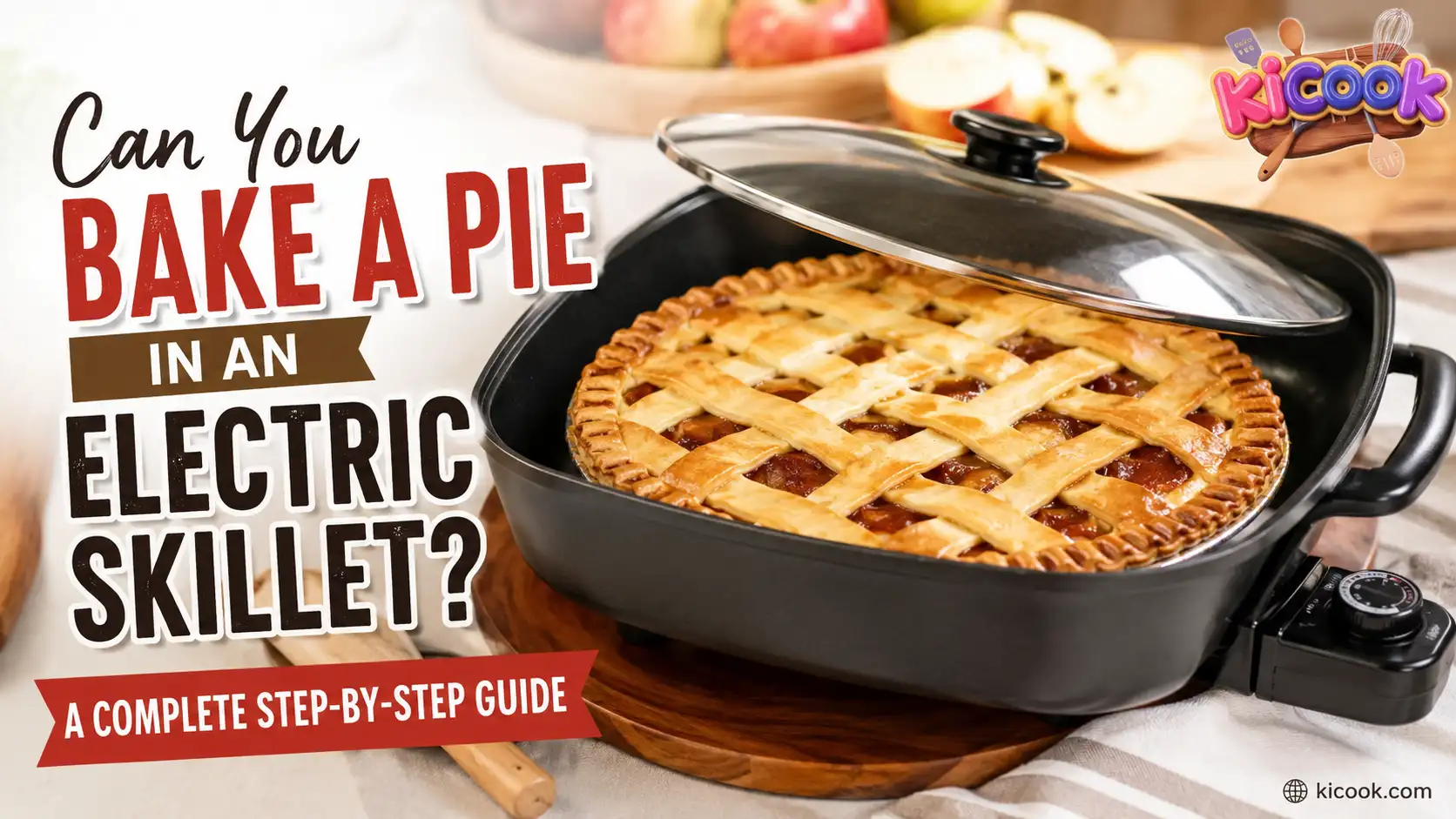
Yes, you can bake a pie in an electric skillet, but the method is a little different from baking one in a conventional oven. The best results usually come from using a covered electric skillet with adjustable temperature control and, when your appliance allows it, a heat-safe pie pan that fits comfortably inside.
The biggest difference is heat direction. An oven surrounds a pie with hot air, while an electric skillet delivers most of its heat from underneath. That makes bottom-crust burning and pale top crusts the two problems you need to watch most closely.
There is also no single temperature or baking time that works for every skillet and every pie. Your appliance design, pie size, filling, pan material, and baking method all matter.
If you are new to this appliance, KiCook’s guide to what you can cook in an electric skillet is a useful starting point for understanding just how versatile an electric skillet can be.
Can You Really Bake a Pie in an Electric Skillet?
You can, provided your electric skillet is suitable for covered baking.
Think of the skillet as a small, bottom-heated cooking chamber rather than a miniature version of a full-size oven. When the lid is on, heat is trapped around the food. That enclosed environment can cook pastry and pie filling surprisingly well, although the finished crust may look different from one baked with strong upper and lower oven heat.
This is the same general reason other covered dishes can work in an electric skillet. If you want to see how that cooking environment behaves with another baked dish, KiCook’s guide on baking a casserole in an electric skillet explains the difference between skillet heat and conventional oven heat in more detail.
The technique is especially useful when your oven is unavailable, already occupied, or simply inconvenient. It can also be handy in a small kitchen, RV, caravan, temporary kitchen, or during warm weather when you would rather not heat a full-size oven.
Electric Skillet vs. Electric Frying Pan: Is There a Difference for Pie Baking?
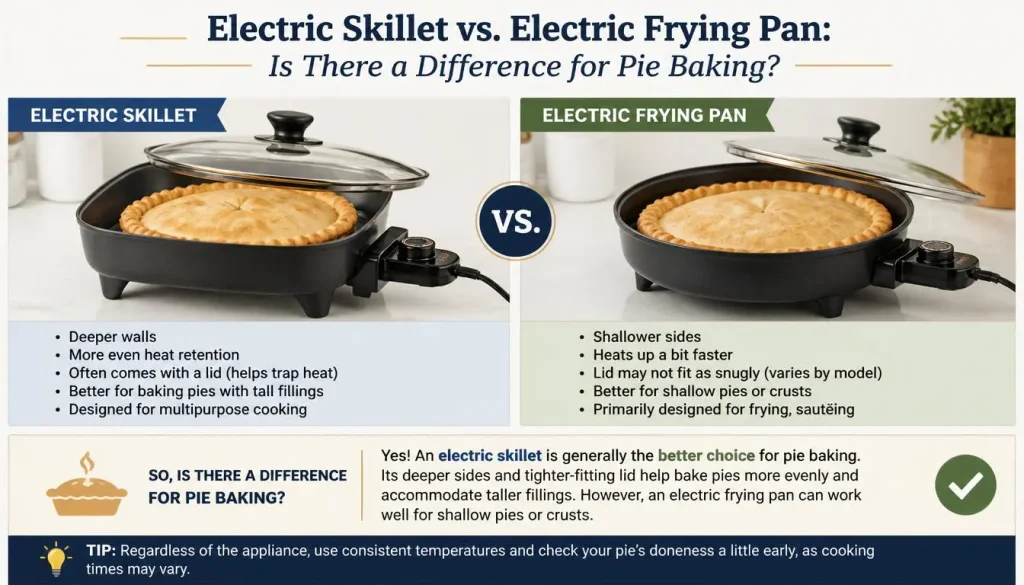
For everyday cooking, “electric skillet,” “electric frying pan,” “electric fry pan,” and “electric frypan” often describe the same basic type of appliance: a pan with its own electric heating element, thermostat, and usually a fitted lid.
The terminology varies between regions and manufacturers. American recipes are more likely to say “electric skillet,” while “electric frypan” or “electric frying pan” may appear more often in other markets.
So if you are wondering whether you can bake a pie in an electric frying pan, the same principles generally apply. What matters more than the name is whether the appliance has controlled heat, enough depth, a suitable lid, and enough room for the pie or pie pan.
Do not confuse an electric skillet with an electric griddle, though. A griddle is usually flatter and often lacks the depth and enclosed cooking space needed for pie baking. KiCook’s electric skillet vs. electric griddle comparison explains those differences.
What Type of Electric Skillet Works Best for Baking Pie?
A deep skillet with adjustable temperature control and a well-fitting lid gives you the most flexibility.
The thermostat is important because pastry does not respond well to uncontrolled direct heat. If the bottom surface becomes too hot, the crust can burn before the filling has finished cooking.
Depth matters too. Once a pie pan, rack, crust, and filling are inside, there still needs to be enough clearance for the lid to close properly.
Skillet size and power can also affect how quickly it heats and recovers after the lid is opened. If you are comparing appliances, KiCook also has a detailed explanation of how many watts an electric skillet uses.
What Do You Need to Bake a Pie in an Electric Skillet?
You do not need a complicated setup, but everything that goes inside the appliance must be suitable for the heat involved.
| Item | Why It Matters |
|---|---|
| Electric skillet | Provides controlled bottom heat |
| Fitted lid | Holds heat around the pie |
| Heat-safe pie pan | Keeps the pie contained and easier to remove |
| Rack or trivet, if approved | Can separate the pie pan from intense direct bottom heat |
| Oven mitts | The pie pan, lid, handles, and surrounding surfaces may become very hot |
| Pie crust and filling | Homemade or recipe-appropriate prepared ingredients |
| Timer | Helps you begin checking before overbaking |
Before putting a separate pan, rack, foil, parchment, or other accessory inside your skillet, check the instructions for your particular model.
What Kind of Pie Pan Can You Use in an Electric Skillet?
A metal pie pan is often the most practical choice because it is lightweight, conducts heat efficiently, and is easy to lift out of a skillet.
A disposable aluminum pie pan may also work if it is sturdy enough and compatible with your cooking method.
Silicone molds can work in some baking setups, although their flexible sides can make a full pie harder to move safely.
Glass requires more caution. A dish that is oven-safe is not automatically suitable for every type of direct or concentrated skillet heat. Only use glass cookware when its manufacturer and your electric skillet instructions permit the intended setup.
Most importantly, the pan has to fit.
A manufacturer-specific example from Saladmaster uses a 9-inch round pan inside a 12-inch electric skillet for an electric skillet pie. That does not mean every 9-inch pan will fit every 12-inch skillet, since wall shape, handles, depth, and lid design differ.
What Size Pie Pan Should You Use?
Choose a pan that leaves enough space around it for safe placement and removal and still allows the lid to close normally.
A shallow 8- or 9-inch pan is often easier to manage in a large electric skillet than a very deep pie dish.
Do a dry fit before adding the crust or filling. Place the empty pan in the cold, unplugged skillet with any manufacturer-approved rack you plan to use, then check whether the lid closes without touching the pie pan.
That simple test can save you from discovering halfway through preparation that the assembled pie is too tall.
Do You Need a Rack Under the Pie Pan?
Not always, but a rack can be useful when the skillet manufacturer approves baking with one.
The heating element in an electric skillet is underneath the cooking surface. If a thin pie pan sits directly against a very hot surface, the bottom crust can receive much more heat than the top.
Elevating the pan can soften that direct heat and create a small air gap underneath.
However, do not assume that every rack or trivet is safe. A skillet designed for direct cooking may have different instructions from one designed to accept baking inserts.
If your manufacturer does not recommend placing a rack and baking pan inside the skillet, follow the approved cooking method instead.
Do You Need to Add Water Under the Pie Pan?
Normally, no.
For conventional-style pie baking, you generally want a dry cooking environment rather than a water bath. Adding water underneath the pan increases steam and moves the cooking method closer to steaming.
That can be useful for certain foods, but it is usually not what you want when trying to develop a pastry crust.
The exception is a recipe specifically designed to use water or a water bath. In that case, follow the recipe and appliance instructions rather than applying a general skillet-baking method.
Should You Preheat the Electric Skillet or Start With a Cold Skillet?
Either method can be correct.
This is one reason you should not treat a single electric skillet temperature as a universal rule.
For example, Saladmaster’s published electric skillet pie recipe places a 9-inch pan into a cold electric skillet, covers it, and then sets the appliance to 400°F/205°C. By contrast, Saladmaster’s general electric-skillet cake and brownie instructions use a lower-temperature preheating method.
The takeaway is not that one method is better. It is that different recipes and skillet designs use different heat-management strategies.
If you are following a recipe written specifically for your model, use that method. If you are adapting a conventional oven recipe, proceed cautiously and expect to make adjustments.
How to Bake a Pie in an Electric Skillet
Once you have confirmed that your skillet can handle the baking setup, the process is fairly straightforward.
- Read your skillet instructions first. Confirm that covered baking and any separate pan, rack, foil, or parchment you plan to use are permitted.
- Choose a suitable pie. A small fruit pie, crumb-topped pie, graham-crust pie, or mini pie is usually easier for a first attempt than a thick double-crust pie.
- Check the pan fit. Make sure the pan sits securely inside the skillet and the lid can close without touching the pie.
- Prepare the crust and filling. Assemble the pie according to your recipe rather than improvising ingredient quantities.
- Set up the skillet. Add an approved rack or trivet if your particular method calls for one.
- Preheat or cold-start as directed. Do not automatically copy an oven temperature just because that temperature appears in the original recipe.
- Place the pie inside and cover. Keep the lid in the position required by your recipe or appliance.
- Monitor the pie as it cooks. Avoid constantly lifting the lid, but begin checking before you assume the original oven time will be correct.
- Remove and cool properly. Use oven mitts, place the hot pan on a heat-safe surface, and allow the pie to cool for the time required by your recipe before slicing.
The first pie you make in a particular skillet is partly a learning batch. Once you know whether your model tends to run hot at the bottom or cook more slowly than expected, the next attempt becomes much easier.
Should You Keep the Lid On While Baking a Pie?
In most electric skillet baking methods, the lid plays an important role because it prevents heat from escaping immediately.
Without it, the base may become extremely hot while the top of the pie receives relatively little heat.
That said, lid position can vary between appliances and recipes. Some methods keep the lid completely closed, while others may allow controlled venting.
Do not repeatedly lift the lid just to look at the pie. Every time you remove it, a significant amount of trapped heat escapes and the cooking environment changes.
What About Condensation Under the Lid?
Condensation is normal in covered electric skillet baking.
Warm moisture from the food rises, reaches the cooler lid, and forms droplets. If enough moisture collects, those droplets can fall back onto the crust.
That is more noticeable with fillings that release a lot of steam.
When removing the lid, lift or turn it carefully so accumulated water does not pour onto the finished pie. Saladmaster gives similar advice in its electric skillet baking guidance, where moisture accumulation under the cover is specifically addressed.
What Temperature Should You Bake a Pie in an Electric Skillet?
There is no single best electric skillet pie temperature.
You may see temperatures from roughly 300°F to 400°F (149°C to 204°C) across different skillet-baking methods, but those numbers should not be treated as interchangeable.
A temperature that works with one manufacturer’s heavy skillet, pan configuration, and recipe could burn the crust in a thinner or faster-heating appliance.
That is why a chart claiming “all electric skillet pies should be baked at 350°F” would be misleading.
Instead, use three pieces of information together: the recipe, the electric skillet manufacturer’s guidance, and what you observe as the pie cooks.
If the bottom is browning much faster than the filling cooks, the heat is too aggressive for your setup. If the filling barely warms and the pastry remains raw after a reasonable period, the temperature may be too low or too much heat may be escaping.
For international readers, common conversions include 325°F/163°C, 350°F/177°C, 375°F/191°C, and 400°F/204°C.
How Long Does a Pie Take in an Electric Skillet?
Cooking time depends too heavily on the recipe and appliance for one number to be reliable.
A shallow mini pie can cook much faster than a deep fruit pie. A cold filling takes longer than a room-temperature filling, and a heavy metal pan behaves differently from thin disposable aluminum.
| Factor | How It Can Affect Cooking Time |
|---|---|
| Mini vs. full-size pie | Mini pies usually cook faster |
| Shallow vs. deep filling | Deeper filling usually takes longer |
| Cold ingredients | Increase cooking time |
| Pan material | Changes heat transfer |
| Skillet temperature accuracy | Can shorten or lengthen baking |
| Frequent lid opening | Releases heat and can extend cooking |
| Frozen pie | Usually requires more time and more careful heat management |
Instead of relying entirely on minutes, learn the visual and textural signs that your particular pie is ready.
How Do You Know When an Electric Skillet Pie Is Done?
Doneness depends on the filling.
For a fruit pie, look for a properly cooked crust, tender fruit, and filling that has thickened and is bubbling as expected for that particular recipe.
A custard-style filling should reach the set or slight-jiggle stage described in its recipe rather than remaining obviously liquid in the center.
A graham-crust or cheesecake-style pie may have completely different doneness cues.
This is another reason crust color alone is unreliable in an electric skillet. The top may remain relatively pale even when the filling has finished cooking.
What Type of Pie Crust Works Best?
Crusts that do not depend heavily on strong overhead browning are generally easier.
A graham cracker crust is forgiving. A single-crust fruit or custard pie can also work because there is less pastry on top competing for heat.
Crumb-topped pies are another practical option because the topping can cook without needing the same evenly browned surface as traditional pastry.
A lattice crust is possible, but it may remain lighter than it would in an oven.
A thick double-crust pie is usually the most challenging because both the filling and upper pastry need enough heat without burning the bottom.
Can You Blind Bake a Pie Crust in an Electric Skillet?
Potentially, yes, if your appliance supports the required baking setup.
Blind baking means partially or fully baking the crust before adding the final filling. It is useful for pies with wet fillings or fillings that do not need as much cooking as the pastry.
The same electric-skillet limitation still applies: bottom heat can be much stronger than top heat.
Use an approved pie pan and follow a method compatible with your appliance. If the recipe uses pie weights or parchment, make sure those materials are safe for the setup before proceeding.
Do not simply copy an oven blind-baking time and assume the crust will behave identically.
How Do You Adapt an Oven Pie Recipe for an Electric Skillet?
Start by treating the oven instructions as a reference rather than a direct translation.
A recipe written for a conventional oven assumes the pie is surrounded by controlled hot air. Your electric skillet creates a different environment.
First check whether the skillet manufacturer provides baking instructions. Then select a pan that fits properly, use an approved rack if required, and decide whether the recipe should begin in a preheated or cold skillet.
Pay particular attention to the bottom crust during your first attempt. If necessary, reduce the temperature rather than continuing to cook at a setting that is obviously browning the base too quickly.
Also expect less top browning.
Perhaps most importantly, do not assume the oven’s exact baking time will carry over. Start checking the pie based on its actual doneness rather than waiting blindly for the original timer to expire.
Can You Bake a Pie Directly in the Electric Skillet?
Some skillet-style desserts can be cooked directly in the pan, but a conventional pie is usually easier to manage in a separate heat-safe pie pan when your appliance allows one.
Using a pie pan gives you the familiar crust shape, makes removal easier, and provides another layer between the delicate pastry and the skillet’s heating surface.
Direct cooking makes more sense for desserts such as skillet cobblers, crustless pies, baked fruit, or recipes specifically developed for direct skillet cooking.
Trying to improvise a traditional filled pastry directly against the nonstick skillet surface can make serving and crust control much more difficult.
Full-Size Pie or Mini Pies: Which Works Better?
Mini pies are usually more forgiving for beginners.
Because each pie is smaller, heat can reach the filling more quickly. Smaller portions are also easier to arrange in a large skillet, and you can often monitor doneness without committing an entire full-size pie to your first experiment.
A full-size pie can work, especially in a large, deep skillet, but pan clearance becomes more important.
If the pie is too wide, airflow and handling become difficult. If it is too tall, the lid may touch the crust.
For a first attempt, a shallow 8- or 9-inch pie or a batch of mini pies is generally easier than a very deep pie.
Which Pies Work Best in an Electric Skillet?
Different pies behave differently because some rely more heavily on top heat than others.
| Pie Type | Electric Skillet Suitability | Main Consideration |
|---|---|---|
| Apple pie | Good with the right setup | Filling must soften before bottom burns |
| Blueberry pie | Good | Watch bubbling fruit juices |
| Peach pie | Good | Moist filling can increase condensation |
| Crumb-topped fruit pie | Very good | Less dependence on upper pastry browning |
| Graham-crust pie | Very good | Crust is relatively forgiving |
| Custard pie | Possible | Requires careful doneness control |
| Mini pies | Very good | Easier heat penetration |
| Double-crust pie | More difficult | Top crust may remain pale |
| Deep-dish pie | More difficult | Center can take much longer to cook |
Saladmaster’s published skillet-pie recipe specifically notes that the fruit can be varied, including options such as apple, blueberry, or peach.
Can You Bake a Store-Bought Pie in an Electric Skillet?
It depends on the pie.
A refrigerated ready-to-bake pie may be adaptable if it fits your skillet and you can safely reproduce the cooking conditions it needs.
However, packaging instructions are usually written for a conventional oven. The printed oven temperature and baking time should not automatically become your electric skillet settings.
Check whether the manufacturer provides alternative cooking methods. If it does not, a homemade or skillet-specific recipe is easier to adapt because you have more control over the pan size, crust thickness, and filling depth.
Can You Bake a Frozen Pie in an Electric Skillet?
It may be possible, but a frozen pie is harder to cook evenly.
The center begins extremely cold while the crust closest to the heating element receives immediate heat. That creates exactly the imbalance electric skillet baking is already prone to: an overcooked bottom and undercooked center.
A frozen full-size pie is therefore not the best first project for this appliance.
If the product manufacturer only provides conventional oven directions and your electric skillet manual provides no guidance for frozen baking, using the recommended oven method is usually more predictable.
Never thaw a product that specifically says it should be cooked from frozen unless its instructions allow it.
How Do You Keep the Bottom Pie Crust From Burning?
Bottom burning usually means the pastry is receiving too much direct heat relative to the rest of the pie.
The first solution is temperature control. Lower heat often works better than trying to rescue a crust after it has already browned too far.
An approved rack or trivet may also help by creating separation between the pie pan and the hot skillet surface.
Pan material matters as well. Very thin metal transfers heat rapidly, while heavier pans tend to moderate temperature changes.
Check the pie earlier during your first attempt. Once you know how quickly your skillet browns the bottom, you can make a more accurate adjustment next time.
How Do You Get the Top Pie Crust Brown?
This is the hardest part of baking a traditional pie in an electric skillet.
Most electric skillets do not have a heating element above the food, so you should not expect the top to brown exactly like it does in a conventional oven.
An egg wash or other recipe-appropriate crust finish can improve color somewhat, but it cannot create overhead heat.
If you want a deeply browned final crust, you may be able to finish the pie separately in an oven or under a broiler—but only after removing it completely from the electric skillet and only if the pie pan itself is approved for that method.
Never put the electric skillet, electrical base, thermostat, cord, or other electrical components under a broiler or inside an oven unless the manufacturer explicitly says the appliance is designed for it.
A pale top does not automatically mean the pie is raw. Check the pastry and filling for actual doneness.
How Do You Prevent a Soggy Pie Crust?
A soggy crust usually comes from excess moisture, insufficient heat at the right stage, or a filling that releases more liquid than the crust can handle.
Use the thickener and filling quantities called for in your recipe. Avoid adding extra juice “for moisture,” especially with fruit fillings.
If your recipe requires blind baking, do not skip it simply because you are using an electric skillet.
Condensation can also contribute to surface moisture, so handle the lid carefully when removing it.
Finally, allow the pie to cool properly. Fruit-pie filling continues to thicken as it cools, and slicing too early can make a properly baked pie look much wetter than it really is.
Electric Skillet vs. Oven for Baking Pie
| Feature | Electric Skillet | Conventional Oven |
|---|---|---|
| Main heat direction | Primarily from below | Surrounds the pie |
| Top browning | Limited | Very good |
| Countertop use | Yes | No |
| Small-batch convenience | Excellent | Good |
| Full-size pie capacity | Depends on skillet | Usually excellent |
| Temperature behavior | Varies considerably by model | Generally more predictable for baking |
| Portability | High | Low |
| Best use | Oven-free or small-batch baking | Traditional pie baking |
If your main goal is a perfectly browned bakery-style double-crust pie, the oven remains easier.
If your goal is to make a good pie when you do not have convenient oven access, an electric skillet can be a genuinely useful alternative.
Common Electric Skillet Pie Problems and Fixes
| Problem | Likely Cause | What to Try |
|---|---|---|
| Bottom crust burns | Too much direct heat | Lower temperature; use an approved rack |
| Top stays pale | No overhead heat | Judge doneness separately; use an appropriate finishing method |
| Filling stays runny | Insufficient cooking or cooling | Continue according to recipe; allow proper cooling |
| Crust becomes soggy | Excess filling moisture | Follow filling ratios and blind-bake if required |
| Pie cooks unevenly | Hot spots or oversized pie | Use a smaller pan and gentler heat |
| Water drips onto pie | Lid condensation | Remove lid carefully |
| Pie takes too long | Low heat, deep filling, or heat loss | Minimize unnecessary lid opening and reassess settings |
| Edge cooks before center | Pie is too large/deep or heat is too aggressive | Reduce heat and use a shallower pie next time |
Common Mistakes to Avoid
The mistake I would avoid most is assuming an electric skillet is simply an oven with a different shape. It is not.
High heat does not necessarily make the pie bake better or faster. It often just makes the bottom cook faster.
Likewise, constantly opening the lid to check progress can work against you by releasing the heat needed to cook the upper part of the pie.
Using an oversized pan is another common problem. Even if you can physically force a pie pan into the skillet, that does not mean there is adequate clearance for safe handling or heat movement.
Finally, do not experiment with random racks, glassware, foil arrangements, or liners when you do not know whether your appliance supports them.
Electric Skillet Pie Safety Tips
The safest starting point is always the instruction manual that came with your appliance.
If you own a Presto skillet, for example, the company maintains a model-specific electric skillet instruction manual finder rather than treating every model as identical. Other manufacturers may provide similar support resources.
Keep the appliance on a stable, heat-resistant surface with adequate clearance.
Use dry oven mitts when moving a hot pie pan. Steam escaping from the lid can burn you, so open the cover away from your face and hands.
Keep electrical controls and connections away from water, and never immerse electrical components unless your manufacturer specifically states that they can be immersed.
Do not use cookware, racks, or liners that interfere with the thermostat, lid, handles, or other appliance components.
Tips for a Better Electric Skillet Pie
Once you understand your own skillet, pie baking becomes much more predictable.
Start with a smaller, forgiving recipe instead of a deep double-crust pie. Keep notes on the pan size, heat setting, cooking time, and whether the crust browned too quickly.
That information is far more useful for your second pie than a universal temperature chart from someone using a completely different electric skillet.
Pay attention to the filling rather than obsessing over top-crust color. The absence of strong overhead heat means a fully cooked pie can look lighter than expected.
Most of all, work with the appliance rather than trying to force it to behave exactly like an oven.
Frequently Asked Questions
Can You Bake in an Electric Skillet?
Yes. Some electric skillets can handle covered baking, including certain pies, cakes, cobblers, casseroles, and similar foods. Check your specific appliance instructions because baking methods vary between models.
Can You Bake a Pie in an Electric Frying Pan?
Usually, yes, if the electric frying pan has appropriate temperature control, enough depth, a fitted lid, and the manufacturer permits the baking method you plan to use.
Can You Put a Pie Pan Inside an Electric Skillet?
Some electric skillets can accommodate a separate heat-safe pie or cake pan. The pan must fit comfortably, the lid must close correctly, and the setup should be allowed by your appliance manufacturer.
Do You Need a Rack to Bake a Pie in an Electric Skillet?
Not always. A rack can help separate the pie pan from strong direct bottom heat, but only use one when your skillet manufacturer allows it.
Do You Put Water Under the Pie Pan?
Usually not for standard dry pie baking. Water creates additional steam and changes the cooking environment. Only add water when a specific recipe or manufacturer method requires it.
Do You Preheat an Electric Skillet for Pie?
Sometimes. Some recipes use a preheated skillet while others begin cold. Manufacturer-specific methods vary, so follow the recipe and appliance instructions rather than assuming preheating is always necessary.
Should the Lid Stay On While the Pie Bakes?
Generally, covered baking helps trap heat around the pie, but exact lid instructions can vary. Follow the method designed for your skillet.
What Temperature Should You Bake a Pie in an Electric Skillet?
There is no universal temperature. The correct setting depends on the skillet model, pan arrangement, filling, crust, and recipe. Published skillet-baking methods vary substantially, so model-specific directions should take priority.
How Long Does a Pie Take in an Electric Skillet?
It depends on the pie size, filling depth, pan material, starting temperature, skillet design, and heat setting. Mini pies are generally faster than full-size deep pies. Use recipe-specific signs of doneness rather than time alone.
Can You Bake Apple Pie in an Electric Skillet?
Yes. Apple pie is one of the fruit pies that can be adapted to certain electric skillets. Make sure the apples become tender without allowing the bottom crust to overcook.
Can You Bake Blueberry or Peach Pie in an Electric Skillet?
Yes, with a suitable recipe and appliance. Keep in mind that juicy fruit fillings can produce extra steam and condensation under the lid.
Can You Bake a Frozen Pie in an Electric Skillet?
Possibly, but frozen pies are more difficult to heat evenly because the bottom crust can become hot long before the frozen center is cooked. Use manufacturer guidance whenever possible.
Can You Use a Glass Pie Dish?
Only if both the glassware manufacturer and your skillet instructions permit that type of heating arrangement. “Oven-safe” does not automatically mean safe for every electric skillet setup.
Can You Use Aluminum Foil in an Electric Skillet?
It depends on the appliance and how the foil is being used. Never let foil interfere with the thermostat or electrical components, and follow your model’s instructions.
Can You Use Parchment Paper?
Some skillet-baking methods use parchment, but it should only be used when compatible with the temperature and appliance setup. Never allow loose paper to contact an exposed heating element.
Why Is My Pie Crust Burning on the Bottom?
The bottom is probably receiving too much heat. Lower the temperature, consider an approved rack or heavier pan, and begin checking sooner.
Why Is the Top of My Pie Not Browning?
Electric skillets normally heat from underneath, so there is little or no direct top heat. A light-colored top can therefore be normal even when the filling and pastry are cooked.
Can an Electric Skillet Replace an Oven?
For some foods, yes. For all baking, no.
An electric skillet is excellent for situations where you need an extra cooking appliance or do not have convenient oven access, but it cannot reproduce the surrounding dry heat and strong top browning of a conventional oven.
Final Verdict: Is an Electric Skillet Good for Baking Pie?
Yes, you can bake a pie in an electric skillet, and the results can be very good when you choose the right pie and understand how your appliance heats.
The key is not finding one magic temperature. It is controlling the stronger bottom heat, using a properly sized pan, keeping enough heat around the pie with the lid, and checking the filling and crust for actual doneness.
Smaller fruit pies, mini pies, graham-crust pies, and crumb-topped pies are generally the easiest place to start. Traditional double-crust pies are possible but more challenging because an electric skillet does not provide the same overhead heat as an oven.
For your first attempt, use a recipe designed for skillet baking or follow the baking guidance supplied by your appliance manufacturer. Once you learn how your skillet behaves, adapting other pie recipes becomes much easier.
So, if your oven is unavailable or you simply want to see what your electric skillet can really do—there is no reason pie has to be off the menu.

“I believe great cooking starts with the right tools, trusted advice, and a little confidence in the kitchen.”
Hi, I’m Emma Carter. My love for cooking began in my grandmother’s kitchen, where I learned that every great meal starts with simple ingredients and the right cookware. Over the years, I’ve spent countless hours researching, testing, and comparing kitchen appliances, cookware, coffee makers, air fryers, and other everyday kitchen essentials.
Here at KiCook, my goal is to make your buying decisions easier with honest product reviews, practical buying guides, and easy-to-follow cooking tips. Whether you’re upgrading your kitchen or searching for the best appliance for your home, I focus on providing clear, reliable, and research-backed information you can trust.
When I’m not testing new kitchen gadgets or writing in-depth guides, you’ll usually find me trying new recipes, visiting local farmers’ markets, or enjoying a quiet cup of coffee while planning my next kitchen project.