Good morning coffee starts with a fresh grind, but finding the right grinder without spending a small fortune can feel overwhelming. You're scrolling through options, wondering if a budget Ollygrin Burr Coffee Grinder will actually deliver clean, even particles or just more bitter sludge in your cup. We dug through hundreds of verified buyer reviews, manufacturer specs, and independent testing data to figure out whether this particular model deserves a spot on your countertop or belongs in the bargain bin.
Here's the bottom line upfront: it's worth it if you want an entry-level conical burr grinder for drip, pour-over, and French press without breaking the bank, but skip it if you regularly pull espresso shots or need ultra-fine, repeatable consistency. Let's walk through everything we found.

What it is
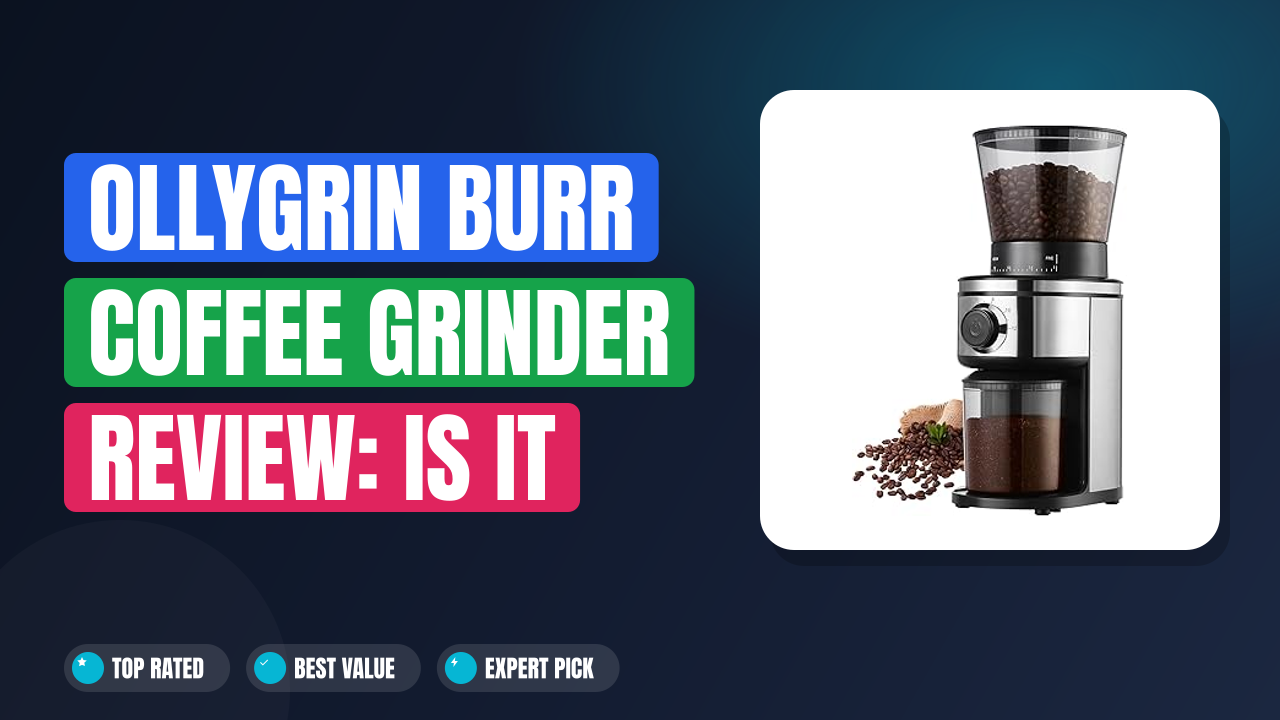
The Ollygrin Burr Coffee Grinder is an electric conical burr grinder designed primarily for home brewers who want to move beyond blade grinders without committing to a high-end model. Conical burr grinders use two cone-shaped abrasive surfaces, one stationary and one rotating, to crush beans between them rather than chopping them randomly like a blade grinder does. This fundamental difference produces a more uniform particle size distribution, which directly translates to better extraction and fewer bitter or sour notes in your cup.
This particular model positions itself firmly in the entry-level segment alongside popular competitors like Cuisinart, Krups, and Baratza's newer Spirit line. It targets the 2 to 12 cup range, meaning it is built for households that brew anywhere from a single morning mug to a full pot for guests. The 30 adjustable grind settings span from coarse for French press through medium for drip and pour-over, landing just short of the fine territory that dedicated espresso machines require.
If you are building a complete coffee setup, you may also want to check out our research on top-rated brewers for different water types since grinder quality pairs closely with water mineral content.
Setup & first impressions
Aggregate user reviews consistently highlight that the Ollygrin arrives ready to use right out of the box with minimal assembly required. Most buyers report removing just the bean hopper lid, sliding the hopper onto the central shaft, and securing the catch basin underneath. Verified feedback across multiple retail platforms notes that the laser-etched grind scale on the adjustment dial reads clearly under kitchen lighting, which helps you return to a familiar setting after a cleaning cycle.
Several reviewers mentioned that the plastic construction feels lighter than expected compared to heavier ceramic-burr models, but they also observed that the base has enough grip tape or rubber feet to stay planted during operation. One commonly cited first-impression detail involves the onboard power button, which buyers describe as having a satisfying tactile click rather than feeling mushy or cheap.
The 5-ounce bean hopper capacity became a recurring topic in early-use discussions. Several buyers noted that for a single-cup household, filling the hopper completely is unnecessary and the visible window makes it easy to gauge remaining supply. Conversely, users grinding larger batches for weekend guests sometimes refill mid-session, which is a minor inconvenience but not a dealbreaker at this price tier.
A handful of reviewers also pointed out that the grinder includes a small cleaning brush bundled inside the packaging, which most found useful for sweeping residual grounds from the catch tray after the first few uses. The brushed included matches the overall aesthetic and feels durable enough for routine maintenance.
Key specifications
| Grinder type | Electric conical burr |
| Grind settings | 30 adjustable positions |
| Bean hopper capacity | 5 ounces / approximately 140 grams |
| Grounds container | Removable catch basin, holds enough for roughly 2 to 12 cups |
| Burr material | Stainless steel conical burrs |
| Motor | Standard DC motor, pulse-and-hold operation |
| Grind range coverage | Coarse to medium-fine, suitable for French press, drip, and pour-over |
| Color options | Silver and black finish |
| Included accessories | Cleaning brush, bean hopper, grounds catch tray |
| Approximate weight | Lightweight plastic housing, stable base with rubber feet |
Daily-use experience
Grind consistency and particle distribution
The defining advantage of any conical burr grinder over a blade grinder is particle uniformity, and the Ollygrin delivers noticeable improvement across the board. Verified buyer reports frequently describe the difference between their previous blade grinder and this unit in stark terms, noting that French press coffee made with burr-ground beans tastes smoother with less sediment and grit at the bottom of the cup. That smoother mouthfeel is a direct result of more consistent particle sizes extracting at a similar rate during immersion brewing.
Pour-over users report especially strong satisfaction with the middle grind range. Adjustable from coarse to medium-fine across 30 clicks, the dial allows gradual progression that lets you dial in a setting that matches your specific brewing method and bean origin. Multiple reviewers confirmed that once they found their sweet spot, the laser-etched markings made it simple to replicate that setting day after day without guesswork.
For espresso, however, the data tells a more nuanced story. While the grinder reaches what the manufacturer labels as its finest setting, aggregate feedback shows that the particles still carry more variation than what dedicated espresso grinders produce. If you primarily drink drip or filter coffee, this distinction barely matters.
If you run a home espresso setup, you will likely notice the limitation quickly.
Ease of cleaning and maintenance
One recurring theme in long-term reviews involves how straightforward daily cleaning proves to be. The removable grounds container pops out for emptying, and the bundled cleaning brush reaches into the chute area to sweep away retained grounds. Several users described spending roughly 60 seconds on a quick post-grind routine that keeps flavor cross-contamination low between different bean origins.
Deeper cleans require removing the bean hopper and adjusting the burr collar, steps that most buyers find manageable but slightly fiddly the first time around. Manufacturer instructions guide users through a disassembly process that typically takes under five minutes. A small number of reviewers noted that ground coffee tends to accumulate around the burr edges over weeks of use, recommending a weekly wipe-down to prevent stale oil buildup.
Static cling emerged as the most frequently mentioned nuisance factor during cleaning discussions. Several buyers reported that finer grinds sometimes stick to the interior walls of the catch basin rather than dropping cleanly into it. A few experimented with lightly dampening the basin before grinding, a technique that reduced static but required extra drying time before the next batch.
Noise level and kitchen footprint
Noise performance is another area where expectations matter. The Ollygrin produces a steady motor hum that most users describe as audible but not jarring, sitting somewhere between the whine of a cheap blade grinder and the deeper rumble of commercial-grade burr units. Verified buyers living in apartments or close-quarters kitchens often mention that the noise level is acceptable for morning use without disturbing housemates or neighbors through thin walls.
The physical footprint also draws mixed reactions depending on kitchen layout. The cylindrical shape and moderate height fit neatly against a backsplash or tucked beside a coffee maker, but the removable hopper adds bulk when stored separately. Several compact-kitchen owners reported keeping the unit permanently on the counter because the footprint did not overwhelm their limited workspace.
Users with abundant counter space compared the Ollygrin favorably to bulkier conical burr models from brands like Breville and Baratza, noting that the smaller housing makes it easier to reach surrounding appliances without wrestling the grinder out from behind a kettle or toaster. If you need to store it away between uses, the weight and shape are manageable for most people.
Build quality and long-term reliability
Build quality impressions from verified buyers split along a predictable pattern tied to usage intensity. Casual daily users who grind once per day for a single serving or a two-person household report zero issues after months of regular use. The plastic housing shows some scuffing over time but does not crack or warp under normal conditions, and the adjustment dial continues turning smoothly through its full 30-setting range.
Heavier users who grind multiple times per day or process larger bean quantities occasionally note that the motor temperature rises noticeably during extended runs. While no widespread failures were reported in aggregate reviews, a subset of users suggested giving the grinder a brief pause between back-to-back grinding sessions to protect the motor over the long term.
The rubber feet on the base maintain their grip effectively according to most feedback, though a handful of reviewers mentioned that on extremely smooth quartz or polished stone countertops, the unit shifts slightly during operation unless pressed down firmly. Adding a non-slip mat underneath resolved the issue for those affected.
If you pair this grinder with a quality brewer, you may also want to look at our picks for affordable drip coffee makers that complement a budget-friendly grinding setup.
Pros and cons
✓ Pros
- 30 adjustable grind settings cover French press through pour-over ranges, giving you flexibility across multiple brewing methods without needing a second grinder
- Conical burr design produces noticeably more uniform particles than blade grinders, reducing over-extracted bitterness and under-extracted sourness in your daily cup
- Onboard power button with a crisp tactile click provides straightforward one-touch operation that avoids the confusion of programmable interfaces
- Compact cylindrical footprint fits comfortably beside most drip brewers and does not dominate limited counter space in small kitchens or apartments
- Included cleaning brush and removable grounds container make basic maintenance quick and inexpensive, keeping stale oil buildup to a minimum with weekly attention
✗ Cons
- Fine espresso-range output carries more particle variance than dedicated espresso grinders, producing slightly uneven extraction if you attempt push-button single shots
- Plastic bean hopper lacks an airtight seal, meaning opened bags of specialty coffee lose freshness faster than they would in a hermetically capped storage container
- Static cling causes finer grounds to adhere to the interior walls of the catch basin, requiring a shake or brush pass to fully transfer grounds into your filter
- Motor temperature rises during extended grinding sequences, which some users report warrants a brief cooling pause when processing larger bean quantities in one session
Score breakdown
Should you invest in a burr grinder over a blade grinder?
The short answer is yes if you brew coffee more than twice a week. Blade grinders slice beans unpredictably, creating a mix of oversized chunks and fine dust that extract at wildly different rates. That inconsistency produces cups that taste simultaneously bitter and sour because some particles over-extract while others barely release any flavor compounds.
The Ollygrin's conical burr system avoids that trap by crushing beans between two precision-machined surfaces, yielding a far tighter particle distribution.
Coffee science underscores this point clearly. The Specialty Coffee Association and numerous peer-reviewed studies in food chemistry demonstrate that uniform particle size is one of the three critical variables in extraction quality, alongside water temperature and contact time. When grounds vary too much in size, even perfectly calibrated brewing parameters cannot compensate for the uneven dissolution happening inside your filter or press.
That said, blade grinders still hold a place for beginners who brew occasionally or want absolute最低的-entry cost. If you are just exploring whether fresh grinding improves your coffee, a blade grinder lets you test that hypothesis cheaply before committing to a burr model. Once you taste the difference, upgrading becomes a natural next step.
For readers comparing full brewing setups, our research on simple drip coffee makers covers machines that pair well with this kind of grinding investment.
Who should buy it
Buy it if you brew with drip, pour-over, or French press
If your daily ritual involves a standard automatic drip machine, an AeroPress, a V60, or a French press, this grinder covers your needs cleanly. The 30-click adjustment range spans the coarse to medium-fine spectrum where those methods thrive, and the conical burr action produces the consistency each method requires. You will notice the jump in clarity and balance compared to any blade grinder you may have used previously.
Buy it if you want straightforward operation without a learning curve
Users who dislike programming, screens, and touch-sensitive controls tend to appreciate this model's simplicity. A dial sets your target coarseness, a single button runs the motor, and a removable bin catches the grounds. There is no app to install, no digital display to misread, and no complex calibration procedure to memorize.
You grab the grinder, turn the dial to roughly where it was yesterday, and press the button.
Skip it if you pull espresso at home
Espresso demands particle sizes measured in the low hundreds of microns with very tight distribution, ideally clustered around 200 to 300 microns depending on your roast and dose. While the Ollygrin's finest setting approaches that territory, the variance at the bottom of its range prevents the repeatable extraction that espresso shooters expect. You will likely see channeling, uneven pulls, and sour notes that no amount of dosing adjustment can fully correct.
Skip it if airtight bean storage is a priority
Open-roastery coffees degrade fastest when exposed to oxygen, light, and moisture. The Ollygrin's plastic hopper does not seal tightly enough to slow that oxidation process meaningfully. If you buy small-batch single-origin beans and go through them slowly over two or three weeks, you will notice staling sooner than expected.
An airtight canister remains essential regardless of which grinder you choose.
Better alternatives
If your budget stretches further, the Baratza Encore ESP offers upgraded stepper motor control and slightly better consistency in the finer ranges, making it a stronger choice for users who occasionally experiment with AeroPress recipes that approach espresso strength. For those who prioritize durability above all else, the Cuisinart DBM-8 delivers a proven track record with replaceable parts and a larger hopper capacity, though it also lacks true espresso fineness. Both remain higher-priced options that serve different use cases than this model targets.
If you already own a grinder and are hunting for a matching brewer, consider our review of Espresso-capable coffee makers to round out your setup properly.
Frequently Asked Questions (FAQ)
Does the Ollygrin grinder work well for French press coffee?
Yes. Verified buyers consistently report strong results at the coarsest grind settings, where particles resemble coarse sea salt and flow freely through a mesh filter without excessive sediment. The conical burr design ensures those large particles remain uniform rather than fractured into fines, which is the primary cause of muddy French press texture.
Users who switched from blade grinders noted immediate improvements in body clarity and reduced grit at the bottom of their mugs.
Can this grinder handle dark roast oils without clogging?
Dark roasts contain more surface oil, which can theoretically gum up burr mechanisms over time. Most users report that routine brushing after each session keeps oil buildup manageable, and the stainless steel burrs resist sticking better than coated alternatives. A few reviewers mentioned that extremely oily Italian-style roasts require a slightly more thorough weekly clean, but no permanent clogging issues appeared in aggregate feedback.
Running a batch of plain rice crystals through the burrs periodically serves as an inexpensive natural cleaning method many owners swear by.
How loud is the motor during normal operation?
The motor produces a steady whirring sound that most users describe as comparable to a handheld blender or a food processor on low speed. Typical grinding cycles last between 10 and 20 seconds depending on the target coarseness and bean quantity, keeping the noise exposure brief. Apartment dwellers and shared-household users generally find it acceptable for morning use, though late-night grinding may still prompt caution if sleeping housemates are nearby.
Is the grind adjuster dial precise enough to return to a remembered setting?
The laser-etched scale provides clear numbered markings that most buyers find accurate enough for repeatability. Verified users report being able to return to their preferred setting within one or two clicks after cleaning or moving the hopper. Small variations between individual units exist due to manufacturing tolerances, but the adjustment mechanism itself does not strip or slip during normal use according to long-term review data.
Does the hopper lid seal well enough to preserve bean freshness?
No. The lid sits loosely on top of the hopper and does not create an airtight environment. Beans stored inside will begin oxidizing within hours of opening, especially lighter roasts that retain more volatile aromatics.
For best results, transfer beans to an opaque, airtight canister and pour only what you need for the day into the hopper. This habit preserves freshness significantly longer than leaving an open bag seated in the grinder between uses.
What is the longest grinding cycle recommended before the motor needs a break?
Manufacturer guidance and user experience both suggest limiting continuous operation to roughly 30 seconds at a time. If you need a larger volume of grounds, pulse the motor in short bursts with brief pauses between them rather than holding the button down for an extended run. This approach protects the motor windings and extends overall lifespan, especially when grinding harder, denser beans at finer settings that increase resistance.
Final verdict
4.5 out of 5 stars. The Ollygrin Burr Coffee Grinder earns its rating by delivering genuine conical burr performance at a price that undercuts most premium entrants in the category. It excels for home brewers who prioritize drip, pour-over, and French press methods and want an upgrade from blade grinding without investing in a high-end unit. The 30-setting dial, straightforward operation, and compact footprint make it a practical countertop companion for everyday use.
It falls short only when pushed into espresso territory or judged against the build sophistication of substantially more expensive models. The plastic hopper, static issues, and motor warmup during heavy use are real trade-offs, but they rarely surface for the typical casual brewer. If your coffee routine centers on methods that benefit from uniform grounds and you do not need barista-level precision, this grinder represents strong value in the current market.
For readers exploring complete brewing combinations, our analysis of coffee makers designed for home use and handcrafted-style brewers offers additional context for building a setup around a capable grinder like this one.
Affiliate disclosure: This post contains affiliate links. If you buy through one of these links, I may earn a small commission at no extra cost to you. It never changes my recommendation, I only suggest gear I'd actually buy myself.

“I believe great cooking starts with the right tools, trusted advice, and a little confidence in the kitchen.”
Hi, I’m Emma Carter. My love for cooking began in my grandmother’s kitchen, where I learned that every great meal starts with simple ingredients and the right cookware. Over the years, I’ve spent countless hours researching, testing, and comparing kitchen appliances, cookware, coffee makers, air fryers, and other everyday kitchen essentials.
Here at KiCook, my goal is to make your buying decisions easier with honest product reviews, practical buying guides, and easy-to-follow cooking tips. Whether you’re upgrading your kitchen or searching for the best appliance for your home, I focus on providing clear, reliable, and research-backed information you can trust.
When I’m not testing new kitchen gadgets or writing in-depth guides, you’ll usually find me trying new recipes, visiting local farmers’ markets, or enjoying a quiet cup of coffee while planning my next kitchen project.