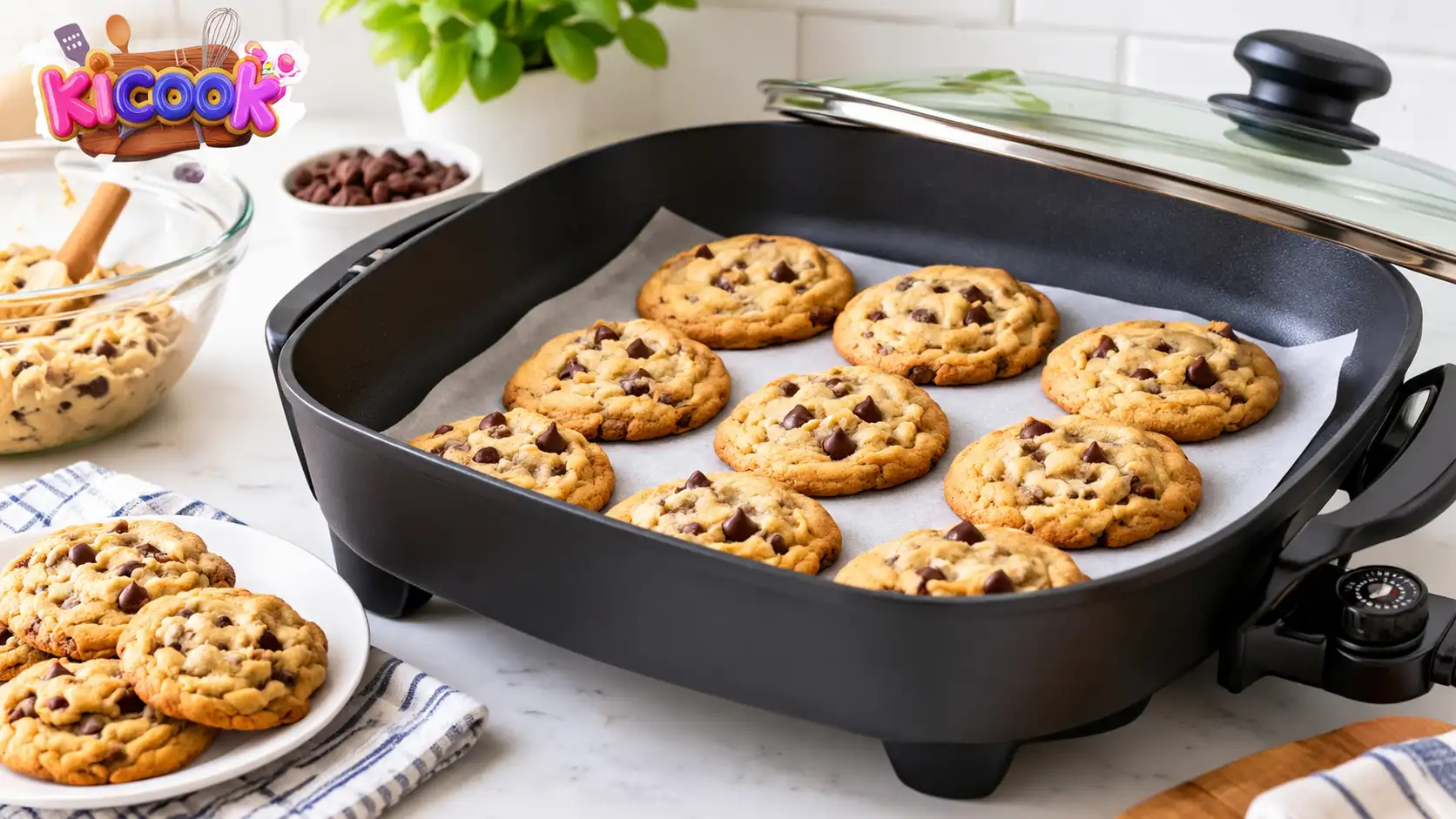
Yes, you can bake cookies in an electric skillet, even when you do not have access to a conventional oven. The trick is understanding that an electric skillet heats differently from an oven. Most of its heat comes from below, so temperature control, cookie thickness, spacing, and timing matter more than they normally would on an oven baking sheet.
For many cookies, a temperature around 300°F to 325°F (149°C to 163°C) is a sensible starting range, depending on the recipe and your skillet. Some cookies can be cooked directly on the skillet surface, while others are easier to manage with a baking pan or rack setup.
If your oven is broken, you are cooking in an RV, or you simply want to make a small batch without heating the whole kitchen, an electric skillet can be surprisingly useful.
Can You Really Bake Cookies in an Electric Skillet?
You can, but the result will not always look exactly like an oven-baked cookie.
A conventional oven surrounds the cookie with hot air. Depending on the oven, heat may come from both the bottom and top, and convection models also circulate heated air.
An electric skillet behaves differently. Its heating element is underneath the cooking surface, so the bottom of a cookie usually receives more intense heat than the top.
Closing the lid helps. The lid keeps some heat around the dough instead of letting it immediately escape, creating a more oven-like environment.
This is the same basic principle explained in our guide to using an electric skillet as an oven.
Kansas State Research and Extension has even published instructions for baking muffins in a covered electric skillet. Its method places a muffin pan on a rack inside the skillet and notes that the muffins will not brown on top in exactly the same way they would in an oven.
That difference in browning is worth remembering when you make cookies, too.
Electric Skillet Cookies vs. Oven-Baked Cookies
| Feature | Electric Skillet | Conventional Oven |
|---|---|---|
| Main heat source | Primarily from below | Heat surrounds the food |
| Top browning | Usually limited | Usually better |
| Batch size | Small | Medium to large |
| Portability | Excellent | Limited |
| Bottom-burning risk | Higher | Usually lower |
| Temperature control | Thermostat varies by model | Generally more consistent |
| Best use | Small batches and no-oven cooking | Traditional baking |
An electric skillet is therefore better viewed as an alternative cooking tool rather than a perfect replacement for your oven.
What Temperature Should You Use for Cookies in an Electric Skillet?
There is no single perfect temperature for every electric skillet cookie recipe.
A useful starting range is approximately 300°F to 325°F (149°C to 163°C).
For example, one published electric skillet oatmeal cookie recipe cooks the cookies at 300°F, while another electric skillet cookie method uses 325°F.
Your ideal setting will depend on the skillet, thermostat accuracy, cookie thickness, dough temperature, and whether the dough is sitting directly against the cooking surface.
If you are unsure what your appliance’s dial settings actually mean, our guide to medium heat on an electric skillet explains electric skillet temperatures in both Fahrenheit and Celsius.
Is 325°F Good for Electric Skillet Cookies?
It can be.
325°F is approximately 163°C, and it may work well for cookies cooked with gentler indirect heat or certain covered methods.
However, do not treat 325°F as a universal rule. A thin cookie directly touching the skillet surface can brown much faster than a cookie sitting on a separate baking pan.
If your first batch is browning underneath before the center sets, lower the temperature rather than simply shortening the cooking time.
How Long Does It Take to Bake Cookies in an Electric Skillet?
Expect roughly 10 to 15 minutes for many small cookies, although cooking time can vary significantly.
One electric skillet oatmeal cookie method, for example, cooks for about 14 minutes total: approximately eight minutes on the first side followed by six minutes after flipping.
Other covered methods may not require flipping.
Instead of watching the clock alone, watch the cookies themselves.
The edges should look set. The surface should no longer look completely raw, and the bottom should be lightly browned rather than dark brown. A soft center is not necessarily a problem because cookies normally firm as they cool.
Always check the first batch earlier than expected. Once you know how your particular skillet behaves, later batches become much easier.
What You Need to Make Cookies in an Electric Skillet
You do not need much equipment.
| Item | Why You Need It |
|---|---|
| Electric skillet | Provides controlled cooking heat |
| Fitted lid | Holds heat around the cookies |
| Silicone or wooden spatula | Helps protect nonstick surfaces |
| Cooling rack | Lets finished cookies cool without steaming underneath |
| Small baking pan | Optional for indirect baking |
| Approved rack or trivet | Optional for separating the pan from direct heat |
| Parchment paper | Only if suitable for your skillet and method |
Always read the instructions supplied with your particular electric skillet before adding a rack, pan, foil, parchment, or other accessory.
Easy Chocolate Chip Cookie Dough for an Electric Skillet
You can use your favorite cookie recipe, but a basic chocolate chip dough works well for learning the technique.
| Ingredient | Amount |
|---|---|
| All-purpose flour | 1 1/4 cups |
| Baking soda | 1/2 teaspoon |
| Salt | 1/4 teaspoon |
| Unsalted butter, softened | 1/2 cup |
| Brown sugar | 1/2 cup |
| Granulated sugar | 1/4 cup |
| Egg | 1 large |
| Vanilla extract | 1 teaspoon |
| Chocolate chips | 3/4 cup |
This is intentionally a relatively small batch because smaller batches are easier to control in an electric skillet.
How to Bake Cookies in an Electric Skillet Step by Step
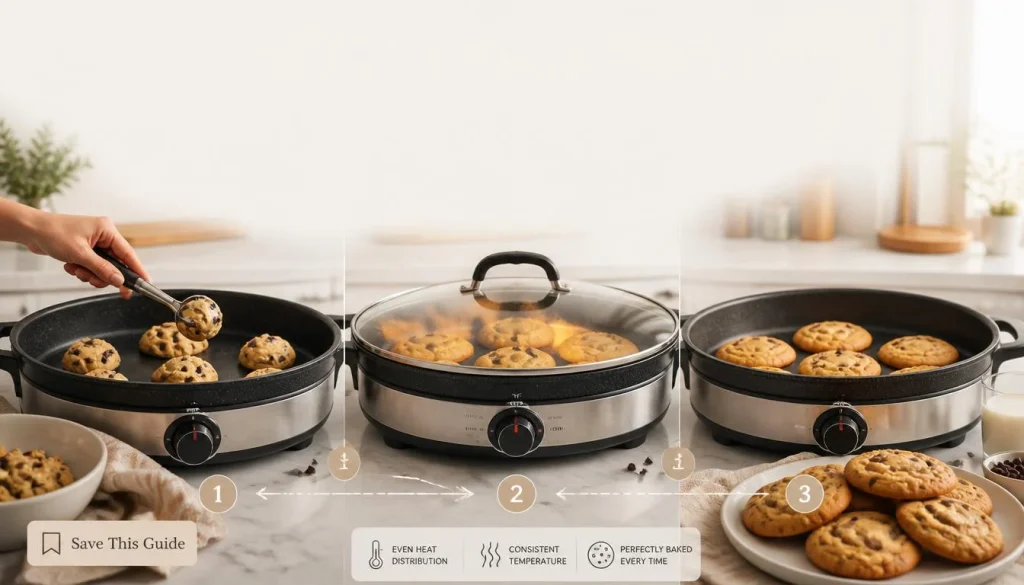
Step 1: Make the Cookie Dough
Combine the flour, baking soda, and salt in a bowl.
In a second bowl, mix the softened butter with the brown and granulated sugars until combined. Add the egg and vanilla.
Gradually mix in the dry ingredients, then fold in the chocolate chips.
Avoid aggressively mixing the dough once the flour has been added. Too much mixing can make cookies firmer than intended.
If the dough feels extremely soft or greasy, refrigerate it for around 20 to 30 minutes before cooking.
Step 2: Preheat the Electric Skillet
Set your skillet to a low-to-moderate baking temperature.
For this type of cookie, begin around 300°F to 325°F (149°C to 163°C) unless your skillet manufacturer or chosen recipe specifies something different.
Allow the skillet to reach temperature before adding the dough if your manufacturer’s instructions recommend preheating.
Temperature dials are not perfectly identical from one appliance to another, so the first batch acts as your calibration batch.
Step 3: Prepare the Cooking Surface
There are two ways to approach this.
You can cook certain cookies directly on an appropriately prepared skillet surface, or you can use a small heat-safe baking pan and approved rack if your skillet allows it.
The rack method creates some space between the baking pan and the heating surface, which can reduce aggressive bottom heat.
If you are interested in other types of baking, our detailed guide to what you can cook in an electric skillet covers additional dishes that work well in this appliance.
Step 4: Portion the Dough
Scoop roughly one tablespoon of dough for each cookie.
Try to make every portion close to the same size. If one cookie is twice as thick as another, they will not finish at the same time.
Flatten each portion slightly when using a direct-skillet method. This helps the center cook before the bottom becomes too dark.
Step 5: Leave Space Between the Cookies
Give the dough approximately two inches of space where possible.
Cookies spread as their butter and sugar warm. Crowding them together can cause them to merge and can also make cooking less even.
Do not try to fill every available inch of the skillet.
Two or three controlled batches usually produce better results than one overcrowded batch.
Step 6: Put the Lid On
Cover the skillet.
The lid is particularly important when you are trying to imitate oven-style cooking because it retains heat above the cookies.
Avoid repeatedly opening it.
Every time you lift the lid, accumulated heat escapes and the skillet needs time to recover.
Step 7: Check the First Batch Early
Take your first look several minutes before you expect the cookies to be finished.
You are looking for lightly browned bottoms and edges that have begun to set.
If the underside is dark while the top still looks very wet, your heat is too high.
Lower the temperature for the rest of the batch.
Step 8: Flip Only When the Method Requires It
Cookies cooked directly against the skillet may sometimes need flipping.
One tested oatmeal-cookie method at 300°F cooks the first side for about eight minutes, flips the cookies, then cooks for around another six minutes.
But that does not mean every electric skillet cookie should be flipped.
If you are using a baking pan elevated on a rack to create a miniature oven-style environment, flipping may be unnecessary and can damage a soft cookie.
Follow the method you choose rather than automatically flipping every batch.
Step 9: Cool Before Eating
Move the cookies to a cooling rack once they are cooked.
Give them several minutes to set before judging the final texture. Cookies that feel very soft straight from the skillet can become pleasantly chewy as they cool.
Method 1: Cook Cookies Directly on the Electric Skillet
Direct cooking is the simplest method.
The dough sits close to the heating surface, which gives you crisp bottoms and allows you to watch the cookies closely.
The downside is that the bottom can cook much faster than the top.
Use relatively small portions, flatten thick dough slightly, keep the temperature moderate, and check early.
If the cookies are sturdy enough and the recipe calls for it, turning them once can help cook both sides.
This method works particularly well for recipes specifically developed for electric-skillet cooking rather than recipes copied directly from an oven cookbook.
Method 2: Use a Baking Pan and Rack
If your electric skillet is deep enough and the manufacturer permits it, a rack-and-pan setup can more closely imitate an oven.
Place an approved rack inside the skillet, then position a heat-safe baking pan on top of it. The lid must still close properly.
The rack creates distance between the baking pan and the hottest surface below.
Kansas State’s electric-skillet muffin method uses this basic setup, which is useful evidence that a covered electric skillet can support baking when the appliance and cookware are appropriate.
Never improvise with accessories that could damage the nonstick coating, interfere with the thermostat, or prevent the lid from closing safely.
Do You Need to Preheat an Electric Skillet for Cookies?
Usually, preheating is helpful when the recipe calls for it because the dough begins cooking at a predictable temperature.
However, preheating instructions differ between manufacturers.
Some electric skillets use an indicator light that turns off once the selected temperature has been reached. Manufacturer instructions also commonly note that the thermostat cycles on and off during cooking to maintain the selected temperature.
Follow your own appliance manual instead of assuming every skillet needs the same preheating time.
Should You Keep the Lid On When Baking Cookies?
For covered electric skillet baking, yes.
A lid holds heated air around the food and helps the top and center cook while the heating element works from underneath.
Without a lid, the bottom can become brown while the upper portion remains soft.
There are exceptions for recipes intentionally designed as griddle-style cookies, but for oven-style electric skillet baking, keeping the lid closed usually produces more predictable results.
How Do You Stop Cookies From Burning on the Bottom?
Burnt bottoms are probably the most common problem when trying to bake cookies in an electric skillet.
Start by lowering the temperature. Electric skillet heat is concentrated underneath, so turning the dial higher rarely solves an undercooked center.
Make the cookies smaller and slightly flatter so the center needs less time to cook.
If your appliance supports it, use a rack and separate baking pan to create more distance from direct heat.
Also pay attention to hot spots. If the cookies on one side consistently burn while cookies on the other side remain pale, the problem may be the appliance rather than your recipe.
Our troubleshooting guide explains the most common causes of an electric skillet heating unevenly.
Why Are My Cookies Sticking to the Electric Skillet?
Sticking can happen because the cooking surface was not prepared correctly, the cookies were moved before they had set, sugar caramelized against the pan, or the nonstick coating has become worn.
Do not immediately scrape a stuck cookie with a metal spatula. That can damage many nonstick coatings.
Allow the cookie to set a little longer and use a manufacturer-approved silicone or wooden utensil.
If food has recently started sticking even though your cooking technique has not changed, see our guide to why food suddenly sticks to an electric skillet.
Can You Use Parchment Paper in an Electric Skillet?
Possibly, but only when your appliance manufacturer permits the setup and the parchment is used within its rated temperature range.
Do not allow loose parchment to contact exposed heating components, extend where it can scorch, or interfere with the skillet controls.
A small properly fitted baking pan may be a better option when you are unsure.
Never assume a technique is safe simply because it works in another person’s electric skillet. Appliance construction varies.
Can You Use Aluminum Foil in an Electric Skillet?
Some recipes and appliances may permit foil, but it should not be treated as universally safe.
Foil can alter the way heat reaches food and may create hotter areas. It can also scratch some nonstick surfaces.
Check the manufacturer’s manual before lining the skillet or using foil as part of a baking setup.
Can You Put a Baking Pan Inside an Electric Skillet?
In some models, yes.
A small heat-safe pan can be placed inside certain electric skillets, particularly when used with an approved rack or trivet.
The pan must fit comfortably, and the lid should close correctly.
Do not force a large pan inside the skillet or allow metal accessories to scrape a nonstick coating.
If you want a broader explanation of rack, pan, lid, and baking setups, read our guide to using an electric skillet for oven-style baking.
Can You Use Refrigerated or Store-Bought Cookie Dough?
Yes, refrigerated cookie dough can often be adapted to an electric skillet, but you should pay close attention to the package directions and your appliance.
Cold dough may spread more slowly, while thick portions can develop browned bottoms before the center is fully cooked.
Start with a small test batch.
If necessary, flatten the portions slightly and reduce the temperature.
Most importantly, do not taste uncooked dough unless the product is specifically labeled as safe to eat raw. The CDC notes that raw flour and raw eggs can contain harmful germs and recommends cooking or baking raw dough according to appropriate directions.
What Types of Cookies Work Best in an Electric Skillet?
Simple, relatively flat cookies are usually easier than thick bakery-style cookies.
Chocolate chip cookies are a good starting point because their doneness is easy to judge from the edges and bottom.
Oatmeal cookies are particularly well suited to direct electric-skillet cooking; published recipes demonstrate that they can be cooked at controlled temperatures and flipped when necessary.
Peanut butter cookies, basic sugar cookies, and other small drop cookies may also work once the temperature and portion size have been adjusted.
Very thick stuffed cookies, meringues, delicate macarons, or recipes that depend heavily on strong top heat are much less suitable.
Can You Make a Giant Cookie in an Electric Skillet?
Yes, although a giant skillet cookie is slightly different from baking individual cookies.
Instead of separate dough portions, the cookie dough is spread across the cooking vessel and cooked as one large dessert.
This can actually be easier because you do not need to maintain spacing between individual cookies.
The challenge is getting the center cooked before the bottom becomes too dark. Lower heat and patient covered cooking become especially important.
Do not confuse a giant skillet cookie with the small individual electric skillet cookies discussed throughout this guide.
Common Electric Skillet Cookie Problems and Fixes
| Problem | Most Likely Cause | What to Try |
|---|---|---|
| Bottom burns quickly | Temperature too high | Reduce heat |
| Center stays raw | Cookie is too thick | Make smaller, flatter cookies |
| Top remains pale | Limited heat from above | Judge doneness by texture, not color alone |
| Cookies spread too much | Dough is warm | Chill dough before cooking |
| Cookies barely spread | Dough too cold or dry | Let dough soften slightly |
| Cookies stick | Surface or coating issue | Use approved preparation and allow cookies to set |
| One side burns | Skillet hot spot | Cook smaller batches and investigate uneven heating |
| Cookies become dry | Cooking too long | Begin checking earlier |
| Second batch burns | Skillet accumulated excess heat | Allow temperature to stabilize before continuing |
What If the Temperature Dial Seems Wrong?
Thermostat problems can make cookie baking frustrating.
If cookies burn rapidly even on a low setting, or one batch cooks normally while the next suddenly scorches, the temperature control may not be behaving correctly.
Electric skillets cycle their heating element as part of normal temperature regulation, so the indicator light turning on and off does not automatically indicate a fault.
Repeated overheating, however, deserves attention.
Our guide to checking whether an electric skillet thermostat is broken explains the common warning signs.
Electric Skillet vs. Electric Frying Pan: Is There a Difference for Cookies?
For everyday cooking, the terms usually describe the same general type of appliance.
“Electric skillet” is particularly common in the United States and Canada, while “electric frying pan” or “electric frypan” is also commonly encountered in places such as the UK and Australia.
Both generally describe a countertop pan with its own electric heating system and temperature control.
So if you are searching for electric frying pan cookies, cookies in an electric frypan, or how to bake cookies in an electric frying pan, the same basic advice applies.
The specifications of your individual appliance matter more than the name printed on the box.
How to Make Cookies Without an Oven Using an Electric Skillet
An electric skillet makes the most sense for cookie baking when a traditional oven is unavailable or inconvenient.
You might use one in an RV or caravan with an appropriate electrical supply, a temporary kitchen, a small apartment, or a home where the main oven is being repaired.
It can also make sense when you only want a handful of cookies and do not want to heat a large oven.
Published electric skillet cookie recipes specifically highlight no-oven situations such as camping and dorm-style living as practical uses for this method.
That convenience is the real strength of an electric skillet.
It is not necessarily going to beat a quality oven at traditional baking, but it can still get warm cookies onto your plate when an oven is not an option.
Safety Tips for Baking Cookies in an Electric Skillet
The most important safety rule is to follow the instructions supplied with your appliance.
Use the skillet on a dry, stable, heat-resistant surface. Keep its power connection away from water, and never immerse a temperature control or electrical component unless the manufacturer specifically says it is designed for that type of cleaning.
Lift a hot lid away from your face because trapped steam can escape quickly.
Use utensils appropriate for the cooking surface, particularly if the skillet has a nonstick coating.
Do not place the complete electric skillet inside a conventional oven unless the manufacturer explicitly identifies the relevant components as oven-safe.
Finally, remember that cookie dough itself deserves normal food-safety precautions. The CDC advises against eating raw dough because uncooked flour and raw eggs can carry disease-causing germs.
Frequently Asked Questions About Can You Bake Cookies in an Electric Skillet
Can You Bake Chocolate Chip Cookies in an Electric Skillet?
Yes. Chocolate chip cookies can be cooked in an electric skillet if you control the bottom heat carefully. Small, evenly sized cookies are easier than thick bakery-style cookies.
What Temperature Do You Cook Cookies in an Electric Skillet?
Around 300°F to 325°F (149°C to 163°C) is a useful starting range for many methods, but the correct setting depends on the recipe, skillet model, and whether you are cooking directly on the surface or using a separate pan.
How Long Do Cookies Take in an Electric Skillet?
Many small electric skillet cookies take approximately 10 to 15 minutes. Start checking earlier because skillet temperature and cookie thickness can change the timing considerably.
Do You Flip Cookies in an Electric Skillet?
Sometimes. Direct-surface cookie recipes may require flipping so both sides cook evenly. Rack-and-pan baking methods generally do not need automatic flipping.
Do You Need to Preheat an Electric Skillet?
Preheating is useful for many recipes because it gives the dough a predictable starting temperature. Follow the instructions for your particular appliance.
Should You Put the Lid On When Making Cookies?
For oven-style electric skillet baking, keeping the lid closed helps retain heat around the cookies and cook their upper portions. Direct griddle-style recipes may use different techniques.
Can You Put Cookie Dough Directly in an Electric Skillet?
Yes, if the recipe and skillet surface are suitable for direct cooking. Use small portions and moderate heat because direct bottom heat can brown cookies quickly.
Can You Use Parchment Paper in an Electric Skillet?
It may be possible when your skillet manufacturer permits it and the parchment remains within its temperature rating. Do not assume every appliance supports the same setup.
Can You Put a Cookie Sheet in an Electric Skillet?
A small heat-safe baking pan may fit inside some deep electric skillets. Use it only if it fits safely, allows the lid to close, and does not conflict with your manufacturer’s instructions.
Can You Cook Refrigerated Cookie Dough in an Electric Skillet?
Yes, in many cases. Start with a small batch, watch the bottoms closely, and adjust the heat or cookie thickness as needed.
Can You Bake Cookies Without an Oven?
Absolutely. An electric skillet is one option for making cookies without a conventional oven. Certain stovetop, air-fryer, toaster-oven, and other alternative methods also work depending on the recipe.
Can an Electric Frying Pan Bake Cookies?
Yes. Electric frying pan and electric skillet are commonly used to describe similar appliances. A temperature-controlled electric frying pan with a suitable lid can cook certain cookie recipes.
Final Verdict: Is an Electric Skillet Good for Baking Cookies?
So, can you bake cookies in an electric skillet? Yes.
An electric skillet can make genuinely enjoyable cookies when you work with the way the appliance heats rather than expecting it to behave exactly like an oven.
Start with small, evenly sized cookies. Keep the temperature moderate—roughly 300°F to 325°F is a practical starting point for many recipes—and keep a close eye on the first batch.
For direct cooking, you may need to flip certain cookies. For oven-style baking, a manufacturer-approved rack and small baking pan can reduce direct bottom heat, while the lid helps retain warmth around the dough.
Do not worry if the tops stay lighter than oven-baked cookies. Electric skillets have much stronger heat underneath than above, so appearance will naturally be different.
Most importantly, adjust based on what your first batch tells you. If the bottom browns too quickly, reduce the heat. If the cookies remain thick and raw inside, make them smaller or flatter. If one side consistently burns, check for hot spots or temperature-control problems.
An electric skillet will not replace an oven for every baking job, but for a small batch of cookies, RV cooking, a temporary kitchen, or any time your oven is unavailable, it is a useful alternative that can do far more than simply fry food.

“I believe great cooking starts with the right tools, trusted advice, and a little confidence in the kitchen.”
Hi, I’m Emma Carter. My love for cooking began in my grandmother’s kitchen, where I learned that every great meal starts with simple ingredients and the right cookware. Over the years, I’ve spent countless hours researching, testing, and comparing kitchen appliances, cookware, coffee makers, air fryers, and other everyday kitchen essentials.
Here at KiCook, my goal is to make your buying decisions easier with honest product reviews, practical buying guides, and easy-to-follow cooking tips. Whether you’re upgrading your kitchen or searching for the best appliance for your home, I focus on providing clear, reliable, and research-backed information you can trust.
When I’m not testing new kitchen gadgets or writing in-depth guides, you’ll usually find me trying new recipes, visiting local farmers’ markets, or enjoying a quiet cup of coffee while planning my next kitchen project.