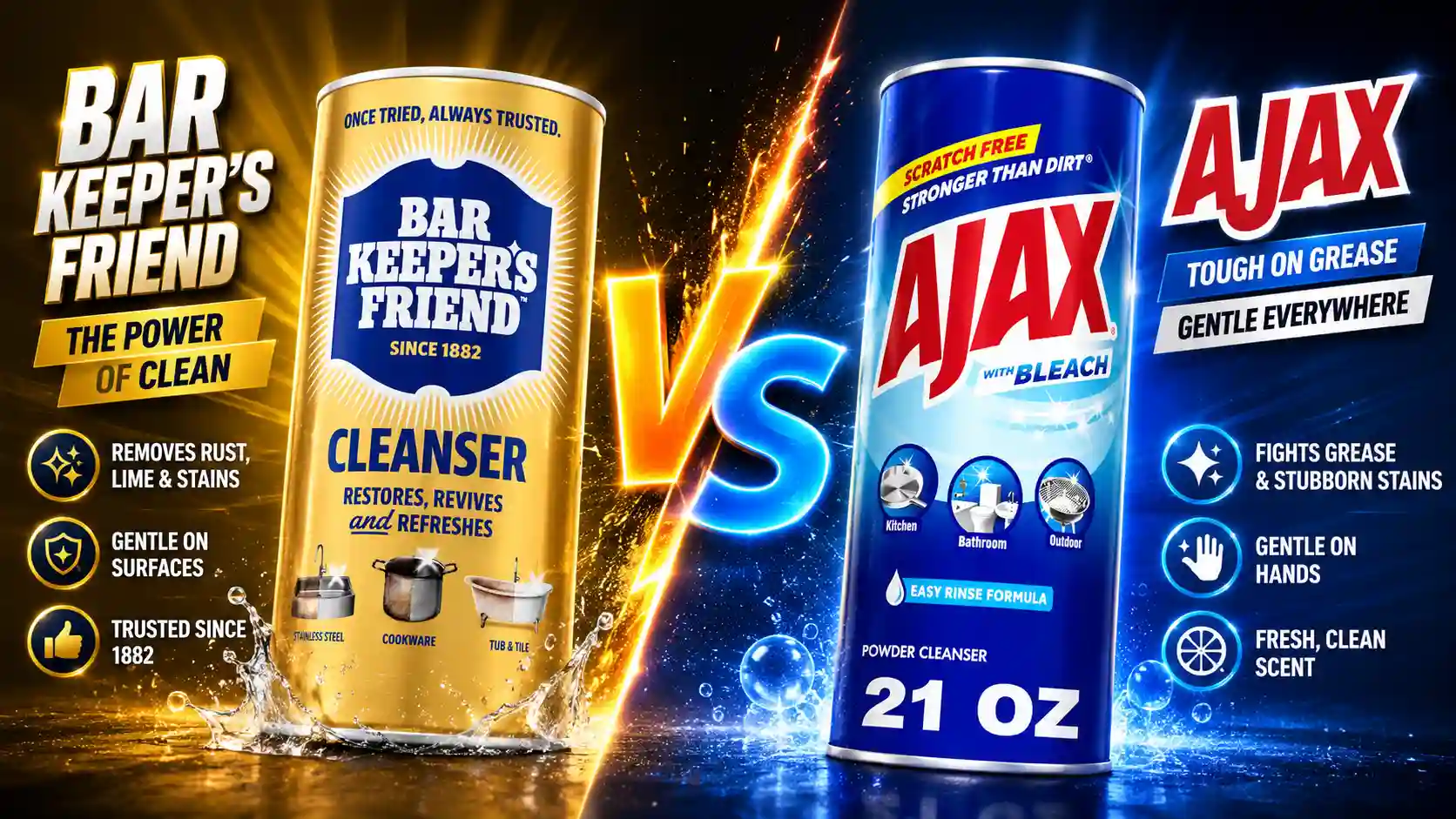
Bar Keepers Friend and Ajax are two familiar powder cleansers, but they are not designed to solve every cleaning problem in the same way. Bar Keepers Friend uses an oxalic-acid-based formula that is particularly useful for rust, mineral deposits, tarnish, and hard-water stains. Ajax Powder Cleanser is sold in the United States as a bleach-containing cleanser intended for scrubbing durable household surfaces such as porcelain, ceramic tile, bathroom fixtures, pots, and pans.
So, which one should you buy?
Bar Keepers Friend is the better overall choice for rust, hard-water buildup, tarnished metal, and restoring stainless-steel cookware. Ajax is a practical budget cleanser for routine scrubbing on durable bathroom and kitchen surfaces.
The right choice ultimately depends on the stain and surface you need to clean. This Bar Keepers Friend vs Ajax comparison explains their formulas, cleaning performance, surface compatibility, safety, value, and ideal uses so you can choose confidently.
Bar Keepers Friend vs Ajax: Quick Comparison
| Feature | Bar Keepers Friend Powder Cleanser | Ajax Powder Cleanser |
|---|---|---|
| Main cleaning approach | Oxalic acid plus a mild abrasive | Bleach-containing abrasive cleanser |
| Best for | Rust, mineral deposits, tarnish, hard water, stainless steel | Routine grime on durable kitchen and bathroom surfaces |
| Rust removal | Excellent | Not its primary strength |
| Hard-water stains | Excellent | Better for light routine cleaning |
| Stainless-steel cookware | Strong option when used correctly | Check the cookware manufacturer’s instructions |
| Porcelain | Suitable when used as directed | Suitable when used as directed |
| Ceramic tile | Suitable | Suitable |
| Natural stone | Do not use the powder cleanser | Do not assume compatibility |
| Nonstick cookware | Avoid | Avoid abrasive powder unless specifically approved |
| Contains bleach | No | Yes, in the U.S. powder formula |
| Disinfectant | No | Do not assume it disinfects without a label claim |
| Typical buying reason | Specialized stain removal and restoration | Affordable everyday scrubbing |
| Overall verdict | Best specialized performer | Best for basic budget cleaning |
Which Products Are We Comparing?
This article primarily compares:
- Bar Keepers Friend Powder Cleanser
- Ajax Powder Cleanser With Bleach sold in the United States
This distinction matters because both companies sell several products.
Bar Keepers Friend also offers Soft Cleanser, Cookware Cleanser & Polish, Cooktop Cleaner, and non-abrasive spray products. Ajax sells dish liquids, multipurpose sprays, cream cleansers, floor cleaners, disinfecting products, and other formulas depending on the country.
Results from one product should not automatically be applied to every product carrying the same brand name. For example, Bar Keepers Friend Soft Cleanser is a ready-to-use liquid formula, while the original cleanser is a powder. Ajax’s Australian product range also differs from its U.S. lineup.
Always check the exact product name and directions printed on the package you are buying.
Product Differences in the USA, UK, Canada, and Australia
Readers in different countries may not find the same package, size, formula, or product name.
The U.S. Ajax website currently lists Ajax Powder Cleanser With Bleach in 14-ounce, 21-ounce, and 28-ounce containers. Ajax Australia promotes a broader regional range that includes sprays, disinfectants, cream cleansers, floor products, and other cleaners. Its Australian cleaning guidance also mentions Ajax Powder Cleanser for porcelain, enamel, and nonporous tile.
Bar Keepers Friend maintains international distribution information, including contacts for Canada and Australia. Availability through individual stores can still differ.
For accurate results:
- Compare products sold in the same country.
- Read the local ingredient and safety label.
- Confirm that your exact surface is listed.
- Do not assume that directions from a U.S. package apply to a regional variation.
- Compare price per ounce or gram rather than package price alone.
What Is Bar Keepers Friend Powder Cleanser?
Bar Keepers Friend Powder Cleanser is an acidic powder cleanser formulated with oxalic acid, a glass-oxide abrasive, and surfactants. Its formula is designed to remove rust stains, tarnish, mineral deposits, hard-water residue, stubborn grime, and some greasy buildup from suitable nonporous surfaces.
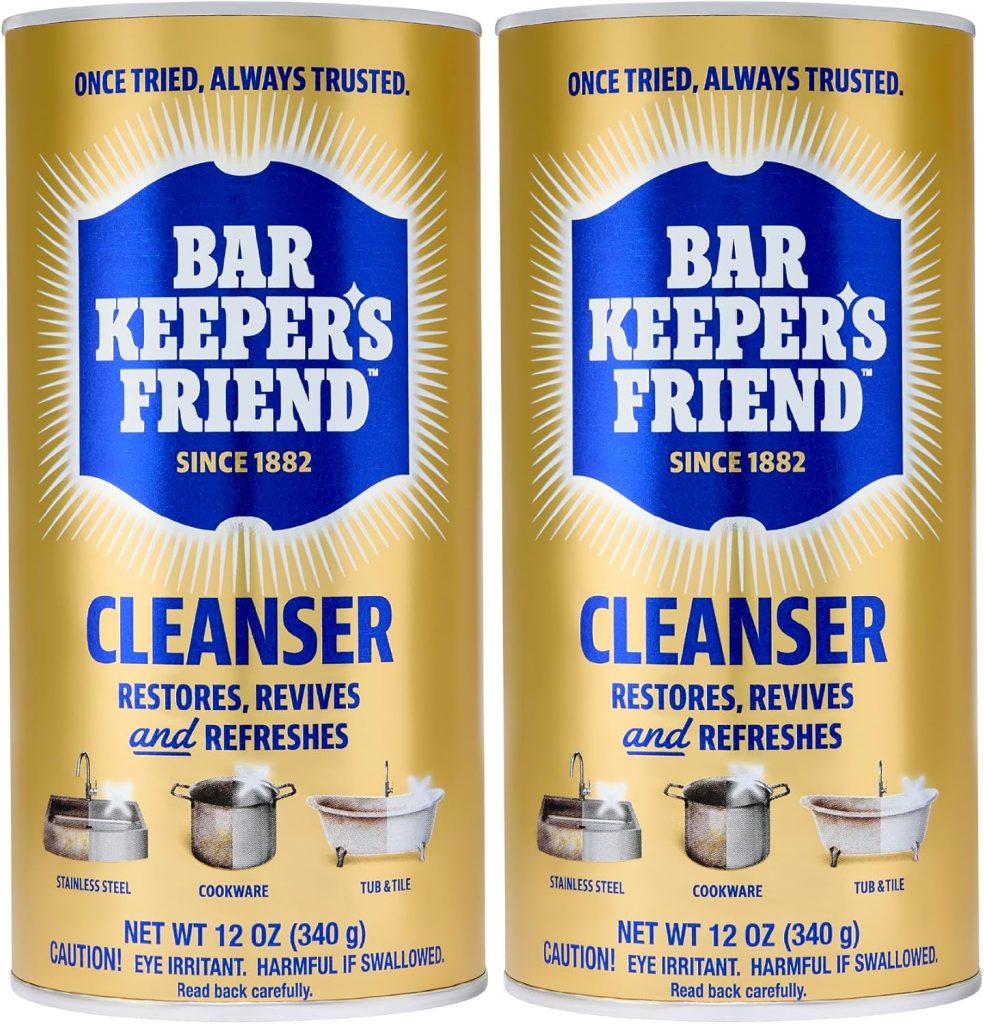
Credit: Amazon
Check Latest Price On Amazon 👆👆👆👆👆
Common approved or promoted uses include:
- Stainless-steel sinks and cookware
- Porcelain sinks and tubs
- Ceramic tile
- Glass shower doors
- Brass
- Copper
- Chrome
- Rust-stained fixtures
- Hard-water deposits
- Tarnished metal
To use the powder, wet the surface, sprinkle on a small amount, rub gently with a wet cloth or sponge, rinse thoroughly within one minute, and wipe dry. The manufacturer advises against leaving the cleanser on longer than necessary.
What Bar Keepers Friend Does Best
Its strongest advantage is its ability to handle stains associated with minerals and oxidation.
That includes:
- Rust rings around drains
- Orange or brown rust stains
- Calcium and lime deposits
- Cloudy hard-water residue
- Tarnish
- Heat discoloration on suitable cookware
- Mineral marks around faucets
- Stains on stainless-steel sinks
Oxalic acid helps break down rust and mineral deposits instead of relying only on abrasive scrubbing.
Bar Keepers Friend Limitations
The original powder should not be used on every surface. The manufacturer advises against using it on marble, granite, other natural stone, cast iron, wood, fabric, leather, painted surfaces, and nonstick cookware. It may remove cast-iron seasoning and damage delicate coatings or polished finishes.
You should also avoid using it in spaces that cannot be rinsed thoroughly, such as the enclosed interior of an oven or microwave.
What Is Ajax Powder Cleanser?
Ajax Powder Cleanser is a bleach-containing scouring cleanser sold for general cleaning around the home. The U.S. manufacturer describes it as an easy-rinse, scratch-free formula for various durable surfaces. However, it still recommends testing delicate materials before cleaning an entire area.
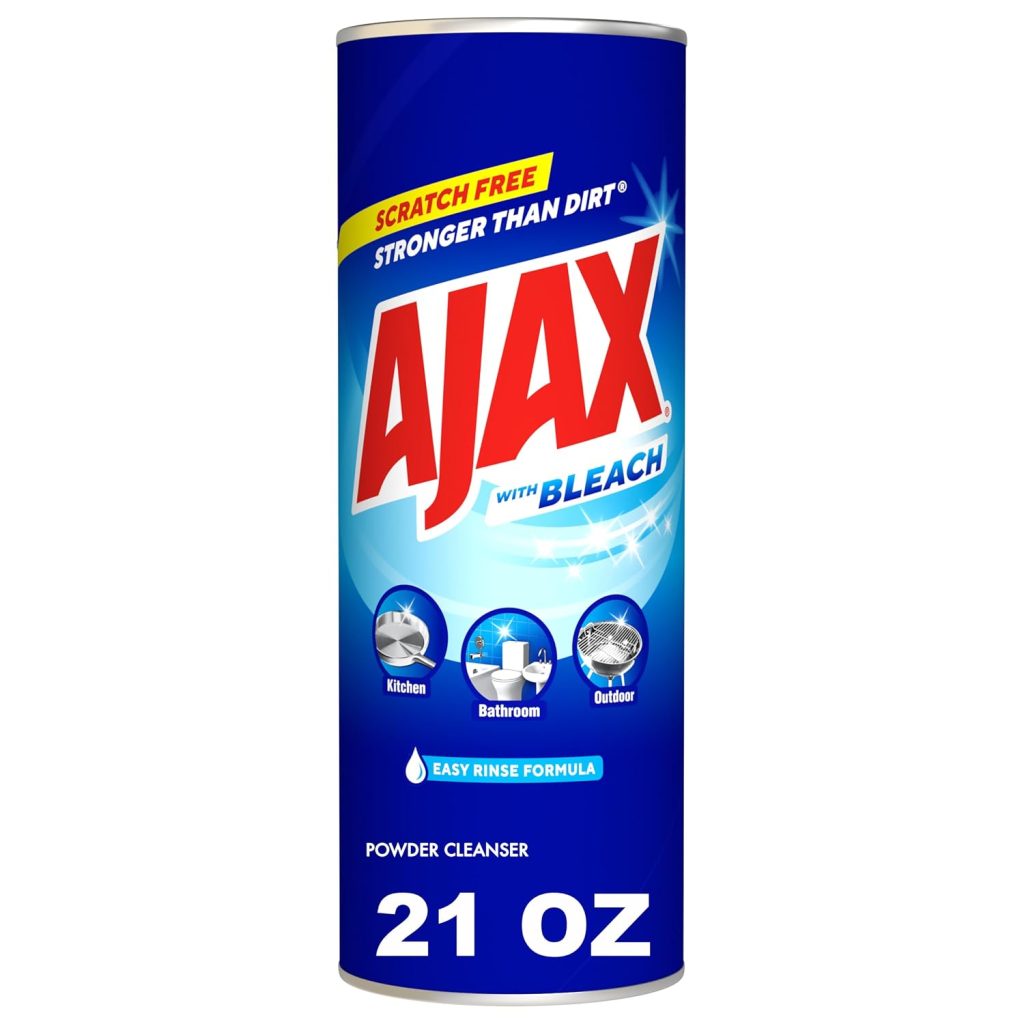
Credit: Amazon
Check Latest Price On Amazon 👆👆👆👆
Officially listed uses include:
- Porcelain
- Ceramic tile
- Bathroom fixtures
- Chrome
- Pots and pans
- Barbecue grills
- Garbage cans
- Other durable washable surfaces
The directions are straightforward: wet the surface, sprinkle the powder, rub lightly with a sponge to create a paste, then clean and rinse.
What Ajax Does Best
Ajax is most useful when you need an inexpensive cleanser for routine scrubbing rather than specialized metal restoration.
It can be practical for:
- Porcelain sinks
- Ceramic bathroom tile
- Durable bathtubs
- Bathroom fixtures
- General household grime
- Outdoor grills
- Garbage cans
- Label-approved pots and pans
Ajax Limitations
Ajax advises users to test fiberglass, imitation marble, plastic, and enameled appliances before broader use. The manufacturer says not to use its U.S. powder cleanser on silver, fabric, painted surfaces, or plexiglass.
The presence of bleach also means it deserves additional caution around metals, fabrics, colored surfaces, and other cleaning chemicals.
Acid-Based vs Bleach-Based Cleaners: Why It Matters
The biggest difference between Bar Keepers Friend and Ajax is not the container or powder texture. It is how their formulas approach stains.
How Bar Keepers Friend Works
Bar Keepers Friend combines:
- Oxalic acid
- A fine abrasive
- Surfactants
The oxalic acid reacts with certain rust, tarnish, and mineral-based stains. The abrasive and surfactants help loosen and lift the remaining residue.
This makes BKF especially useful when the problem is not simply loose dirt but oxidation, calcium, lime, or stubborn discoloration.
How Ajax Works
Ajax Powder Cleanser combines a bleach-containing cleaning formula with physical scrubbing action. Its main role is general cleaning on durable washable surfaces.
It may help remove ordinary discoloration and grime, but it should not automatically be considered equivalent to an acid-based rust or mineral remover.
Why One Cleaner Cannot Win Every Category
Different messes require different solutions:
- Rust and mineral deposits: An acidic cleanser usually has the more relevant cleaning mechanism.
- Routine grime on durable porcelain or tile: A general scouring powder may be sufficient.
- Greasy dishes: Dish soap may be easier and more appropriate.
- Heavy burned food: A cookware-specific cleanser may outperform either general powder.
- Mold or germ control: A properly registered disinfecting product may be required.
- Natural stone: A pH-balanced stone cleaner is safer than either general powder.
The best cleaner is therefore the one designed for the specific material and stain—not necessarily the strongest-looking package.
Bar Keepers Friend vs Ajax: Detailed Performance Comparison
Rust Removal
Winner: Bar Keepers Friend
Rust removal is one of Bar Keepers Friend’s clearest advantages. Its oxalic acid is specifically useful for breaking down rust stains and oxidation on approved surfaces. The company promotes the powder cleanser for rust on stainless steel, porcelain, tile, and suitable metal fixtures.
Ajax may improve light surface staining through scrubbing, but rust removal is not the central purpose emphasized in its official powder-cleanser directions.
Choose Bar Keepers Friend for:
- Rust around stainless-steel sink drains
- Orange stains in suitable porcelain tubs
- Rust spots on stainless-steel cookware
- Rust-stained chrome fixtures
- Metal oxidation on approved surfaces
Hard-Water Stains and Mineral Deposits
Winner: Bar Keepers Friend
Hard water leaves calcium, lime, and other mineral deposits on sinks, faucets, shower doors, and cookware.
Bar Keepers Friend’s oxalic-acid formula is designed to remove hard-water stains and mineral deposits. It can be particularly effective on shower glass and stainless-steel sinks when the surface is compatible and the product is rinsed promptly.
Ajax can clean ordinary bathroom grime, but it is not positioned as the stronger specialized mineral remover.
Soap Scum
Winner: Bar Keepers Friend for mineral-heavy buildup; Ajax for light routine cleaning
Soap scum often contains a mixture of soap residue, body oils, and hard-water minerals.
If the deposit is chalky, cloudy, or mineral-heavy, Bar Keepers Friend has the advantage. If you are performing routine cleaning on approved porcelain or ceramic tile, Ajax may be sufficient.
Neither product should be used blindly on acrylic, fiberglass, coated glass, or polished surfaces. Test first and follow the surface manufacturer’s care instructions.
Grease and Everyday Grime
Winner: Depends on the cleaning job
Bar Keepers Friend officially claims that its powder cleanser cuts grease, while Ajax is marketed for household messes and general scrubbing.
However, powder cleanser is not always the most efficient first step for fresh grease. Dish soap or a surface-approved degreaser may require less scrubbing and present less risk of scratching.
Use Ajax when you want affordable scrubbing on a durable, approved surface. Use BKF when grease is combined with discoloration, baked-on residue, tarnish, or mineral buildup on compatible cookware.
Burnt-On Food
Winner: Bar Keepers Friend, especially a cookware-specific BKF formula
Bar Keepers Friend Powder Cleanser can clean suitable stainless-steel cookware, but the company’s Cookware Cleanser & Polish is more specifically formulated for baked-on food, stubborn grease, and cookware discoloration.
Ajax is listed for pots and pans, but cookware finish matters. Do not use either abrasive powder on nonstick coatings unless the cookware manufacturer explicitly approves it.
For a burned stainless-steel pan:
- Allow the pan to cool.
- Remove loose food.
- Wet the stained area.
- Apply a small amount of approved cleanser.
- Rub gently with a non-scratch sponge.
- Rinse thoroughly.
- Repeat rather than increasing pressure aggressively.
Tarnish and Metal Discoloration
Winner: Bar Keepers Friend
BKF is designed to remove tarnish and discoloration from suitable stainless steel, copper, brass, and other approved metals. Ajax is a general household powder, not a dedicated metal polish or restoration cleanser.
Always check whether the metal is solid, plated, coated, brushed, or lacquered before cleaning it. A product that works on solid stainless steel may damage a decorative coating.
Cleaning Speed and Scrubbing Effort
Bar Keepers Friend may require less physical scrubbing when the stain involves rust or mineral deposits because its acidic formula targets those deposits chemically. However, it must be rinsed within approximately one minute of application.
Ajax is simple to apply and can be effective for basic grime, but difficult stains may require repeated light scrubbing.
Actual cleaning time depends on:
- Stain age
- Surface material
- Amount of buildup
- Water hardness
- Sponge type
- Product quantity
- Scrubbing pressure
- Whether the correct cleaner was selected
Using more powder or pressing harder is not always better. Reapplying gently is safer than aggressively grinding an abrasive into a finish.
Rinsing and Residue
Both products need thorough rinsing.
BKF can leave a temporary white film if its abrasive particles are not removed completely. Ajax is promoted as an easy-rinse cleanser, but it should still be rinsed well, especially on cookware and food-contact surfaces.
Use a clean wet cloth for the final rinse and dry shiny surfaces afterward to inspect for residue.
Odor and Ventilation
Ajax’s bleach-containing U.S. formula may be less suitable for people who dislike bleach-associated cleaning odors. Bar Keepers Friend is bleach-free but is still an acidic cleaning product and should be used according to its directions.
Use both products in a ventilated area. Avoid inhaling airborne powder, keep your face away while sprinkling, and stop using the product if it causes discomfort.
Surface Compatibility: Which Cleaner Should You Use?
| Surface or Cleaning Problem | Better Choice | Recommendation |
|---|---|---|
| Rust on approved stainless steel | Bar Keepers Friend | Use gently and rinse promptly |
| Hard-water buildup | Bar Keepers Friend | Best match for mineral deposits |
| Stainless-steel cookware | Bar Keepers Friend | Check manufacturer instructions |
| Porcelain sink | Either | Choose BKF for rust/minerals and Ajax for routine grime |
| Porcelain bathtub | Either | Spot test and rinse thoroughly |
| Ceramic tile | Either | Avoid aggressive pressure |
| Glass shower door | Bar Keepers Friend | Use only on compatible, uncoated glass |
| Chrome fixtures | Either | Test first; do not leave product sitting |
| Natural stone | Neither powder | Use a stone-specific cleaner |
| Nonstick cookware | Neither | Abrasion can damage the coating |
| Cast iron | Neither | May strip seasoning or promote rust |
| Painted surface | Neither | Both may damage the finish |
| Plexiglass | Neither | Ajax specifically says not to use it |
| Fiberglass | Use caution | Test first and follow manufacturer guidance |
| Acrylic tub | Use caution | Prefer the tub manufacturer’s recommended cleaner |
| Silver | Avoid Ajax | Ajax says not to use it on silver |
| Grout | Surface-dependent | Test first, especially on colored or sealed grout |
Bar Keepers Friend vs Ajax for Stainless Steel
Bar Keepers Friend is generally the better choice for uncoated stainless steel affected by rust, mineral stains, tarnish, or heat discoloration.
However, “stainless steel” describes the base material, not necessarily the entire finish. Refrigerators and dishwashers may have:
- Fingerprint-resistant coatings
- Clear protective layers
- Brushed finishes
- Decorative films
- Painted-look finishes
Do not use an abrasive powder on a coated appliance unless its manufacturer approves it. Test a hidden area, rub with the grain, use light pressure, and rinse completely.
Chloride-containing cleaners can also be problematic for some stainless-steel finishes. When cleaning expensive appliances, the appliance manufacturer’s care guide should take priority over general cleaner recommendations.
Bar Keepers Friend vs Ajax for Porcelain
Both products may be used on compatible porcelain.
Choose:
- Bar Keepers Friend for rust rings, mineral stains, hard-water marks, or stubborn discoloration.
- Ajax for routine dirt and general scrubbing.
Porcelain can still become dull or scratched if a cleaner is applied with an excessively rough pad or heavy pressure. Use a damp non-scratch sponge and test older, refinished, or decorative porcelain first.
Bar Keepers Friend vs Ajax for Bathtubs
The correct choice depends on what the bathtub is made from.
Porcelain or Enameled Tub
Either cleaner may work when the label and tub manufacturer permit it. BKF is the better match for rust and mineral deposits. Ajax may be enough for ordinary grime.
Fiberglass Tub
Ajax tells users to test fiberglass first. BKF should also be spot-tested, and a gentler surface-specific bathroom cleaner may be safer.
Acrylic Tub
Avoid assuming either powder is safe. Acrylic can scratch more easily than porcelain. Follow the bathtub manufacturer’s cleaning instructions.
Refinished Tub
Use extreme caution. Abrasive or acidic products may affect the refinished coating. A non-abrasive cleaner approved by the refinishing company is usually the safer option.
Bar Keepers Friend vs Ajax for Toilets
Ajax Powder Cleanser is promoted for tubs, sinks, and toilets in the U.S. product information. Bar Keepers Friend also makes dedicated toilet-cleaning products, which may be more convenient than using its general powder cleanser inside a bowl.
For toilet cleaning:
- Never mix products.
- Do not combine either powder with toilet cleaner already in the bowl.
- Flush and rinse thoroughly before switching products.
- Avoid using abrasive powder on plastic seats or decorative finishes.
- Use a dedicated toilet-bowl product when possible.
Bar Keepers Friend vs Ajax for Shower Doors
Bar Keepers Friend is the stronger choice for hard-water film on compatible glass.
The manufacturer recommends using a small amount, allowing no more than roughly one minute of contact time, gently scrubbing, rinsing well, and drying with a soft cloth.
Do not use it without checking first if the shower glass has:
- A protective coating
- Tint
- Decorative film
- Etching
- Manufacturer-applied water-repellent treatment
Ajax is not the obvious first choice for glass shower doors, particularly when the main problem is mineral buildup.
Bar Keepers Friend vs Ajax for Tile and Grout
Both can clean compatible nonporous ceramic tile.
For grout, proceed carefully because grout may be:
- Porous
- Colored
- Sealed
- Cracked
- Surrounded by natural stone
Test a small area first. Do not use either powder across a natural-stone tile installation unless the cleaner is approved for that stone.
Cookware Comparison by Material
| Cookware Material | Bar Keepers Friend | Ajax | Recommendation |
|---|---|---|---|
| Uncoated stainless steel | Generally suitable | May be suitable | BKF is better for discoloration and burned residue |
| Copper | Suitable BKF formula may help | Not the first choice | Use a product approved for copper |
| Aluminum | Test first | Test first | Finish may discolor or change |
| Enameled cookware | Test first | Test first | Avoid aggressive scrubbing |
| Glass cookware | May be suitable | Check label | Use light pressure |
| Ceramic cookware | Depends on the finish | Depends on the finish | Follow cookware instructions |
| Nonstick | Avoid | Avoid | Powder may wear away the coating |
| Cast iron | Avoid | Avoid | Can strip seasoning |
| Carbon steel | Avoid general scouring | Avoid | May strip seasoning and expose metal |
| Silver | Not generally recommended | Do not use | Choose a silver-specific polish |
Bar Keepers Friend states that its Cleanser is NSF-registered and suitable for food-preparation and serving surfaces when used correctly. Food-contact items must still be rinsed thoroughly to remove cleaner and abrasive residue.
Which Cleaner Is More Abrasive?
There is no responsible universal answer that Ajax is always more abrasive or that Bar Keepers Friend can never scratch.
Both are powder cleansers that depend partly on physical scrubbing. Ajax calls its formula scratch-free but still recommends caution and spot testing on delicate surfaces. Bar Keepers Friend describes its abrasive as a fine glass-oxide material and warns against use on several delicate finishes.
Scratching risk depends on:
- Surface hardness
- Protective coatings
- Amount of powder
- Water used
- Sponge or pad
- Pressure
- Scrubbing direction
- Length of contact
- Existing damage
How to Perform a Safe Spot Test
- Choose a hidden area.
- Wet the surface.
- Apply a very small amount.
- Use a soft damp cloth or non-scratch sponge.
- Rub gently for a few seconds.
- Rinse completely.
- Dry the area.
- Inspect it under bright light from several angles.
Stop immediately if you notice dullness, color transfer, scratching, coating damage, or an uneven finish.
Do Bar Keepers Friend or Ajax Disinfect?
Does Bar Keepers Friend Disinfect?
No. Bar Keepers Friend clearly states that its products are not disinfectants. They are designed to remove stains and clean compatible surfaces.
Does Ajax Powder Cleanser Disinfect?
Do not assume that Ajax Powder Cleanser disinfects merely because the U.S. version is marketed “With Bleach.”
Cleaning, sanitizing, and disinfecting are different processes. A disinfectant should have an appropriate label claim, approved organisms, required contact time, and country-specific registration or authorization.
Ajax sells other products in some countries that carry explicit antibacterial or disinfecting claims. Those claims apply to the exact registered products—not automatically to every Ajax cleanser.
When disinfection is required, use a properly labeled disinfectant and follow its contact-time instructions exactly.
Can You Mix Bar Keepers Friend and Ajax?
No. Never mix Bar Keepers Friend and Ajax.
Bar Keepers Friend contains oxalic acid, while the U.S. Ajax Powder Cleanser is marketed as containing bleach. The BKF manufacturer warns that combining its cleanser with bleach can release dangerous chlorine gas.
You should also never combine either cleanser with:
- Ammonia
- Toilet-bowl cleaner
- Drain cleaner
- Vinegar
- Descaler
- Mold remover
- Another unknown cleaning chemical
Can You Use One After the Other?
Only after the first product has been completely removed.
The safest approach is:
- Stop using the first cleaner.
- Rinse the surface repeatedly with clean water.
- Remove all visible powder and residue.
- Allow the area to ventilate.
- Check the second product’s label.
- Use the second product separately only when necessary.
Bar Keepers Friend specifically advises rinsing an area before applying it if another cleaner was recently used.
If two products are accidentally mixed and strong fumes develop, leave the area, get to fresh air, and contact local emergency or poison-control services.
Safety and Handling
Follow these rules when using either powder cleanser:
- Read the full label before use.
- Keep the container dry and tightly closed.
- Avoid creating airborne dust.
- Do not inhale the powder.
- Use adequate ventilation.
- Protect your eyes from splashes or powder.
- Wear gloves for prolonged cleaning or sensitive skin.
- Keep away from children and pets.
- Never transfer the cleaner into an unmarked container.
- Rinse food-contact surfaces thoroughly.
- Store separately from incompatible chemicals.
- Do not reuse an empty cleanser container.
Bar Keepers Friend recommends gloves for prolonged use or sensitive skin. Ajax instructs users to store its powder in a cool, dry place and not to reuse the empty container.
Price and Cost per Use
Ajax is commonly positioned as the more budget-oriented everyday powder cleanser, while Bar Keepers Friend is purchased more often for specialized stain removal.
However, shelf price alone does not determine value.
Compare:
- Package weight
- Price per ounce or gram
- Amount required per cleaning job
- Number of repeat applications
- Whether a second product is needed
- Risk of damaging the wrong surface
- Availability in your country
The U.S. Ajax powder is listed in multiple sizes, so a large Ajax container should not be compared directly with a smaller BKF container without calculating unit price.
Bar Keepers Friend may cost more per container but offer better value when it solves a rust or hard-water problem that an ordinary cleanser cannot remove efficiently. Ajax may provide better value for frequent basic cleaning on approved durable surfaces.
Bar Keepers Friend Pros and Cons
Pros
- Excellent for rust stains
- Strong performance on mineral deposits
- Effective against hard-water residue
- Useful for tarnished approved metals
- Well suited to uncoated stainless-steel cookware
- Bleach-free
- Requires only a small amount
- Useful for restoration-type cleaning
Cons
- Not safe for natural stone
- Not recommended for nonstick cookware
- Must be rinsed promptly and thoroughly
- Can damage delicate coatings or finishes
- Cannot be mixed with bleach or other cleaners
- Often costs more than basic scouring powder
- May leave white residue if poorly rinsed
Ajax Pros and Cons
Pros
- Usually affordable
- Simple application
- Suitable for many durable household surfaces
- Useful for routine porcelain and tile cleaning
- Available in several U.S. package sizes
- Easy-rinse formula
- Can be used on label-approved pots, pans, and outdoor items
Cons
- Contains bleach in the U.S. powder formula
- Not the strongest choice for rust or mineral deposits
- Not suitable for silver, fabric, painted surfaces, or plexiglass
- Requires testing on fiberglass, plastic, imitation marble, and enamel
- Should not be assumed to disinfect
- Abrasive action may be unsuitable for delicate finishes
- Regional product availability and formulas vary
Who Should Buy Bar Keepers Friend?
Choose Bar Keepers Friend if your main problems include:
- Rust stains
- Hard-water buildup
- Calcium or lime deposits
- Stainless-steel discoloration
- Tarnished approved metal
- Burned residue on suitable cookware
- Cloudy shower glass
- Mineral rings around faucets or drains
It is the better product for homeowners who need a specialized stain remover rather than only a routine scouring powder.
Who Should Buy Ajax?
Choose Ajax if you want:
- An inexpensive general powder cleanser
- Routine cleaning for approved porcelain
- Basic ceramic-tile scrubbing
- A cleanser for durable bathroom fixtures
- An easy-to-find everyday cleaning product
- A bleach-containing powder for label-approved cleaning tasks
- A cleanser for grills, garbage cans, and similar durable items
Ajax makes more sense when the problem is ordinary grime and you do not require specialized rust, tarnish, or mineral removal.
Do You Need Both Bar Keepers Friend and Ajax?
Some households may benefit from owning both because they perform different roles.
A practical cleaning cabinet might use:
- Bar Keepers Friend: Rust, stainless steel, hard water, tarnish, and mineral stains
- Ajax: Routine scrubbing on approved porcelain, tile, bathroom fixtures, and durable outdoor items
- Dish soap: Fresh grease and everyday dishwashing
- Non-abrasive multipurpose cleaner: Routine countertops and coated surfaces
- Registered disinfectant: Situations that specifically require germ control
- Stone cleaner: Granite, marble, and other natural stone
Owning both does not mean using them together. Store them separately and never combine them on the same wet surface.
Bar Keepers Friend vs Ajax: Final Verdict
Bar Keepers Friend is the overall winner for specialized cleaning performance. Its oxalic-acid formula gives it a meaningful advantage over Ajax for rust, hard-water deposits, tarnish, mineral stains, and stainless-steel restoration.
Ajax wins as the straightforward budget option for routine scouring. It is suitable for many durable kitchen, bathroom, and outdoor surfaces when used according to the package directions.
Here is the simplest buying decision:
- Choose Bar Keepers Friend for rust: BKF wins.
- Choose Bar Keepers Friend for hard water: BKF wins.
- Choose Bar Keepers Friend for stainless-steel restoration: BKF wins.
- Choose Bar Keepers Friend for tarnish: BKF wins.
- Choose Ajax for inexpensive routine scrubbing: Ajax wins.
- Choose Ajax for basic porcelain or ceramic-tile cleaning: Ajax is a practical option.
- Choose neither for marble, granite, nonstick cookware, painted finishes, or other sensitive materials: Buy a surface-specific cleaner instead.
For most shoppers choosing only one product, Bar Keepers Friend offers greater problem-solving versatility. For buyers who only need an affordable cleanser for basic, durable surfaces, Ajax may be all that is necessary.
Frequently Asked Questions
Is Bar Keepers Friend the Same as Ajax?
No. Bar Keepers Friend is an oxalic-acid-based cleanser, while the U.S. Ajax Powder Cleanser is marketed as a bleach-containing scouring powder. They have different formulas and different cleaning strengths.
Is Bar Keepers Friend Better Than Ajax?
Bar Keepers Friend is better for rust, mineral deposits, hard-water stains, tarnish, and stainless-steel restoration. Ajax is a practical budget choice for routine scrubbing on approved durable surfaces.
Does Ajax Contain Bleach?
The U.S. Ajax Powder Cleanser is currently marketed as “Ajax With Bleach.” Formulas may differ in other countries, so check your local package.
Does Bar Keepers Friend Contain Bleach?
No. Bar Keepers Friend states that its formulas are bleach-free and chlorine-free.
Is Bar Keepers Friend Acidic?
Yes. The original powder cleanser contains oxalic acid, which helps remove rust, calcium, lime, and other mineral deposits.
Can Ajax Remove Rust?
Ajax may scrub away some light surface discoloration, but it is not the better specialized rust remover. Bar Keepers Friend’s oxalic-acid formula is more directly suited to rust stains.
Which One Is Better for Stainless Steel?
Bar Keepers Friend is generally better for compatible uncoated stainless steel affected by rust, hard water, tarnish, or heat discoloration. Check the manufacturer’s instructions before using it on coated appliances.
Which One Is Better for a Porcelain Sink?
Use Bar Keepers Friend for rust and mineral stains. Use Ajax for routine grime. Both should be applied gently and rinsed thoroughly.
Which One Is Better for a Bathtub?
It depends on the bathtub material. Both may work on approved porcelain or enamel. Fiberglass, acrylic, and refinished tubs require more caution and should be cleaned according to the tub manufacturer’s directions.
Can You Use Bar Keepers Friend in a Toilet?
It may be used only where its label permits and where thorough rinsing is possible. However, Bar Keepers Friend also sells products formulated specifically for toilet bowls, which may be the more convenient choice.
Can You Use Ajax on Glass Shower Doors?
Ajax is not the strongest choice for hard-water film on shower glass. Before using any powder cleanser, check whether the glass has a protective coating and follow the enclosure manufacturer’s recommendations.
Is Bar Keepers Friend Safe for Fiberglass?
Do not assume it is universally safe. Spot test first and follow the fiberglass manufacturer’s care instructions. A gentler bathroom cleaner may be more appropriate.
Can Ajax Scratch a Bathtub?
Ajax describes its U.S. powder as scratch-free but still instructs users to test delicate surfaces such as fiberglass and enamel. The tub material, sponge, pressure, and condition of the finish all affect scratching risk.
Is Bar Keepers Friend Abrasive?
Yes. The powder contains a fine glass-oxide abrasive. It should be used with water, gentle pressure, and a non-scratch cloth or sponge.
Can Bar Keepers Friend Scratch a Surface?
It can damage incompatible or delicate surfaces, particularly natural stone, nonstick coatings, painted finishes, and polished materials. Always follow the label and spot test uncertain surfaces.
Can You Use Either Cleaner on Granite or Marble?
Do not use the original BKF powder on granite, marble, or other natural polished stone. Use a pH-balanced cleaner specifically formulated for natural stone. Ajax should also not be used unless the exact stone manufacturer approves it.
Do Bar Keepers Friend or Ajax Disinfect?
Bar Keepers Friend is not a disinfectant. Do not assume Ajax Powder Cleanser disinfects simply because the U.S. formula contains bleach. Use an appropriately labeled disinfectant when germ control is required.
Can You Mix Ajax and Bar Keepers Friend?
No. Never mix them. The acid in Bar Keepers Friend can react dangerously with bleach-containing cleaners and release chlorine gas.
Can You Use Bar Keepers Friend After Ajax?
Only after Ajax has been completely removed and the surface has been rinsed repeatedly with clean water. Never apply BKF over Ajax residue.
Which Cleaner Requires Less Scrubbing?
Bar Keepers Friend may require less scrubbing for rust and mineral deposits because its formula targets those stains. Ajax may be equally convenient for light routine dirt on compatible surfaces.
Is Bar Keepers Friend Worth the Higher Price?
It is usually worth considering if you regularly deal with rust, hard water, tarnished metal, or stainless-steel discoloration. Ajax may offer better value when you only need an inexpensive routine scouring powder.
Should You Own Both Cleaners?
You may benefit from both if you regularly clean different types of messes. Use BKF for mineral and oxidation-related stains and Ajax for basic scrubbing on approved durable surfaces. Store and use them separately.

“I believe great cooking starts with the right tools, trusted advice, and a little confidence in the kitchen.”
Hi, I’m Emma Carter. My love for cooking began in my grandmother’s kitchen, where I learned that every great meal starts with simple ingredients and the right cookware. Over the years, I’ve spent countless hours researching, testing, and comparing kitchen appliances, cookware, coffee makers, air fryers, and other everyday kitchen essentials.
Here at KiCook, my goal is to make your buying decisions easier with honest product reviews, practical buying guides, and easy-to-follow cooking tips. Whether you’re upgrading your kitchen or searching for the best appliance for your home, I focus on providing clear, reliable, and research-backed information you can trust.
When I’m not testing new kitchen gadgets or writing in-depth guides, you’ll usually find me trying new recipes, visiting local farmers’ markets, or enjoying a quiet cup of coffee while planning my next kitchen project.