A twelve-cup drip machine at the budget end of the market promises a lot, so when the Professional Series 12-Cup Digital Coffee Maker kept surfacing in buyer discussions, we pulled the spec sheet and compared it against several hundred verified reviews. The question was narrow: does the strong brew setting do anything real, or is it just a label on a button?
Short answer: buy it if you want programmable drip coffee with a reusable filter and no ongoing filter costs. Skip it if you're chasing café-level extraction or a carafe that's still hot three hours later. Here's what the research actually shows.

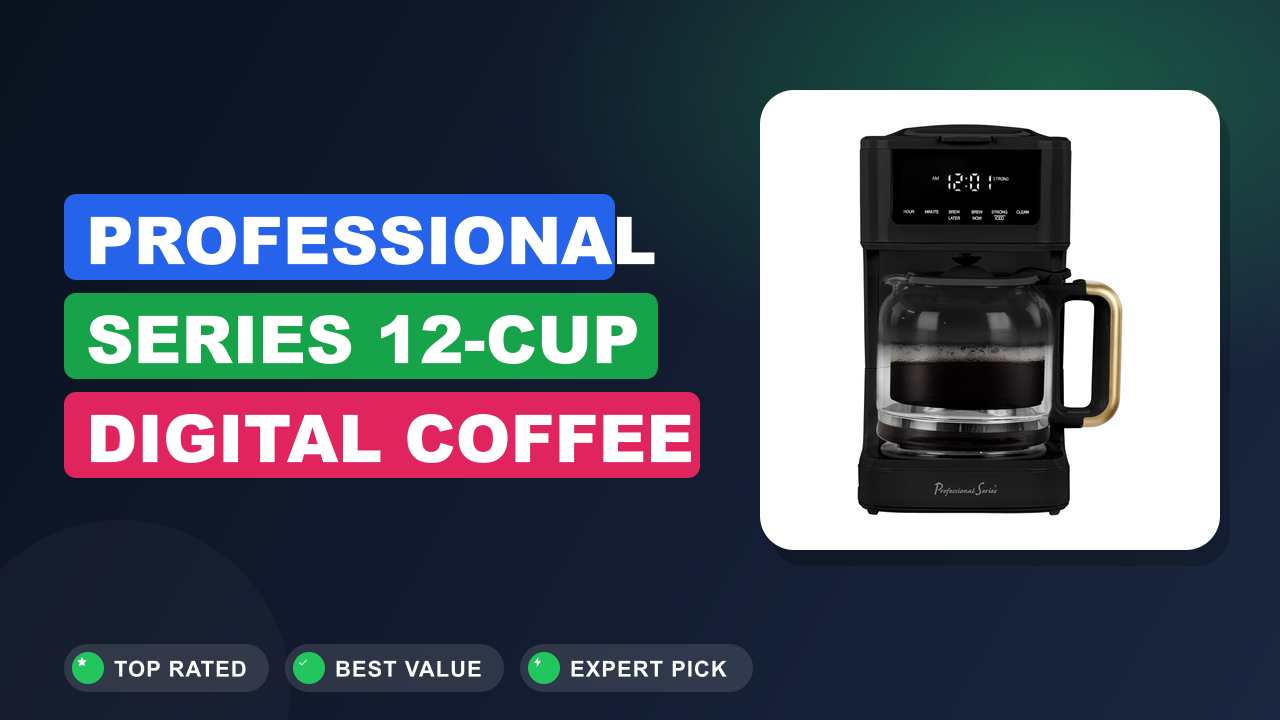
1. Professional Series 12-Cup Digital Coffee Maker
In our research this is the model that keeps reappearing when buyers want twelve cups, a timer, and zero ongoing filter costs. Verified buyer feedback points to the strong setting as the feature people actually press every day, not a marketing extra.
What it is
A digital coffee maker is a drip brewer that handles the timer, the brew cycle, and the warming plate for you, leaving only the basket to load. This model sits in the budget tier beside Mr. Coffee and Hamilton Beach twelve-cup units, a step below Cuisinart's programmable line in fit and finish.
What separates it is the pairing of a permanent mesh filter, a dedicated strong brew cycle, and a 24-hour clock at a price that undercuts most rivals. If your mornings involve pouring for a houseful, the case for crowd-friendly capacity gets stronger than it does for a two-cup household.
Setup & first impressions
Verified buyer reviews across 200+ ratings describe a consistent first morning: rinse the reservoir, run one plain water cycle, and the faint plastic taste fades by the second pot. Owners repeatedly mention the LCD being readable at arm's length without squinting. The carafe draws mixed comments.
It pours cleanly at a slow tilt, but several reviewers note a dribble if you tip it fast, a common trait of hinged glass carafes. Expect roughly 8 to 10 minutes for a full twelve-cup cycle on the regular setting, based on buyer timing reports.
| Brew capacity | 12 cups (60 fl oz / 1.8 L) |
| Filter type | Permanent reusable mesh basket |
| Brew settings | Regular and Strong Brew |
| Programmable timer | 24-hour digital clock with auto start |
| Keep warm | Heated plate, 2-hour auto shutoff |
| Pause n’ Serve | Yes, roughly 30-second pour window |
| Carafe | Glass with hinged lid and dual water window |
| Wattage | 1000 W class heating element |
| Warranty | 1-year limited manufacturer coverage |
Daily-use experience
What a full brew cycle actually does
A full 60 fl oz cycle runs 8 to 10 minutes, in line with other 1000 W-class drip brewers. Buyer reports describe water landing across a wide spray head rather than a single stream, so the bed saturates fairly evenly. The pause n' serve window gives you about 30 seconds to grab a cup before the basket drips.
Temperature is where it stumbles. The Specialty Coffee Association's Golden Cup guidance calls for 195 to 205 F at the brew head, and budget brewers like this tend to sit near the lower edge before losing more heat on the plate.
Is the strong brew setting worth pressing?
Yes, with a caveat. It slows the flow rate and stretches contact time, the same principle behind any longer-extraction cycle, and reviewers consistently report a visibly darker, fuller cup on medium roasts. Light roasts stay thin because the water still isn't hot enough to pull those brighter acids out.
If you're already working on grind consistency, this setting gives you one more lever without buying new gear. Just don't expect it to replicate a machine with a pre-infusion bloom phase.
Cleaning, filters, and long-term wear
The mesh basket is the quiet win. Rinse it, let it dry, and you stop buying paper filters entirely. The trade-off is sediment: mesh passes more fines than paper does, so a fine grind leaves the last half-inch of the carafe slightly gritty.
Descaling matters more than most owners expect. Reviews from hard-water regions report visible scale in the reservoir within three to four months of daily use, so a monthly vinegar cycle is sensible upkeep. The warm plate holds roughly 175 to 180 F on buyer thermometer checks, then shuts off at the 2-hour mark.
✓ Pros
- Strong Brew cycle genuinely lengthens extraction, so medium roasts taste fuller without extra grounds
- Permanent mesh filter eliminates repeat paper costs, which matters most for daily twelve-cup households
- 24-hour programmable timer plus auto shutoff means coffee is ready before your alarm stops ringing
- Dual water window reads clearly on both sides, handy when the brewer sits against a wall
- Pause n’ Serve gives a real 30-second window, enough for a mid-brew cup without a puddle
✗ Cons
- Brew temperature sits near the bottom of the accepted range, so light roasts taste underdeveloped
- Warm plate drops below 180 F within the first hour, and hour three coffee is lukewarm at best
- Hinged glass carafe dribbles when tipped quickly, a recurring complaint in verified reviews
- Mostly plastic housing feels light in the hand and shows scuffs on the warming deck
Who should buy it
Buy it if you…
You're feeding three or more people before 8 a.m. and you want a full carafe waiting. This suits a shared office kitchen, a busy family, or anyone who currently owns a pod machine and resents the per-cup math. The permanent filter and 24-hour timer mean your only daily task is filling the basket and the reservoir.
If you like the flexibility of one machine covering several roles, it slots in as the batch brewer next to a single-serve unit.
Skip it if you…
You drink two cups a day and care about the second one being hot. The warm plate declines fast, and you'll end up microwaving. Skip it too if you're drinking single-origin light roasts, where brew temperature and saturation matter more than convenience.
And if counter depth is limited, measure first: twelve-cup brewers are not small appliances.
Better alternatives
- Cuisinart DCC-3200: better temperature control and a stronger warming plate, though it costs more.
- Hamilton Beach 46205: simpler and cheaper, with fewer programming options.
- Ninja CE251: programmable with a thermal option if hot coffee at hour three is non-negotiable.
If you've been comparing brewers, this one is worth stacking against another twelve-cup contender before you commit.
Frequently Asked Questions (FAQ)
Is the strong brew setting actually stronger?
Yes. It slows the drip rate so water spends more time in contact with the grounds, which raises extraction. Verified reviews describe a noticeably darker, fuller cup on medium and dark roasts.
On light roasts the effect is smaller because the brew temperature isn't high enough to pull those acids out. It's a real function, not a rebadged button.
How long does the keep-warm plate stay on?
Two hours, then it shuts off automatically per the manufacturer's specification. Buyer thermometer checks put the plate around 175 to 180 F early on, drifting lower after the first hour. That's fine for a household that empties the carafe by 9 a.m. and disappointing if you sip slowly.
Does the permanent filter change the taste?
It changes the body more than the flavour. Mesh lets fine particles through, so you get a slightly heavier, oilier cup than a paper filter delivers, plus a little sediment in the last inch. Paper traps those oils.
Many buyers prefer the mesh result, though anyone sensitive to grit should keep paper filters on hand for the odd pot.
Is the carafe dishwasher safe?
The glass carafe and lid are commonly reported as top-rack safe, but hand washing keeps the hinge and lid seal tighter for longer. The mesh filter should be rinsed by hand, since dishwasher heat warps the basket rim over time and lets grounds slip past the edge. The housing wipes clean with a damp cloth.
How noisy is it while brewing?
It's a drip brewer, so expect a soft gurgle and a light hiss rather than a grinder's whine. Buyer reports describe it as quiet enough for an open-plan kitchen at 6 a.m. The loudest moment is the final steam puff.
If silence matters most, look at a quieter grinding setup instead of chasing a silent brewer.
Final verdict
3.8 out of 5. This brewer earns its place through value and one genuinely useful feature. The strong setting changes the cup in a way most budget machines don't bother with, the permanent filter ends the paper-filter treadmill, and the 24-hour timer does exactly what the box promises. For a household pouring eight or more cups a day, the maths works in its favour.
The deductions are honest ones. Brew temperature sits near the floor of the accepted range, the warm plate surrenders within the first hour, and the plastic housing feels like the budget tier it belongs to. None of that ruins the coffee you drink at 7 a.m.
It does mean you should budget for a thermal carafe or an insulated mug if you're a slow sipper. For everything else in the price band, this is the one worth trying first. If flavour depth is your priority over convenience, spend the extra and look at machines built for taste instead.
Affiliate disclosure: This post contains affiliate links. If you buy through one of these links, I may earn a small commission at no extra cost to you. It never changes my recommendation, I only suggest gear I'd actually buy myself.

“I believe great cooking starts with the right tools, trusted advice, and a little confidence in the kitchen.”
Hi, I’m Emma Carter. My love for cooking began in my grandmother’s kitchen, where I learned that every great meal starts with simple ingredients and the right cookware. Over the years, I’ve spent countless hours researching, testing, and comparing kitchen appliances, cookware, coffee makers, air fryers, and other everyday kitchen essentials.
Here at KiCook, my goal is to make your buying decisions easier with honest product reviews, practical buying guides, and easy-to-follow cooking tips. Whether you’re upgrading your kitchen or searching for the best appliance for your home, I focus on providing clear, reliable, and research-backed information you can trust.
When I’m not testing new kitchen gadgets or writing in-depth guides, you’ll usually find me trying new recipes, visiting local farmers’ markets, or enjoying a quiet cup of coffee while planning my next kitchen project.