
You make your usual morning coffee, take the first sip, and something is clearly wrong. Instead of tasting smooth, sweet, or pleasantly rich, the coffee hits you with a sharp sourness that almost makes your mouth pucker.
If that sounds familiar, the good news is that your coffee machine probably is not ruined.
Coffee from a machine usually tastes sour because the coffee is under-extracted. In simple terms, the water did not pull enough flavour from the grounds before the brewing process ended. A grind that is too coarse, water that is not hot enough, a shot that runs too quickly, or an incorrect coffee-to-water ratio can all cause it.
Start with the easiest fix: grind a little finer and brew again without changing anything else. If that does not improve the flavour, work through temperature, brew time, dose, water quality, beans, and machine cleanliness one at a time.
Quick Diagnosis: Why Does Coffee From My Machine Taste Sour?
Before changing several settings at once, use the taste and behaviour of your machine to narrow down the problem.
| What You Notice | Most Likely Cause | What to Try First |
|---|---|---|
| Sour and thin coffee | Under-extraction | Grind finer |
| Sour and watery espresso | Water passes through too quickly | Use a finer grind |
| Espresso gushes out quickly | Grind is too coarse or dose is too low | Adjust grind first |
| Sour and lukewarm coffee | Brewing temperature is too low | Fully preheat the machine |
| Sour coffee from light-roast beans | The coffee needs more extraction | Grind finer or increase temperature |
| Sour coffee after descaling | Descaling solution may remain in the machine | Run fresh-water rinse cycles |
| Sour coffee from every type of bean | Machine temperature or water may be the problem | Test temperature and water |
| Sour and bitter at the same time | Uneven extraction or channeling | Check puck preparation |
| Bright, fruity, and sweet | Natural coffee acidity | You may not need to fix anything |
The key is to change one variable at a time. If you change the grind, dose, temperature, beans, and brew time together, you may accidentally improve the coffee without knowing what actually fixed it.
Sour Coffee Usually Means Under-Extraction
Coffee brewing is an extraction process. Hot water dissolves flavour compounds from roasted coffee and carries them into your cup.
If too little is extracted, the cup can taste sharp, thin, acidic, salty, or sour. If extraction goes too far, the coffee can become dry, harsh, bitter, or astringent.
Breville’s guide to the coffee extraction process explains that grind size is one of the main ways to control extraction. Finer grounds expose more surface area to the water, while coarse grounds generally extract more slowly.
That is why a finer grind is usually the first adjustment worth making when machine-made coffee tastes obviously sour.
However, sourness does not always mean something is wrong.
Is Sour Coffee the Same as Acidic Coffee?
Not quite.
Acidity is a natural part of coffee. Some coffees, particularly lighter roasts and beans from certain origins, can have flavours that remind you of citrus, berries, apples, tropical fruit, or wine.
Good acidity usually feels lively and balanced. There is often sweetness behind it.
Problematic sourness feels different.
Pleasant Coffee Acidity May Taste Like:
- Orange or lemon zest
- Berries
- Apple
- Stone fruit
- Pineapple
- Floral or wine-like notes
- Bright fruit combined with sweetness
Under-Extracted Sour Coffee May Taste Like:
- Sharp lemon juice
- Vinegar
- Sour candy without sweetness
- Salty acidity
- Thin or watery coffee
- Hollow flavour that disappears quickly
- An unpleasant mouth-puckering sensation
A light-roast Ethiopian coffee, for example, may naturally have noticeable citrus acidity. That does not automatically mean it is under-extracted.
If the coffee is both bright and sweet, the acidity may be part of the bean.
If it is sharp, thin, hollow, salty, or unpleasantly sour, extraction is a more likely problem.
1. Your Coffee Grind Is Too Coarse
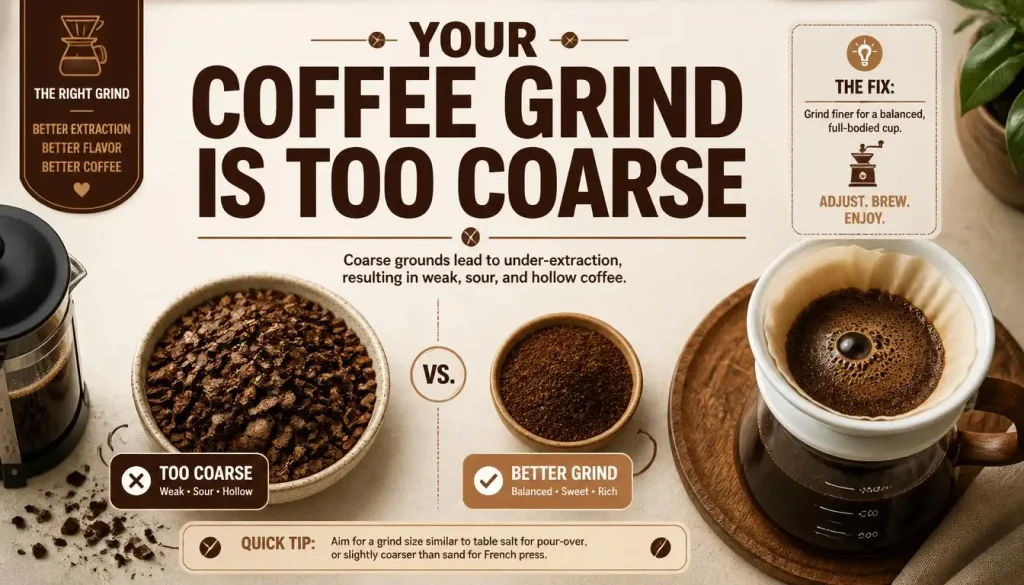
This is the first thing I would check.
When coffee particles are too large for the brewing method, the water may move through them without extracting enough soluble flavour.
With espresso, the problem is especially obvious because the brewing time is short. Water can rush through a coarse coffee bed, producing a pale, thin shot that tastes sour.
Breville’s espresso guidance also lists coarse grounds as a common cause of under-extraction and recommends moving finer when espresso is weak or sour. See Breville’s espresso grind guidance
How to Fix It
Move your grinder one or two small steps finer.
Then make another coffee using the same:
- Bean
- Dose
- Water amount
- Temperature
- Brewing programme
Taste the result.
If the coffee becomes sweeter and fuller, you are moving in the right direction.
Do not immediately jump from very coarse to extremely fine. Small changes make it much easier to find the sweet spot.
If your current machine struggles with consistent grinding or you are considering a machine specifically for espresso, KiCook’s guide to choosing a coffee maker for espresso can help you compare machines where temperature stability and extraction control matter.
2. Your Water Is Not Hot Enough
Coffee needs sufficiently hot water to extract flavour efficiently.
If your machine brews with water that is too cool, acids can become noticeable before enough sweetness and balancing flavour compounds have been extracted.
For espresso, the Specialty Coffee Association has historically used a brewing temperature range around 195–205°F (90.5–96°C) as a useful reference range. That does not mean every bean tastes best at exactly the same temperature, but it gives you a practical starting point. Read the SCA’s discussion of espresso brewing parameters
What to Check
Ask yourself:
- Did the machine have enough time to warm up?
- Is the first cup of the day worse than the second?
- Does the coffee come out unusually cool?
- Are you brewing a very light roast?
- Does your machine allow temperature adjustment?
Some espresso machines need several minutes of warm-up time even if the display says they are technically ready.
The portafilter, group head, and cup can also pull heat away from the brew.
Try This
Allow the machine to warm thoroughly.
If you use a portafilter machine, run a short blank water cycle before brewing. Warm the cup as well if it is very cold.
If your machine has adjustable brew temperature and you are using a lighter roast, a slightly higher temperature may improve extraction.
Do not immediately set everything to maximum heat. Increase temperature gradually and judge the result by taste.
3. Your Coffee Is Brewing Too Quickly

If espresso pours into the cup almost like water, that is an important clue.
A fast shot often means the water is not encountering enough resistance from the coffee bed.
The usual causes are:
- Grind too coarse
- Too little coffee in the basket
- Poor distribution
- Incorrect basket size
- Channeling through the puck
A fast shot is often thin and sour because the water has not spent enough effective time extracting the coffee.
What Should You Do?
Start with grind size.
Make the grind slightly finer and brew again.
If the shot is still unusually fast, check that you are using the correct dose for your basket.
Do not rely entirely on the timer. Two espresso shots can run for similar lengths of time and still extract very differently.
4. Your Espresso Dose, Yield, or Brew Ratio Is Off
Many people focus on shot time but ignore what is actually going into and coming out of the machine.
For espresso, it helps to track:
Dose: the weight of dry coffee in the basket.
Yield: the weight of liquid espresso in the cup.
Brew ratio: the relationship between the two.
For example, a common starting point might be:
18 grams of coffee in → about 36 grams of espresso out
That is approximately a 1:2 brew ratio.
It is not a universal recipe.
Different beans, roast levels, grinders, baskets, and machines may taste better with different ratios. The SCA has also documented 1:2 as a common ratio among espresso professionals rather than an absolute requirement.
How Ratio Can Affect Sourness
Imagine you use 18 grams of coffee but stop the shot at 25 grams because the timer reaches a number you read online.
The shot may still be under-extracted.
Allowing a little more yield can sometimes extract additional sweetness and reduce unpleasant sourness.
Try something like:
18 g in → 36 g out
If it still tastes obviously sour:
18 g in → 40 g out
Taste both.
The better-tasting cup matters more than hitting a fashionable number.
5. Uneven Extraction or Channeling Is Making the Coffee Sour
Sometimes the grind, dose, and shot time all look reasonable, yet the espresso still tastes wrong.
Channeling may be the reason.
Channeling happens when water finds weak paths through the coffee puck instead of flowing evenly through all the grounds.
Some areas become heavily extracted while others barely extract at all.
The result can be confusing because the same espresso may taste both sour and bitter.
Common Causes of Channeling
- Uneven coffee distribution
- Large clumps in the grounds
- Crooked tamping
- Cracks in the puck
- Incorrect dose
- Grounds stuck around the basket edge
- Poorly matched grind size
How to Reduce It
Distribute the grounds as evenly as possible before tamping.
Keep the portafilter level.
Tamp evenly instead of trying to use extreme force.
If you use a bottomless portafilter, spraying or multiple uneven streams can make channeling easier to spot.
The goal is not to create a perfectly beautiful puck. The goal is simply to give the water fewer easy shortcuts.
6. Your Pre-Ground Coffee May Be Too Coarse
A common problem with entry-level espresso setups has nothing to do with the machine.
It is the coffee.
General-purpose pre-ground coffee is often ground for drip brewing rather than espresso. In a traditional non-pressurized espresso basket, it may allow water to pass through much too quickly.
That can produce:
- Fast shots
- Pale crema
- Thin body
- Weak flavour
- Sharp sourness
What Can You Do?
If you use pre-ground coffee, look for coffee specifically ground for espresso.
If your machine includes both pressurized and non-pressurized baskets, the pressurized basket is usually more forgiving with pre-ground coffee.
For greater control, a capable burr grinder is the better long-term solution.
Fresh grinding also allows you to adjust when weather, bean age, or a new roast changes the way your espresso flows.
7. Your Basket May Not Match Your Coffee or Grinder
Not all espresso baskets behave the same way.
Pressurized or Double-Wall Basket
A pressurized basket creates additional resistance itself.
It can work reasonably well with:
- Pre-ground coffee
- Entry-level grinders
- Less precise puck preparation
Non-Pressurized or Single-Wall Basket
A non-pressurized basket depends much more heavily on the coffee itself to create the correct resistance.
You normally need:
- A suitable espresso grind
- Consistent dose
- Even distribution
- Reasonably capable grinder
If you switch from a pressurized basket to a single-wall basket and suddenly every shot becomes fast and sour, the machine may not be the problem. Your grinder may simply be unable to grind finely or consistently enough.
8. Your Beans or Roast Need a Different Approach
Different beans do not behave the same way.
A dark-roast espresso recipe that tastes balanced may produce sharp sourness when used unchanged with a dense light roast.
Light roasts can require more effort to extract.
You may need to experiment with:
- A finer grind
- Slightly higher temperature
- A longer ratio or greater yield
- Better preheating
At the same time, remember that many light-roast coffees are intentionally bright and fruity.
Do not chase every trace of acidity out of the cup.
You are trying to remove unbalanced sourness, not erase the character of the coffee.
What About Old Coffee Beans?
Stale beans are more commonly associated with dull, flat, papery, or lifeless flavours than intense sourness.
However, ageing changes how beans behave during extraction. You may need to adjust the grinder as coffee gets older.
If you recently switched beans and the sourness appeared immediately, dial in the new coffee rather than assuming your previous settings should still work.
9. Your Coffee Machine Needs Cleaning or Descaling
If your coffee tasted fine for weeks or months and gradually became worse, check the machine.
Coffee oils, fine grounds, and mineral deposits can build up in parts of the brewing system.
Depending on the machine, pay attention to:
- Filter basket
- Portafilter
- Group head
- Shower screen
- Brew chamber
- Pod holder
- Needles
- Water reservoir
- Internal water pathways
Scale can also interfere with normal water flow and heating.
If you own a Keurig, KiCook has a complete step-by-step guide to cleaning a Keurig coffee maker that covers routine cleaning, needle maintenance, descaling, and rinsing.
Why Does My Coffee Taste Sour After Descaling?
If the sour taste appeared immediately after descaling, stop adjusting the grinder.
The first thing to consider is residual descaling solution.
Acid-based descalers can leave an unpleasant sharp or chemical taste if the machine has not been rinsed thoroughly.
Keurig’s official descaling instructions include a fresh-water rinse stage after the descaling solution has passed through the brewer. See Keurig’s official descaling procedure
Follow the rinse instructions for your specific machine and continue with fresh water until there is no chemical or acidic smell or taste.
Always follow your manufacturer’s instructions rather than assuming every coffee machine uses the same descaling process.
Your Water Can Make Coffee Taste Sharper
Water has a bigger effect on coffee than many people realise.
After all, most of the liquid in your cup is water.
Extremely hard water can create scale inside a coffee machine. On the other hand, water with very low mineral content or low alkalinity can change how acidity is perceived.
The Specialty Coffee Association explains that alkalinity plays an important role in buffering coffee acids and can significantly influence perceived acidity. Read the SCA’s guide to water and coffee acidity
This does not mean you need to become a water chemist to make breakfast.
If every coffee tastes unusually sharp despite sensible grind, temperature, and ratio adjustments, try brewing with a suitable filtered or mineral-balanced drinking water and compare the result.
If You Live in a Hard-Water Area
Hard water can lead to faster mineral buildup inside the machine.
Regular maintenance becomes especially important.
If scale is a constant problem in your home, KiCook’s guide to choosing a coffee maker for hard water discusses features that can make maintenance easier.
Why Is My Espresso Still Sour Even at 25 to 30 Seconds?
This is where espresso troubleshooting gets interesting.
You have read that espresso should take around 25 or 30 seconds. Your shot does exactly that.
Yet it still tastes sour.
The mistake is assuming that time equals extraction.
It does not.
Shot time is useful information, but it is only one part of the recipe.
Check Your Yield, Not Just the Timer
A 30-second shot that produces very little liquid may still taste under-developed.
A 30-second shot with an unusually large yield may have a completely different problem.
Measure both dose and output.
Taste the coffee rather than stopping the shot only because the timer reached a particular number.
Check for Channeling
A channelled puck can produce a normal-looking shot time while extracting different areas of the puck unevenly.
Look for:
- Sudden changes in flow
- Spraying from a bottomless portafilter
- Espresso favouring one side
- Sourness mixed with dryness or bitterness
Consider Brew Temperature
A lightly roasted bean may remain sour at the same temperature that works beautifully for a darker roast.
If your machine allows temperature adjustment, test a small increase.
Check the Grinder
A grinder can produce enough fine particles to slow the shot while still creating an uneven particle distribution.
That can make the timer look correct without creating an even extraction.
This is one reason taste should remain your final judge.
Sour vs. Bitter Coffee: What Should You Change?
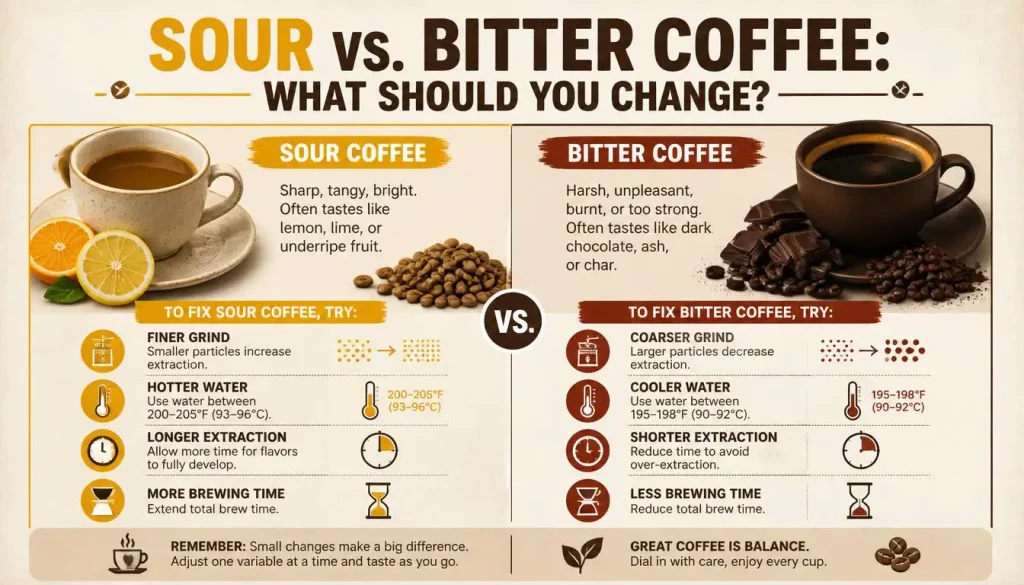
Sourness and bitterness usually call for opposite adjustments.
| Taste | Likely Direction | First Adjustment |
|---|---|---|
| Sour, sharp, thin | Under-extracted | Grind finer |
| Sour and watery | Under-extracted | Grind finer or increase contact |
| Sour and salty | Strong under-extraction | Check grind, ratio, and temperature |
| Bitter, dry, harsh | Over-extracted | Grind slightly coarser |
| Bitter and burnt | Excessive extraction or temperature issue | Reduce extraction |
| Sour and bitter together | Uneven extraction | Check distribution/channeling |
| Bright and sweet | Natural acidity | No adjustment may be necessary |
This is not a perfect diagnostic tool, but it gives you a useful direction.
If you make a change and the coffee becomes more balanced, continue in that direction gradually.
If it gets worse, return to your previous setting.
How to Fix Sour Coffee in the Right Order
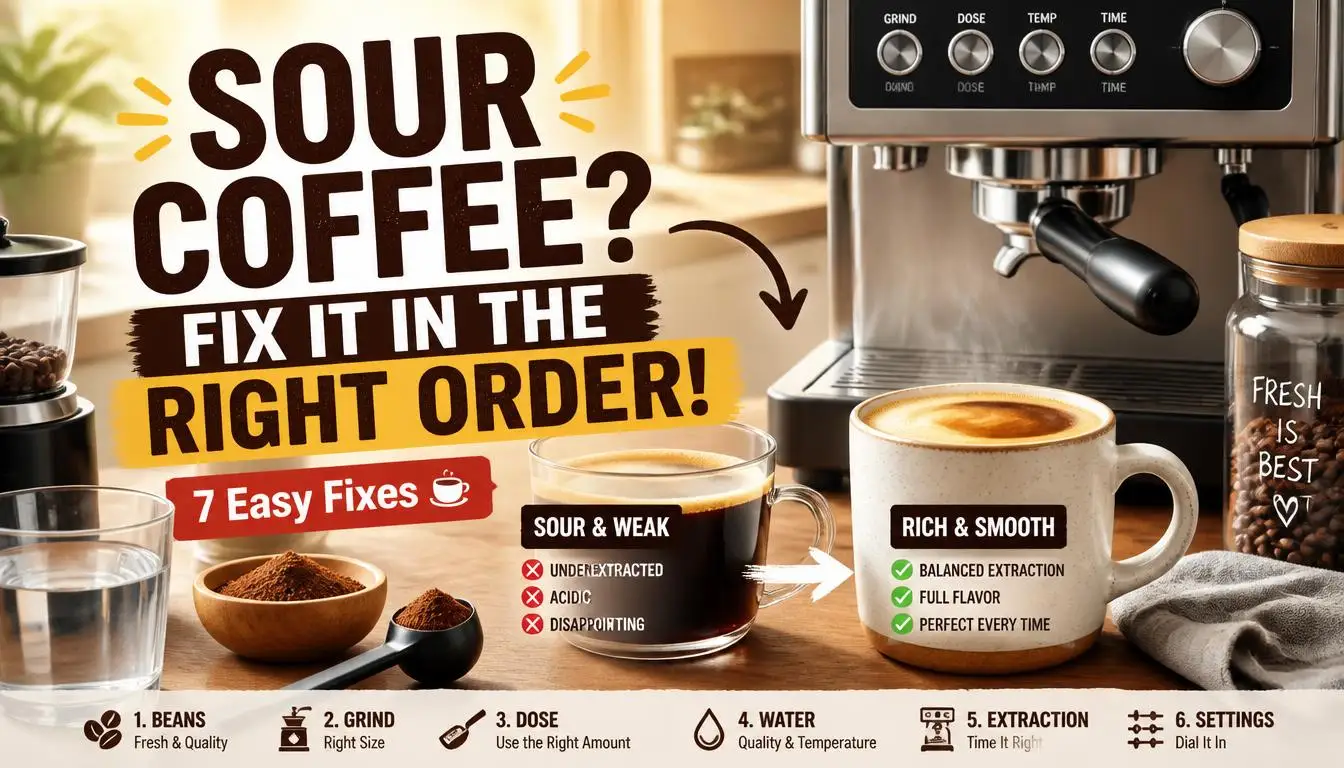
When several things could be wrong, follow this sequence rather than changing everything at once.
Step 1: Decide Whether It Is Actually Sour
Ask whether the flavour is unpleasantly sharp and thin or simply bright and fruity.
If it is sweet as well as acidic, the coffee may already be correctly extracted.
Step 2: Grind Slightly Finer
This solves a large percentage of sour-coffee problems.
Make a small adjustment.
Brew again.
Step 3: Watch the Flow
If espresso races into the cup, continue working on grind and dose.
If it drips extremely slowly, you may have gone too fine.
Step 4: Check Dose and Yield
Use a small digital scale if possible.
Knowing what goes in and what comes out makes espresso troubleshooting much easier.
Step 5: Fully Preheat the Machine
Let the group, portafilter, and brewing system reach stable temperature.
Step 6: Adjust Temperature If Your Machine Allows It
This can be especially useful with lighter roasts.
Step 7: Try Different Beans
Use a familiar medium roast.
If the sourness disappears, the original coffee may simply need a different recipe.
Step 8: Clean the Brewing Parts
Remove coffee residue from components your manufacturer says can be cleaned.
Step 9: Descale If Necessary
Follow the manufacturer’s maintenance schedule and rinse thoroughly afterward.
Step 10: Test Different Water
If every other variable looks right, compare your normal water with suitable filtered water.
Working in this order prevents random adjustments and usually gets you to the answer much faster.
Fixing Sour Coffee by Machine Type
The best solution depends partly on what kind of coffee machine you own.
Espresso Machine
Start with:
- Grind size
- Dose
- Yield
- Shot flow
- Temperature
- Puck preparation
- Machine cleanliness
If espresso consistently runs too fast, focus on grind and dose before blaming the machine.
If you are comparing machines because your current setup offers very little control, KiCook’s espresso coffee maker guide covers options designed around espresso brewing.
Drip Coffee Maker
With a drip machine, check:
- Grind size
- Coffee-to-water ratio
- Water temperature
- Whether all the grounds are being wetted
- Mineral buildup
- Filter type
- Bean freshness
If the coffee tastes both sour and weak, try a slightly finer grind before dramatically increasing the amount of coffee.
If your brewer is old or struggles with consistency, KiCook’s guide to a basic drip coffee maker may also help you understand what features matter in a straightforward drip setup.
Bean-to-Cup or Automatic Machine
Automatic machines make things convenient, but their default settings are not perfect for every bean.
Try:
- Moving the grinder one step finer
- Increasing coffee strength or dose
- Raising brew temperature if available
- Reducing or adjusting beverage volume
- Cleaning the brew group
- Descaling when required
Make grinder adjustments according to the manufacturer’s instructions. Some automatic machines should only be adjusted while the grinder is operating.
Pod or Capsule Machine
With a pod brewer, you normally cannot change grind size because the coffee is already inside the capsule.
Focus on:
- Cup size
- Machine warm-up
- Pod freshness
- Correct pod type
- Water quality
- Blocked needles or outlets
- Descaling
- Post-descaling rinsing
If you make a very large drink from a small coffee capsule, the cup may taste weak or unbalanced even when the machine is functioning normally.
Keurig Coffee Maker
If a Keurig suddenly starts making unpleasant coffee, check the pod, water, brew size, needles, and scale buildup.
A clogged or dirty brewing system can change flow and cup quality.
For the maintenance side, follow KiCook’s detailed Keurig cleaning instructions rather than experimenting with random cleaning methods.
When the Coffee Machine Itself May Be the Problem
Most sour coffee can be improved through brewing adjustments.
But sometimes you really are dealing with a machine problem.
Consider the machine itself if:
- Several different coffees all taste equally sour
- Changing grind has very little effect
- Water never seems properly hot
- Brew temperature changes dramatically from cup to cup
- Water flow has become unusually weak or erratic
- The machine has heavy scale buildup
- Coffee quality changed suddenly without any change in beans or grinder
- The machine displays errors or struggles to heat
The Machine May Not Be Heating Properly
If the coffee is consistently lukewarm and sour even after proper warm-up, the heating system may not be reaching normal brewing temperature.
Consult the troubleshooting section of your owner’s manual.
Scale May Be Affecting Performance
Mineral buildup can restrict water pathways and interfere with heating efficiency.
Descaling may restore normal performance if scale is the cause.
The Grinder May Be the Limitation
If your grinder is already on its finest setting and espresso still pours far too quickly, the grinder may simply not be suitable for a non-pressurized espresso basket.
In that situation, changing machines may not solve the problem unless the new setup also addresses grinding.
Common Mistakes That Make Sour Coffee Harder to Fix
A few habits turn a simple adjustment into an endless troubleshooting session.
Changing Everything at Once
You will not know which adjustment helped.
Change one major variable, brew again, and taste.
Obsessing Over Shot Time
Twenty-five or thirty seconds is not magic.
Use time together with dose, yield, flow, and taste.
Assuming More Coffee Will Always Make It Stronger
Increasing the dose changes resistance and extraction. It can improve one problem while creating another.
Ignoring the Grinder
With espresso, the grinder is part of the brewing system.
A great machine cannot fully compensate for wildly inconsistent grounds.
Assuming All Sourness Is Bad
A properly brewed light-roast coffee can be noticeably acidic.
Look for balance and sweetness rather than trying to make every bean taste like dark chocolate.
Forgetting About Water
If you have adjusted everything else and still cannot get a balanced cup, test the water before buying a new machine.
Frequently Asked Questions
Why does my coffee suddenly taste sour?
If the coffee previously tasted balanced and became sour suddenly, first check whether anything changed: beans, grind setting, dose, water, machine temperature, or cleaning routine.
With espresso, a grinder setting can shift or beans can require adjustment as they age. In a machine that has been used for months, scale or buildup may also affect brewing.
Why does my espresso taste sour but not bitter?
Sour espresso commonly points toward under-extraction.
Try grinding finer first. Then evaluate dose, yield, temperature, and shot flow.
Does sour coffee mean the grind is too fine or too coarse?
Most often, sour and thin coffee suggests the grind is too coarse, especially when espresso flows quickly.
A grind that is too fine is more commonly associated with slow flow and harsh or over-extracted flavours, although channeling can make the flavour less predictable.
How do I make machine coffee less acidic?
First determine whether you are tasting desirable acidity or under-extracted sourness.
If it is under-extracted, try a finer grind, sufficient brewing temperature, and an appropriate coffee-to-water ratio.
If the coffee is properly extracted but naturally very bright, consider trying a medium or darker roast.
Why does my coffee taste sour after descaling?
Residual descaling solution is one possibility.
Run the fresh-water rinse procedure recommended by your machine manufacturer. Do not brew coffee again until the rinse water smells and tastes neutral.
Can a dirty coffee machine make coffee taste sour?
A dirty machine can contribute to unpleasant or inconsistent flavour. Scale can also affect water flow and heating.
Cleaning should be part of troubleshooting if your usual settings suddenly stop producing good coffee.
Can old coffee beans taste sour?
Age can change how coffee extracts, but stale beans more commonly taste dull, flat, woody, or lifeless.
If older beans begin flowing differently through an espresso machine, adjust the grinder before assuming the machine is faulty.
Why is my espresso sour even though it takes 30 seconds?
Because extraction cannot be judged by time alone.
Your dose, yield, temperature, grind distribution, and puck preparation still matter. Measure your output and taste the shot rather than relying only on the timer.
What temperature should I use if my coffee tastes sour?
For espresso, roughly 195–205°F (90.5–96°C) is a useful general reference range, but the ideal temperature varies with the bean, roast, recipe, and equipment. Lighter roasts often respond well to the warmer end of a machine’s normal brewing range.
Why does every coffee taste sour from my machine?
If different beans all taste sour after you have tested grind, ratio, and temperature, look at factors that affect every cup.
These include:
- Water quality
- Machine heating
- Scale buildup
- Grinder consistency
- Incorrect automatic settings
- Brewing-system problems
Testing a familiar medium-roast coffee with suitable water can help isolate the cause.
Final Takeaway
When coffee from your machine tastes sour, do not start by replacing the machine.
Start with extraction.
A slightly finer grind is usually the most sensible first adjustment, particularly when the coffee is thin or the espresso runs quickly.
If that does not solve it, work through the variables logically: grind, flow, dose, yield, temperature, beans, water, cleaning, and machine condition.
For espresso, remember that a 30-second shot is not automatically a good shot. For drip coffee, remember that temperature and coffee-to-water ratio matter just as much as the machine itself. And if the sour taste appeared immediately after descaling, rinse the machine before touching your grinder.
Most importantly, let taste guide the final decision.
The goal is not to eliminate every trace of acidity. Great coffee can be bright, fruity, and lively.
You are looking for the point where that brightness is supported by sweetness, body, and balance instead of tasting sharp, watery, or unfinished.

“I believe great cooking starts with the right tools, trusted advice, and a little confidence in the kitchen.”
Hi, I’m Emma Carter. My love for cooking began in my grandmother’s kitchen, where I learned that every great meal starts with simple ingredients and the right cookware. Over the years, I’ve spent countless hours researching, testing, and comparing kitchen appliances, cookware, coffee makers, air fryers, and other everyday kitchen essentials.
Here at KiCook, my goal is to make your buying decisions easier with honest product reviews, practical buying guides, and easy-to-follow cooking tips. Whether you’re upgrading your kitchen or searching for the best appliance for your home, I focus on providing clear, reliable, and research-backed information you can trust.
When I’m not testing new kitchen gadgets or writing in-depth guides, you’ll usually find me trying new recipes, visiting local farmers’ markets, or enjoying a quiet cup of coffee while planning my next kitchen project.