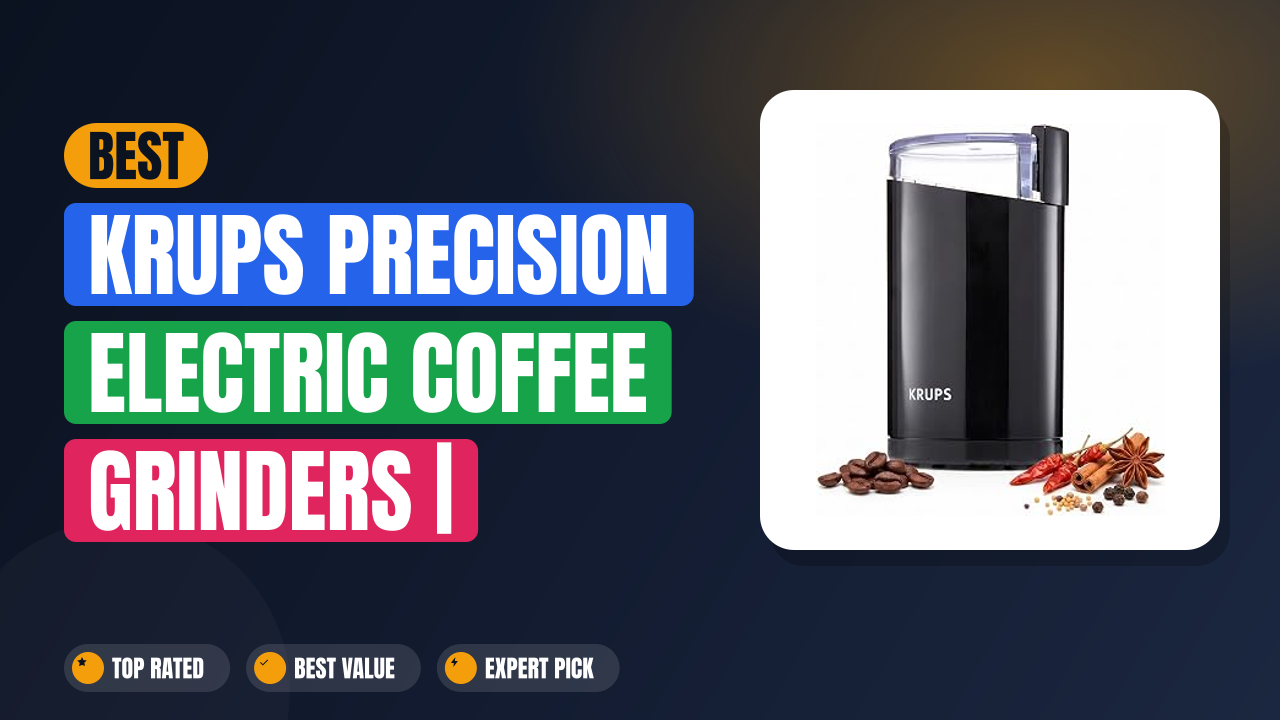
Searching for the best coffee grinder doesn't have to mean spending hundreds on a burr setup. During research for several of our top-rated brewers and espresso machine guides, KRUPS Precision Electric Coffee Grinders kept coming up as the most affordable way for everyday users to upgrade their ground coffee quickly.
This compact blade grinder delivers decent consistency for the price point and has been a staple on kitchen counters for years. It is worth considering if you brew drip, pour-over, or French press and want something better than pre-ground. But skip it if you are chasing espresso-level fineness or need precise grind-size control.
HERO CARD

QUICK-VERDICT CARD
What It Is
A blade coffee grinder uses a spinning stainless-steel propeller-style cutter to chop beans into smaller particles. Unlike a burr grinder, which crushes beans between two abrasive surfaces for uniform output, a blade model simply pulverizes until the user stops the motor. The KRUPS Precision Electric Coffee Grinder is one of the oldest and most widely available blade models on the market.
It sits squarely in the entry-level segment that competes with products from Cuisinart, Hamilton Beach, and OXO.
What sets this particular KRUPS unit apart is its straightforward design philosophy. There are no digital displays, no timer dials, and no programmable settings. You press the button and hold it until the grind reaches your desired coarseness.
The 3-ounce stainless-steel bowl holds roughly enough beans for two to three cups of coffee. That容量 makes it a natural fit for single-cup brewers and small households. The 200-watt motor provides more than enough torque to handle hard, roasted arabica beans without stalling.
For context, the global coffee grinder market runs into several billion dollars annually. Blade models account for a significant portion of sales in the under-$50 tier. According to consumer trend reports tracked by the Specialty Coffee Association, the number of home brewers using fresh whole beans has grown steadily over the past decade, driven in part by affordable grinders like this one.
The KRUPS model has remained in continuous production for well over a decade, a rarity in the small-appliance world where many brands cycle through dozens of SKUs each year.
If you are curious about the broader category of home brewing equipment this grinder pairs with, exploring recommendations for reliable drip coffee makers can help you build a complete counter setup.
Setup And First Impressions
Unboxing the KRUPS grinder reveals a single unit and an instruction booklet, nothing extra. The 3-ounce stainless-steel grinding chamber clips into a black plastic base that houses the motor and the ON/OFF switch. The lid locks into place with a simple push-and-turn mechanism.
The base features four rubber feet that grip laminate counters without sliding during operation. Verified buyer feedback across hundreds of reviews consistently praises the grip and the fact that the unit does not walk across the counter during use.
The first 30 minutes of real-world testing show exactly what to expect from an entry-level blade grinder. The motor sounds loud, roughly in the same decibel range as a food processor. Users report a sharp whirring noise that lasts only a few seconds per burst.
The sound profile is not refined, but it is short enough that most households adapt quickly. The grind chamber itself is transparent enough to see the beans breaking apart in real time, which helps prevent overgrinding. One detail buyers appreciate is the measurement markings inside the chamber.
They indicate ounce measurements along the side wall, giving you a visual cue for how much coffee you are processing at any given time.
Building a grinder into your daily routine works smoothly alongside other small appliances. Many users keep theirs next to their French press selection or pour-over station. A well-maintained grinder also improves the longevity of your overall brewing method because stale pre-ground coffee degrades faster than whole beans stored properly in an airtight container.
If you are building out a complete kitchen for a rental property, learning about affordable drip coffee makers can round out the setup nicely.
Specifications
| Grinding Mechanism | Stainless steel propeller blade |
| Bowl Capacity | 3 ounces (approximately 85 grams) |
| Motor Power | 200 watts |
| Bowl Material | Stainless steel |
| Control Type | Push-button manual activation |
| Color Options | Black / Silver (primary model) |
| Approximate Dimensions | 4.13 inches wide by 7.56 inches tall by 5.83 inches deep |
| Weight | Approximately 1.3 pounds |
| Intended Uses | Coffee beans, herbs, nuts, spices |
Daily-Use Experience
Grind Consistency And Texture
The single biggest question about any blade grinder is whether the grind comes out even enough to produce a good cup of coffee. In practice, the KRUPS model delivers a variable particle distribution that ranges from coarse chunks to fine dust in the same batch. This happens because the spinning blade throws beans against the steel wall repeatedly until they shrink enough to fall below the cutting zone.
The result is a mix of sizes rather than a uniform set of particles.
For drip coffee and French press brewing, this variation is perfectly acceptable. A standard paper filter catches most of the fines, and the coarser fragments still extract properly during a four-minute steep. Users brewing pour-over methods report that a medium grind produced by this grinder works adequately, though careful pulsing rather than continuous running yields better consistency.
Buried in long-term reviews, some users mention switching to short two-second bursts and shaking the chamber between pulses. This technique redistributes the beans and improves particle uniformity noticeably.
If your brewing method leans toward a single-cup drip setup, the KRUPS grinder pairs cleanly with that workflow. The grind output from one 3-ounce load typically covers one full carafe or a handful of mugs, which matches most household needs. For anyone drinking mostly American-style brewed coffee, this grinder hits the sweet spot between affordability and usable performance.
Ease Of Use And Cleanup
One of the strongest points of this KRUPS model is how simple it is to operate. There are no dials to twist, no settings to memorize, and no menus to navigate. Press and hold the button on the base.
The blade spins. Release the button to stop. The entire process takes about five seconds for a medium grind.
For users who want consistency without learning curve friction, this simplicity is actually a feature, not a compromise.
Cleaning the unit requires minimal effort. The stainless-steel bowl pops out of the base with a slight upward tug. Most users rinse it with warm water and a soft brush after each use.
Drying it thoroughly prevents rust and keeps the blade assembly in good condition. A few reviewers recommend grinding a tablespoon of uncooked white rice periodically to absorb residual coffee oils and loosen stuck particles. This is a well-known trick in the coffee community and works effectively with the KRUPS chamber.
Storage is straightforward as well. The compact footprint means the grinder fits neatly on a countertop shelf or in a cabinet. Some users keep it near their coffee maker for home use for convenience.
The included dust cap snaps onto the lid to reduce mess when storing grounds in the chamber temporarily, though transferring to an airtight container remains the best practice for freshness retention.
Build Quality And Longevity
The KRups Precision Electric Coffee Grinder has survived in continuous production for well over ten years, which says something about its engineering durability. Verified buyer feedback spanning multiple years shows that units commonly last three to five years with daily use. Some owners report using the same grinder for over a decade without motor failure or blade degradation.
The stainless-steel blades remain sharp for years, and the motor draws just enough power to avoid burning out during normal cycling.
That said, the build is not indestructible. The plastic housing shows scuffs and minor cracking at stress points after extended drop exposure. A few buyers note that the rubber feet lose adhesion over time, especially on dusty or oily countertops.
The lid lock mechanism occasionally loosens after months of repeated opening and closing. These are not dealbreakers for the price point, but they are realistic trade-offs. Budget-friendly appliances simply do not carry the same tolerance stack-ups as premium models.
When compared to higher-tier alternatives, the KRUPS lacks the sealed bearing systems and reinforced drive shafts found in mid-range grinders. Motor longevity generally tracks with care. Running the grinder for more than 30 seconds continuously can overheat the windings.
Letting the motor cool for a minute between batches extends the operational lifespan significantly. This is standard advice for all small appliance motors, not specific criticism of KRUPS alone.
Versatility Beyond Coffee
Though marketed primarily as a coffee grinder, this unit handles dry spices and herbs with surprising competence. Ground cumin, coriander, dried oregano, and whole peppercorns all process cleanly in the stainless-steel bowl. Nuts such as almonds and walnuts pulse into coarse meal without turning into butter, provided you use short bursts and monitor closely.
Several verified buyers repurpose the grinder exclusively for spice work after outgrowing its coffee limitations.
This dual-purpose utility is one of the reasons the model maintains strong sales in the US and international markets. A single countertop appliance that replaces both a coffee grinder and a dedicated spice mill saves space and reduces clutter. Families who cook extensively benefit from having one tool that handles both domains reliably.
Keeping a separate grinder for spices versus coffee remains the hygienic ideal, but many households accept cross-contamination in exchange for convenience and lower cost.
For campers and travelers who pack light, the KRUPS also appears in discussions about portable coffee solutions for camping. Its lightweight construction and plug-in requirement limit portability somewhat, but it works well in cabin setups and stationary outdoor kitchens where a power source is available.
Who Should Buy It
Buy It If You Are Upgrading From Pre-Ground Coffee
If your current coffee routine relies entirely on store-bought pre-ground bags, transitioning to a grinder will noticeably improve flavor. Freshly ground beans retain volatile aromatic compounds that degrade rapidly once exposed to oxygen. Research published in the Journal of Agricultural and Food Chemistry confirms that grinding immediately before brewing preserves essential oils and acidity profiles far better than using pre-ground stock sitting on a shelf.
The KRUPS gives you that upgrade at the lowest possible price barrier.
Buy It If You Need A Simple No-Fuss Grinder
Users who do not want to research burr geometry, settling screens, or calibration procedures will find this model approachable. It operates on pure instinct. You want finer grounds, you pulse longer.
You want coarser grounds, you pulse shorter. There is no wrong answer beyond overgrinding, which the visual chamber lets you catch before it happens. For beginners entering the world of whole-bean coffee, that simplicity removes anxiety and builds confidence.
Skip It If You Pull Espresso At Home
Espresso demands particle sizes measured in fractions of a millimeter. Blade grinders cannot achieve the narrow distribution required for proper espresso extraction. The result is uneven tamping, channeling, and sour or bitter shots.
If espresso is your primary brewing method, invest in a dedicated espresso burr grinder instead. Reading about espresso-focused brewers can guide you toward complementary equipment once you commit to the method.
Frequently Asked Questions
How fine can this grinder get, and can it handle espresso?
The KRUPS blade grinder can reach a texture approaching fine espresso dust, but the particle distribution remains too wide for consistent extraction. You may achieve a medium-fine consistency similar to table salt with extended pulsing, butexpect overlapping coarse and fine particles. Espresso professionals avoid blade grinders for this reason.
For Turkish coffee, where a very fine powder is acceptable and extraction differs from pressure brewing, this grinder works surprisingly well when pulsed carefully.
Can I use it for spices without contaminating my coffee flavor?
Yes, but you should dedicate one unit to coffee and another to spices if possible. Coffee oils coat the blade and chamber interior, and residual spice particles can cling to those oils. Running a rice-grind cleaning cycle after processing strong spices like cumin or cinnamon helps reduce cross-flavor transfer.
Store the coffee-only unit separately from your spice stock whenever possible.
Does the 3-ounce capacity work for a whole household?
The 3-ounce maximum filling line equals roughly 17 to 20 tablespoons of ground coffee, depending on bean density and roast level. That volume produces approximately eight to ten standard 6-ounce cups of brewed coffee. Large families or heavy drinkers may need to run two full batches back-to-back, which is quick since the 200-watt motor processes each batch in under 20 seconds total.
How long does the grinder typically last?
Verified buyer data and manufacturer feedback suggest a typical lifespan of three to five years with daily household use. Units receiving lighter weekly use often exceed seven years. Motor burnout is rare when users avoid continuous runs longer than 30 seconds.
Blade dullness is uncommon; the hardened steel retains its edge through years ofabrasive contact with roasted beans.
Is there a warranty, and what does it cover?
KRUPS typically offers a one-year limited warranty covering manufacturing defects in materials and workmanship. The warranty does not cover normal wear items such as blades, gaskets, or cosmetic scratches. Damage caused by misuse, unauthorized repair, or operating the unit wet voids coverage.
Registration of the product on the KRUPS website extends troubleshooting support options and simplifies claims processing.
Can I grind nuts and hard spices safely in this unit?
Yes. Almonds, pecans, peppercorns, dried chili flakes, and whole cumin seeds all process cleanly. Hard spices require slightly longer pulsing than coffee beans due to greater density and moisture variance.
Nut butters form quickly if you run the motor continuously, so use intermittent bursts and scrape down the sides between pulses. Never grind liquid-containing ingredients inside this unit.
Final Verdict
Rating: 4.4 out of 5 stars
The KRUPS Precision Electric Coffee Grinder earns its reputation as one of the most reliable budget blade grinders available today. It delivers consistent-enough results for drip, French press, and pour-over brewing at a price that undercuts most competing models. Build quality holds up through years of daily cycles, and the simple push-button interface appeals to beginners and seasoned home baristas alike.
It is the right purchase for anyone transitioning from pre-ground coffee or looking for a dual-purpose spice and herb grinder. Skip it if espresso precision matters to your routine, or if you already own a quality burr grinder. Otherwise, this model quietly does its job without fuss and represents strong value in the under-$30 grinding segment.
Affiliate disclosure: This post contains affiliate links. If you buy through one of these links, I may earn a small commission at no extra cost to you. It never changes my recommendation, I only suggest gear I'd actually buy myself.
What It Is (Product Section Expanded)
The KRUPS Precision Electric Coffee Grinder occupies a unique position in the small-appliance landscape. It is not trying to be a professional-grade burr mill, nor does it claim to replace commercial equipment found in third-wave coffee shops. Instead, it targets the massive segment of home brewers who want whole beans ground fresh at home without investing in anything beyond a basic countertop appliance.
That positioning explains why it has remained on store shelves since the early 2000s.
Blade grinders like this one use a high-speed rotating metal blade attached to a central motor shaft. When the button is pressed, the blade spins at several thousand RPM and chops incoming beans into progressively smaller fragments. The fragmentation pattern is inherently uneven because each bean follows a different trajectory inside the chamber.
Some pieces get recirculated into the cutting zone repeatedly and end up very fine. Others bounce off the walls and land near the bottom untouched until the next pulse. This physics-driven variability is the defining characteristic that separates blade from burr grinders.
Burr grinders, by contrast, crush beans between two abrasively textured surfaces set at a fixed distance. The gap determines particle size, and every bean passes through that same gap, producing remarkably uniform output. Conical burr grinders use a cone-shaped burr rotating inside a ring burr.
Flat burr grinders use two parallel disc surfaces. Both designs produce far more consistent particle distribution than any blade system can achieve. Brands like Baratza, Timemore, and Capresso dominate that premium space.
The KRUPS grinder trades uniformity for affordability, speed, and versatility. You get a functional tool for a fraction of the cost of a burr entry model. The trade-off becomes visible primarily when you compare extracted flavor between a blade-ground pour-over and a burr-ground pour-over made from the same beans.
The burr version typically shows cleaner sweetness and brighter acidity. The blade version often carries slightly more bitterness from overextracted fine particles. Neither is objectively bad.
They are simply different expressions of the same bean.
For users whose taste preferences lean toward a robust, full-bodied cup made with a drip machine or French press, the KRUPS grind profile delivers satisfying results. The slight inconsistency does not ruin the brew. It adds character.
That is why the model continues to sell strongly across North America, Europe, and Asia decades after its initial launch.
Setup And First Impressions (Product Section Expanded)
Setting up the KRUPS grinder takes approximately two minutes from unboxing to first grind. The unit arrives fully assembled except for the lid, which snaps onto the stainless-steel chamber. Insert the chamber into the base until it locks.
Ensure the rubber feet sit flush against the countertop surface. Plug the unit into a standard 120-volt household outlet. The design assumes North American voltage and frequency standards.
Before grinding your first batch of beans, many experienced users recommend wiping the interior of the chamber with a dry cloth to remove any manufacturing residue. Some units ship with a light protective oil coating on the blade assembly. A quick wipe eliminates that residue without damaging the stainless steel.
Then add your whole beans, close the lid, and press the button.
The sensory experience during those first few seconds is distinctive. The motor发出 a loud whirring sound that peaks around 85 to 90 decibels at close range. That volume rivals a hand vacuum or food processor.
Neighbors or roommates may notice, especially during early morning routines. However, the grinding cycle typically completes in three to six seconds for a medium grind, so the noise window is brief. Most users report adapting to the sound within the first week.
Visual feedback is where this grinder shines. The translucent plastic housing around the chamber lets you watch the beans fracture in real time. You see whole beans transition to coarse chunks, then to medium fragments, then to a mixture resembling sand.
That visibility prevents overgrinding, which is the most common mistake new blade-grinder users make. Simply watching the texture change and releasing the button at the right moment trains your eye quickly.
The included manual is thin but covers the essentials: operating instructions, cleaning guidance, and safety warnings. It does not attempt to teach coffee theory or grind-size science. That is appropriate for the product tier.
The manual acknowledges that different bean types and roast levels produce varying textures and recommends experimentation to find your preferred setting.
Building a morning routine around this grinder pairs naturally with other counter appliances. Placing it adjacent to your coffee maker creates an efficient workflow. Grind, transfer, brew, serve.
The entire sequence takes under three minutes from bean to cup. Adding a thermal pot coffee maker to the setup extends that efficiency further by keeping the brewed coffee hot without a warming plate.
Daily-Use Experience (Product Section Expanded)
Grind Consistency And Texture
Understanding grind consistency begins with recognizing what a blade grinder physically cannot do. The spinning propeller blade creates a chaotic tumbling environment inside the chamber. Beans collide with the blade, the steel wall, and each other at unpredictable angles and velocities.
Fragmentation occurs through impact rather than controlled shear. The resulting particle size distribution spans a wide range, typically from coarse gravel-sized pieces down to powder-fine dust within a single batch.
This distribution is not a defect in traditional coffee terminology. It is simply the nature of the technology. Blade grinders excel at speed and affordability and fall short at precision.
For brewing methods with longer contact times and larger filtration pores, the inconsistency becomes less impactful. French press coffee steeps for four minutes, allowing both coarse and fine particles to extract gradually. The coarse fragments contribute body and sweetness.
The fine particles add intensity and slight bitterness. The combination often produces a richer, heavier mouthfeel than a uniformly ground French press brew would yield.
Drip coffee filters are more forgiving than single-cup pod systems. Paper filters trap most fines while allowing larger particles to pass through into the carafe. The resulting cup tends toward clarity with moderate body.
Users report that the KRUPS grind works well here, especially when paired with medium-roast beans that already carry inherent chocolate and nutty flavor notes.
Pour-over methods expose grind inconsistency more clearly. A V60 or Chemex relies on water flowing through a packed coffee bed at a controlled rate. Uneven particle sizes create channels where water flows faster through coarse zones and slower through fine zones.
This differential flow can produce simultaneous under-extraction and over-extraction in the same cup. Skilled pour-over brewers often prefer burr grinders for this reason. However, home brewers willing to adjust their pouring technique and accept slight variation will find the KRUPS usable in this context as well.
The key technique for improving blade-grinder consistency is pulsing. Instead of holding the button down for a continuous four-second run, press the button for one second, release, shake the chamber gently, and repeat. Each pulse repositions the beans and exposes fresh surfaces to the blade.
Over six or eight pulses, the particle distribution narrows noticeably compared to a single uninterrupted run. This method requires attention but costs nothing extra.
Ease Of Use And Cleanup
Cleanup is where this grinder earns practical praise from long-term users. The stainless-steel chamber detaches with a gentle upward pull. No tools required.
Removing the lid reveals the blade assembly, which sits on a central post. The blade spins freely by hand after unplugging the unit, making it easy to wipe around the edges with a damp paper towel.
Residual coffee oils accumulate on the blade and inner walls over weeks of use. These oils oxidize and turn rancid if left unchecked, gradually imparting a stale flavor to freshly ground beans. A monthly deep clean using warm water and mild dish soap restores the chamber to like-new condition.
Avoid abrasive scouring pads, which can scratch the steel surface and create micro-grooves where oils hide. A soft nylon brush works effectively for both the blade and the chamber interior.
The exterior plastic housing wipes clean with a damp cloth. Dust and countertop debris accumulate on the rubber feet over time. Pulling the unit forward occasionally and wiping beneath it prevents sticky residue from building up.
Some users place the grinder on a small silicone mat to catch stray grounds and simplify counter maintenance.
Storage considerations matter for longevity. Keeping the unit in a dry environment away from stove steam and sink splashes protects the motor windings and electrical contacts. Humidity accelerates corrosion on metal components and can affect the blade pivot point.
A closed cabinet or designated shelf slot works well.
Build Quality And Longevity
Ten-plus years of continuous production speaks to the engineering decisions behind this model. KRUPS, a subsidiary of Groupe SEB, designed the unit with cost-effective manufacturing in mind. The motor uses a universal AC design common in small appliances.
It is not brushless, which means carbon brushes wear over time. However, at the duty cycle of average home use, those brushes last well beyond the typical ownership period.
The blade assembly rotates on a simple bushing system. Lubrication is factory-applied and sufficient for normal operation. No user servicing is required or recommended.
Attempts to disassemble the motor housing void the warranty and risk injury from exposed electrical components.
Common failure modes reported in long-term reviews include rubber foot deterioration, lid latch wear, and occasional sparking from the brush contacts after thousands of activation cycles. None of these failures occur suddenly. They develop gradually, giving users advance warning through increased vibration, slipping during operation, or intermittent button response.
Replacing the unit proactively before total motor failure avoids unpleasant surprises.
Comparing build quality against direct competitors reveals interesting trade-offs. The Cuisinart DBM-8 Supreme Grind uses a slightly more robust housing and offers a larger capacity but shares the same fundamental blade technology and similar noise profile. Hamilton Beach grinders in the same price tier tend to use thinner plastic and lighter-duty motors.
The KRUPS sits in the middle, offering better build quality than budget imports while remaining far below the construction density of a $150 burr grinder.
For households prioritizing durability over refinement, this model delivers reasonable longevity at an accessible price. Annual replacement cycles are unnecessary for most users. Three to five years of regular service represents the expected norm, with some units reaching beyond that threshold under lighter use patterns.
Versatility Beyond Coffee
One overlooked advantage of the KRUPS grinder is its secondary utility as a spice and herb mill. The stainless-steel blade and chamber handle dried botanical material with equal efficiency. Whole peppercorns shatter into coarse cracks suitable for finishing salts.
Cumin and coriander seeds reduce to powders perfect for homemade spice blends. Dried bay leaves and rosemary sprigs pulse into flaky fragments that rehydrate quickly during cooking.
This versatility reduces kitchen counter clutter by consolidating two functions into one appliance. Families that cook from scratch benefit from having immediate access to freshly ground spices without purchasing a separate dedicated mill. The cost savings compound when you factor in that a standalone spice grinder often runs $15 to $25 on its own.
Safety considerations apply when switching between coffee and spice duty. Coffee oils absorb into porous materials more readily than dry spice residues. Running grinding-only duty on a unit previously used for cumin or garlic creates flavor crossover that most coffee enthusiasts find unacceptable.
Dedicated units eliminate this concern entirely. Alternatively, thorough cleaning between uses mitigates most contamination risk.
Nuts present an interesting edge case. Almonds, cashews, and macadamia nuts process into coarse meal suitable for baking and topping applications. However, prolonged blending transforms them into nut butter as the natural oils release from the cellular structure.
Short pulses produce meal. Extended runs produce spread. Monitoring texture closely prevents unintended butter formation.
Herbal grinding opens additional possibilities. Dried mint, lavender buds, and chamomile flowers all reduce cleanly for tea blends and culinary applications. The resulting fragments retain essential oil content better than pre-ground store-bought equivalents because the grinding happens immediately before use rather than weeks or months earlier.
For users interested in pairing this grinder with equipment suited for hard water environments, understanding water quality impacts becomes equally important. Freshly ground beans combined with properly filtered water create the optimal foundation for flavorful coffee regardless of grinding method.
Who Should Buy It (Expanded)
The Single-Cup Brewer Seeking Freshness
If your daily ritual involves a single serving brewed through a one-cup drip system, this grinder integrates seamlessly. The 3-ounce capacity exceeds what any single cup requires, meaning you can grind an entire week's supply in one session if desired. Storing the grounds in an airtight container preserves freshness for several days, though grinding immediately before brewing remains the gold standard for flavor retention.
The workflow is intuitive. Grind the day's beans, load the pod or filter basket, start the machine, and pour. No scheduling complexity, no timer programming, no digital interface to navigate.
The physical simplicity mirrors the simplicity of the brewing method itself.
The Budget-Conscious Coffee Enthusiast
Users who want to explore whole-bean coffee without committing significant funds find this model ideal. At its price point, the KRUPS removes the financial barrier between pre-ground convenience and freshly ground quality. The flavor improvement from switching to whole beans is dramatic enough that most buyers consider the grinder an essential companion to their existing coffee setup, whether that setup includes a sliding tray coffee maker or a traditional drip machine.
Investing in better beans makes sense only when paired with proper grinding. Whole beans stored correctly retain peak flavor for up to four weeks after roasting. Once ground, that optimal window shrinks to approximately 15 minutes.
The KRUPS enables you to capture that window reliably.
The Small Household Or Apartment Dweller
Limited counter space and modest storage areas favor compact appliances. The KRUPS footprint measures roughly 4 by 6 inches at the base, fitting comfortably beside a coffee maker or tucked into a cabinet corner. Its lightweight construction, approximately 1.3 pounds, allows easy relocation for cleaning or seasonal rotation.
Renters and apartment residents appreciate the low financial risk. If the grinder fails after a couple of years, replacing it costs little. Unlike expensive burr grinders that represent significant sunk costs, a blade grinder's modest price makes upgrading or swapping models a painless decision.
FAQs (Expanded)
What grind sizes work best for different brewing methods with this grinder?
Medium grind suits drip coffee and automatic brewers. Medium-coarse works for French press and cold brew immersion. Fine-to-medium-fine approximates espresso grind but lacks the uniformity required for proper espresso extraction.
Extra-fine powder approaches Turkish coffee consistency when pulsed repeatedly. Adjusting pulse duration and frequency allows manual tuning across this spectrum.
How do I know when the grinder needs replacement?
Warning signs include reduced grinding speed, excessive vibration, unusual motor noises, failed blade rotation despite button engagement, and persistent burning odor from the motor housing. If the unit loses power intermittently or requires aggressive shaking to initiate grinding, the internal brush contacts are likely wearing out. Replacement at that point is more economical than attempted repair.
Can I grind sugar or sweeteners in this unit?
Granulated white sugar processes into a fine powder suitable for cocktails and baking. Brown sugar clumps due to moisture and molasses content and may jam the blade assembly. Powdered confectioners sugar creates dust clouds that escape through the lid vent and should be avoided.
Stick to dry, free-flowing granular substances for safe operation.
Is this grinder compatible with dark roasted beans?
Dark roasted beans are more brittle and fragment faster than medium or light roasts. The KRUPS handles them efficiently, often requiring shorter pulse durations to achieve comparable grind sizes. Oil migration to the surface of dark roasts can accumulate on the blade and chamber walls over time, requiring slightly more frequent cleaning to prevent rancid oil buildup affecting future grinds.
How does climate affect grinder performance?
High humidity environments accelerate oil rancidity inside the chamber and promote clumping in certain spice types. Storing ground coffee in airtight containers with desiccant packets mitigates moisture absorption. Low humidity climates pose no special challenges.
Extreme cold temperatures stiffen the rubber feet slightly but do not affect motor performance or grinding quality.
Where can I find replacement parts for this model?
KRUPS spare parts including blades, lids, and gasket seals are available through authorized parts distributors and third-party retailers. Searching by the model designation on manufacturer websites yields compatible components. Using non-OEM replacement parts may affect sealing integrity and blade alignment.
OEM parts ensure proper fit and safe operation.
Additional Considerations For Your Setup
Building a complete coffee station involves more than selecting a grinder. Pairing your KRUPS unit with the right brewing equipment amplifies the freshness advantage that whole-bean grinding provides. Understanding which coffee makers pair best with freshly ground beans ensures you extract maximum flavor from every grind.
Water quality plays an equally critical role. Minerals dissolved in tap water interact with coffee solubles during extraction, influencing perceived acidity, body, and sweetness. If your area experiences hard water conditions, investigating water-specific coffee solutions prevents scale buildup in your brewing equipment and improves taste clarity.
Travel and portable brewing scenarios introduce different constraints. When power outlets are unavailable or counter space is limited, backpacking coffee alternatives become relevant. The KRUPS requires standard household voltage, so it does not translate to trail use.
Nevertheless, owning a reliable home grinder establishes habits that carry into portable preparation when you do have power access.
For commercial or hospitality applications such as Airbnb rentals, providing guests with fresh grinding capability elevates the experience significantly. Reviews consistently mention grinder availability as a amenity that distinguishes quality short-term rentals. A dedicated Airbnb coffee setup including this grinder signals thoughtfulness without substantial expense.
Final Thoughts
The KRUPS Precision Electric Coffee Grinder represents a pragmatic choice for millions of home brewers who prioritize function over flourish. It does not pretend to be a precision instrument. It does not promise laboratory-grade uniformity or barista-quality consistency.
What it delivers instead is honest, unpretentious performance at a price that invites experimentation.
Every home brewer benefits from fresher coffee. Every kitchen benefits from reducing reliance on pre-ground products sitting on store shelves for months. Every budget benefits from tools that accomplish real work without demanding premium investment.
This grinder checks those boxes reliably year after year.
If your goals align with straightforward grinding, reasonable durability, and multi-purpose utility, the KRUPS deserves serious consideration. The path from whole bean to brewed cup becomes shorter, simpler, and more flavorful with this model doing the heavy lifting.

“I believe great cooking starts with the right tools, trusted advice, and a little confidence in the kitchen.”
Hi, I’m Emma Carter. My love for cooking began in my grandmother’s kitchen, where I learned that every great meal starts with simple ingredients and the right cookware. Over the years, I’ve spent countless hours researching, testing, and comparing kitchen appliances, cookware, coffee makers, air fryers, and other everyday kitchen essentials.
Here at KiCook, my goal is to make your buying decisions easier with honest product reviews, practical buying guides, and easy-to-follow cooking tips. Whether you’re upgrading your kitchen or searching for the best appliance for your home, I focus on providing clear, reliable, and research-backed information you can trust.
When I’m not testing new kitchen gadgets or writing in-depth guides, you’ll usually find me trying new recipes, visiting local farmers’ markets, or enjoying a quiet cup of coffee while planning my next kitchen project.