

Yes, you can deep fry in some electric skillets, but not every model is designed for it. The most important step is checking the manufacturer’s instructions before filling your skillet with oil. A deep electric skillet with stable temperature control and enough safe oil capacity may handle frying well, while a shallow model may be suitable only for pan-frying or shallow-frying.
For most fried foods, an oil temperature of around 350–375°F (175–190°C) works well. You also need to avoid overcrowding the skillet, keep water away from hot oil, and monitor the temperature throughout cooking.
If your electric skillet’s manual says not to deep fry, do not ignore that warning. For example, the official Proctor Silex electric skillet instructions specifically state that the appliance is not intended for deep frying. Proctor Silex electric skillet use and care guide
So, the short answer is: yes, but only if your specific electric skillet is designed and approved for the amount of oil required.
Can You Really Deep Fry in an Electric Skillet?
An electric skillet can look like a countertop version of a regular frying pan, but there is an important difference: it has its own heating element and thermostat.
That temperature control can make frying convenient. Instead of constantly adjusting a stovetop burner, you can select a temperature and let the skillet cycle on and off to maintain it.
However, the ability to get hot enough for frying does not automatically mean the appliance is safe for true deep frying.
You need to consider:
- The depth of the skillet
- The maximum safe oil level
- The manufacturer’s instructions
- The stability of the appliance
- Its maximum temperature
- The condition of the cooking surface
- How much empty space remains above the oil
A skillet that is excellent for frying chicken in a shallow layer of oil might still be unsuitable for completely submerging French fries or doughnuts.
If you want a broader look at how versatile these appliances can be, see our guide to what you can cook in an electric skillet.
Is an Electric Skillet the Same as an Electric Frying Pan?
In everyday cooking, electric skillet and electric frying pan usually refer to the same type of appliance.
The wording varies by country and manufacturer. “Electric skillet” is especially common in the United States and Canada, while “electric frying pan” or “electric frypan” is also commonly used in places such as the UK and Australia.
That means someone searching “can you deep fry in an electric frying pan?” is essentially asking the same question.
The safety rules are also the same: check the manual before using a large quantity of oil.
When Should You Not Deep Fry in an Electric Skillet?
Do not use an electric skillet for deep frying when:
- The manufacturer specifically prohibits deep frying
- The pan is too shallow to safely contain the oil
- There is no clear guidance about maximum oil capacity
- The temperature control is damaged or unreliable
- The skillet wobbles or sits unevenly
- The power cord or temperature probe is damaged
- The nonstick coating is badly scratched, peeling, or deteriorated
When in doubt, shallow-frying is usually the more practical choice for an electric skillet.
Deep Frying vs. Shallow Frying in an Electric Skillet
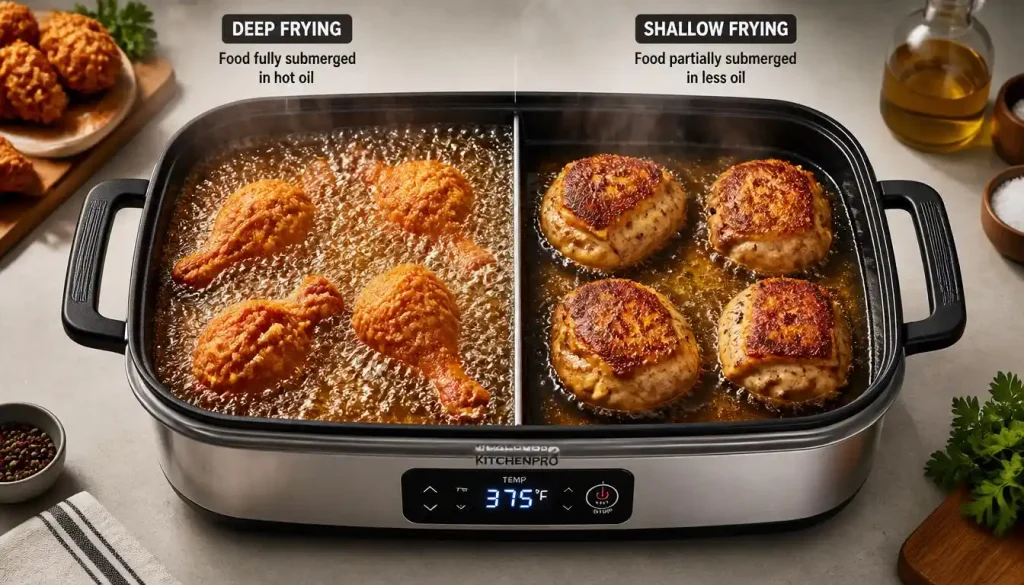
The terms deep frying and shallow frying are sometimes used interchangeably, but they describe different cooking methods.
What Is Deep Frying?
Deep frying means cooking food while it is completely or almost completely surrounded by hot oil.
Examples include:
- French fries
- Doughnuts
- Fried chicken
- Onion rings
- Mozzarella sticks
- Fritters
Because deep frying requires a substantial quantity of oil, the depth and capacity of the cooking vessel matter.
What Is Shallow Frying?
With shallow frying, only part of the food sits in oil. You turn the food during cooking so both sides become browned and crisp.
It works particularly well for:
- Chicken cutlets
- Fish fillets
- Pork chops
- Breaded vegetables
- Fritters
- Fried potatoes
Which Method Is Better for an Electric Skillet?
For many electric skillets, shallow frying is the safer and more practical option.
You need less oil, there is less chance of overflow, and the wide cooking surface makes it easy to arrange food in a single layer.
True deep frying should be reserved for electric skillets whose manufacturer specifically allows that use.
What Type of Electric Skillet Can Be Used for Frying?
A good skillet for oil-based frying should have a stable base, reliable temperature control, adequate depth, sturdy handles, and enough capacity to keep the hot oil well below the top edge.
How Deep Should an Electric Skillet Be?
There is no single safe depth that applies to every electric skillet.
The key measurement is not simply the depth of the pan—it is the maximum amount of oil the manufacturer says the appliance can safely hold.
When food enters hot oil, especially battered or frozen food, bubbling can make the oil level rise rapidly. A skillet that looks deep enough when empty may have much less usable capacity once the food is added.
Never fill an electric skillet close to the rim.
If the manual does not provide guidance for deep frying, do not guess.
Can You Deep Fry in a Nonstick Electric Skillet?
Possibly, but only when the manufacturer permits it.
Most modern electric skillets have nonstick surfaces. High temperatures, metal utensils, abrasive cleaning, and damaged coatings can shorten the life of that surface.
If your skillet has begun sticking during ordinary cooking, it may be worth checking our guide on why food starts sticking to an electric skillet before using it for high-temperature frying.
What Temperature Should You Deep Fry at in an Electric Skillet?
For many fried foods, 350–375°F (175–190°C) is a useful working range.
The exact temperature depends on what you are cooking.
| Food | Suggested Frying Range |
|---|---|
| French fries | 350–375°F / 175–190°C |
| Chicken pieces | About 350°F / 175°C |
| Fish | 350–375°F / 175–190°C |
| Onion rings | 350–375°F / 175–190°C |
| Doughnuts | Around 350–375°F / 175–190°C |
| Fritters | Around 350–375°F / 175–190°C |
These are cooking-oil temperatures, not safe internal food temperatures.
If you want to understand how dial settings relate to actual cooking heat, our electric skillet medium-heat and temperature guide explains the differences between Fahrenheit, Celsius, and typical skillet settings.
Is 350°F Hot Enough for Deep Frying?
For many foods, yes.
At around 350°F, moisture inside the food rapidly turns to steam while the exterior browns and becomes crisp.
If the temperature falls too low, the food may absorb more oil and become heavy or greasy.
Is 375°F Too Hot?
Not necessarily.
Some foods fry well around 375°F, especially foods that cook quickly. However, pushing the temperature higher is not automatically better.
If the oil begins smoking, stop heating it. Different cooking oils have different smoke points, which is why high-heat frying works best with oils suited to higher temperatures. Cleveland Clinic provides a useful overview of choosing cooking oils for high-heat cooking and frying.
How Much Oil Should You Put in an Electric Skillet?
There is no universal number of cups or inches that is safe for every electric skillet.
Use the amount specified by your appliance manufacturer.
For shallow frying, you may need only enough oil to cover part of the food. True deep frying requires considerably more, which is why it is not suitable for every electric skillet.
Remember that adding food causes the oil level to rise and bubble.
Never assume:
“If the oil fits in the skillet, it is safe.”
Capacity and safe frying capacity are not necessarily the same thing.
How Deep Should the Oil Be?
For true deep frying, there should be enough oil for the food to float or remain mostly submerged without touching the bottom continuously.
However, if achieving that depth would require filling your skillet beyond the manufacturer’s recommended level, do not deep fry in it.
Use a dedicated deep fryer or a suitable deep, heavy cooking vessel instead.
What Is the Best Oil for Deep Frying in an Electric Skillet?
Choose an oil that can handle frying temperatures without smoking excessively and that has a flavor appropriate for your food.
Common choices include:
Canola Oil
Canola oil has a relatively neutral flavor, making it useful for chicken, potatoes, fish, and many other foods.
Vegetable Oil
Refined vegetable oil is another convenient all-purpose option. It is widely available and usually has a neutral taste.
Peanut Oil
Peanut oil is popular for frying because it performs well at high temperatures and can produce crisp results.
Keep food allergies in mind if you are serving other people.
Sunflower Oil
Refined sunflower oil can also work well for higher-temperature cooking.
Penn State Extension notes that refined edible oils are commonly used for pan frying and deep-fat frying because refining improves their stability during high-temperature cooking. Learn more about edible oils and high-temperature frying
What Oils Should You Avoid?
Butter alone is not ideal for deep frying because its milk solids can burn at frying temperatures.
Unrefined oils with relatively low smoke points may also be poor choices for prolonged high-temperature frying.
If your oil starts smoking heavily, do not simply add the food and continue. Turn off the heat and allow the oil to cool safely.
How to Deep Fry in an Electric Skillet Step by Step
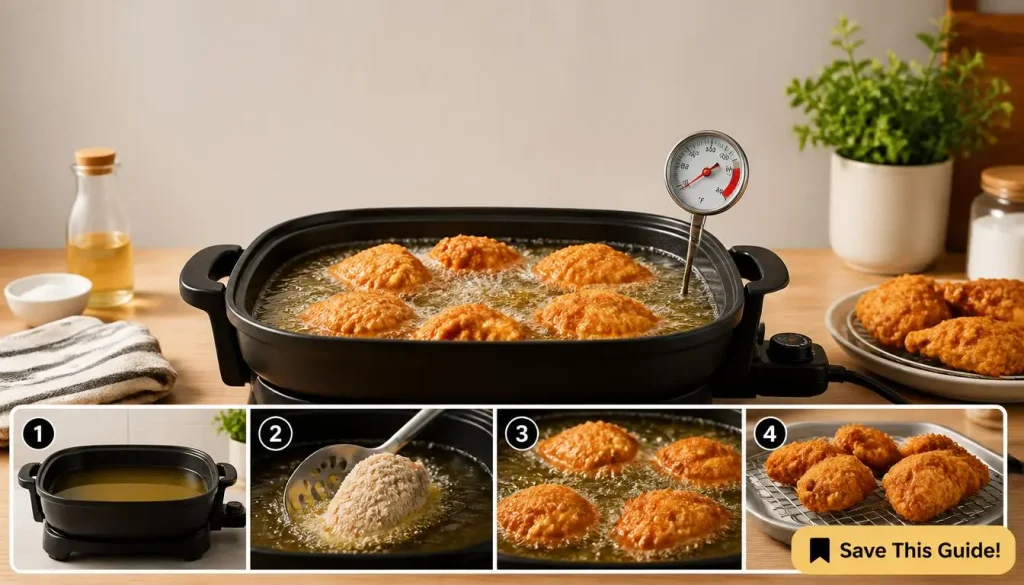
If your skillet manufacturer allows deep frying, the following method will help you control the process safely.
Step 1: Read the Manufacturer’s Manual
This comes before everything else.
Confirm that your skillet can be used for the type of frying you intend to do.
Check:
- Maximum temperature
- Oil restrictions
- Maximum capacity
- Recommended utensils
- Cleaning instructions
- Whether deep frying is permitted
Never override the manufacturer’s instructions with a generic recipe.
Step 2: Place the Skillet on a Stable Surface
Place the appliance on a flat, dry, heat-resistant surface.
Keep it away from:
- The edge of the counter
- Water
- Hanging towels
- Paper products
- Children and pets
Position the power cord so nobody can catch or pull it accidentally.
Step 3: Add the Correct Amount of Oil
Add oil while the skillet is cool.
Stay below any manufacturer-specified maximum oil level and leave plenty of room for bubbling when food is added.
Step 4: Preheat the Oil
Set the temperature according to your recipe, usually around 350°F to 375°F for common fried foods.
Allow the oil to heat gradually.
Do not walk away while oil is heating.
Step 5: Check the Oil Temperature
A thermometer is the easiest way to confirm the real oil temperature.
Built-in skillet thermostats are useful, but the dial setting does not always equal the exact temperature of the oil.
Step 6: Prepare and Dry the Food
Excess surface moisture causes hot oil to splatter.
Pat meat, vegetables, and other fresh ingredients dry when appropriate before adding breading or batter.
Be particularly careful with wet and icy foods.
Step 7: Lower the Food Into the Oil Carefully
Use long-handled tongs, a frying spider, or another appropriate heat-safe utensil.
Lower food gently instead of dropping it.
Dropping food can splash hot oil onto your hands, the counter, or the appliance controls.
Step 8: Fry in Small Batches
Give each piece enough room.
Overcrowding causes the oil temperature to drop quickly and can leave food oily rather than crisp.
Small batches also give you better control over bubbling and oil level.
Step 9: Monitor the Temperature
Check the oil temperature between batches.
If it drops significantly, give it time to recover before adding more food.
Step 10: Check the Food for Doneness
Color alone cannot reliably tell you whether meat is safe.
Use a food thermometer for meat, poultry, and fish.
According to the USDA, poultry should reach 165°F (73.9°C), ground meats 160°F (71.1°C), and fish 145°F (62.8°C). Whole cuts of beef, pork, lamb, and veal should reach at least 145°F (62.8°C) followed by a three-minute rest. USDA safe minimum internal temperature chart
Step 11: Drain the Food
Transfer fried food to a wire rack or a plate lined appropriately for draining.
A wire rack often helps maintain crispness because steam can escape instead of collecting underneath the food.
Step 12: Turn Off the Skillet and Let the Oil Cool
Unplug or switch off the appliance according to its instructions.
Do not move a skillet containing hot oil.
Allow the oil and appliance to cool completely before straining, storing, disposing of the oil, or cleaning the skillet.
How Long Does Oil Take to Heat in an Electric Skillet?
Oil often takes several minutes to reach frying temperature, but there is no reliable universal heating time.
It depends on:
- The skillet’s wattage
- Oil quantity
- Starting oil temperature
- Pan size
- Desired temperature
- Thermostat accuracy
- Room temperature
Many electric skillets need roughly several minutes to preheat, but temperature is a better indicator than time.
Do not assume the oil is ready just because five or ten minutes have passed.
How Do You Know When Oil Is Ready for Frying?
The safest and most reliable approach is to use a thermometer suitable for hot oil.
For most recipes in this article, you are looking for approximately 350–375°F.
Can You Deep Fry Without a Thermometer?
You can fry without one, but you lose precision.
A tiny amount of breading dropped into properly heated oil should begin sizzling promptly without burning immediately. However, this is only a rough visual clue.
Do not test hot frying oil by splashing water into it.
Water can instantly turn to steam and throw hot oil out of the skillet.
A thermometer removes much of the guesswork.
How to Maintain the Right Oil Temperature While Frying
Getting the oil hot is only the beginning. Keeping it within the right range is what produces consistently crisp food.
Fry Smaller Batches
Every piece of cool food absorbs heat from the oil.
Adding too much food at once can dramatically lower the temperature.
Wait Between Batches
Give the skillet time to recover before adding another batch.
Check the thermometer rather than immediately refilling the pan.
Do Not Keep Turning the Dial Up
If the temperature drops after adding food, that does not always mean you need to turn the skillet to maximum heat.
Give the thermostat time to respond.
Excessive adjustment can cause the oil to overshoot your target temperature once the food is removed.
Should You Put the Lid On While Deep Frying?
During normal deep frying, it is generally better not to cover hot frying oil unless your appliance manufacturer specifically instructs you to do so.
A lid can trap moisture and condensation. Water and hot oil are a dangerous combination.
There is one very different situation in which a lid may become important: a cooking-oil fire.
The National Fire Protection Association advises staying in the kitchen whenever you fry with oil or grease. For a pan fire, its guidance includes sliding a lid over the pan, turning off the heat, and allowing the pan to cool. NFPA kitchen fire-safety guidance
Never pour water onto burning cooking oil.
What Foods Can You Fry in an Electric Skillet?
If your model is suitable for the technique, an electric skillet can handle many familiar fried foods.
Chicken
Chicken pieces, wings, tenders, and cutlets work particularly well because an electric skillet gives you plenty of cooking surface.
French Fries
French fries need stable oil temperature and enough room to move.
Cook them in small batches rather than filling the entire skillet at once.
Fish
Breaded or battered white fish can cook quickly in hot oil.
Fish generally requires less cooking time than thick chicken pieces, so monitor it closely.
Onion Rings
Keep batter reasonably dry on the outside before lowering rings into the oil.
Avoid adding a large batch all at once.
Doughnuts
Doughnuts cook quickly and usually need to be turned for even browning if they are not fully floating.
Fritters
Vegetable, corn, apple, and other fritters work well in controlled batches.
Mozzarella Sticks
Keep them cold until frying and avoid overcooking, which can cause the cheese to escape through the coating.
How to Fry Chicken in an Electric Skillet
Chicken deserves special attention because it is one of the most popular foods to fry in an electric skillet.
Heat the oil to around 350°F and arrange the chicken so the pieces are not touching.
Do not judge doneness only by the golden-brown crust. Thick chicken can brown outside before the center is fully cooked.
The USDA recommends that all poultry reach a minimum internal temperature of 165°F (73.9°C) measured with a food thermometer.
For the complete preparation, breading, temperature, and cooking process, follow our detailed guide on how to fry chicken in an electric skillet.
Can You Fry Frozen Food in an Electric Skillet?
Some commercially frozen foods, including certain French fries and appetizers, are designed to be cooked from frozen.
However, frozen food introduces an additional problem: ice.
Loose ice crystals and excess moisture can cause violent bubbling and splattering when they hit hot oil.
Before frying:
- Follow the food package instructions
- Remove loose surface ice when possible
- Do not add visibly wet food
- Cook small quantities at a time
- Lower food into the oil carefully
- Keep your hands and face away from the skillet
Never pour water into hot oil to cool it down.
How to Prevent Oil From Splattering or Boiling Over
A few habits make a major difference.
First, keep food reasonably dry before frying.
Second, never overfill the skillet with oil.
Third, leave enough empty capacity for oil to expand and bubble when food is added.
Fourth, use smaller batches.
Finally, lower food gently with long-handled utensils rather than dropping it from above the oil.
If the oil begins rising dangerously, do not attempt to move the skillet. Stop adding food and turn off the heat if it is safe to do so.
Why Does Fried Food Turn Greasy in an Electric Skillet?
Greasy fried food usually means something went wrong with temperature or batch size.
The Oil Was Too Cool
Food placed into underheated oil can absorb more oil before its exterior becomes crisp.
The Skillet Was Overcrowded
Adding too much food can cause a large temperature drop.
You Added the Next Batch Too Soon
Allow the oil to return to the target temperature before continuing.
The Coating Was Too Wet or Heavy
Excess batter can absorb oil or fall off during frying.
The Food Was Not Drained Properly
Move cooked food from the oil promptly and allow excess oil to drain.
These small adjustments usually improve texture more than simply increasing the temperature.
Electric Skillet Deep-Frying Safety Tips
Hot oil deserves your full attention.
Follow these basic rules every time you fry:
- Read your appliance manual first
- Never leave hot oil unattended
- Keep children and pets away
- Keep water away from frying oil
- Do not overfill the skillet
- Never move an electric skillet full of hot oil
- Keep the cord away from walkways and counter edges
- Use long, heat-resistant utensils
- Add food slowly
- Avoid cooking excessively large batches
- Stop heating oil if it begins smoking heavily
- Keep combustible items away from the appliance
- Know what to do if an oil fire starts
- Never throw water onto a grease or cooking-oil fire
The NFPA specifically advises remaining in the kitchen while frying or cooking with oil or grease.
Common Mistakes When Frying in an Electric Skillet
Even experienced cooks can run into problems when switching from a regular frying pan or deep fryer.
Mistake 1: Assuming Every Electric Skillet Can Deep Fry
Some cannot.
Always verify first.
Mistake 2: Filling the Pan Too High
You need to account for the increase in oil level when food enters the skillet.
Mistake 3: Adding Wet Food
Water causes splattering and can create a serious burn hazard.
Mistake 4: Overcrowding
Too much food lowers the oil temperature and reduces crispness.
Mistake 5: Guessing the Oil Temperature
A thermometer gives you much better control.
Mistake 6: Moving the Skillet While the Oil Is Hot
Leave the appliance in place until everything is completely cool.
Mistake 7: Ignoring a Damaged Nonstick Surface
If the coating is peeling or severely damaged, stop using the skillet according to the manufacturer’s guidance.
Electric Skillet vs. Deep Fryer: Which Is Better?
Both appliances can fry food, but they are designed differently.
| Feature | Electric Skillet | Dedicated Deep Fryer |
|---|---|---|
| Pan frying | Excellent | Limited |
| Shallow frying | Excellent | Possible |
| True deep frying | Model-dependent | Designed for it |
| Temperature control | Good | Usually very good |
| Oil capacity | Limited/model-dependent | Higher |
| Splatter containment | More exposed | Often better |
| Cooking surface | Wide | Usually narrower/deeper |
| Versatility | Very high | Mostly frying |
| Storage value | One appliance, many uses | Specialized appliance |
| Best for | General cooking + occasional frying | Frequent deep frying |
If you mainly cook pancakes, eggs, chicken, burgers, vegetables, casseroles, and one-pan meals, an electric skillet is more versatile.
If you regularly want to completely submerge large batches of fries, chicken, or battered foods, a dedicated deep fryer is usually the more appropriate tool.
Pros and Cons of Frying in an Electric Skillet
Advantages
Good temperature control: You can select a target heat rather than constantly adjusting a burner.
Large surface area: You can arrange multiple pieces without stacking them.
Versatility: The same appliance can sauté, fry, simmer, brown, and cook many one-pan meals.
Portable cooking: It provides an extra cooking surface when your stovetop is full.
Disadvantages
Not every model permits deep frying: This is the biggest limitation.
Shallower sides: Compared with a dedicated fryer, many electric skillets have less room for bubbling oil.
Open cooking surface: Splatter can be harder to contain.
Thermostat cycling: Oil temperature may rise and fall during cooking.
No frying basket: Removing small foods such as fries may be less convenient.
How to Cool, Strain, Store, and Reuse Frying Oil
Never handle oil immediately after frying.
Let it cool completely.
If the oil is still in good condition and you plan to reuse it, strain out food particles before storage.
Penn State Extension recommends allowing used frying oil to cool completely before transferring it to a container and removing food particles before storage. Its food-safety guidance also notes that oil showing unusual foaming, significant color changes, off flavors, or strange odors should not be reused. Penn State Extension guidance on reusing frying oil
Do not mix very old, deteriorated oil with fresh oil just to make it appear usable again.
How to Dispose of Used Frying Oil
Do not pour a large amount of cooking oil down your sink.
Oil and grease can contribute to clogged household plumbing and sewer systems.
Instead:
- Let the oil cool completely.
- Pour it into a sealable disposable container.
- Check local waste or recycling rules.
- Dispose of it according to your local authority’s instructions.
Some communities also have used cooking-oil recycling programs.
How to Clean an Electric Skillet After Frying
Always let the appliance cool before cleaning.
Then:
- Unplug the skillet.
- Remove the temperature control or probe if your model requires it.
- Remove cooled oil.
- Wipe away remaining grease.
- Wash the cooking surface according to the manufacturer’s instructions.
- Use non-abrasive tools on nonstick coatings.
- Dry the connection area completely before reassembling or using the appliance.
Do not assume the entire electric skillet can be submerged in water or placed in a dishwasher.
Some models allow certain parts to be immersed while others do not.
Your manual should make that distinction clear.
Frequently Asked Questions About Can You Deep Fry in an Electric Skillet
Can you deep fry in an electric frying pan?
You can deep fry in some electric frying pans, but only when the manufacturer permits it and the pan has enough depth and safe oil capacity. “Electric frying pan” and “electric skillet” usually describe the same general appliance.
Can you deep fry chicken in an electric skillet?
Yes, if your skillet is approved for the amount of oil you intend to use. Maintain the correct oil temperature and cook chicken to an internal temperature of at least 165°F (73.9°C).
For detailed instructions, see our guide to frying chicken in an electric skillet.
Can you fry French fries in an electric skillet?
Yes. French fries can be shallow-fried or deep-fried depending on the skillet and recipe. Fry in small batches so the oil temperature does not fall too quickly.
Can you fry fish in an electric skillet?
Yes. Electric skillets work well for breaded, battered, and pan-fried fish. The USDA recommends cooking fish to a minimum internal temperature of 145°F (62.8°C).
Can you fry doughnuts in an electric skillet?
You can if your skillet safely accommodates the necessary oil. Keep the oil temperature controlled and fry only a few doughnuts at a time.
What temperature should an electric skillet be for frying?
Many fried foods cook well at approximately 350–375°F (175–190°C). The exact temperature depends on the recipe and food.
How much oil should you put in an electric skillet?
Use only the amount permitted by your specific appliance manufacturer. There is no universal safe oil level for every electric skillet.
How long does oil take to heat in an electric skillet?
Usually several minutes, but skillet wattage, oil quantity, starting temperature, and thermostat design all affect preheating time. Use oil temperature rather than the clock as your main guide.
Can you use vegetable oil in an electric skillet?
Yes. Refined vegetable oil is commonly used for frying because of its neutral flavor and suitability for higher-temperature cooking.
Can you use canola oil?
Yes. Canola oil is another practical choice for many fried foods.
Can you use peanut oil?
Yes, provided peanut allergies are not a concern for anyone eating the food.
Can you deep fry without a thermometer?
It is possible, but a suitable thermometer provides much better control and removes much of the guesswork.
Never test hot oil by splashing water into it.
Should you put the lid on while frying?
Generally, keep the lid off during active deep frying unless your manufacturer’s instructions say otherwise. Covering hot oil can trap condensation.
A lid may be used differently in a cooking-oil fire emergency according to appropriate fire-safety guidance.
Can you deep fry frozen food?
Some frozen foods are designed to be fried directly from frozen. Follow the package instructions and remove loose ice when possible. Be especially careful because ice and moisture can cause intense splattering.
Is an electric skillet safer than a deep fryer?
Not necessarily.
A dedicated deep fryer is specifically designed to contain a larger volume of oil, while many electric skillets are primarily designed for pan or shallow frying.
The safest appliance is one being used exactly as its manufacturer intended.
Can you reuse frying oil?
Yes, if the oil has been handled and stored properly and shows no signs of deterioration. Cool it completely, strain out food particles, and store it appropriately. Discard oil that develops unusual foaming, odors, flavors, or significant color changes.
Final Verdict: Should You Deep Fry in an Electric Skillet?
You can deep fry in an electric skillet when the manufacturer specifically allows the appliance to be used that way. A deep-sided skillet with reliable temperature control can make frying chicken, fries, fish, onion rings, fritters, and similar foods convenient.
But the fact that an electric skillet can reach 350°F or 375°F does not automatically make it a deep fryer.
Before adding a large quantity of oil, check the manual. If your skillet is shallow, provides no safe deep-frying instructions, or specifically says not to deep fry, use it for pan-frying or shallow-frying instead.
When frying is permitted, keep the oil around the temperature required by your recipe, cook in small batches, keep food reasonably dry, never leave the skillet unattended, and use a thermometer when food safety depends on internal temperature.
Used correctly, an electric skillet can be an excellent frying tool. Used beyond its design limits, the extra oil simply is not worth the risk.

“I believe great cooking starts with the right tools, trusted advice, and a little confidence in the kitchen.”
Hi, I’m Emma Carter. My love for cooking began in my grandmother’s kitchen, where I learned that every great meal starts with simple ingredients and the right cookware. Over the years, I’ve spent countless hours researching, testing, and comparing kitchen appliances, cookware, coffee makers, air fryers, and other everyday kitchen essentials.
Here at KiCook, my goal is to make your buying decisions easier with honest product reviews, practical buying guides, and easy-to-follow cooking tips. Whether you’re upgrading your kitchen or searching for the best appliance for your home, I focus on providing clear, reliable, and research-backed information you can trust.
When I’m not testing new kitchen gadgets or writing in-depth guides, you’ll usually find me trying new recipes, visiting local farmers’ markets, or enjoying a quiet cup of coffee while planning my next kitchen project.