
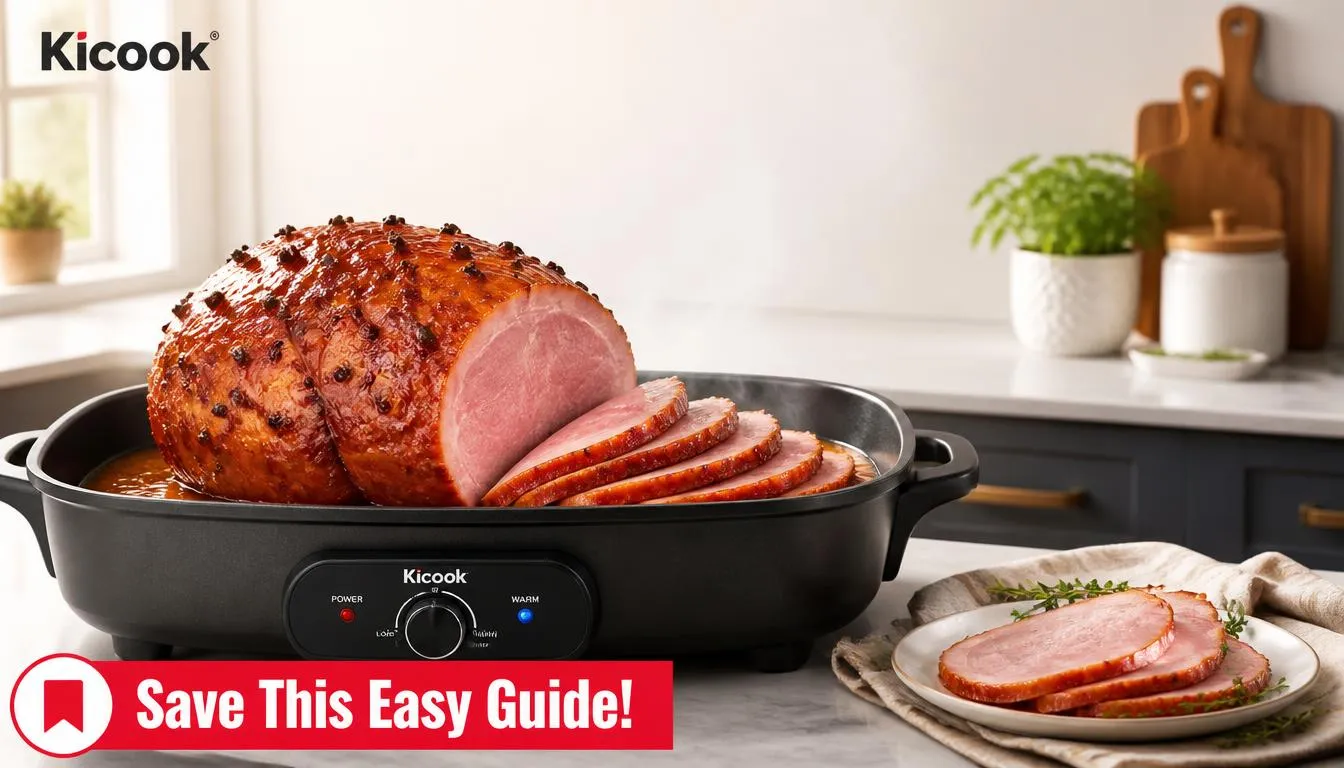
Yes, you can cook a ham in an electric skillet, and for a smaller ham or ham portion, it can be a surprisingly practical alternative to using the oven. A deep electric skillet with adjustable temperature control and a well-fitting lid can hold steady heat while keeping moisture around the meat.
The important part is knowing what kind of ham you have. A fully cooked ham only needs safe reheating, while a fresh or cook-before-eating ham needs to be cooked properly all the way through. The size of your skillet, the ham’s thickness, the temperature setting, and the final internal temperature all matter.
This guide explains how to cook ham in an electric skillet step by step, including temperature, cooking time, glazing, moisture control, food safety, spiral ham, fresh ham, ham steaks, and common mistakes to avoid.
If you are still discovering everything this countertop appliance can handle, see KiCook’s guide to what you can cook in an electric skillet.
Can You Cook a Ham in an Electric Skillet?
Yes. You can cook or reheat many types of ham in an electric skillet as long as the ham fits comfortably, the lid can close properly, and your skillet is designed for the cooking method you plan to use.
Electric skillets work well for ham because they provide controlled bottom heat while the covered pan traps heat and moisture around the meat. Some deep electric skillets can even be used for roast-style cooking with a rack.
However, an electric skillet is not exactly the same as an oven. Most of its heat comes from underneath rather than surrounding the food from every direction. That means temperature management and using a meat thermometer are especially important.
KiCook’s guide on whether an electric skillet can be used as an oven explains this difference in more detail.
Before You Start: Check What Type of Ham You Have
Before turning on the skillet, read the package label.
This step matters more than the recipe because the word “ham” can describe several products that require very different preparation.
Fully Cooked or Ready-to-Eat Ham
A fully cooked ham has already been cooked during processing. Depending on the product and local food-safety guidance, it may be safe to eat without reheating.
If you put one in an electric skillet, your main goal is usually to warm it without drying it out.
Cook-Before-Eating Ham
A ham labelled “cook before eating” has not received enough heat during processing to be considered ready to eat.
Treat it as meat that requires proper cooking. Follow the package instructions and verify doneness with a food thermometer.
Fresh Ham
Fresh ham is uncured raw pork from the leg. It does not have the same salty, smoky flavour as traditional cured ham.
Because it is raw, it must be cooked to a safe internal temperature rather than simply warmed.
Smoked Ham
Do not assume that “smoked” automatically means fully cooked.
Some smoked hams are ready to eat, while others are cook-before-eating products. The package label is the easiest way to know which one you have.
The USDA specifically distinguishes between fresh, cook-before-eating, cooked, picnic, country, and other ham types, which is why checking the label should always come before choosing a cooking time.
What Types of Ham Work in an Electric Skillet?
Several types work well, but some are easier than others.
| Ham Type | Electric Skillet Suitable? | Best Use |
|---|---|---|
| Fully cooked boneless ham | Yes | Gentle reheating |
| Bone-in ham portion | Yes, if it fits | Reheating or cooking |
| Spiral-sliced ham | Yes | Gentle covered reheating |
| Fresh ham | Yes, with careful temperature monitoring | Full cooking |
| Cook-before-eating ham | Yes | Full cooking |
| Smoked ham | Yes | Depends on package label |
| Half or picnic-style ham | Often | Covered cooking |
| Ham steak | Excellent | Quick skillet cooking |
A smaller boneless or half ham is generally easier to handle than a large whole ham because you need enough space around the meat for the lid to close.
What Size Ham Can You Cook in an Electric Skillet?
There is no universal maximum ham weight because electric skillets come in different shapes and depths.
Instead of choosing by weight alone, check three things:
- The ham must fit inside the cooking surface without being forced against the sides.
- The lid must close completely.
- There should be enough space for a rack if your cooking method requires one.
A smaller ham portion is usually more practical than a large holiday-sized whole ham.
If the ham is too tall for the lid or barely fits into the pan, use a smaller portion rather than trying to force it inside. A lid that cannot close properly will release heat and moisture and make cooking less predictable.
Bone-in hams also require more room than similarly weighted boneless hams.
What Temperature Should You Cook Ham at in an Electric Skillet?
This is where many electric skillet ham recipes become confusing.
There are actually two different temperatures to think about:
- the temperature setting on the electric skillet
- the internal temperature of the ham
They are not the same thing.
Electric Skillet Temperature
There is no single skillet temperature that works for every ham and every electric skillet.
For example, West Bend has published electric skillet instructions that use 225°F (107°C) for covered rack-roasting of fresh, smoked, or canned ham. The same manufacturer’s instructions use around 325°F (163°C) for skillet-browning ham slices.
That difference shows why you should not blindly set every ham to 325°F or any other fixed temperature.
Your safest approach is to:
- check your electric skillet manual
- follow the ham package instructions
- use the appropriate method for the size and type of ham
- verify the centre temperature with a food thermometer
If your temperature dial uses words instead of numbers, KiCook’s electric skillet medium-heat temperature guide can help you understand how common dial settings relate to actual heat.
Ham Internal Temperature
The internal temperature tells you whether the meat has reached the appropriate level of doneness or reheating.
For U.S. readers, USDA guidance says fresh ham and cook-before-eating ham should reach 145°F (63°C) followed by at least a 3-minute rest. USDA-inspected fully cooked packaged ham being reheated should generally reach 140°F (60°C), while leftover or repackaged cooked ham should be reheated to 165°F (74°C).
Food-safety guidance differs somewhat by country. Health Canada recommends 71°C (160°F) for whole cuts of pork including ham, while the UK Food Standards Agency advises cooking food to combinations such as 70°C for two minutes and following package instructions. Australian guidance generally recommends using a food thermometer and cooking food thoroughly; Healthdirect lists 70°C for pork.
Because this guide serves readers in several countries, follow the product label and your local food-safety authority when its instructions differ from another country’s recommendation.
Quick Ham Temperature Guide
| Situation | What Matters |
|---|---|
| Raw/fresh ham | Cook to the temperature required by your local authority/package |
| Cook-before-eating ham | Cook fully according to label instructions |
| Factory-packaged fully cooked ham | Reheat only if desired; follow package/local guidance |
| Leftover cooked ham | Reheat thoroughly |
| Repackaged cooked ham | Treat according to local reheating guidance |
| Spiral fully cooked ham | Heat gently to avoid drying |
The food thermometer is more reliable than colour, cooking time, or guesswork.
How Long Does Ham Take in an Electric Skillet?
The honest answer is: it depends on the ham and the skillet.
Whole ham cooking time can vary dramatically depending on:
- weight
- thickness
- bone-in or boneless construction
- fresh versus precooked ham
- starting temperature
- skillet depth
- temperature setting
- use of a rack
- how often the lid is opened
For that reason, do not treat a minutes-per-pound estimate from a conventional oven recipe as a guaranteed electric skillet cooking time.
A better approach is to cook according to your appliance’s instructions and begin checking the internal temperature before you expect the ham to be finished.
Ham steaks are much faster. One West Bend skillet guide, for example, instructs cooks to brown a ¾- to 1-inch ham slice at 325°F for roughly 8 to 10 minutes per side before glazing. Treat figures like these as model-specific guidance rather than a universal rule.
The clock tells you when to check. The thermometer tells you when the ham is ready.
What You Need to Cook Ham in an Electric Skillet
You do not need complicated equipment.
Equipment
- Deep electric skillet with lid
- Temperature control
- Food thermometer
- Heat-safe tongs
- Basting brush or spoon
- Roasting rack, if supplied and approved for your skillet
Basic Ingredients
- Ham
- Small amount of water, broth, apple juice, or pineapple juice if needed
- Optional brown sugar
- Honey or maple syrup
- Mustard
- Ground black pepper
- Optional pineapple slices
- Optional cloves or warm spices
The exact ingredients depend on whether you want a simple savoury ham or a sweet glazed version.
Should You Use a Rack When Cooking Ham in an Electric Skillet?
A rack can be useful for a larger ham because it lifts the meat away from direct contact with the hottest part of the pan.
Some electric skillet manufacturers specifically include rack-roasting instructions. West Bend, for example, has instructed users to place ham on the supplied rack, cover the skillet, and roast at a controlled temperature.
However, not every electric skillet comes with a rack or is designed for this type of cooking.
Do not improvise by placing a random metal accessory inside the skillet unless your manufacturer says it is suitable.
For ham steaks and thin slices, you normally cook directly on the skillet surface.
How to Cook a Ham in an Electric Skillet Step by Step

The following method is a flexible framework for a ham portion that fits comfortably inside a deep electric skillet.
Always adjust it to match your appliance manual and ham package instructions.
Step 1: Read the Ham Label
Determine whether the ham is:
- fully cooked
- ready to eat
- fresh
- smoked
- cook before eating
This determines whether you are reheating the ham or actually cooking raw meat.
Step 2: Thaw the Ham if Necessary
For the most predictable result, thaw frozen ham safely before cooking.
The USDA lists refrigerator thawing, cold-water thawing in leak-proof packaging, and microwave thawing as acceptable methods. Refrigerator thawing may take around 4 to 6 hours per pound, while cold-water thawing takes roughly 30 minutes per pound and requires changing the water regularly.
Do not leave frozen ham on the counter to thaw at room temperature.
Step 3: Prepare the Ham
Remove packaging that is not intended for cooking.
If the ham has a thick fat layer, you can lightly score the surface in a shallow diamond pattern. Avoid cutting deeply into the meat.
Scoring helps glaze cling to the surface and can improve presentation.
Step 4: Prepare the Electric Skillet
Check your manual for the recommended setup.
For rack-roasting, install the manufacturer’s rack before adding the ham.
If you are warming a ham directly in the skillet, a small amount of liquid may help reduce drying and prevent sugary drippings from scorching.
Step 5: Place the Ham in the Skillet
Set the ham in the centre with enough clearance for the lid.
If using a rack, position the meat securely so it will not roll or press against the lid.
Do not overcrowd the pan with vegetables at this stage.
Step 6: Add a Small Amount of Liquid if Needed
Pour a modest amount of water, broth, apple juice, or pineapple juice into the bottom.
You do not need to submerge the ham.
The goal is to create moisture, not boil the meat.
Some manufacturer ham-roasting instructions suggest about ½ cup of water when needed, but the correct amount depends on skillet size and cooking method.
Step 7: Cover and Cook
Put the lid on and maintain the temperature recommended for your skillet and ham type.
Try not to lift the lid every few minutes. Each time you open it, heat and steam escape.
Electric skillets regulate heat by cycling their heating element on and off. That cycling is normal.
Step 8: Baste Occasionally
If the ham looks dry, spoon some of the cooking liquid over the surface.
Do not continually open the lid just to baste. Once or twice during a longer cooking session is often enough.
Step 9: Add the Glaze Near the End
Sugar burns easily.
A glaze made with brown sugar, honey, maple syrup, or fruit juice should usually be added toward the end rather than at the beginning of a long cooking period.
Brush on a thin layer, cover again, and allow it to become glossy.
Step 10: Check Internal Temperature
Insert a clean food thermometer into the thickest part of the ham.
Do not rely on browned edges or hot cooking liquid as proof that the centre is ready.
Step 11: Rest Before Slicing
Once the ham reaches the required temperature, turn off the skillet and carefully remove it.
Allow raw/fresh ham the required resting period under your applicable safety guidance. Resting also helps the juices settle before carving.
Where Should You Insert the Meat Thermometer?
Insert the thermometer into the thickest part of the meat.
Avoid:
- touching the bone
- resting the probe against the skillet
- inserting it into a large pocket of fat
Bone and fat can give misleading readings.
Manufacturer electric skillet instructions for ham similarly advise placing the thermometer in the thickest portion without letting the tip touch bone or sit in fat.
For a large or irregularly shaped ham, checking two or three thick areas can give you more confidence that it has heated evenly.
How Much Water Should You Add When Cooking Ham?
Usually, very little.
You are not trying to boil the ham.
For a covered ham portion, approximately ¼ to ½ cup of liquid may be enough in many skillets, but use your appliance instructions as the final guide.
Possible liquids include:
- water
- apple juice
- pineapple juice
- low-sodium broth
Juice gives the cooking liquid a slightly sweeter flavour, which works particularly well with brown sugar or mustard glaze.
If the ham releases a lot of liquid on its own, you may not need to add much at all.
Should You Cover Ham While Cooking It?
For a thick ham portion, generally yes.
The lid traps heat and moisture, helping the inside warm while reducing surface drying.
Covered cooking is especially useful for:
- fully cooked ham
- spiral ham
- bone-in portions
- fresh ham
- cook-before-eating ham
For a ham steak, you may cook uncovered when browning the surfaces, depending on your recipe.
Do You Need to Flip Ham in an Electric Skillet?
A large ham normally does not need frequent flipping when it is being cooked covered on a roasting rack.
Ham steaks are different.
Because they sit directly on the hot skillet surface, flip them so both sides brown and heat evenly.
If you are cooking a thick ham portion directly against the pan rather than on a rack, follow the instructions for your specific recipe and appliance.
How to Cook a Fully Cooked Ham in an Electric Skillet
Fully cooked ham is the easiest type to prepare because you are usually reheating rather than cooking raw pork.
For best results:
- Check that the ham fits comfortably.
- Add a small amount of moisture if necessary.
- Cover the skillet.
- Warm gently according to your appliance instructions.
- Avoid excessive heat.
- Check the centre temperature.
- Glaze near the end.
The main challenge is not safety from undercooking raw meat—it is preventing the ham from becoming dry, salty, and tough.
According to USDA guidance, factory-packaged fully cooked hams may be eaten cold if labelled accordingly. If reheated, USDA guidance for federally inspected packaged ham uses 140°F (60°C); repackaged or leftover ham should reach 165°F (74°C).
How to Cook Fresh Ham in an Electric Skillet
Fresh ham requires more attention because it is raw pork.
Start by confirming that your electric skillet is deep enough and approved for roast-style cooking.
Then:
- Thaw the ham fully.
- Season the surface.
- Place it on the appropriate rack if your model uses one.
- Cover.
- Cook at the manufacturer’s recommended setting.
- Monitor the internal temperature.
- Rest the meat before carving.
Do not use a fully cooked ham reheating recipe for fresh ham.
For U.S. readers, USDA guidance sets 145°F (63°C) with at least a three-minute rest for fresh ham. Other countries may use different pork-temperature recommendations, so follow your local guidance and product label.
How to Reheat Spiral Ham Without Drying It Out
Spiral ham needs gentle treatment because every cut surface can lose moisture.
Keep the ham covered and use moderate heat rather than trying to brown it aggressively.
A small amount of liquid in the bottom of the skillet can help maintain moisture.
Avoid pulling the slices apart while heating because that exposes more surface area.
Add glaze late in the reheating process.
USDA notes that spiral-sliced fully cooked ham is safe to eat cold when appropriately packaged and that reheating can dry the meat. Its conventional-oven guidance recommends keeping spiral ham covered; individual slices can also be warmed in a skillet.
How to Cook Ham Steak in an Electric Skillet
Ham steak is one of the easiest ways to enjoy electric skillet ham because it cooks quickly.
Simple Method
- Preheat the skillet according to your recipe or appliance guide.
- Lightly grease the cooking surface if necessary.
- Place the ham steak flat in the skillet.
- Brown the first side.
- Flip once.
- Brown the second side.
- Add glaze during the final minutes.
- Verify that any required reheating or cooking temperature has been reached.
For a sweet-and-savoury version, add pineapple rings after browning the ham and finish with a brown sugar-orange glaze.
A West Bend electric skillet recipe uses a ¾- to 1-inch ham slice at about 325°F, browning each side before preparing an orange, brown sugar, and pineapple glaze in the same pan.
Easy Brown Sugar Ham Glaze
This simple glaze works well with fully cooked ham, spiral ham, or ham steak.
Ingredients
- ½ cup brown sugar
- 2 tablespoons honey or maple syrup
- 1 tablespoon Dijon or yellow mustard
- 1 to 2 tablespoons apple or pineapple juice
- Pinch of black pepper
Directions
Combine everything in a small bowl until smooth.
Brush a thin layer over the ham during the final part of cooking.
Keep the temperature under control after adding the glaze because brown sugar and honey can scorch if exposed to intense bottom heat for too long.
If you want a thicker coating, add a second light layer shortly before serving instead of pouring a large amount over the meat at once.
Pineapple Glaze Variation
For a classic sweet ham flavour, replace the apple juice with pineapple juice.
You can also add pineapple rings to the skillet near the end.
A simple combination is:
- brown sugar
- pineapple juice
- Dijon mustard
- honey
- small pinch of cinnamon or ground cloves
Keep spices subtle. Ham already has a strong savoury flavour, and too much clove or cinnamon can easily dominate it.
How to Keep Ham Moist in an Electric Skillet
Dry ham usually comes from too much heat or too much cooking time.
Use these techniques:
Keep the Lid On
The lid traps steam and slows moisture loss.
Use Moderate Heat
Turning the skillet up does not necessarily cook a thick ham better. It may simply overcook the outside before the centre is properly heated.
Add a Little Liquid
Water, broth, or juice in the bottom of the pan can create a more humid cooking environment.
Do Not Overcook
Once the ham reaches the temperature required for its type, continuing to heat it only pushes out more moisture.
Glaze Late
Sugar can burn before the centre of a thick ham is ready.
Rest Before Cutting
Give the meat a few minutes before carving.
Slice Only What You Need
A whole warmed ham stays moist longer than one that has been completely sliced and left exposed.
Can You Cook Potatoes and Vegetables With the Ham?
Yes, depending on the size of your skillet.
Potatoes, carrots, onions, green beans, pineapple, and apples can all pair well with ham.
For rack-style cooking, some manufacturer instructions even mention placing potatoes around meat when enough space is available.
The challenge is timing.
A large potato may take much longer than sliced carrots or green beans. Add vegetables according to how quickly they cook.
Do not pack the skillet so tightly that the lid will not close or heat cannot circulate.
Good combinations include:
- ham + baby potatoes + onions
- ham + carrots + potatoes
- ham + green beans
- ham + pineapple
- ham + apples + onions
Common Mistakes When Cooking Ham in an Electric Skillet
Avoiding a few simple mistakes can make the difference between juicy ham and a dry, burned result.
1. Not Checking the Label
A fresh ham and a fully cooked ham should not be treated the same way.
2. Using a Ham That Is Too Large
If the lid cannot close, choose a smaller portion.
3. Assuming Every Electric Skillet Uses the Same Temperature
Different models heat differently.
Follow your owner’s manual whenever possible.
4. Confusing Skillet Temperature With Meat Temperature
Setting the skillet to 225°F does not mean the centre of the ham has reached 225°F.
Always check the meat separately.
5. Adding Too Much Water
Too much liquid turns the cooking process into simmering or boiling.
You only need enough to support moisture.
6. Adding Sugar Too Early
Brown sugar, maple syrup, and honey can burn on the hot skillet surface.
Glaze near the end.
7. Opening the Lid Constantly
Each peek releases heat and steam.
8. Relying Only on Cooking Time
Two hams of the same weight may still heat differently because of shape, bone structure, and starting temperature.
9. Putting the Thermometer Against Bone
That can produce an inaccurate reading.
10. Overheating a Fully Cooked Ham
More heat does not make precooked ham better. It usually makes it drier.
What if the Electric Skillet Keeps Cycling On and Off?
Normal thermostat cycling is part of how an electric skillet maintains its selected temperature.
The heating element switches on when the pan cools and switches off once it reaches the target range.
However, repeated long shutdowns, overheating, a burning smell, sparks, or a hot electrical cord are not normal.
If your skillet repeatedly loses heat while cooking, KiCook’s guide to why an electric skillet keeps shutting off while cooking explains the common causes and safety checks.
Do not continue cooking with an appliance that shows signs of electrical damage.
How to Store Leftover Electric Skillet Ham
Refrigerate leftover ham promptly in shallow, covered containers or tightly wrapped portions.
Storage time depends on the ham type.
USDA guidance lists many cooked and opened hams at around 3 to 5 days refrigerated, while some whole cooked store-wrapped hams may have different storage periods. Spiral-cut ham and consumer-cooked ham leftovers are listed at 3 to 5 days.
If you will not eat the leftovers within the recommended refrigerator period, freeze them.
For the best texture, divide the ham into meal-sized portions before freezing so you only thaw what you need.
How to Reheat Leftover Ham in an Electric Skillet
Place the ham slices or portion in the skillet with a small splash of water or broth.
Cover and heat until the centre reaches the appropriate reheating temperature.
For U.S. readers, USDA guidance calls for reheating leftovers to 165°F (74°C).
UK, Canadian, and Australian recommendations may use slightly different temperature-and-time combinations, so follow your local guidance.
Avoid reheating the same batch repeatedly. Reheat only the amount you plan to eat.
Cleaning the Skillet After Cooking Ham
Ham glaze can leave a sticky layer of sugar and rendered fat behind.
Unplug the skillet and allow it to cool before cleaning.
Never assume the entire appliance can go into a dishwasher or sink. Some models have removable dishwasher-safe components, while others contain electrical parts that must stay dry.
If you are unsure how your model should be washed, see KiCook’s guide explaining whether electric skillets are dishwasher safe.
Following the manufacturer’s cleaning instructions also helps protect the nonstick coating.
Frequently Asked Questions
How long do you cook a ham in an electric skillet?
There is no universal cooking time. It depends on the type, weight, thickness, starting temperature, skillet model, and whether the ham is fresh or fully cooked. Use your electric skillet manual and package instructions, then verify doneness with a food thermometer.
What temperature should I set my electric skillet for ham?
The correct setting depends on the method and appliance. Some electric skillet manufacturer instructions use around 225°F (107°C) for covered rack-roasting ham and higher temperatures for ham steaks. Always follow your model’s manual rather than assuming one temperature works for every skillet.
Do you put water in an electric skillet when cooking ham?
You can add a small amount of water, broth, or juice to help maintain moisture, especially during covered cooking. You normally do not need enough liquid to submerge the ham.
Can you heat a precooked ham in an electric skillet?
Yes. A fully cooked ham can be reheated in a covered electric skillet. Use gentle heat and avoid overcooking it, which can make the meat dry.
Can you cook a spiral ham in an electric skillet?
Yes, provided it fits comfortably. Keep the spiral ham covered and use gentle heat because the exposed sliced surfaces dry more quickly than an unsliced ham.
Can you cook a bone-in ham in an electric skillet?
Yes, if the skillet is deep enough and the lid closes properly. Insert the thermometer into the thickest part without touching the bone.
Can you cook fresh ham in an electric skillet?
Yes, if your skillet supports roast-style cooking and the ham fits correctly. Fresh ham is raw pork, so it needs to reach the safe internal temperature required by your local food-safety authority.
Can you cook frozen ham directly in an electric skillet?
Thawing first is usually the more predictable approach for a large ham. Safe thawing methods include refrigeration, cold water in leak-proof packaging, or microwave thawing followed by immediate cooking. Always follow the product and appliance instructions.
Do you need to flip ham in an electric skillet?
A large ham cooking on a roasting rack normally does not require frequent flipping. A ham steak should usually be flipped so both sides brown evenly.
How do you keep ham from drying out in an electric skillet?
Keep the skillet covered, use moderate heat, add a small amount of liquid when appropriate, avoid excessive cooking time, and add sugary glaze near the end.
Can I cook ham and potatoes together in an electric skillet?
Yes, if there is enough room and your skillet is suitable for covered cooking. Add ingredients according to their cooking time and avoid overcrowding the pan.
Can I use apple juice instead of water?
Yes. Apple juice can add mild sweetness while supplying moisture. Pineapple juice is another good option for glazed ham.
Is an electric skillet better than an oven for ham?
Not necessarily. An oven is usually better for very large whole hams, while an electric skillet can be convenient for smaller ham portions, ham steaks, holiday overflow, RV cooking, or kitchens where the oven is being used for other dishes.
Final Verdict: Is an Electric Skillet Good for Cooking Ham?
Yes, an electric skillet can be a very useful way to cook or reheat ham, especially when you are working with a smaller portion, boneless ham, spiral ham, or ham steak.
The key is not finding one magic temperature or cooking time. Start by identifying whether your ham is fresh, cook-before-eating, or fully cooked. Make sure it fits comfortably inside the skillet, follow your appliance instructions, keep the lid closed when appropriate, and use a food thermometer to verify the centre temperature.
For thick ham portions, controlled heat and a little moisture help prevent drying. For ham steaks, the electric skillet is especially convenient because you can brown both sides and prepare a glaze in the same pan.
Most importantly, remember that food-safety recommendations can differ between the USA, UK, Canada, and Australia. Follow the ham package and the guidance provided by the food-safety authority where you live. For U.S. readers, the USDA Ham and Food Safety guide is a useful reference; UK readers can consult the Food Standards Agency cooking guidance, Canadian readers can check Health Canada’s safe cooking temperatures, and Australian readers can refer to Food Standards Australia New Zealand’s food-safety basics.
With the right ham, enough room in the skillet, controlled temperature, and a reliable thermometer, cooking ham in an electric skillet can be simple, moist, and convenient.

“I believe great cooking starts with the right tools, trusted advice, and a little confidence in the kitchen.”
Hi, I’m Emma Carter. My love for cooking began in my grandmother’s kitchen, where I learned that every great meal starts with simple ingredients and the right cookware. Over the years, I’ve spent countless hours researching, testing, and comparing kitchen appliances, cookware, coffee makers, air fryers, and other everyday kitchen essentials.
Here at KiCook, my goal is to make your buying decisions easier with honest product reviews, practical buying guides, and easy-to-follow cooking tips. Whether you’re upgrading your kitchen or searching for the best appliance for your home, I focus on providing clear, reliable, and research-backed information you can trust.
When I’m not testing new kitchen gadgets or writing in-depth guides, you’ll usually find me trying new recipes, visiting local farmers’ markets, or enjoying a quiet cup of coffee while planning my next kitchen project.