
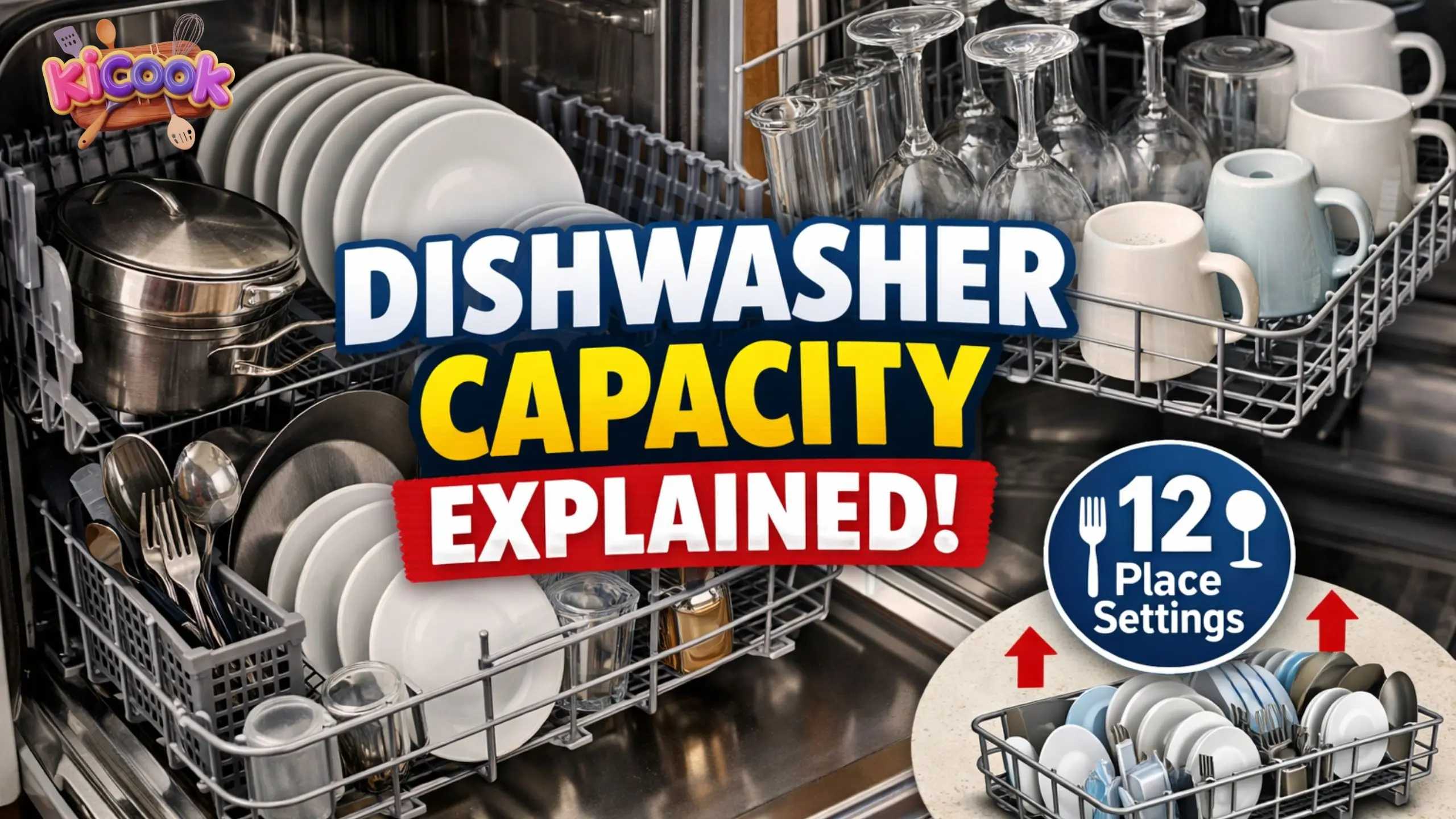
Dishwasher capacity is a standardized measurement that tells you how many place settings a dishwasher can hold. It’s the most important specification to understand because choosing the right size directly impacts how well your dishwasher fits your life, saves you time, and reduces your utility bills.
I’ve spent years writing about and living with home appliances, and I can tell you that getting the capacity wrong is the number one reason people feel let down by their dishwasher.
In my own kitchen, I’ve gone from a too-small model that left me hand-washing pots, to an oversized one that felt wasteful for daily use, and finally landed on the right fit. It makes a tangible difference in your daily routine.
Real Problems You Face When Choosing Dishwasher Capacity
Getting the size wrong isn’t just a minor inconvenience; it leads to ongoing frustrations. Here are the real issues I see people struggle with most often:
- You run half-full loads because you don’t have enough dirty dishes to wait for a full cycle. This wastes a tremendous amount of water, energy, and detergent.
- You have to pre-wash or hand-wash large items like baking sheets, stock pots, or mixing bowls because they won’t fit in your machine.
- Your dishes come out still dirty or spotted because you’ve overloaded the racks in an attempt to fit everything in, blocking the water spray arms.
- The cycle times feel unbearably long for the amount of dishes you’re actually washing, making you question the appliance’s efficiency.
- You didn’t realize how much physical kitchen space the dishwasher would need, not just the cabinet cutout, but also clearance for the door to swing open fully.
How Understanding Capacity Solves These Problems
Getting a handle on what capacity really means helps you avoid these pitfalls before you buy and use your machine better afterward.
Problem 1: Wasting Energy and Water on Small Loads
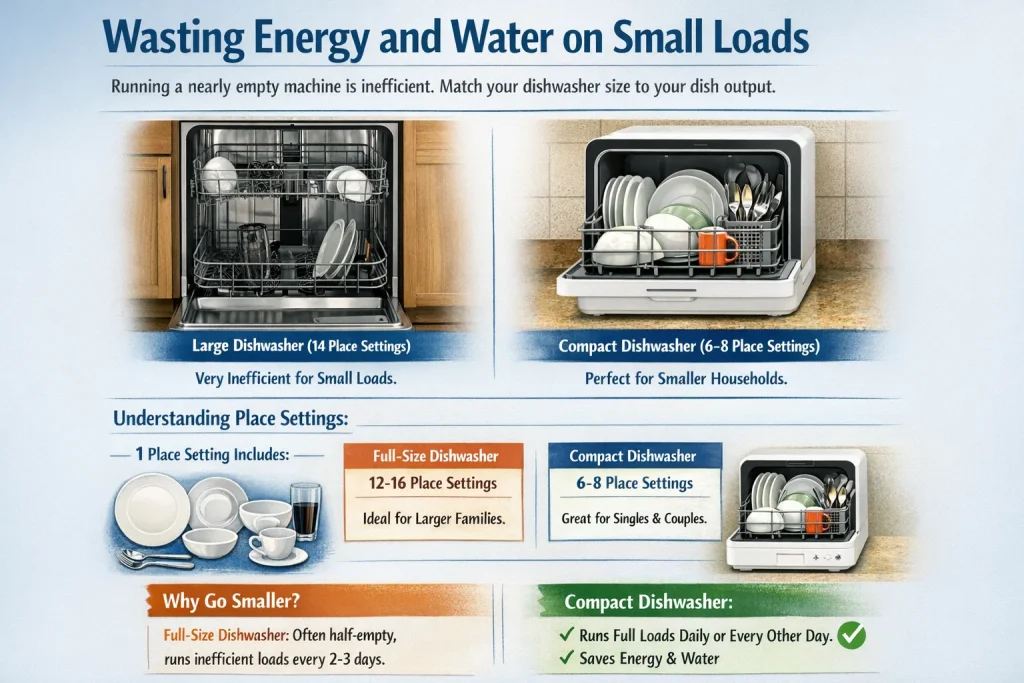
The frustration of running a nearly empty machine is real. The solution lies in matching the dishwasher’s internal volume to your household’s typical dish output.
How it works: Dishwasher capacity is measured in “place settings.” A standard place setting includes a dinner plate, salad plate, bowl, cup, saucer, glass, and flatware. A full-size dishwasher typically holds 12-16 place settings.
If you’re a single person or a couple, a machine rated for 14 settings might only be truly “full” once every 2-3 days, forcing you to run inefficient loads.
In practice, opting for a compact or countertop dishwasher, often rated for 6-8 settings, can be a perfect fit. You can run it daily or every other day when it’s truly full, which is far more efficient. I’ve seen this work perfectly in home offices or apartments where a full-size unit would be overkill.
Problem 2: Not Fitting Your Largest Pots and Pans
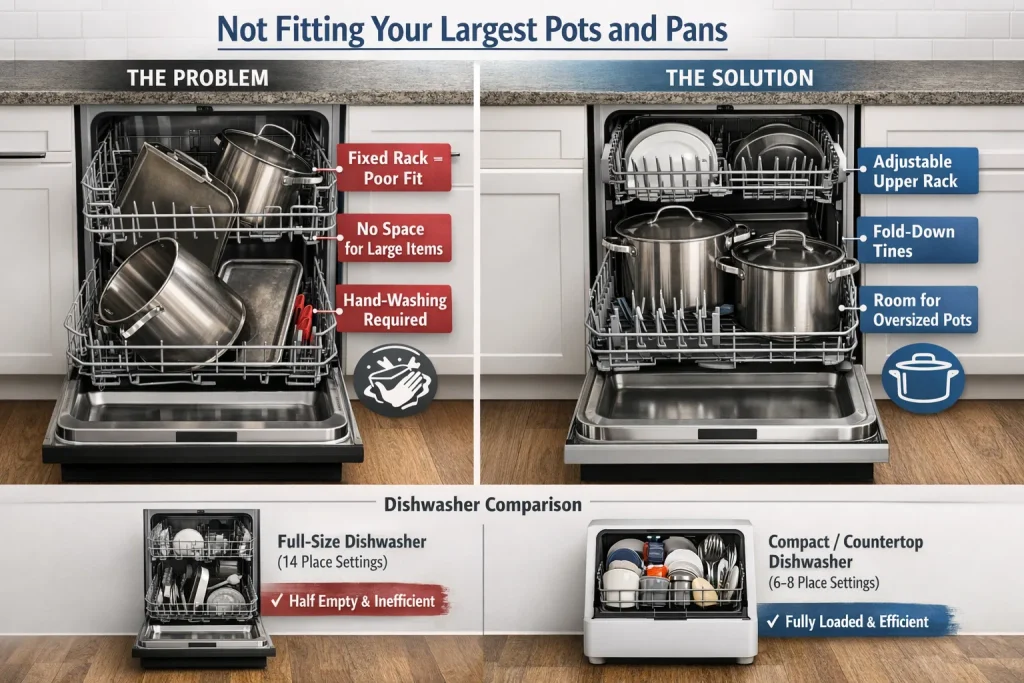
There’s nothing more annoying than having to hand-wash the one big pot you use every night. This is a failure of rack design and interior layout, which are tied to how the overall capacity is engineered.
How it works: Look beyond just the place setting number. A quality dishwasher designed for real use will have adjustable upper racks, fold-down tines, and strategic gaps to accommodate oversized items. Some models even have removable top racks to create vertical space.
When shopping, mentally test-fit your largest cookie sheet or stock pot. A good rule of thumb I use: if the top rack can’t be raised high enough to fit a dinner plate standing upright underneath it, you’ll likely struggle with pots. This is where reading detailed reviews and looking at rack photos is more valuable than the capacity number alone.
Problem 3: Overloading Leads to Poor Cleaning
We’ve all been guilty of stuffing one more glass in, only to find it still dirty. This isn’t always the dishwasher’s fault—it’s a capacity and loading issue.
How it works: Understanding capacity means respecting the machine’s design. The spray arms need clear paths to reach every surface. Overloading blocks these paths. The solution is learning to load for the capacity you have. Bowls and pots should face the center where the water pressure is strongest.
Glasses go between tines, not over them. Leave space between items. It’s better to run a slightly more frequent, properly loaded cycle than one overloaded “marathon” load that requires re-washing. For a deeper look at efficiency, comparing dishwasher vs. hand washing water usage reveals that a fully-loaded, properly run dishwasher almost always wins on conservation.
Problem 4: Long Cycles for Small Amounts of Dishes
Many modern dishwashers have sensors, but if you’re using a “Normal” cycle on a half-full, large-capacity machine, you’re still using most of the water and energy intended for a full load.
How it works: The fix is two-fold. First, choose a machine with a genuine “Half-Load” or “1-Hour” cycle that actually uses less water. Second, understand that a smaller-capacity dishwasher inherently addresses this. A countertop dishwasher typically runs a complete cycle in under an hour because its tub is smaller and requires less water to fill and heat.
For small households, this speed and efficiency can be a lifestyle upgrade, a point well-explained in articles on how a countertop dishwasher works.
Problem 5: Misjudging the Physical Space It Needs
The capacity number doesn’t tell you about the machine’s external footprint. A “portable” dishwasher adds capacity, but also demands significant floor space.
How it works: You must measure twice. For built-in models, know the exact cabinet cutout dimensions. Remember, the door needs to swing down completely, requiring clear floor space. For portable or countertop dishwashers, measure not just the counter space, but also the permanent spot it will occupy and the clearance for venting and connecting to the sink.
I always advise people to tape out the dimensions on their floor or counter to live with it for a day. The advantages and disadvantages of a portable dishwasher often hinge entirely on whether you have the dedicated space for it.
How This Differs in the USA, UK, Canada, and Australia
Dishwasher needs aren’t universal; they’re shaped by local housing, habits, and costs.
- USA: Homes are generally larger, with bigger kitchens and bigger families. Standard 24-inch wide dishwashers with 14+ place settings are the norm. Energy and water costs are relatively moderate, making the efficiency of a full-size unit running nightly a common practice.
- UK & Australia: Space is often at a premium, especially in city apartments and older homes. There’s a strong and growing market for slimline (18-inch wide) dishwashers and integrated models that save space. In Australia, with high electricity costs and frequent drought concerns, water and energy efficiency ratings are a major purchasing driver.
- Canada: Similar to the US in household size but with higher energy costs, particularly in provinces like Ontario. This makes the energy efficiency of a properly sized, fully-loaded dishwasher a significant financial consideration. Harsh detergents are sometimes favored for hard water, which can affect how you load and maintain your machine.
What Improved in My Home When I Got the Capacity Right
When I finally replaced my mismatched dishwasher with one that correctly fit my household of two, the change was immediate. The constant background guilt of wasting resources disappeared because I was now running full, efficient loads every other day instead of half-loads daily.
My water bill showed a noticeable dip the next quarter. Kitchen cleanup became a simpler, faster ritual, everything from the dinner plates to the baking sheet had a designated spot.
Most importantly, the machine just worked consistently, with no more re-washes or re-arranging. It became a reliable tool, not a source of frustration.
What Others Have Noticed
“Switching to a smaller capacity dishwasher for our downtown condo was a revelation. We use it daily, it’s always full, and our utility bills are lower. It fits our actual lifestyle, not the one appliance marketers assume.” – Priya Chen, Food Blogger & Small-Space Dweller
“In my appliance repair business, the most common complaint I hear isn’t about breakdowns; it’s ‘it doesn’t clean well.’ Nine times out of ten, the owner is overloading a machine that’s too small for their needs. Correct loading is free maintenance.” – Marcus Reed, Appliance Repair Technician
“The push for ever-larger capacity in standard models ignores the demographic shift toward smaller households. Choosing a appropriately sized appliance is the single biggest step toward reducing household energy consumption.” – Dr. Lisa Hammond, Sustainability Researcher
Practical Tips for Your Dishwasher
- Do the Place Setting Test: Before you buy, count your typical daily dishes in terms of plates, bowls, and glasses. If you rarely hit 12 full settings, consider a compact model.
- Measure for Reality: Include the door swing! Use painter’s tape to mark the full area the dishwasher will occupy, door open, on your floor.
- Load from the Bottom Up: Place large items like pots and platters on the bottom rack first, then build around them. Put glasses and delicate items on top.
- Use the Right Cycle: Don’t default to “Heavy” or “Normal.” Use “Eco” or “Light” for everyday loads and save the powerful cycles for baked-on grime.
- Maintain the Filters: A clogged filter reduces cleaning performance, making you think you need a bigger or better machine. Rinse the filter weekly.
Frequently Asked Questions for Dishwasher capacity explained
What does a “standard place setting” actually include?
It’s a standardized set for testing: a dinner plate, salad plate, soup bowl, cup, saucer, water glass, and a set of flatware (knife, fork, spoon, teaspoon). It’s a useful benchmark, but your actual dishes may vary in size.
Can a portable dishwasher be a good permanent solution?
Absolutely. If you lack the cabinet space or wiring for a built-in, a portable dishwasher provides full cleaning capacity. The key is having a dedicated spot for it and being comfortable with connecting it to your sink faucet. Weighing the portable dishwasher advantages and disadvantages will help you decide.
Is a countertop dishwasher powerful enough?
Yes, modern models are surprisingly effective. They use the same cleaning mechanics (spray arms, heated drying) as full-size units, just in a smaller tub. They are perfect for very small households, studios, or as a secondary machine in an entertainment area. Many people find they are absolutely worth it for their specific situation.
How much space do I need to leave around a built-in dishwasher?
You need the exact width and height of the cabinet cutout. Depth usually includes an allowance for the door. Always follow the manufacturer’s installation guide precisely for clearances, especially for sides and rear ventilation.
Do I need a special faucet for a portable or countertop dishwasher?
You need a standard kitchen faucet with removable aerator. The hose from the dishwasher attaches via a quick-connect adapter that screws onto the faucet threads. No special plumbing is required.
Will a Bosch dishwasher fit my large plates?
Bosch is known for their flexible racking systems like the third rack (often for cutlery) and fully adjustable upper racks, which help maximize usable capacity. While internal tub dimensions are industry-standard, their rack design often makes fitting odd-sized items easier.
Checking a detailed review of specific Bosch dishwasher models will give you the best sense of their loading flexibility.
How many place settings do I need for a family of four?
A family of four typically generates 12-16 place settings worth of dishes per day (three meals, plus cups and glasses). A standard 14-place-setting dishwasher is usually a good fit, allowing you to run one full load per day, which is efficient.
Conclusion
Choosing the right dishwasher capacity isn’t about getting the biggest machine you can fit; it’s about finding the one that matches the rhythm of your daily life. It saves you money on utilities, saves you time at the sink, and removes a minor but constant source of household stress.
By understanding what those place-setting numbers mean, considering your actual dish habits, and measuring your space honestly, you’ll find an appliance that genuinely works for you for years to come.
For independent, data-driven information on appliance energy use and standards, a trusted resource is the U.S. Department of Energy’s appliance energy guide page, which provides benchmarks for efficiency.

“I believe great cooking starts with the right tools, trusted advice, and a little confidence in the kitchen.”
Hi, I’m Emma Carter. My love for cooking began in my grandmother’s kitchen, where I learned that every great meal starts with simple ingredients and the right cookware. Over the years, I’ve spent countless hours researching, testing, and comparing kitchen appliances, cookware, coffee makers, air fryers, and other everyday kitchen essentials.
Here at KiCook, my goal is to make your buying decisions easier with honest product reviews, practical buying guides, and easy-to-follow cooking tips. Whether you’re upgrading your kitchen or searching for the best appliance for your home, I focus on providing clear, reliable, and research-backed information you can trust.
When I’m not testing new kitchen gadgets or writing in-depth guides, you’ll usually find me trying new recipes, visiting local farmers’ markets, or enjoying a quiet cup of coffee while planning my next kitchen project.