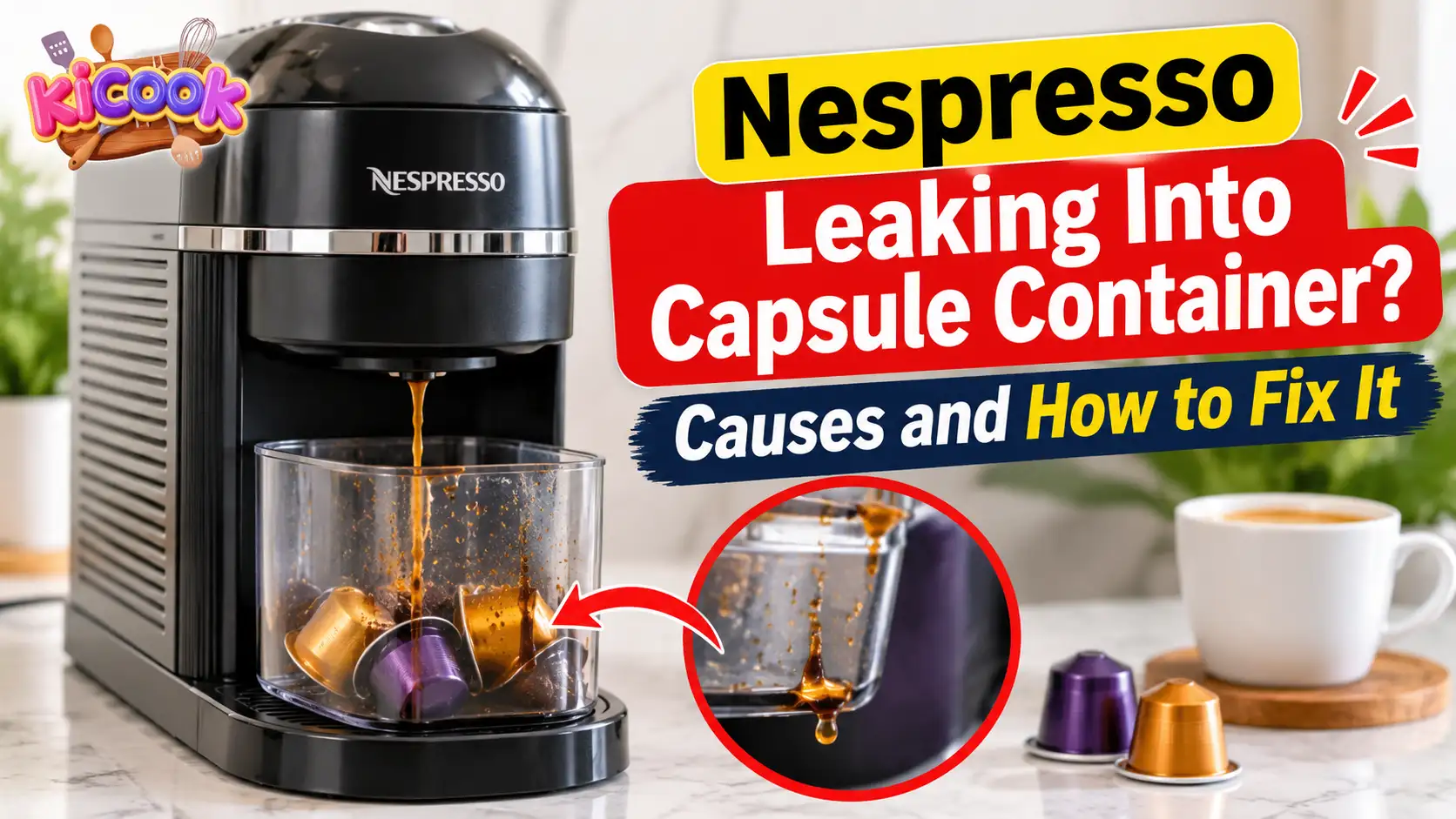
Finding water inside your Nespresso capsule container can be confusing. You might notice a few drops after making coffee, or you may find the used capsule bin filling with water much faster than usual.
The important thing is that a small amount of water in the capsule container does not always mean your Nespresso machine is leaking. Some liquid can collect there during normal brewing. However, excessive water, coffee flowing into the used capsule bin, or repeated leakage around the capsule area may indicate a problem.
Common reasons include an incorrectly positioned capsule, a full capsule container, a blocked coffee outlet, or a problem with the machine’s brewing system.
In this guide, I will explain what is normal, how to identify the cause, and what you can safely do to fix the problem. I will also cover the differences between Nespresso Original and Vertuo machines.
Quick Answer: Why Is My Nespresso Leaking Into the Capsule Container?
Your Nespresso may be putting water into the used capsule container because of normal brewing drainage, an incorrectly positioned capsule, or a blocked coffee outlet. A full capsule container or a problem with the brewing unit may also contribute to the issue.
Start by emptying the capsule container, checking the capsule position, and cleaning the accessible brewing area according to your machine’s manual. If excessive water continues to collect after these checks, contact Nespresso support.
Is It Normal to Have Water in a Nespresso Capsule Container?
Yes, it can be normal.
Nespresso explains in its official troubleshooting FAQ that water can collect in the drip tray and capsule container during normal brewing.
You may notice more water when:
- You prepare a larger cup of coffee.
- You brew several cups within a short period.
- You activate the pump without inserting a capsule.
- You run a cleaning or rinsing function.
This means you should not assume that every drop of water inside the used capsule container is a sign of damage.
You can read Nespresso’s explanation in its official troubleshooting FAQ.
When a Small Amount of Water Is Normal
A few drops or a small amount of residual liquid may collect inside the waste container after brewing.
This is especially important to understand if you own a machine with a combined capsule collection and drip tray system.
For example, the Nespresso Vertuo Up has a short rinsing function. According to its user manual, this function dispenses approximately 40 ml of hot water when activated without a capsule. Around 20 ml is redirected into the waste water container.
Therefore, seeing water in the container after using this function does not automatically indicate a leak.
You can check the official Nespresso Vertuo Up user manual for the exact instructions.
When Water Buildup Indicates a Problem
Water collection deserves attention when you notice:
- The capsule container fills unusually quickly.
- Large amounts of water appear after every coffee.
- Coffee flows into the used capsule container instead of your cup.
- Water collects around the capsule area.
- The machine leaks water onto the countertop.
- Emptying and cleaning the container do not improve the situation.
If any of these symptoms occur repeatedly, you should investigate before continuing to use the machine.
Water in the Capsule Container vs. Drip Tray: What’s the Difference?
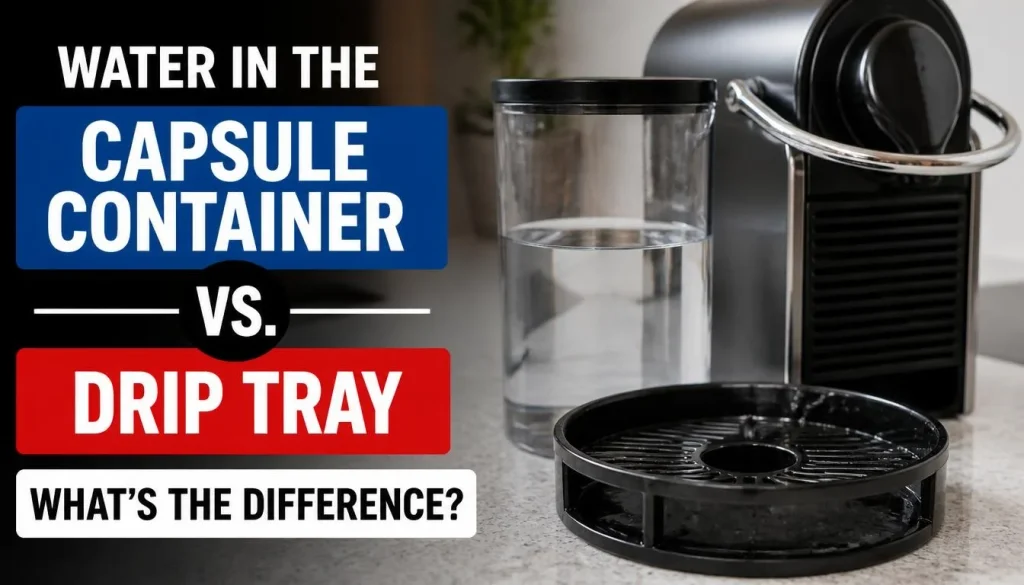
Before trying a repair, identify exactly where the water is collecting.
Some Nespresso models have removable parts that connect the used capsule container and drip tray. Other models use a maintenance module with separate collection areas.
| What You Notice | Possible Explanation | What to Check |
|---|---|---|
| A few drops inside the capsule container | Normal residual liquid | Observe after brewing |
| Water in the drip tray | Normal drainage or rinse water | Empty and inspect regularly |
| Water after brewing without a capsule | Rinsing function | Check your model’s manual |
| Coffee and excess grounds in the capsule bin | Possible coffee outlet blockage | Inspect the accessible outlet |
| Large amounts of water after every brew | Possible capsule or brewing problem | Check capsule positioning |
| Water underneath the machine | Possible external or internal leak | Stop using the machine and seek support |
The location of the water is an important clue. It helps you avoid trying the wrong solution.
Why Is My Nespresso Leaking Into the Capsule Container?
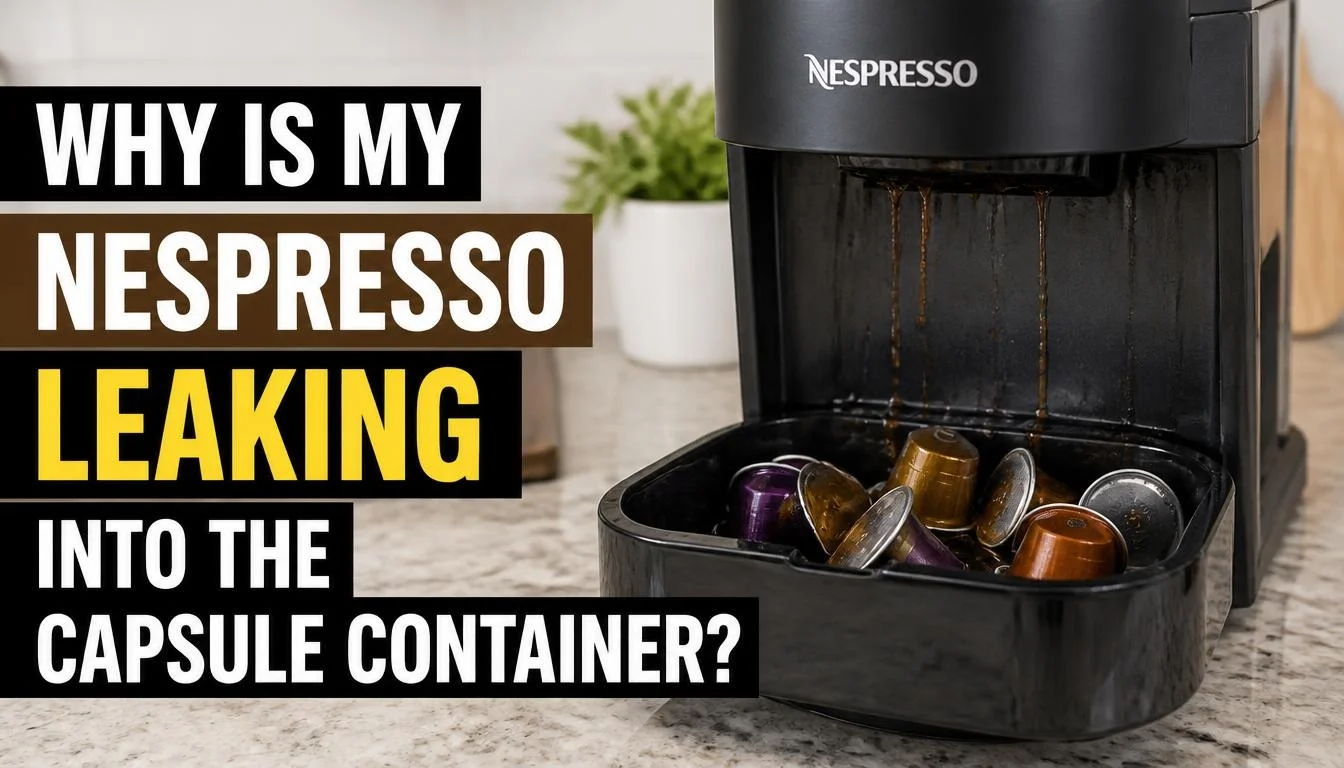
There are several possible reasons. The following causes focus on the specific problem of water or coffee entering the used capsule container.
1. The Coffee Capsule Is Not Positioned Correctly
An incorrectly positioned capsule is one of the first things to check.
Nespresso capsules need to sit properly in the brewing chamber. If a capsule is not positioned correctly, the brewing mechanism may not close as intended.
Some Nespresso Original manuals specifically list incorrect capsule positioning as a possible reason for capsule-area leakage.
You may notice:
- Water collecting around the capsule area.
- A wet used capsule container.
- Coffee leaking during brewing.
- A capsule that looks crushed or unusually deformed.
How to fix it:
- Stop the brewing cycle.
- Switch off the machine.
- Allow the machine to cool before handling the capsule area.
- Open the machine according to the manufacturer’s instructions.
- Remove the capsule if it is safe to do so.
- Check whether it is damaged or incorrectly positioned.
- Insert a fresh, compatible capsule.
- Close the lever or machine head completely.
Do not force the capsule into position.
Try another fresh capsule to see whether the problem disappears. If the capsule area continues leaking, the machine may need further inspection.
2. The Capsule Is Damaged or Deformed
A damaged capsule can interfere with the normal brewing process.
For example, a capsule with a bent rim or damaged sealing area may not sit correctly inside the brewing chamber.
This can cause problems with how the machine handles water during extraction.
Check the capsule before inserting it.
Look for:
- A bent or crushed rim.
- A damaged foil seal.
- Unusual dents.
- Visible damage around the capsule edges.
- Signs that the capsule has already been used.
Use a fresh capsule that is compatible with your Nespresso system.
Remember that Original and Vertuo capsules are not interchangeable. Choose the correct type for your machine.
If several fresh capsules produce the same problem, the capsule itself may not be the cause.
3. The Used Capsule Container Is Full
A full used capsule container can interfere with the next brewing cycle.
When too many used capsules collect inside the bin, a new capsule may not sit correctly in the brewing chamber.
This is particularly important for machines where the used capsule holder must be emptied before the next capsule can be inserted properly.
How to fix it:
- Switch off the machine.
- Remove the used capsule container according to your manual.
- Empty all used capsules.
- Remove any loose coffee residue.
- Check that no capsule is stuck inside the machine.
- Clean the removable container.
- Reinstall it correctly.
Do not try to fit another capsule when the collection bin is already full.
After cleaning, use a fresh capsule and check whether the machine works normally.
4. The Coffee Outlet or Pyramid Plate Is Blocked
This is an important cause to investigate, especially if coffee is going into the used capsule container instead of coming through the coffee outlet.
Over time, coffee residue, oils, and small capsule fragments can collect around the brewing area.
On some Nespresso Original machines, the pyramid plate is the part that pierces the capsule. If the coffee flow becomes blocked, extraction may not work properly.
You might notice:
- Less coffee in your cup than usual.
- Coffee grounds appearing in unusual amounts.
- Slow or irregular coffee flow.
- Coffee going into the used capsule container instead of the outlet.
Nespresso’s troubleshooting information identifies a partially or completely blocked coffee outlet as a possible reason for coffee going into the used capsule container.
How to fix it:
- Turn off the machine and allow it to cool.
- Remove the used capsule if possible.
- Empty the capsule container.
- Check the accessible coffee outlet area.
- Follow your model’s cleaning instructions.
- If your manual identifies an accessible pyramid plate, clean it using a soft sponge or suitable soft brush as recommended.
- Run the manufacturer-approved cleaning procedure.
Avoid metal tools, needles, or sharp objects. They can damage the brewing components.
Also, do not assume that every Nespresso machine uses the same cleaning procedure.
If the outlet remains blocked or coffee still enters the capsule container, contact Nespresso.
5. The Maintenance Module or Removable Parts Are Not Positioned Correctly
This issue is especially relevant to Nespresso machines with removable maintenance modules.
If you have removed the capsule container, drip tray, or maintenance module for cleaning, check that everything has been returned to its correct position.
On the Vertuo Up, Nespresso specifically advises checking that the water tank and maintenance module are correctly positioned when the machine appears to leak.
How to fix it:
- Switch off the machine.
- Remove the maintenance module if your model allows it.
- Empty the used capsules and collected liquid.
- Clean the removable parts according to the manual.
- Check for visible coffee residue around the fitting areas.
- Reinstall each component correctly.
- Make sure nothing is forced or left out of position.
Use only the cleaning products and methods approved for your particular model.
6. A Used Capsule Is Stuck Inside the Machine
Sometimes a previously used capsule does not eject properly.
A stuck capsule can interfere with the next capsule insertion and prevent the machine from operating as intended.
This is worth checking if:
- The machine does not open or close normally.
- You notice an old capsule inside the brewing chamber.
- The collection bin does not slide into place.
- A capsule appears to be trapped near the machine head.
How to fix it:
- Turn off the machine.
- Allow it to cool.
- Follow the instructions for opening the machine head or lever.
- Check for a trapped used capsule.
- Remove it only if it can be accessed safely.
- Empty the used capsule container.
- Check for visible capsule fragments.
- Close the machine according to the manufacturer’s instructions.
Never force the machine head open or try to pull out a tightly trapped capsule with sharp tools.
If the capsule cannot be removed safely, ask Nespresso for assistance.
7. The Internal Brewing System May Have a Fault
If you have checked the capsule, collection container, and accessible brewing area but water continues entering the capsule container, an internal problem may be responsible.
Possible problems include a damaged seal, a faulty brewing component, or another internal water-flow issue.
You may notice:
- Excessive water after every brewing cycle.
- Water leaking around the machine head.
- Coffee production becoming inconsistent.
- Continuous leakage despite cleaning.
- Water appearing underneath the machine.
These problems cannot always be diagnosed from outside the machine.
What should you do?
Stop using the machine if the leak is substantial, comes from an internal area, or reaches electrical connections.
Check your warranty and contact Nespresso or an authorized repair service.
Do not open the machine housing or attempt to repair internal electrical or pressurized components yourself.
How to Fix a Nespresso Leaking Into the Capsule Container: Step-by-Step Guide
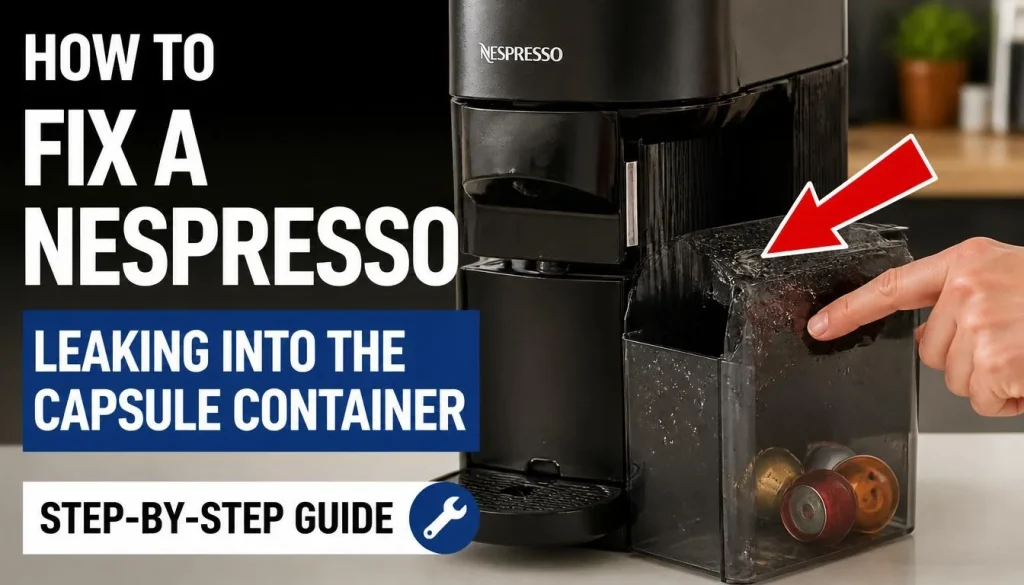
If you are unsure where to start, follow this order. It helps you check the simpler causes before assuming that the machine needs repair.
Step 1: Turn Off the Machine
Stop brewing and switch off your Nespresso.
If water has reached the electrical plug or outlet, do not touch wet electrical connections. Keep away from the wet area and disconnect power only from a safe, dry location.
Step 2: Check Where the Water Is Collecting
Look carefully at the machine.
Is water collecting inside the used capsule container, the drip tray, or underneath the coffee maker?
This distinction helps identify whether you are seeing normal drainage or a possible leak.
Step 3: Empty and Clean the Capsule Container
Remove all used capsules and empty the collected liquid.
Clean the removable parts according to your machine’s instructions.
For the Vertuo Up, Nespresso recommends cleaning the relevant collection components with mild, odourless detergent and drying them before reinstalling them.
Step 4: Check the Capsule
Look for a damaged, bent, or incorrectly positioned capsule.
Try a fresh compatible capsule rather than reusing an old one.
Make sure the machine head or lever closes correctly.
Step 5: Inspect the Coffee Outlet
Check for visible coffee residue around the accessible outlet and brewing area.
Clean these areas using the method recommended in your manual.
Do not insert sharp objects into the capsule-piercing mechanism.
Step 6: Recheck the Water Tank and Removable Parts
Make sure the water tank, capsule container, drip tray, and maintenance module are correctly positioned where applicable.
Pay particular attention to the components you recently removed for cleaning.
Step 7: Run an Approved Test Cycle
Follow the cleaning or rinsing instructions for your exact Nespresso model.
Some machines have specific water-only or short-rinsing functions. Others require a different cleaning procedure.
Do not press the brewing button without a capsule simply to test for leakage unless your model’s instructions tell you to do so. On supported models, doing this can activate a rinsing function and send additional water into the waste container.
If the problem continues after these checks, stop experimenting and contact Nespresso support.
Nespresso Original vs. Vertuo: Does the Problem Differ?
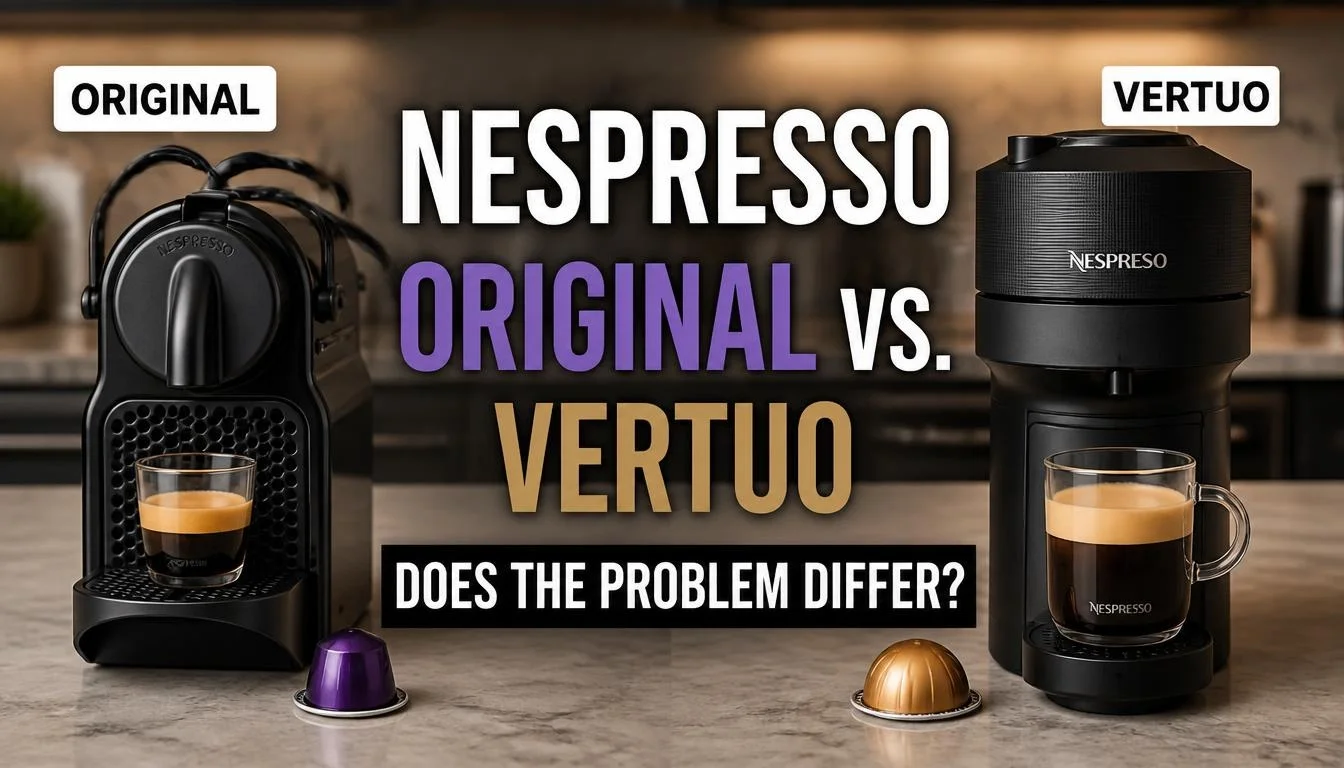
Yes. Nespresso Original and Vertuo machines use different brewing systems, so their troubleshooting procedures are not always the same.
Understanding the difference can prevent you from trying an unsuitable repair.
Nespresso Original Capsule Container Leakage
Nespresso Original machines use a pressure-based brewing system.
For some Original models, the official troubleshooting instructions specifically mention capsule positioning when water appears inside the capsule container.
Start by checking:
- Whether the capsule is positioned correctly.
- Whether the capsule is damaged.
- Whether the used capsule container is full.
- Whether the accessible coffee outlet needs cleaning.
- Whether the machine still leaks with fresh capsules.
For example, the official Inissia troubleshooting guidance advises positioning the capsule correctly and contacting Nespresso if the leakage continues.
You can also use our guide to fixing a Nespresso machine that is not brewing if your machine has additional problems with coffee output or water flow.
Nespresso Vertuo Capsule Container Filling With Water
Vertuo machines use a different brewing system called Centrifusion.
They also read information from the barcode printed on compatible Vertuo capsules.
For these machines, check:
- Whether the capsule is fresh and undamaged.
- Whether the capsule is positioned correctly.
- Whether the machine head is fully closed.
- Whether the previous capsule has been ejected.
- Whether the collection container is full.
- Whether the maintenance module is correctly installed, if your model has one.
Some Vertuo models also have special rinsing functions that direct water into the waste collection area.
The Vertuo Up manual, for example, explains that its short rinsing function sends some of the water into the waste water container.
Do not assume that the same function or cleaning procedure applies to every Vertuo model.
Always follow the instructions for your exact machine.
When Should You Contact Nespresso Customer Support?
Not every capsule container leak requires professional repair. However, some situations should not be ignored.
Contact Nespresso if:
- Water continues entering the capsule container in excessive amounts.
- The machine leaks around the capsule area after checking the capsule position.
- Coffee repeatedly goes into the used capsule container instead of your cup.
- The machine leaks from underneath.
- The brewing head appears damaged.
- Cleaning does not improve the problem.
- You notice unusual mechanical noises or repeated warning lights.
Before contacting support, note your machine’s model name and explain what happens during brewing.
It also helps to describe whether the liquid is clear water, watery coffee, or coffee mixed with grounds.
You can find model-specific troubleshooting instructions through Nespresso’s official Machine Assistance website.
If the machine is still covered by its warranty, contact the manufacturer before attempting any independent repair.
How to Prevent Water From Building Up in the Capsule Container
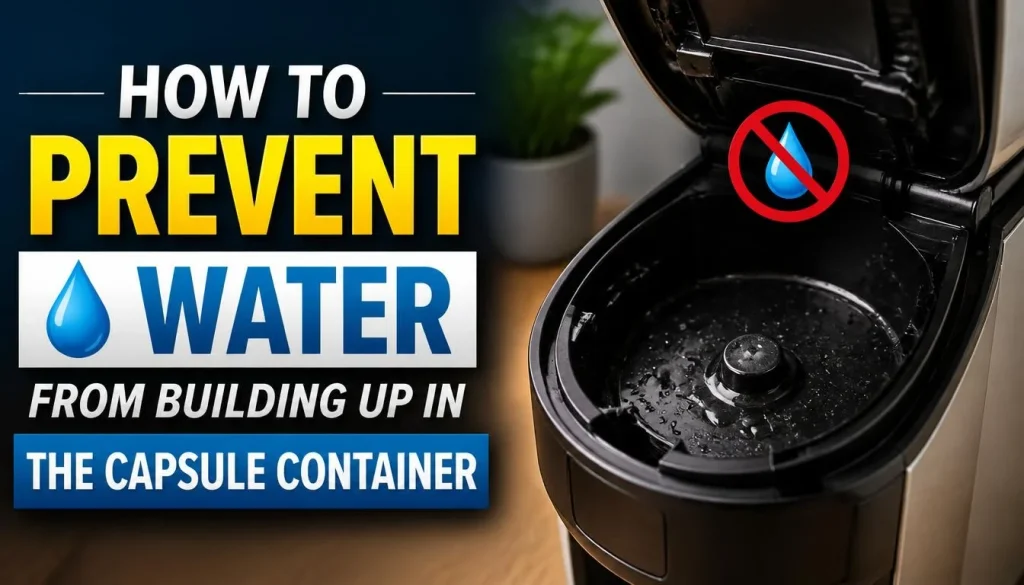
You cannot prevent every possible machine fault, but a few simple habits can reduce avoidable problems.
Empty the Used Capsule Container Regularly
Do not wait until the bin becomes completely full.
Remove the used capsules and collected liquid at regular intervals according to your model’s instructions.
Use Compatible and Undamaged Capsules
Always choose capsules designed for your machine.
Check the capsule before inserting it. Avoid using damaged or previously brewed capsules.
Clean the Brewing Area
Coffee residue can collect around the outlet and capsule chamber.
Follow the recommended cleaning routine to remove visible residue before it becomes a problem.
For a more detailed maintenance schedule, see our guide on how often you should clean your coffee maker.
Follow the Correct Descaling Schedule
Descaling helps remove mineral deposits from the internal water system.
However, it is not a universal fix for capsule container leakage.
Follow the descaling alerts and instructions for your specific machine. Use an approved descaling product rather than experimenting with household cleaning solutions.
Check Removable Parts After Cleaning
Whenever you remove the water tank, drip tray, or capsule container, make sure everything is correctly positioned before using the machine again.
A poorly fitted removable part can create avoidable problems.
Frequently Asked Questions
Why Is My Nespresso Capsule Container Filling With Water?
A small amount of water can collect in the capsule container during normal brewing. However, excessive water may indicate an incorrectly positioned capsule, a full collection bin, or a brewing problem.
Check your capsule, empty the container, and inspect the accessible brewing area. If the problem continues, contact Nespresso.
Is It Normal to Have Water in a Nespresso Capsule Bin?
Yes. Nespresso confirms that water can collect in the drip tray and capsule container during normal operation.
You may notice more water after brewing larger cups, preparing several coffees, or activating the pump without a capsule.
The amount and location of collected liquid depend on your machine model.
Why Is My Nespresso Coffee Going Into the Used Capsule Container?
One possible reason is a blocked coffee outlet.
On some Nespresso Original machines, coffee residue can block the outlet or pyramid plate, affecting normal coffee delivery.
Check the accessible outlet and clean it according to your manual. If coffee continues going into the used capsule container, ask Nespresso for assistance.
Why Does My Nespresso Leak From the Capsule Area?
A capsule that is not positioned correctly may prevent the brewing unit from closing properly.
A damaged capsule or an internal brewing problem may also be responsible.
Remove the capsule if it is safe to do so, try a fresh compatible one, and make sure the machine closes correctly.
If water continues leaking from the capsule area, contact Nespresso support.
Why Is My Nespresso Capsule Container Filling Up So Quickly?
The container may collect residual liquid during normal brewing, but unusually fast filling deserves investigation.
Check whether you are running a rinsing cycle without a capsule, whether the capsule container is full, and whether the machine is positioned correctly.
If excessive water appears after every normal brew, arrange further troubleshooting.
Why Is My Nespresso Vertuo Waste Container Full of Water?
On some Vertuo models, water enters the waste collection area during normal rinsing and brewing operations.
For example, the Vertuo Up manual describes water being redirected to its waste water container during the short rinsing function.
Check the manual for your specific Vertuo model before deciding whether the amount is abnormal.
Why Is There Water in My Nespresso Drip Tray?
Water in the drip tray can be part of normal machine operation.
Some machines release residual water during brewing, rinsing, or cleaning.
Empty the tray regularly. If water repeatedly overflows or appears underneath the machine, check the removable parts and contact support if necessary.
Can I Still Use My Nespresso If Water Collects in the Capsule Container?
You can generally continue using the machine when only a small amount of liquid collects as part of normal operation and the coffee is brewing correctly.
However, do not ignore excessive leakage, water around electrical components, or persistent water loss.
Stop using the machine if you suspect an internal leak and seek professional assistance.
Final Verdict
A Nespresso leaking into the capsule container does not always mean that your coffee maker is broken.
A small amount of residual water may be normal, depending on the machine and its brewing or rinsing process. However, excessive water, coffee entering the used capsule container, or repeated leakage around the capsule area deserves attention.
Start with the simplest checks: empty the capsule container, inspect the capsule, clean the accessible brewing area, and make sure removable parts are correctly positioned.
Remember that Nespresso Original and Vertuo machines have different brewing systems. A cleaning method that works for one model may not work for another.
If the leakage continues after the recommended checks, contact Nespresso rather than opening the machine yourself.
The best approach is to identify where the liquid is coming from before attempting a repair. This can save you time, prevent unnecessary cleaning cycles, and help you avoid replacing a machine that may only need a simple correction.

“I believe great cooking starts with the right tools, trusted advice, and a little confidence in the kitchen.”
Hi, I’m Emma Carter. My love for cooking began in my grandmother’s kitchen, where I learned that every great meal starts with simple ingredients and the right cookware. Over the years, I’ve spent countless hours researching, testing, and comparing kitchen appliances, cookware, coffee makers, air fryers, and other everyday kitchen essentials.
Here at KiCook, my goal is to make your buying decisions easier with honest product reviews, practical buying guides, and easy-to-follow cooking tips. Whether you’re upgrading your kitchen or searching for the best appliance for your home, I focus on providing clear, reliable, and research-backed information you can trust.
When I’m not testing new kitchen gadgets or writing in-depth guides, you’ll usually find me trying new recipes, visiting local farmers’ markets, or enjoying a quiet cup of coffee while planning my next kitchen project.