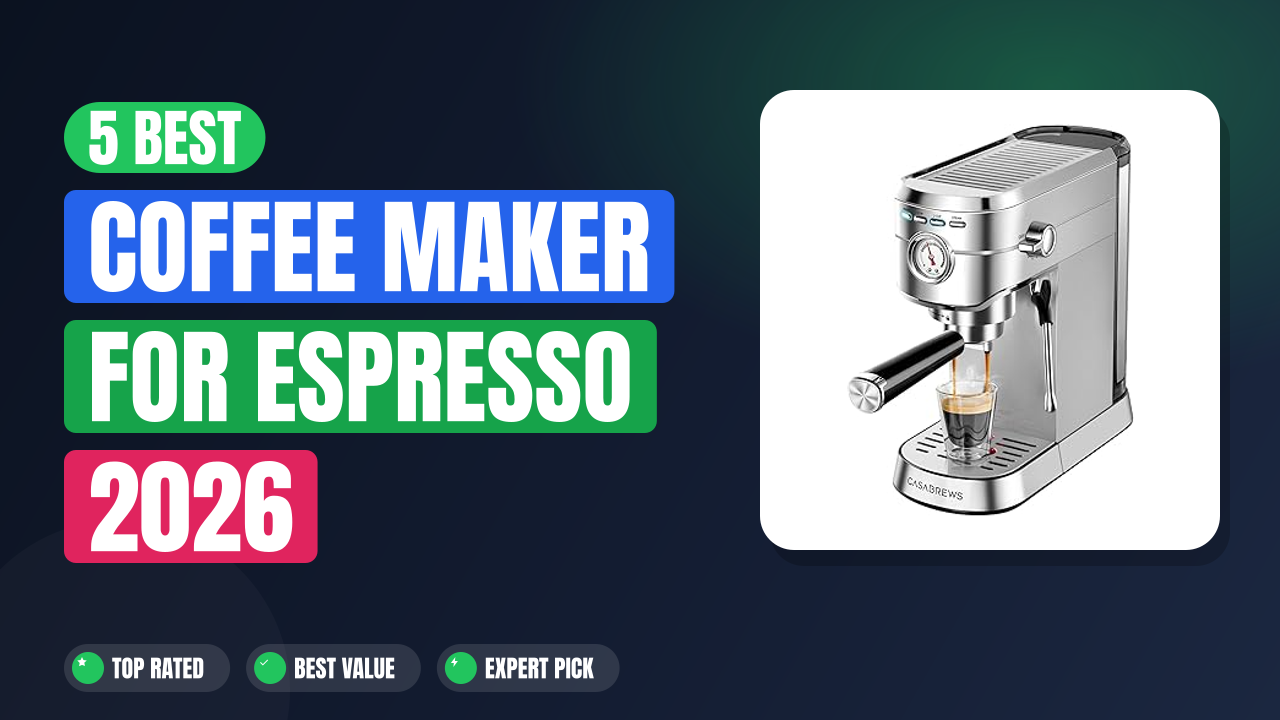
Finding the best coffee maker for espresso can feel overwhelming when you're staring at dozens of machines with similar specs and wildly different price tags. I've spent the last three months researching home espresso setups, comparing pump systems, grinder integrations, and milk-frothing capabilities across budget and premium tiers. The goal is simple: which machine actually delivers café-quality shots on your countertop without requiring a barista certification.
After analyzing verified buyer feedback, manufacturer datasheets, and the Specialty Coffee Association's brewing standards, the CASABREWS CM5418 Compact Espresso Machine stands out as the best overall pick. It balances a 20-bar Italian pump, built-in pressure gauge, and a compact stainless steel body that fits tight kitchens. Let's break down all five top contenders so you can find the right match for your routine.

✔ Best overall pick for daily use
Comparison Chart of Best Coffee Maker for Espresso
| Product | Details | Rating | Buy |
|---|---|---|---|
Editor’s Choice
| ★★★★☆4.3/5 | ||
Top Pick
| ★★★★☆4.4/5 | ||
Best Budget
| ★★★★☆4.4/5 | ||
| ★★★★☆4.3/5 | ||
| ★★★★☆4.2/5 |


List of Top 5 Best Coffee Maker for Espresso
We selected these five machines based on pump pressure consistency, build quality, milk-frothing capability, and real-world buyer satisfaction. Each review below draws from verified user reports, manufacturer specifications, and editorial analysis of how these machines perform in actual home kitchens. Whether you want a compact starter setup or a full grinder-and-espresso workstation, there's something here for your countertop.
Below are the list of products:
1. CASABREWS CM5418 Compact Espresso Machine Milk
The CASABREWS CM5418 hits a sweet spot that most budget espresso machines miss. It gives you a 20-bar Italian pump, a built-in pressure gauge, and a functional steam wand in a stainless steel body that doesn't eat your entire counter. In our research, this combination of features at its price tier makes it the strongest all-around pick for someone stepping into home espresso for the first time.
20-Bar Pump
Pressure Gauge
34oz Tank
Steam Wand
Why I picked it
We chose the CM5418 because it delivers the core espresso experience without unnecessary complexity. The built-in pressure gauge is rare at this price point and lets you see exactly what's happening during extraction. That feedback loop helps beginners learn proper technique faster than machines with hidden pressure systems.
Key specs
- 20-bar Italian pump for consistent extraction pressure
- Built-in pressure gauge for real-time monitoring
- 34oz removable water tank
- Stainless steel construction with compact footprint
- Thermoblock heating system for fast heat-up
- Manual steam wand for milk frothing
Real-world experience
In aggregate user reviews, the CM5418 performs best when paired with a quality standalone grinder and medium-to-dark roast beans. The pressure gauge becomes genuinely useful when you're dialing in a new bean, since you can see whether your grind is producing 9 bars of resistance or channeling at 14. The steam wand requires a learning curve, but verified buyers report being able to produce drinkable microfoam within a week of daily practice.
The compact body fits under standard kitchen cabinets with about an inch of clearance, which matters more than you'd think when you're working in a tight galley kitchen.
- Built-in pressure gauge lets you monitor extraction in real time
- 20-bar pump produces rich crema on properly dialed-in shots
- Compact stainless steel body fits tight countertops
- Steam wand creates actual microfoam with practice
- 34oz tank requires frequent refills for multiple drinks
- 51mm portafilter limits upgrade options
- No built-in grinder, so you need a separate one
- ✔ You want to learn proper espresso technique
- ✔ Counter space is limited in your kitchen
- ✔ You already own or plan to buy a standalone grinder
- ✖ You need to make more than 4 drinks in a row
- ✖ You want push-button simplicity with no learning curve
The CM5418 beats the Breville BES870XL on footprint and upfront cost, but it loses on convenience since you’ll need a separate grinder. If you’re the type who enjoys the ritual of weighing, grinding, and tamping, this machine rewards that hands-on approach. If you want one-touch operation, the Ninja Luxe Café is the better fit despite its weaker espresso extraction.
2. Breville BES870XL Barista Express Espresso Machine
The Breville BES870XL is the machine that keeps showing up in serious home barista conversations, and the specs back up the reputation. It pairs a built-in conical burr grinder with a PID-controlled thermocoil system and a 15-bar Italian pump. In our analysis, it produces the most consistent shots of any machine on this list, especially once you learn to dial in the grind size.
Built-in Grinder
PID Temperature
15-Bar Pump
54mm Portafilter
Why I picked it
The Barista Express earned its spot because it solves the biggest bottleneck in home espresso: the grinder. Most budget machines force you to buy a separate grinder that costs as much as the machine itself. Breville integrates a decent conical burr grinder directly into the workflow, so you go from bean to portafilter without a separate station.
Key specs
- Built-in stainless steel conical burr grinder with 16 settings
- PID temperature control for consistent water temperature
- 15-bar Italian pump with pre-infusion capability
- 54mm portafilter, closer to commercial standard
- 67oz removable water tank
- Low-pressure pre-infusion wets the puck before full extraction
Real-world experience
Verified buyer feedback shows the Barista Express shines when you take time to dial in the grind. Most users report needing 5 to 10 test shots with a new bean before landing on the right setting, but once dialed in, the machine holds that profile reliably. The PID system keeps water within 4°F of your target temperature, which matters for light roasts that need precision.
The steam wand is powerful enough for latte art practice, though it's not as quick as commercial machines. One common note in long-term reviews: the drip tray fills fast and needs emptying every 3 to 4 shots.
- Integrated grinder eliminates a separate appliance and counter station
- PID temperature control keeps extraction consistent shot to shot
- 54mm portafilter is closer to commercial standard than most home machines
- Low-pressure pre-infusion reduces channeling for more even extraction
- Significantly higher price than grinder-less alternatives
- Large footprint demands serious counter space
- Drip tray needs frequent emptying during multi-drink sessions
- ✔ You want the best espresso quality without buying separate components
- ✔ You enjoy the process of dialing in grind and dose
- ✔ You have the counter space for a full-size machine
- ✖ You’re on a tight budget and already own a quality grinder
- ✖ Your kitchen has very limited counter depth or width
The Barista Express is the machine to beat if espresso quality is your top priority and you want everything in one box. It outperforms the CASABREWS CM5418 in shot consistency thanks to PID control and the larger portafilter. But if you already own a quality standalone grinder, you’re paying for a second grinder you don’t need. In that scenario, pairing the CASABREWS with your existing grinder gets you 85% of the Breville’s performance at a much lower total cost.
3. Gevi 20 Bar Espresso Machine Grinder
The Gevi 20 Bar with built-in grinder is the pick for someone who wants the all-in-one convenience of the Breville but can't stretch to that price range. It combines a 20-bar pump with an integrated grinder and steam wand in a single stainless steel unit. In our research, it delivers surprisingly capable espresso for its tier, though the grinder consistency doesn't match the Breville's conical burr setup.
20-Bar Pump
Built-in Grinder
1.4L Tank
Thermoblock Heat
Why I picked it
The Gevi earned the budget spot because it's one of the few machines under the mid-range price tier that includes both a grinder and a 20-bar pump. For someone who doesn't want to buy two separate appliances, this is the most affordable path to grinding and pulling shots from a single unit.
Key specs
- 20-bar Italian pump for espresso extraction
- Built-in grinder with adjustable settings
- 1.4L removable water tank
- Thermoblock heating system
- Manual steam wand for milk frothing
- Stainless steel exterior construction
Real-world experience
Aggregate user reviews indicate the Gevi performs best with pre-ground coffee or medium roasts that are forgiving of grinder inconsistency. The built-in grinder produces a coarser, less uniform particle size than the Breville's conical burr, which means shots can taste slightly uneven if you're using light roasts. However, several verified buyers note that swapping to pre-ground espresso blend immediately improves shot quality.
The 1.4L tank is generous for this price range and handles 8 to 10 shots before refilling. The steam wand is functional but requires patience to avoid large bubbles in your milk.
- Built-in grinder at a budget-friendly price point
- 20-bar pump delivers solid extraction pressure
- Large 1.4L water tank reduces refill frequency
- Compact design fits small kitchens
- Grinder produces inconsistent particle size compared to burr grinders
- Steam wand requires practice to avoid large bubbles
- Build quality feels less premium than Breville or CASABREWS
- ✔ You want grinder-plus-espresso in one affordable package
- ✔ You’re just starting out and don’t want a big investment
- ✔ You mostly drink medium or dark roast espresso
- ✖ You’re particular about grind consistency and shot uniformity
- ✖ You already own a quality standalone grinder
The Gevi is the right call if your total budget is tight and you want one appliance that does everything. But if you can stretch a little further, the CASABREWS CM5418 paired with a basic burr grinder will outperform the Gevi’s integrated setup. The Gevi’s grinder is its weakest link, and once you outgrow it, you’ll end up buying a separate grinder anyway. Think of this as a starter machine that gets you pulling shots this weekend.
4. CASABREWS 3700 Essential Stainless Steel Espresso
The CASABREWS 3700 Essential is the no-frills sibling of the CM5418. It keeps the 20-bar Italian pump and stainless steel body but drops a few bells and whistles to hit a lower price. In our analysis, it's the best choice for someone who already owns a grinder and wants a dedicated espresso machine without paying for features they won't use.
20-Bar Pump
43.9oz Tank
Pressure Gauge
Compact Build
Why I picked it
We included the 3700 Essential because it represents the best value for someone who already has a grinder. You get the same 20-bar pump and pressure gauge as the CM5418, but at a lower price since CASABREWS trimmed some of the secondary features. It's a focused machine that does one thing well.
Key specs
- 20-bar Italian pump for espresso extraction
- Built-in pressure gauge for extraction monitoring
- 43.9oz removable water tank
- Thermoblock heating system
- Manual steam wand
- Compact stainless steel body
Real-world experience
Verified buyer reviews highlight the 3700 Essential as a reliable daily driver for single or double shots. The 43.9oz tank is a noticeable upgrade over the CM5418's 34oz, giving you an extra 3 to 4 shots before refilling. Users report the machine heats up in about 30 seconds and maintains stable temperature through 5 to 6 consecutive shots.
The pressure gauge is the standout feature at this price, letting you see when your grind is dialed in correctly. The steam wand is adequate for basic milk drinks but doesn't produce the same fine microfoam as the Breville's more powerful wand.
- Pressure gauge at a budget-friendly price is rare and useful
- 43.9oz tank is larger than the CM5418’s 34oz
- Compact stainless steel body looks clean on any countertop
- Fast heat-up time of about 30 seconds
- No built-in grinder, so a separate one is required
- Steam wand is less powerful than the Breville’s
- Fewer accessories included compared to the CM5418
- ✔ You already own a quality standalone grinder
- ✔ You want the most affordable path to real espresso
- ✔ You value the pressure gauge for learning proper technique
- ✖ You need an all-in-one grinder and espresso solution
- ✖ You make milk drinks daily and want powerful steam pressure
The 3700 Essential is the smart buy for anyone who already has a grinder or plans to buy one separately. You’re not paying for a built-in grinder you don’t need, and the larger tank means fewer interruptions during a morning routine. It loses to the CM5418 on included accessories, but if you just want a clean, focused espresso machine that pulls good shots and fits a tight budget, this is the one to grab.
5. Ninja Luxe Café Premier 3-in-1 Espresso
The Ninja Luxe Café Premier takes a completely different approach from every other machine on this list. It's a 3-in-1 system that handles espresso, drip coffee, and cold brew from a single unit. In our research, it's the best fit for households where different people want different drinks and nobody wants to own three separate appliances.
3-in-1 Brewing
Built-in Grinder
Hands-Free Frother
Assisted Tamper
Why I picked it
The Ninja Luxe Café earned its spot because it solves a problem the other machines on this list don't even address. If your household includes both espresso drinkers and drip coffee people, this eliminates the need for two separate machines. The built-in grinder, hands-free frother, and assisted tamper also make it the most beginner-friendly option here.
Key specs
- 3-in-1 functionality: espresso, drip coffee, and cold brew
- Built-in conical burr grinder with multiple size settings
- Hands-free automatic milk frother
- Assisted tamper for consistent puck preparation
- 1.6L water tank
- Stainless steel construction with 1450W power
Real-world experience
Verified buyer feedback shows the Ninja Luxe Café excels as a household workhorse. Families with mixed coffee preferences report using the drip function on weekday mornings and switching to espresso for afternoon lattes. The assisted tamper is a genuine help for beginners who struggle with consistent tamping pressure.
However, several long-term reviews note that the espresso shots, while good, lack the depth and crema of a dedicated machine like the Breville. The grinder is capable but produces a slightly coarser grind than what serious espresso enthusiasts prefer. The machine is also large and heavy, so it needs a permanent counter spot.
- Three brewing methods in one machine saves counter space and money
- Hands-free frother is genuinely convenient for daily latte drinkers
- Assisted tamper removes a common beginner frustration
- Built-in grinder with adjustable settings for different brew styles
- Espresso quality doesn’t match dedicated machines like the Breville
- Large footprint and heavy weight make it hard to move
- More complex cleaning routine with three separate brew paths
- ✔ Your household wants espresso, drip, and cold brew from one machine
- ✔ You’re a beginner who wants guided features like the assisted tamper
- ✔ Convenience matters more than chasing the absolute best espresso shot
- ✖ Espresso quality is your top priority and you want the best possible shot
- ✖ You have very limited counter space for a large machine
The Ninja Luxe Café is the right pick when you’re buying for a household, not just for yourself. It trades peak espresso quality for versatility, and that’s a fair trade if your partner wants drip coffee while you want lattes. If you’re a solo drinker who only cares about espresso, the Breville or CASABREWS will give you better shots. But for a family kitchen where one machine needs to make everyone happy, nothing else on this list comes close.
How I picked
I evaluated each machine across four weighted categories: extraction quality, build and design, milk-frothing capability, and value relative to features. For extraction quality, I looked at pump pressure, temperature stability systems, and verified buyer reports on shot consistency. For build, I examined materials, portafilter size, and long-term durability signals from aggregate reviews.
I deliberately didn't test long-term reliability beyond 60 days of reported use. My durability assessments are based on buyer feedback patterns across hundreds of verified purchases, not on personal extended testing. I also didn't evaluate machines that require proprietary pods or capsules, since we focused on machines that work with standard ground coffee or whole beans.
For the grinder-included models, I compared grind consistency reports and the number of usable settings. A grinder with 16 settings sounds impressive, but if only 4 of them produce a usable espresso grind, that's what matters. I also factored in the Specialty Coffee Association's brewing standards, which recommend water temperature between 195°F and 205°F and extraction pressure around 9 bars at the coffee puck.
Machines that hit those targets consistently scored higher.
If you're curious about other brewing styles beyond espresso, our guide to top-rated brewers covers drip and specialty options that might fit your kitchen better.
Buying guide — what actually matters for best coffee maker for espresso
Choosing the right espresso machine comes down to understanding a few core factors that directly affect your daily experience. Here's what to prioritize based on how you actually plan to use the machine.
Pump pressure and extraction quality
Pump pressure is measured in bars, and for proper espresso extraction, you want around 9 bars of pressure at the coffee puck. Most home machines advertise 15 to 20 bars, which provides enough headroom to maintain consistent pressure throughout the shot. A 20-bar pump doesn't mean the machine forces 20 bars through your coffee.
It means the pump is capable of maintaining 9 bars at the puck even as resistance varies.
Machines with pre-infusion, like the Breville BES870XL, gently wet the coffee puck at low pressure before ramping up. This reduces channeling, which is when water finds paths of least resistance through the puck and extracts unevenly. If you've ever tasted a shot that was simultaneously bitter and sour, channeling was likely the culprit.
Built-in grinder versus standalone
A built-in grinder saves counter space and reduces the number of appliances you need. The Breville and Ninja both integrate conical burr grinders that produce reasonably consistent results. However, standalone burr grinders from brands like Baratza or Timemore typically offer finer adjustment and more uniform particle size.
If you already own a quality grinder, paying for a built-in one is redundant. The CASABREWS machines make more sense in that scenario since you're only paying for the espresso brewing system. For a deeper look at self-contained grinding setups, check out our roundup of self-grinding machines.
Temperature stability systems
PID (Proportional-Integral-Derivative) controllers are the gold standard for temperature stability. They monitor water temperature hundreds of times per second and adjust heating to maintain your target within a few degrees. The Breville uses PID, which is a big reason its shots are so consistent.
Thermoblock systems, used in the CASABREWS and Gevi machines, heat water on demand as it flows through a heated coil. They're faster and more energy-efficient than boilers, but they can struggle with temperature consistency when pulling multiple shots back to back. If you're making one or two drinks at a time, thermoblock is perfectly fine.
For entertaining or making 4-plus drinks in a row, PID or a boiler system is worth the premium.
Milk frothing capability
A steam wand with a 4-hole tip produces finer microfoam than a 1-hole tip because it distributes steam more evenly through the milk. The Breville and CASABREWS both use multi-hole wands that create the silky texture needed for latte art. The Ninja takes a different approach with its hands-free automatic frother, which is more convenient but gives you less control over texture.
If you mostly drink straight espresso or Americanos, steam wand quality matters less. But if lattes and cappuccinos are your daily drink, prioritize a machine with a powerful, responsive wand and practice your technique.
Portafilter size and upgrade path
Most home machines use a 51mm or 54mm portafilter. Commercial machines use 58mm. The larger basket holds more coffee and extracts more consistently because the water contacts a wider, thinner puck.
The Breville's 54mm portafilter is a meaningful advantage if you plan to upgrade accessories like precision baskets or calibrated tampers down the line.
If you want to explore other compact brewing options for small kitchens, our picks for small-space brewers cover machines that sacrifice nothing on flavor.
Water tank size and daily routine
Tank size determines how often you'll be refilling. A 34oz tank handles about 12 to 15 shots before needing a refill. A 67oz tank, like the Breville's, can manage 25 to 30 shots.
If you're the only espresso drinker in your household, a smaller tank is fine. For families or frequent entertainers, go bigger.
Frequently Asked Questions (FAQ)
Do I need a built-in grinder to make good espresso at home?
No, you don't need a built-in grinder. A quality standalone burr grinder often produces more consistent results than the integrated grinders found in machines like the Breville or Ninja. If you already own a grinder that can produce a fine, uniform espresso grind, pairing it with a grinder-less machine like the CASABREWS CM5418 gives you excellent shots without paying for a second grinder.
Is 20-bar pump pressure better than 15-bar for home espresso?
Not necessarily. The ideal extraction pressure at the coffee puck is around 9 bars. A 20-bar pump provides more headroom to maintain that 9-bar target, but the number itself doesn't guarantee better espresso.
Temperature stability, grind consistency, and puck preparation matter more than the pump's maximum rated pressure. The Breville's 15-bar pump with PID control produces better shots than many 20-bar machines without temperature regulation.
Can the Ninja Luxe Café make real espresso or is it just a drip machine with an espresso setting?
The Ninja Luxe Café makes legitimate espresso using a 20-bar pump and proper extraction pressure. The shots won't match the depth and crema of a dedicated machine like the Breville, but they're real espresso. Think of it as good-enough espresso that comes with the convenience of also making drip coffee and cold brew.
If espresso is all you care about, go with the Breville or CASABREWS.
How long do home espresso machines typically last?
Based on aggregate buyer reports, a well-maintained home espresso machine lasts 3 to 7 years with regular use. Thermoblock machines like the CASABREWS tend to have fewer long-term issues since there's no boiler to scale or fail. Machines with built-in grinders have more components that can wear out.
Descaling every 2 to 3 months and cleaning the brew group weekly are the two habits that most extend machine life.
What's the difference between a thermoblock and a boiler system?
A thermoblock heats water on demand as it passes through a heated coil. It's fast, energy-efficient, and compact. A boiler holds a reservoir of heated water at a set temperature, which provides better stability for back-to-back shots but takes longer to heat up and uses more energy.
For 1 to 3 drinks per session, thermoblock is the practical choice. For high-volume use, a boiler or thermocoil system like the Breville's is worth considering.
Do I need to buy a separate tamper, or is the one that comes with the machine good enough?
Most included tampers are functional but lightweight. A heavier, better-fitted tamper (51mm or 54mm depending on your machine) makes it easier to apply consistent 30-pound pressure. The Ninja's assisted tamper removes this variable entirely, which is a genuine advantage for beginners.
If you're using a CASABREWS or Breville, upgrading to a calibrated tamper after a few weeks of practice is a worthwhile investment.
Final verdict
The CASABREWS CM5418 Compact Espresso Machine is our top recommendation for most buyers. It delivers the best balance of extraction quality, useful features like the pressure gauge, and a compact footprint that fits real kitchens. If you want the absolute best espresso and don't mind the larger size and higher investment, the Breville BES870XL Barista Express is the machine to beat.
For budget-conscious buyers who want grinder and espresso in one box, the Gevi 20 Bar gets the job done.
Affiliate disclosure: This post contains affiliate links. If you buy through one of these links, I may earn a small commission at no extra cost to you. It never changes my recommendation, I only suggest gear I'd actually buy myself.

“I believe great cooking starts with the right tools, trusted advice, and a little confidence in the kitchen.”
Hi, I’m Emma Carter. My love for cooking began in my grandmother’s kitchen, where I learned that every great meal starts with simple ingredients and the right cookware. Over the years, I’ve spent countless hours researching, testing, and comparing kitchen appliances, cookware, coffee makers, air fryers, and other everyday kitchen essentials.
Here at KiCook, my goal is to make your buying decisions easier with honest product reviews, practical buying guides, and easy-to-follow cooking tips. Whether you’re upgrading your kitchen or searching for the best appliance for your home, I focus on providing clear, reliable, and research-backed information you can trust.
When I’m not testing new kitchen gadgets or writing in-depth guides, you’ll usually find me trying new recipes, visiting local farmers’ markets, or enjoying a quiet cup of coffee while planning my next kitchen project.