
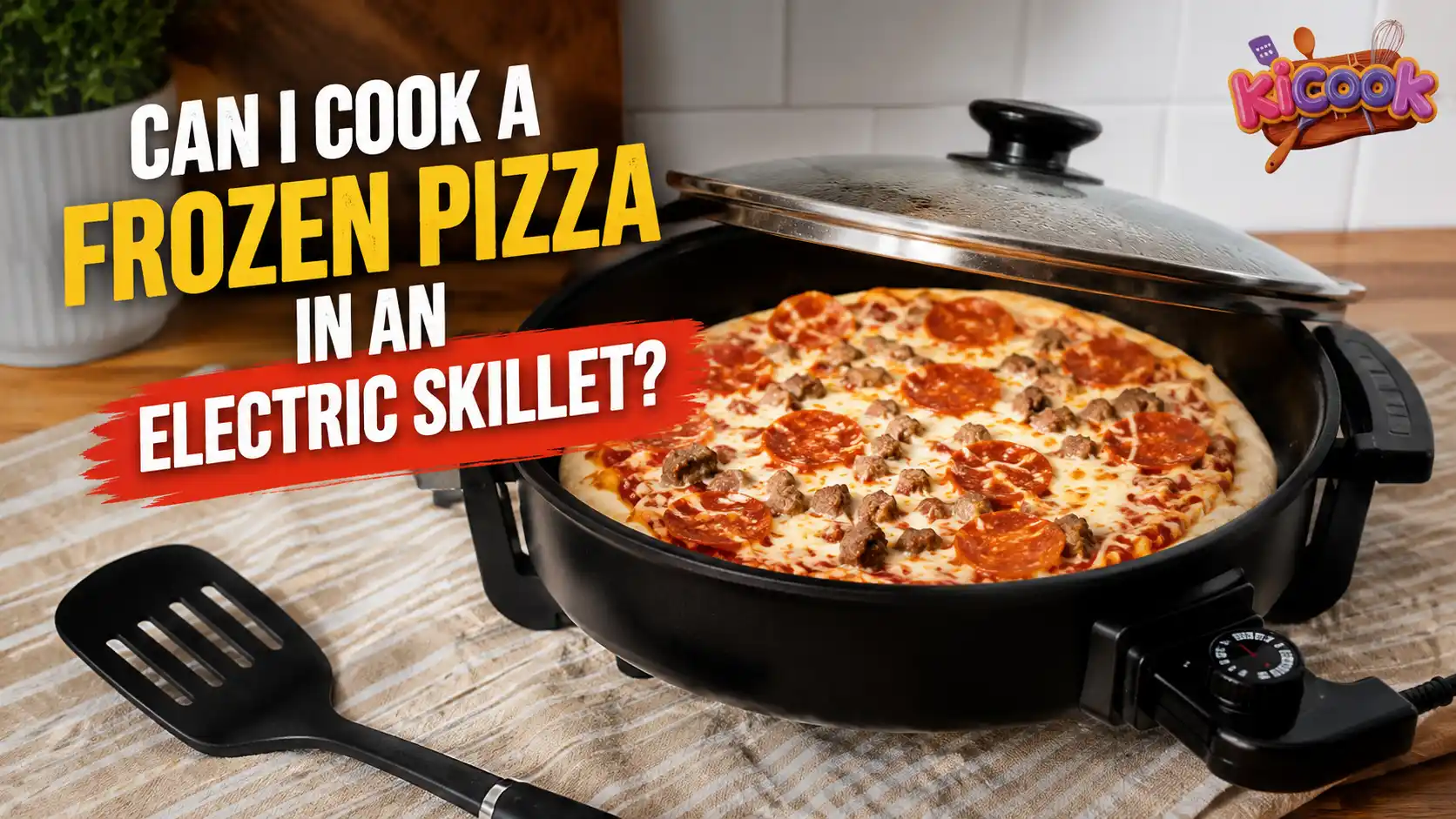
Yes, you can cook a frozen pizza in an electric skillet, and it can turn out surprisingly good when you control the heat properly. The biggest challenge is that an electric skillet sends most of its heat through the bottom, while a conventional oven surrounds the pizza with hot air.
That means the crust can brown before the cheese and toppings are fully heated if you simply crank the temperature up and walk away.
For most standard frozen pizzas, the best approach is to use a skillet large enough for the pizza to sit flat, preheat it, cook with the lid on for most of the time, and check the bottom crust regularly.
A setting somewhere around 350°F to 400°F (177°C to 204°C) can work depending on the pizza and the skillet. The exact setting is less important than watching how your particular appliance cooks.
Below, I’ll show you exactly how to cook frozen pizza in an electric skillet without ending up with a burned bottom, cold center, or soggy crust.
Can You Really Cook Frozen Pizza in an Electric Skillet?
Absolutely, provided your electric skillet is large enough and your model is designed for this kind of cooking.
Electric skillets are more versatile than many people realize. They can fry, sauté, simmer, grill, and handle some baking-style dishes. If you are interested in getting more use from yours, this guide to what you can cook in an electric skillet covers dozens of other foods and cooking methods.
Pizza is slightly different from ordinary skillet cooking because an oven normally heats the top and bottom at the same time.
An electric skillet mainly heats from underneath. Putting the lid on changes things considerably. The enclosed space traps heat around the pizza, helping the cheese melt and the toppings warm while the crust cooks underneath.
That is why the lid is one of the most important parts of this method.
How an Electric Skillet Cooks Pizza Differently From an Oven
In a conventional oven, hot air surrounds the pizza. Heat reaches the crust, cheese, toppings, and edges at roughly the same time.
An electric skillet works more like this:
- The heating element warms the cooking surface.
- The hot surface cooks the pizza crust directly.
- The lid traps some of the heat above the pizza.
- The trapped heat helps warm the cheese and toppings.
- The thermostat cycles on and off to maintain the selected temperature.
Because the bottom receives more intense heat than the top, temperature control matters much more than it does with a normal oven.
Electric skillets can also handle other oven-style foods under the right conditions. For example, KiCook’s guide on baking a casserole in an electric skillet explains how the lid and bottom heat work together for baking-style cooking.
What Size Frozen Pizza Fits in an Electric Skillet?
Measure the usable cooking surface before opening the pizza.
A pizza needs to sit reasonably flat against the bottom of the skillet. If it rides far up the sides, the crust may cook unevenly and the lid may not close correctly.
A small personal pizza is usually the easiest option. Many 12-inch pizzas require a fairly large skillet, and some won’t fit comfortably in a nominally 12-inch pan because the actual flat cooking area may be smaller.
If skillet size is something you’re trying to figure out, the comparison between a 12-inch and 16-inch electric skillet gives a useful idea of how much usable cooking space changes with skillet size.
Can You Cut a Frozen Pizza to Fit the Skillet?
Yes, if the pizza is too large, you can cut it into smaller sections before cooking.
A sturdy kitchen knife or pizza cutter may work, although a rock-hard frozen crust can be difficult to cut.
Another option is to let the pizza sit just long enough to make cutting easier without fully thawing it. Once divided, arrange the pieces in a single layer without overlapping them.
Do not stack pizza pieces on top of one another. The crust needs contact with the cooking surface.
Should You Preheat an Electric Skillet for Frozen Pizza?
Preheating is usually a good idea because it gives you more predictable cooking and helps the crust begin crisping as soon as the pizza goes into the pan.
The exact preheating procedure depends on your model.
For example, Presto’s electric skillet instructions state that certain models take about 5 to 10 minutes to reach the selected temperature and recommend following the appliance’s temperature controls and operating instructions.
You can check Presto’s official electric skillet instructions if you own a compatible model.
For most skillets, a practical routine is:
- Place the skillet on a dry, heat-resistant surface.
- Set the desired temperature.
- Allow the skillet to preheat according to its manual.
- Add the frozen pizza once the cooking surface is hot.
Don’t assume every electric skillet needs the same amount of preheating time. Wattage, size, thermostat accuracy, and construction all affect how quickly it warms.
What Temperature Should You Cook Frozen Pizza in an Electric Skillet?
A useful starting range is approximately 350°F to 400°F (177°C to 204°C), but there is no universal temperature that works perfectly for every frozen pizza and every skillet.
If you are cooking a thick pizza, starting closer to 350°F to 375°F gives the center more time to warm before the bottom becomes too dark.
For a small, thin-crust pizza, a higher setting may work because the pizza cooks through faster.
Interestingly, an older West Bend electric skillet temperature guide specifically lists 400°F (204°C) for heating frozen pizza.
That doesn’t mean every frozen pizza should automatically be cooked at 400°F. Different skillet models heat differently, and direct bottom heat can burn some crusts quickly.
A safer practical approach is:
| Pizza Type | Suggested Starting Range | What to Watch |
|---|---|---|
| Thin crust | 375–400°F / 190–204°C | Check bottom early |
| Regular crust | 350–375°F / 177–190°C | Watch cheese and center |
| Thick crust | 325–350°F / 163–177°C | Cook longer and covered |
| Mini/personal pizza | 350–375°F / 177–190°C | Usually cooks faster |
These are starting points rather than fixed rules. Your pizza packaging and electric skillet manual should take priority.
If temperature settings on your skillet are confusing, KiCook’s guide to medium heat on an electric skillet explains Fahrenheit, Celsius, dial settings, and why two skillets can behave differently at the same displayed temperature.
Is 375°F or 400°F Better?
For many standard frozen pizzas, I would start around 350°F to 375°F rather than immediately jumping to 400°F.
Why?
Because an electric skillet delivers intense heat directly to the crust.
Starting slightly lower gives the heat trapped under the lid time to warm the upper half of the pizza.
You can always increase the heat slightly near the end if the crust still needs more crispness.
On the other hand, starting too hot and burning the crust is difficult to fix.
When Should You Reduce the Temperature?
Turn the heat down if:
- The bottom is darkening quickly.
- You smell scorching crust.
- Cheese is still barely melted while the bottom looks finished.
- The outer crust is cooked but the center remains cold.
- Your skillet frequently runs hotter than the dial suggests.
Drop the temperature by roughly 25°F to 50°F and continue cooking with the lid on.
How Long Does Frozen Pizza Take in an Electric Skillet?
Expect roughly 12 to 25 minutes for many frozen pizzas, although the actual cooking time can be shorter or longer.
Thickness matters more than the brand name alone.
| Pizza Type | Approximate Time |
|---|---|
| Mini/personal pizza | 8–15 minutes |
| Thin crust | 10–15 minutes |
| Regular crust | 12–20 minutes |
| Thick crust | 18–25+ minutes |
| Deep dish | May require substantially longer |
Treat those times as estimates.
Don’t remove a pizza simply because a timer went off. Check the crust, center, cheese, and toppings.
Likewise, don’t automatically cook for the full oven time printed on the box. An electric skillet transfers heat differently from an oven.
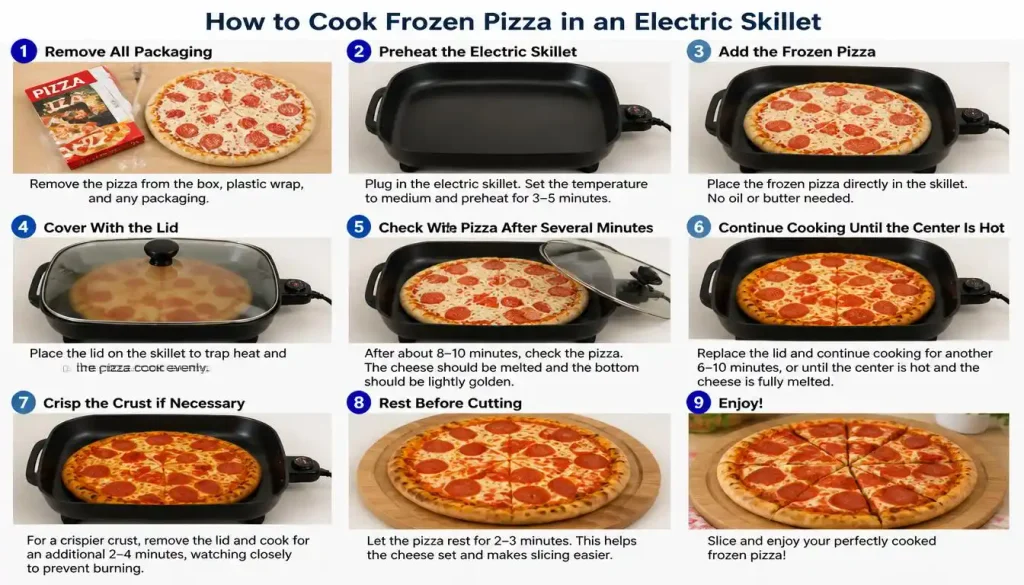
How to Cook Frozen Pizza in an Electric Skillet Step by Step
Here is the method that gives you the best chance of getting a crisp bottom and properly heated top.
Step 1: Remove All Packaging
Take the frozen pizza out of its box.
Remove:
- Plastic wrapping
- Cardboard
- Protective films
- Packaging inserts
Do not assume a cardboard disc under the pizza is designed to be cooked.
Follow the pizza manufacturer’s directions whenever the package specifically says to leave or remove a cooking tray.
Step 2: Preheat the Electric Skillet
Set your skillet to approximately 350°F to 375°F as a starting point for a standard frozen pizza.
Allow it to preheat according to your appliance manual.
For thick pizzas, you may want to begin closer to 325°F to 350°F.
For very thin pizza, 375°F may work well.
Step 3: Add the Frozen Pizza
Place the pizza directly onto the skillet’s cooking surface.
Center it as much as possible.
It should not be folded, heavily bent, or overlapping itself.
If your skillet has a good nonstick coating, you usually don’t need much oil.
Step 4: Cover With the Lid
Put the lid on immediately.
This is important.
Without a lid, the skillet heats the bottom efficiently but loses much of the heat needed to melt the cheese and warm the toppings.
The lid essentially creates a small enclosed cooking chamber.
Step 5: Check the Pizza After Several Minutes
Don’t wait until the expected finishing time before looking at the crust.
After roughly 5 to 8 minutes, carefully lift one edge with a heat-safe spatula.
If the bottom is becoming dark while the cheese is barely soft, lower the temperature.
If your skillet develops noticeable hot spots, rotate the pizza 90 or 180 degrees.
You don’t need to turn it upside down.
Step 6: Continue Cooking Until the Center Is Hot
Replace the lid and continue cooking.
Watch for:
- Fully melted cheese
- Hot toppings
- A hot center
- A firm, cooked crust
- A golden or crisp bottom
For meat-containing pizzas, follow the frozen pizza manufacturer’s cooking and food-safety instructions.
Step 7: Crisp the Crust if Necessary
If the cheese is melted but the crust is softer than you want, remove or slightly vent the lid for the final minute or two.
This lets excess steam escape.
Watch the bottom carefully because it can go from golden to burned quickly.
Step 8: Rest Before Cutting
Turn off and unplug the skillet.
Transfer the pizza to a cutting board or plate and let it rest for about 2 minutes.
This helps the cheese settle and prevents steam trapped beneath the crust from making it soggy.
Should You Thaw Frozen Pizza Before Cooking It?
Usually, no.
Most frozen pizzas are designed to be cooked from frozen unless the package tells you otherwise.
Thawing can change both the cooking time and texture. A partially thawed crust may become softer and more difficult to crisp.
If you do need to thaw food for another reason, don’t leave it sitting on the kitchen counter for a long period. USDA guidance recommends safe thawing methods such as refrigeration, cold water, or a microwave rather than uncontrolled room-temperature thawing.
You can read the USDA’s safe food-thawing guidance for more detail.
For frozen pizza in an electric skillet, however, starting from frozen is usually the simplest approach.
Do You Need Oil to Cook Frozen Pizza in an Electric Skillet?
Not necessarily.
A frozen pizza already contains fat in the cheese and often in the crust or toppings. If your electric skillet has a healthy nonstick cooking surface, additional oil may not be needed.
A tiny amount of oil can help if:
- Your skillet tends to stick.
- The crust is extremely dry.
- You want slightly more browning.
Use only a thin film.
Pouring a pool of oil beneath a pizza can make the bottom greasy rather than crisp.
Also check your appliance manual before using aerosol nonstick sprays. Some manufacturers discourage them on particular nonstick coatings.
If foods have recently started sticking even though they never did before, it may be worth checking the causes covered in KiCook’s guide to food sticking to an electric skillet.
Do You Need a Lid to Cook Frozen Pizza?
A lid is strongly recommended.
Remember, the heating element is below the pizza.
The lid keeps hot air and steam inside, making it much easier to heat:
- Cheese
- Sauce
- Meat toppings
- Vegetables
- The center of the pizza
Without the lid, you may get a beautifully browned crust and cheese that is still barely warm.
Can You Cook Frozen Pizza Without a Lid?
Technically, yes, but the results are less predictable.
If you don’t have a lid, keep the temperature relatively low and give the pizza more time.
However, I would not improvise by putting random materials over a hot electrical appliance. Use only accessories that are safe for your specific skillet.
For thick-crust pizza in particular, a lid makes a major difference.
How Do You Know When Frozen Pizza Is Done?
Don’t judge a pizza by melted cheese alone.
Look at the entire pizza.
It should have:
- Fully melted cheese
- A hot center
- Heated toppings
- A firm crust
- A browned bottom
- No noticeably cold or frozen areas
The center is normally the slowest part to heat.
If the edges look perfect but the center still feels cold, reduce the heat slightly, cover the skillet, and give it a few more minutes.
Always follow any specific doneness or temperature instructions printed on your frozen pizza package.
How to Make Frozen Pizza Crispy in an Electric Skillet
Getting the crust crisp isn’t difficult. Preventing it from burning while the rest of the pizza cooks is the real challenge.
Try these techniques.
Preheat First
A properly heated skillet begins crisping the frozen crust immediately instead of slowly warming it into a soft texture.
Don’t Use Too Much Oil
Too much oil can make the bottom heavy and greasy.
Cook Covered First
The cheese and center need trapped heat.
Keep the lid on during most of the cooking period.
Vent the Lid Near the End
Once the pizza is hot, letting some moisture escape can improve crispness.
Move the Finished Pizza Out of the Skillet
Don’t leave the pizza sitting in the covered skillet after turning off the power.
Residual steam can soften the bottom.
How to Keep the Bottom of the Pizza From Burning
This is the most common problem when cooking frozen pizza in an electric skillet.
If it keeps happening, focus on three things.
First, lower the heat.
If 400°F burns your pizza, try 350°F or even 325°F for a thick crust.
Second, keep the lid on.
The upper half needs trapped heat. Otherwise, you may keep waiting for the cheese while the crust continues cooking.
Third, check early.
Don’t assume a 20-minute cooking time means you can ignore the pizza for 20 minutes.
Electric skillets cycle their heating elements, and some surfaces develop hotter areas than others.
Why Is My Pizza Bottom Burned but the Cheese Isn’t Melted?
Your heat is probably too high.
The cooking surface is transferring energy into the crust faster than the enclosed air can heat the cheese.
Try this next time:
- Reduce the starting temperature.
- Keep the lid closed.
- Use a thinner pizza if possible.
- Rotate the pizza if your skillet has hot spots.
- Cook for slightly longer at lower heat.
If other foods are suddenly burning even when you’re using low or moderate settings, there may be a thermostat issue rather than a pizza problem. KiCook’s guide on how to tell if an electric skillet thermostat is failing can help you troubleshoot that.
Why Is My Frozen Pizza Soggy?
A soggy pizza usually comes from excess moisture.
Possible causes include:
- Too much oil
- Cooking at very low heat
- Leaving the pizza covered after cooking
- Allowing the pizza to thaw before cooking
- Very wet toppings
- Excessive condensation under the lid
The solution is to balance covered and uncovered cooking.
Keep the pizza covered while the middle and toppings heat. Once they are almost finished, vent or remove the lid briefly so some moisture can escape.
What if the Cheese Melts Before the Crust Is Done?
This problem is actually easier to solve than a burned crust.
Remove the lid and continue cooking briefly at moderate heat.
Without the lid trapping as much heat above the pizza, more of the cooking energy will focus on the bottom.
Check every minute or two.
You don’t want to fix a pale crust by turning it black.
Can You Cook Different Types of Frozen Pizza in an Electric Skillet?
Yes, but some styles work much better than others.
Thin-Crust Frozen Pizza
Thin crust is generally one of the easiest types to cook.
It heats quickly and crisps well.
The downside is that it can burn quickly, so check the underside early.
Regular-Crust Frozen Pizza
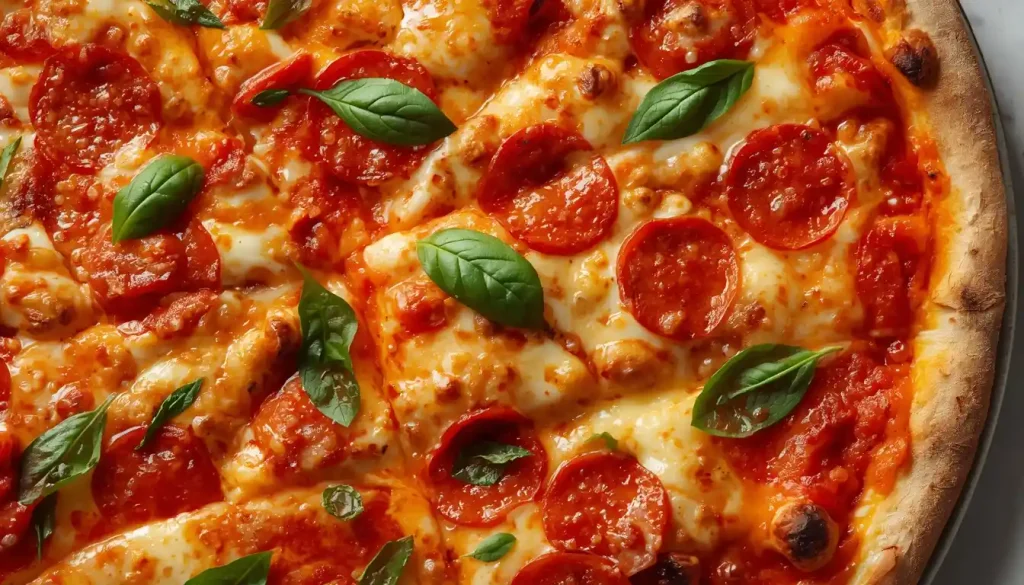
Regular frozen pizza is also a good candidate.
Start around moderate to medium-high heat, use the lid, and adjust based on how quickly the bottom browns.
Thick-Crust Frozen Pizza
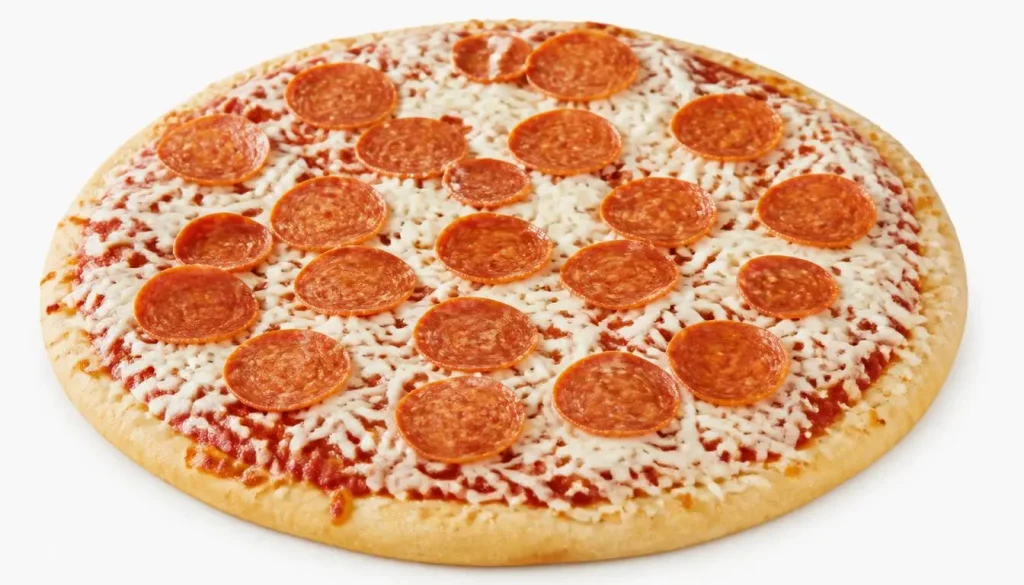
Thick crust requires patience.
Use lower heat and a longer cooking time.
High heat is likely to burn the bottom before the center is ready.
Deep-Dish Frozen Pizza
Deep-dish pizza is the hardest style to cook successfully in an electric skillet.
It has much more mass, and an electric skillet doesn’t provide strong direct heat from above.
If the package specifically requires oven baking, an oven may be the better choice.
Mini or Personal Frozen Pizza
Mini pizzas are ideal for electric skillets.
They fit easily, heat quickly, and are easier to rotate if the pan has hot spots.
Electric Skillet vs Oven for Frozen Pizza
Both methods work, but an oven still has an advantage when you want even browning across the entire pizza.
| Feature | Electric Skillet | Conventional Oven |
|---|---|---|
| Small pizza | Excellent | Excellent |
| Large pizza | Limited by skillet size | Better |
| Thin crust | Very good | Excellent |
| Thick crust | More difficult | Better |
| Bottom crispness | Very good | Very good |
| Top browning | Limited | Better |
| Preheating | Usually faster | Usually slower |
| Heats the kitchen | Less | More |
| Portable | Yes | No |
An electric skillet makes the most sense when:
- You don’t want to turn on a full-size oven.
- You’re cooking one small pizza.
- You live in a small space.
- Your oven is unavailable.
- You want a portable cooking option.
An oven is usually better for thick, oversized, stuffed, or deep-dish frozen pizzas.
Electric Skillet vs Air Fryer for Frozen Pizza
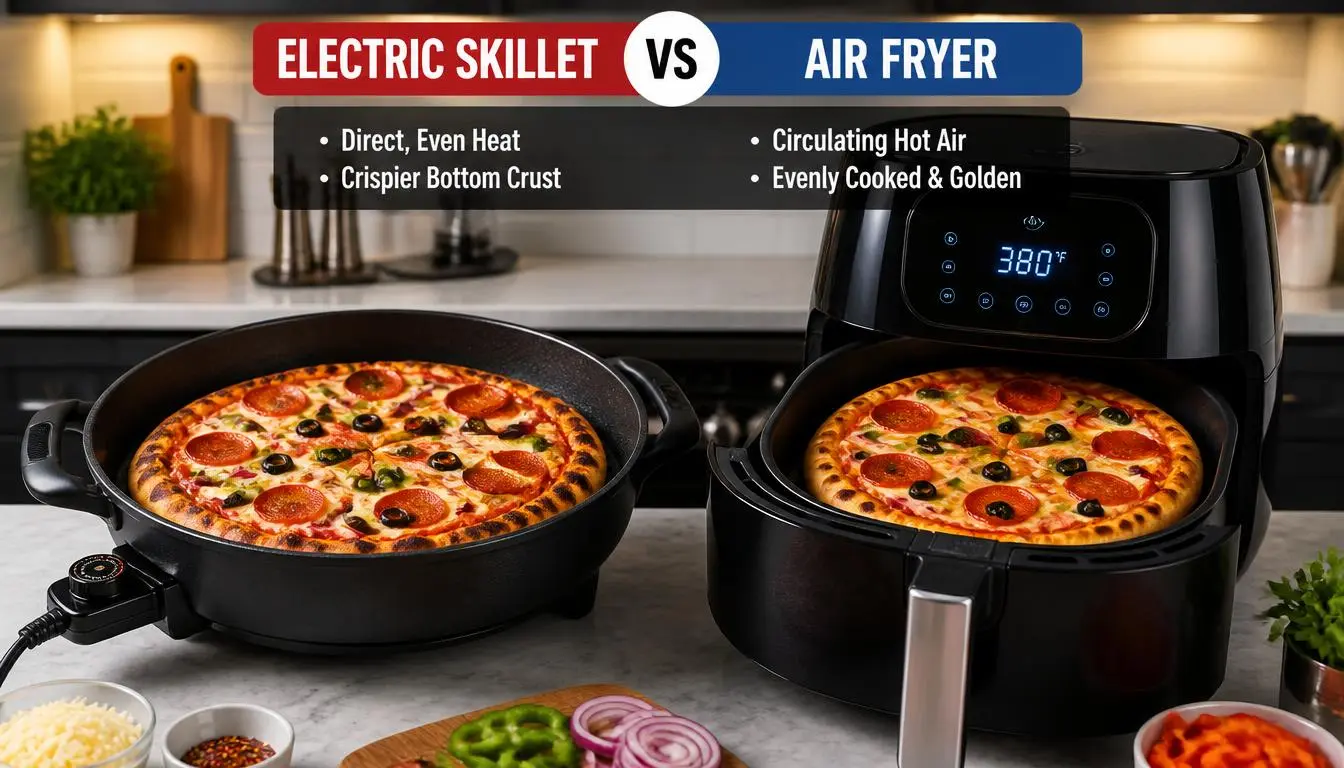
An air fryer has one major advantage: hot air circulates around the pizza.
That generally makes it easier to cook both the top and bottom.
However, basket size can be a problem.
A full-size frozen pizza may fit comfortably in a large electric skillet but not in a standard air fryer.
Choose an electric skillet when you need more flat cooking space.
Choose an air fryer when the pizza fits and your priority is strong all-around crispness.
Should You Flip a Frozen Pizza in an Electric Skillet?
No, you generally should not flip a conventional topped frozen pizza.
Some skillet-pizza techniques involve flipping plain dough or crust before toppings are added, but that is very different from turning a fully assembled frozen pizza upside down.
Trying to flip a cheese-covered frozen pizza can send melted cheese, sauce, and toppings onto your skillet.
Instead, leave the topping side facing upward.
If the pizza cooks unevenly, rotate it horizontally rather than flipping it.
Can You Use Parchment Paper Under Frozen Pizza?
Only if your electric skillet manufacturer allows it and the parchment is rated for the temperature you’re using.
Parchment also reduces direct contact between the crust and skillet, which may change browning.
For most nonstick electric skillets, it isn’t necessary.
Never assume that something safe in an oven is automatically safe against the cooking surface of every countertop appliance.
Can You Put Aluminum Foil Under Pizza in an Electric Skillet?
Again, check your appliance manual.
Don’t cover electrical components, temperature probes, vents, or areas where the manufacturer says airflow is required.
For most pizzas, putting them directly on a clean nonstick surface is simpler.
Common Mistakes When Cooking Frozen Pizza in an Electric Skillet
A few mistakes account for most disappointing skillet pizzas.
1. Starting With Maximum Heat
High heat doesn’t necessarily mean faster pizza.
It often means burnt crust.
2. Cooking Without the Lid
This leaves the top struggling to catch up with the bottom.
3. Never Checking the Crust
Frozen pizza is not a set-it-and-forget-it food in an electric skillet.
4. Using a Pizza That’s Too Large
If the pizza can’t lie flat, cooking becomes inconsistent.
5. Using Too Much Oil
You’re trying to crisp the crust, not shallow-fry it.
6. Thawing the Pizza on the Counter
Besides changing texture and cooking behavior, extended room-temperature thawing is not a good food-safety practice. USDA recommends controlled thawing methods when thawing is necessary.
7. Assuming Every Skillet Runs at the Same Temperature
Thermostat calibration varies.
Learn how your own appliance behaves.
8. Relying Only on Cooking Time
Check the pizza itself rather than trusting a timer blindly.
Safety Tips for Cooking Frozen Pizza in an Electric Skillet
Electric skillets are straightforward appliances, but they still combine high heat and electricity.
Follow a few basic rules.
- Read your specific skillet manual.
- Use the appliance on a stable, dry, heat-resistant surface.
- Keep electrical controls and connections dry.
- Don’t use a damaged cord or plug.
- Use heat-resistant utensils.
- Be careful when removing the lid because trapped steam can burn.
- Keep the skillet away from the counter edge.
- Don’t leave a hot appliance unattended for long periods.
- Unplug it when you’re finished.
- Let it cool before cleaning.
Manufacturer instructions matter because electric skillets are not all designed the same way. West Bend maintains an official user-manual library for its appliances, while Presto also provides model-specific skillet instructions and manuals.
Is an Electric Skillet a Good Way to Cook Frozen Pizza?
For the right pizza, yes.
It is particularly useful for a thin or regular-crust pizza that fits comfortably inside the pan.
An electric skillet can give you a crisp bottom, melted cheese, and a hot center without heating an entire oven.
The technique becomes less convenient with very thick or deep-dish pizzas because those styles need more heat around the sides and top.
Think of an electric skillet as a practical alternative rather than an exact replacement for an oven.
Once you understand how quickly the bottom cooks and how important the lid is, the method becomes much easier to control.
Frequently Asked Questions About Can I Cook a Frozen Pizza in an Electric Skillet
Can I Put a Frozen Pizza Directly in an Electric Skillet?
Yes. In most cases, you can place the pizza directly on the cooking surface after removing all packaging. Make sure the skillet is large enough and use the lid while cooking.
Can I Cook Frozen Pizza in an Electric Frying Pan?
Yes. “Electric frying pan” and “electric skillet” generally refer to the same type of appliance. The wording is especially common in the UK and Australia.
Can I Cook Frozen Pizza Without an Oven?
Yes. An electric skillet is one option. Depending on pizza size and equipment, you may also be able to use an air fryer, toaster oven, countertop pizza cooker, or covered stovetop skillet.
What Temperature Should I Use?
Start around 350°F to 375°F for most regular frozen pizzas and adjust as needed. Some electric skillet guidance lists temperatures as high as 400°F for frozen pizza, but direct bottom heat means you should watch the crust carefully.
How Long Should I Cook Frozen Pizza in an Electric Skillet?
Many pizzas take approximately 12 to 25 minutes. Thin pizzas may cook faster, while thick pizzas can take longer.
Should I Flip Frozen Pizza?
Normally, no. Keep the topping side facing upward and rotate the pizza instead if your skillet heats unevenly.
Do I Need to Thaw Frozen Pizza First?
Usually not. Unless the package tells you otherwise, cook it directly from frozen.
Do I Need Oil?
Usually very little or none if your skillet has a good nonstick surface.
Can I Cook Pizza Without a Lid?
You can, but it’s much harder to heat the toppings and cheese before the bottom crust becomes overcooked. A lid is strongly recommended.
Can I Cook a 12-Inch Frozen Pizza in an Electric Skillet?
Yes, if your skillet has enough flat cooking space for the entire pizza and the lid can close normally. Remember that a skillet advertised as 12 inches may not provide a full 12 inches of completely flat cooking surface.
Can I Cook DiGiorno, Red Baron, or Totino’s Pizza in an Electric Skillet?
Potentially, yes, if the pizza fits your skillet. However, crust thickness and preparation vary between products. Check the package instructions first, then adjust skillet temperature and cooking time based on how quickly the crust browns and the center heats.
Final Verdict
Yes, you can cook a frozen pizza in an electric skillet.
The method works best when the pizza fits flat inside the skillet, the appliance has good temperature control, and you use a lid to trap heat around the cheese and toppings.
For most pizzas, start with moderate heat rather than immediately choosing the highest setting. Check the bottom crust after the first several minutes, rotate the pizza if your skillet has hot spots, and reduce the temperature if the crust is browning before the top is ready.
Thin, regular, and personal-size frozen pizzas are generally the easiest to cook this way. Thick and deep-dish pizzas may be better suited to a conventional oven because they need more surrounding heat.
The main rule is simple: control the bottom heat and give the top enough trapped heat to catch up.
Do that, and an electric skillet can turn a frozen pizza into a crisp, hot meal even when using an oven isn’t convenient.

“I believe great cooking starts with the right tools, trusted advice, and a little confidence in the kitchen.”
Hi, I’m Emma Carter. My love for cooking began in my grandmother’s kitchen, where I learned that every great meal starts with simple ingredients and the right cookware. Over the years, I’ve spent countless hours researching, testing, and comparing kitchen appliances, cookware, coffee makers, air fryers, and other everyday kitchen essentials.
Here at KiCook, my goal is to make your buying decisions easier with honest product reviews, practical buying guides, and easy-to-follow cooking tips. Whether you’re upgrading your kitchen or searching for the best appliance for your home, I focus on providing clear, reliable, and research-backed information you can trust.
When I’m not testing new kitchen gadgets or writing in-depth guides, you’ll usually find me trying new recipes, visiting local farmers’ markets, or enjoying a quiet cup of coffee while planning my next kitchen project.