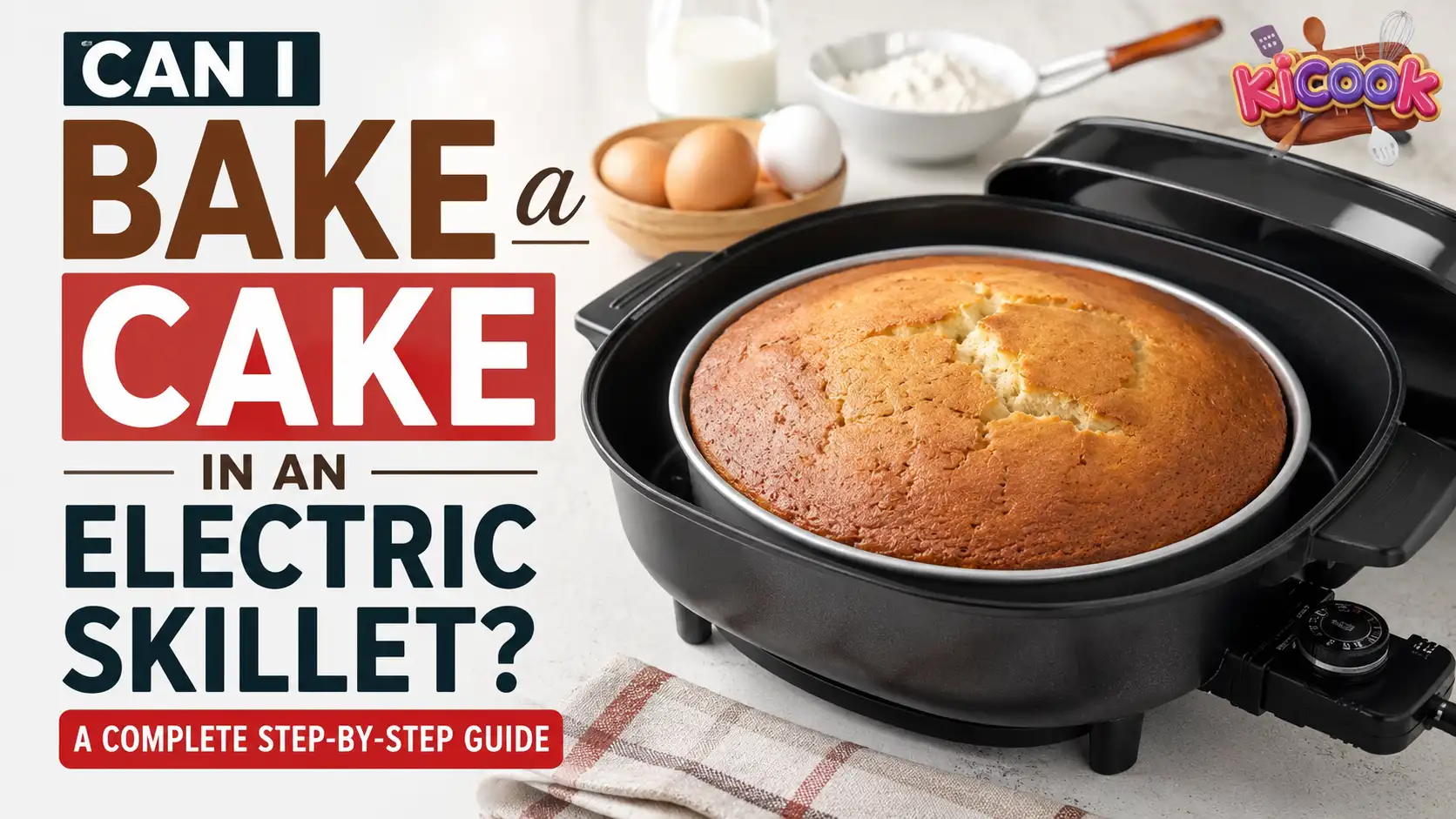
Yes, you can bake a cake in an electric skillet. In fact, an electric skillet can be a surprisingly useful alternative when you do not have access to a conventional oven.
The trick is understanding that an electric skillet does not bake exactly like an oven. Most of the heat comes from underneath, while the lid traps warm air and moisture around the cake. Because of that, temperature control, pan placement, cake thickness, and keeping the lid closed all matter.
For many simple cakes, you have two options: bake the batter directly in the skillet or place a cake pan on a suitable rack inside the skillet. The second method usually gives you more control because it separates the cake pan from the strongest direct heat.
This guide walks you through both methods, including temperature, baking time, cake-pan size, boxed cake mix, common problems, and how to keep the bottom from burning.
Can You Really Bake a Cake in an Electric Skillet?
Yes. Some electric skillets are specifically designed to handle baking-style cooking in addition to frying, sautéing, simmering, and making casseroles.
A covered electric skillet creates a small enclosed cooking chamber. The heating element warms the bottom of the skillet, while the closed lid helps hold heat around the food.
It is not exactly the same environment as an oven, though.
A conventional oven surrounds a cake with hot air. An electric skillet delivers much more heat from below. As a result, the bottom of a cake can cook faster than the top.
That is why electric skillet baking usually works best when you:
- Keep the temperature moderate.
- Use the lid.
- Avoid making the cake excessively thick.
- Monitor the cake before the estimated cooking time ends.
- Use a cake pan and rack if your skillet manufacturer permits it.
Electric skillets are more versatile than many people realize. If you want to see other possibilities beyond cake, take a look at what you can cook in an electric skillet.
How Does an Electric Skillet Bake a Cake?
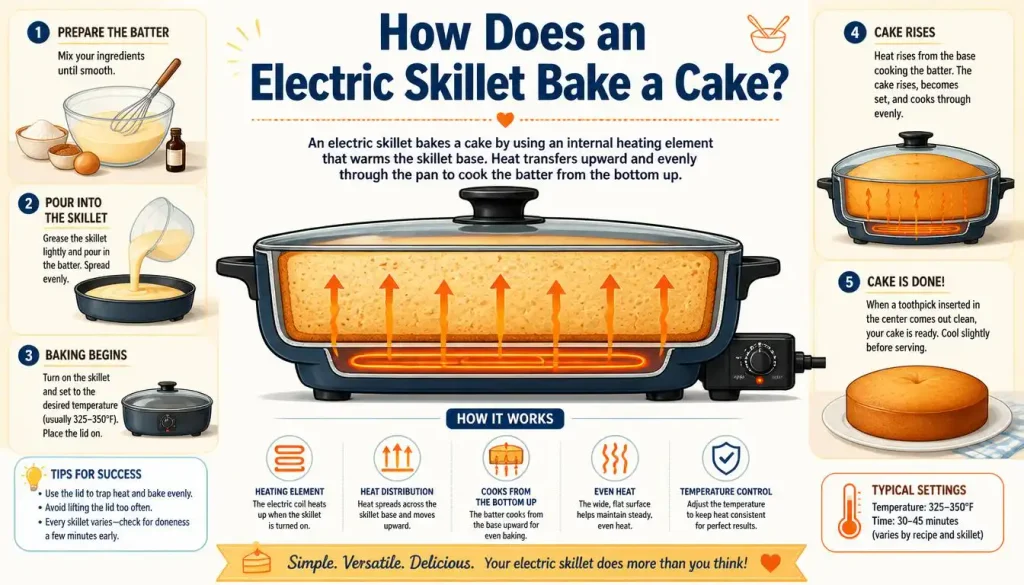
The heating element in an electric skillet is located below or integrated into the cooking surface. That makes the bottom of the pan the main source of heat.
When you put the lid on, some of that heat remains trapped inside. The enclosed space becomes hot enough to cook cake batter gradually.
Three things make the biggest difference.
Bottom Heat
The strongest heat is underneath the cake. This is why using too high a temperature can leave you with a dark bottom and an undercooked center.
The Lid
The lid is essential for most electric skillet cakes. Without it, much of the heat escapes before it can cook the upper portion of the cake.
Temperature Control
A thermostat-controlled skillet cycles its heating element on and off to maintain the selected setting.
However, electric skillets do not all heat exactly the same way. Older thermostats, hot spots, pan construction, wattage, and skillet size can all affect the actual cooking temperature.
If your appliance frequently burns food on one side, read this guide to electric skillet uneven heating before attempting a cake.
What You Need to Bake a Cake in an Electric Skillet
For the cake-pan method, gather:
- An electric skillet with a fitted lid
- A cake pan that fits comfortably inside
- An approved rack or trivet
- Prepared cake batter
- Butter, shortening, or cooking spray
- Parchment paper, if appropriate for your pan
- A toothpick or cake tester
- Heat-resistant oven mitts
- A cooling rack
Before using any rack, pan, or baking accessory inside the skillet, check the instructions for your particular model.
Some electric skillets are designed for this type of baking. Others may have different restrictions.
Can You Put a Cake Pan Inside an Electric Skillet?
Yes, in suitable electric skillets.
For example, Presto’s electric skillet instructions describe placing cake batter in a baking pan, setting that pan on a rack inside the skillet, and baking it with the cover in place.
The important part is making sure the cake pan fits properly.
It should not:
- Force against the skillet walls
- Prevent the lid from closing
- Touch electrical components
- Sit directly on an unsuitable heating surface
- Be so tall that the rising cake reaches the lid
A metal cake pan is generally the simplest choice because metal responds to heat predictably and is widely used for baking.
Do not assume an ordinary glass dish can safely sit over concentrated bottom heat. Only use glass cookware when both the cookware manufacturer and your skillet manufacturer approve that type of use.
What Size Cake Pan Works Best?
There is no universal cake-pan size because electric skillets come in different shapes and dimensions.
A 12-inch round skillet obviously gives you less space than a large rectangular family-size model.
Instead of choosing a pan by diameter alone, check three things.
Leave Space Around the Pan
The cake pan should fit comfortably rather than being wedged tightly against the skillet.
Check Lid Clearance
The lid must close completely.
Remember that cake rises as it cooks, so leave enough space above the batter as well.
Avoid an Overly Deep Cake
Shallow single-layer cakes are generally easier to cook evenly than very deep cakes.
If the cake is too thick, the bottom may finish long before heat reaches the center.
Do You Need a Rack to Bake Cake in an Electric Skillet?
Not for every cake.
Some cakes, particularly upside-down skillet cakes, can be cooked directly in the skillet.
For a conventional cake baked in a separate pan, however, a rack can be very useful.
The rack lifts the cake pan above the hottest cooking surface. That reduces direct bottom heat and creates a more oven-like environment around the pan.
Use only a rack or trivet suitable for your appliance.
The official Presto electric skillet instructions describe rack-assisted baking as one method for cake batter.
Do You Need to Preheat an Electric Skillet Before Baking a Cake?
It depends on the appliance and recipe, but many electric skillets are designed to be preheated before cooking.
For example, some manufacturer instructions recommend allowing the skillet several minutes to reach the selected temperature.
That does not mean you should automatically heat an empty nonstick skillet at a high setting.
Follow your manufacturer’s instructions.
If your recipe calls for preheating:
- Set up the skillet on a level, heat-resistant surface.
- Insert the temperature control correctly.
- Set the appropriate temperature.
- Allow the skillet to stabilize.
- Add the cake setup according to the recipe.
A stable starting temperature can help the cake cook more predictably.
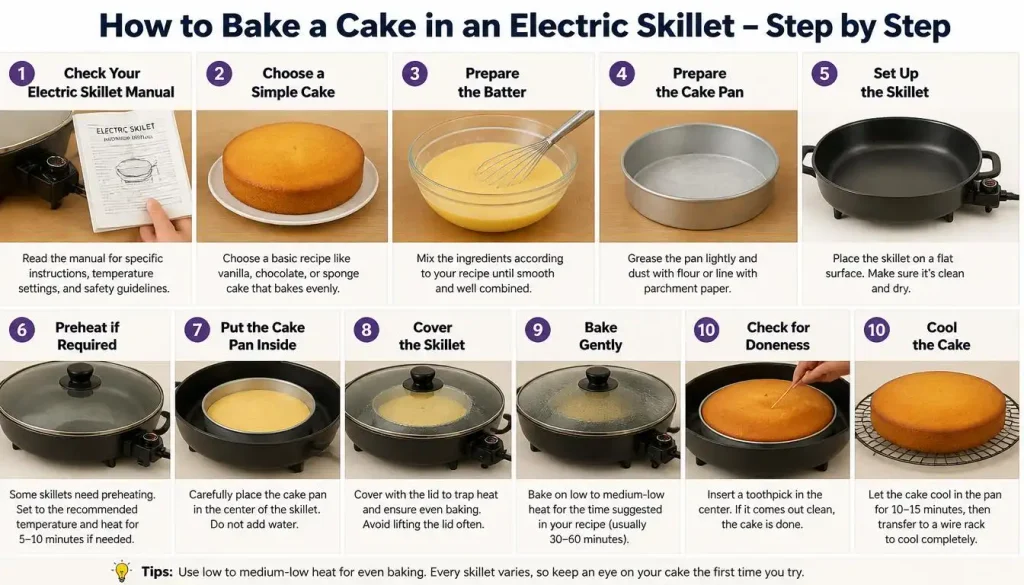
How to Bake a Cake in an Electric Skillet Step by Step
The following method is designed for a cake pan placed inside a covered electric skillet.
Step 1: Check Your Electric Skillet Manual
Do this before anything else.
Confirm that your model supports baking and whether the manufacturer allows a rack or baking pan inside the skillet.
Step 2: Choose a Simple Cake
Start with a basic single-layer vanilla, yellow, chocolate, or similar cake.
Avoid an unusually thick cake for your first attempt.
Step 3: Prepare the Batter
Make the cake batter according to your recipe.
Do not change the flour, liquid, eggs, or leavening simply because you are using an electric skillet unless the recipe specifically calls for an adjustment.
Step 4: Prepare the Cake Pan
Grease the pan thoroughly.
If appropriate for your recipe, line the bottom with parchment paper to make removal easier.
Fill the pan only as high as the recipe recommends. You need room for the cake to rise.
Step 5: Set Up the Skillet
Place the approved rack inside the skillet.
The purpose of the rack is to keep the cake pan from sitting directly on the hottest surface.
Step 6: Preheat if Required
Set the skillet to the temperature recommended by your recipe or manufacturer and allow it to stabilize if preheating is required.
Step 7: Put the Cake Pan Inside
Carefully place the filled cake pan on the rack.
Make sure it sits level.
Step 8: Cover the Skillet
Put the lid in place.
Try not to repeatedly remove it during the early stages of cooking. Every time you lift the lid, trapped heat escapes.
Step 9: Bake Gently
Allow the cake to cook while watching for signs that the bottom is browning too quickly.
Electric skillets cycle on and off as they maintain temperature, so the indicator light may change during cooking. That is usually normal.
Step 10: Check for Doneness
Begin checking before you would normally expect an oven cake to finish, especially the first time you use a particular skillet.
Insert a toothpick into the center.
The cake is generally ready when the toothpick comes out clean or with only a few moist crumbs rather than wet batter.
Step 11: Cool the Cake
Turn off and unplug the skillet.
Carefully remove the cake pan using heat-resistant mitts.
Let the cake cool in its pan briefly before transferring it to a cooling rack according to your recipe.
What Temperature Should You Bake a Cake in an Electric Skillet?
There is no single temperature that is correct for every electric skillet cake.
The proper setting depends on:
- Whether the batter is directly in the skillet or in a separate cake pan
- The type of cake
- The thickness of the batter
- The skillet design
- The accuracy of the thermostat
- The amount of heat trapped by the lid
For reference, Presto lists approximately 225°F to 275°F (107°C to 135°C) for an upside-down cake cooked directly in one of its electric skillet models.
That does not mean every cake in every skillet should be baked at 225°F to 275°F.
A separate cake pan, different skillet model, or different recipe may require another setting.
The safest approach is to follow a recipe intended for your cooking method and the instructions provided with your skillet.
If you are adapting a recipe, moderate heat is generally easier to manage than aggressive heat because the bottom of the skillet receives the strongest heat.
Why Electric Skillet Temperature Can Vary
You may set the dial to one temperature and still get different results from someone using another skillet.
Several factors explain this.
Thermostat Cycling
The heating element does not necessarily stay on continuously. It cycles as the appliance tries to maintain the selected temperature.
Hot Spots
Some skillets distribute heat more evenly than others.
Skillet Construction
The thickness and material of the pan affect how quickly heat spreads.
Wattage
Larger and more powerful skillets may heat and recover differently. If you are curious about this, KiCook has a separate breakdown of how many watts an electric skillet uses.
Thermostat Problems
If your skillet burns food even when set to low heat, takes unusually long to heat, or behaves unpredictably, the issue may be the control rather than your cake.
You can check the common signs in this guide to a broken electric skillet thermostat.
How Long Does It Take to Bake a Cake in an Electric Skillet?
Expect the baking time to vary considerably.
Instead of relying on one universal number, use your recipe as a starting point and monitor the cake.
Cooking time depends on:
- Cake-pan diameter
- Batter depth
- Skillet temperature
- Skillet size
- Thermostat accuracy
- Cake ingredients
- Starting temperature of the ingredients
- How often the lid is opened
A shallow cake will usually finish sooner than a thick one.
The first time you make a particular cake, start checking early and write down what worked. The second attempt will be much easier.
How Do You Know When an Electric Skillet Cake Is Done?
Do not judge the cake by top color alone.
This is especially important with an electric skillet because it does not provide the same overhead heat as a conventional oven.
The top may remain pale even when the cake is fully cooked.
Use one or more of these checks instead.
Toothpick Test
Insert a clean toothpick into the center.
If it comes out covered in wet batter, the cake needs more time.
If it comes out clean or with a few moist crumbs, the center is likely done.
Spring-Back Test
Gently press the center of the cake.
A finished cake often springs back rather than leaving a deep indentation.
Check the Edges
Depending on the recipe, the edges may begin pulling slightly away from the pan.
Never keep cooking simply because you are waiting for the top to become as brown as an oven-baked cake.
Easy Electric Skillet Vanilla Cake
If you want to experiment, a simple vanilla cake is easier to manage than a very deep or heavily filled cake.
Ingredients
- 1 1/2 cups all-purpose flour
- 1 1/2 teaspoons baking powder
- 1/4 teaspoon salt
- 1/2 cup softened unsalted butter
- 3/4 cup granulated sugar
- 2 large eggs
- 1 teaspoon vanilla extract
- 1/2 cup milk
Instructions
Grease a small metal cake pan that fits comfortably inside your skillet.
In one bowl, combine the flour, baking powder, and salt.
In another bowl, beat the softened butter and sugar until creamy. Add the eggs one at a time, followed by the vanilla.
Add the dry ingredients and milk gradually, alternating between them. Mix only until the batter is combined.
Transfer the batter to the prepared pan.
Place an approved rack inside the electric skillet and set the cake pan on top.
Cover the skillet and cook according to the baking guidance for your particular appliance, using moderate heat and checking the cake early.
Because electric skillet models behave differently, avoid treating a single temperature or time as universal.
Check the center with a toothpick before removing the cake.
Once done, turn off the skillet, unplug it, carefully remove the pan, and allow the cake to cool before frosting.
Can You Bake a Cake Directly in the Electric Skillet?
Yes, some cakes can be baked directly in the cooking surface.
Upside-down cakes are a classic example.
Cooking directly in the skillet has one major advantage: you do not need a separate cake pan.
However, there is also a disadvantage. The batter is closer to the heating element, making temperature control especially important.
For a traditional fluffy layer cake, I prefer the cake-pan-and-rack method when the appliance manufacturer approves it.
| Method | Best For | Main Advantage | Main Limitation |
|---|---|---|---|
| Direct in skillet | Upside-down and skillet-style cakes | Simple setup | Stronger bottom heat |
| Cake pan on rack | Traditional single-layer cakes | Better separation from direct heat | Requires suitable pan and rack |
How to Bake a Cake Without a Cake Pan
If your electric skillet is designed for direct cake baking, you may not need a separate pan.
Grease the cooking surface carefully and follow a recipe developed for a skillet-style cake.
Do not automatically pour a standard oven cake recipe directly into the skillet.
The batter depth and heating pattern may be very different from what the original recipe expects.
Pineapple upside-down cake is particularly well suited to direct skillet baking because its presentation does not depend on a browned top.
Can You Use Box Cake Mix in an Electric Skillet?
Yes, you can often use boxed cake mix, provided you choose a suitable cooking method and your skillet supports baking.
Prepare the batter according to the package directions unless you are following a tested skillet-specific adaptation.
The important adjustment is usually not the batter itself. It is the way you cook it.
Use a suitable pan, avoid making the cake too deep, keep the skillet covered, and start checking the center early.
This can work with common vanilla, yellow, chocolate, spice, or similar boxed mixes.
Can You Convert a Regular Oven Cake Recipe to an Electric Skillet?
Sometimes, but do not copy the oven directions blindly.
An oven recipe assumes heat is circulating around the cake. Your skillet heats primarily from underneath.
When adapting a recipe:
- Choose a relatively shallow cake.
- Use a properly fitting pan.
- Use a rack if approved.
- Keep the lid closed during most of the cooking.
- Watch the bottom carefully.
- Check the center rather than relying on top browning.
- Start checking before the original baking time has fully elapsed.
- Adjust temperature only when necessary.
If a recipe depends heavily on dry heat from above, crisp edges, or precise browning, a conventional oven may still be the better appliance.
How to Prevent Condensation From Dripping Onto the Cake
Because the lid traps moisture, droplets may collect underneath it.
A small amount of condensation is normal during covered cooking.
The goal is to maintain enough trapped heat to bake the cake without repeatedly opening the skillet.
If condensation becomes excessive, follow the venting instructions for your particular skillet rather than improvising with the lid.
Avoid placing towels, paper, or other flammable materials near the heating appliance simply to catch condensation.
Why Is My Electric Skillet Cake Burning on the Bottom?
This is one of the most common electric skillet baking problems.
Usually, the bottom burns because the cake is receiving too much heat before the center finishes.
Possible causes include:
- Temperature set too high
- Cake pan sitting directly on the hot cooking surface
- Batter too deep
- Skillet hot spots
- Faulty thermostat
- Cake left cooking too long
If you are using a separate cake pan and your manufacturer permits it, placing that pan on a suitable rack can reduce direct heat.
You may also need to lower the temperature.
Why Is My Cake Raw in the Middle?
A raw center usually means heat has not had enough time to penetrate the entire cake.
Common causes include:
- Cake is too thick
- Temperature is too high
- Cake pan is too small and deep
- Lid was repeatedly removed
- Cooking time was too short
A high temperature may seem like the solution, but it can make the problem worse by burning the outside before the center cooks.
Lower, steadier heat is often more effective.
Why Is the Top of My Cake Still Wet?
If the bottom appears cooked but the top remains very wet, check:
- Whether the lid fits correctly
- Whether the cake is too thick
- Whether the skillet is maintaining its temperature
- Whether you have opened the lid too frequently
Remember that a pale top and a raw top are not the same thing.
The surface can remain light in color while the cake itself is fully cooked.
Why Isn’t My Electric Skillet Cake Browning on Top?
This is normal.
Unlike an oven, an electric skillet does not have an upper heating element surrounding the cake with dry heat.
Manufacturer instructions for skillet baking specifically warn that the top of a cake may not brown.
Instead of overcooking the cake while waiting for color, test the center.
Once cooled, you can improve its appearance with:
- Frosting
- Glaze
- Powdered sugar
- Fruit
- Nuts
- Chocolate drizzle
Why Didn’t My Cake Rise?
Several problems can prevent a cake from rising properly:
- Old baking powder or baking soda
- Overmixed batter
- Incorrect ingredient quantities
- Opening the lid too often
- Batter sitting too long before cooking
- Incorrect temperature
Measure your ingredients carefully and get the cake into the heated cooking environment soon after mixing when the recipe requires it.
Why Is My Cake Dense or Gummy?
A dense or gummy cake may be undercooked, but baking technique is not always the cause.
Other possibilities include:
- Too much liquid
- Too much flour
- Overmixing
- Incorrect leavening
- Batter depth that is too great for the skillet setup
Before changing the electric skillet temperature drastically, make sure the cake recipe itself is correctly measured.
Why Is My Cake Sticking?
Proper pan preparation matters.
Grease the baking pan thoroughly, including the corners and sides.
If the recipe allows it, parchment on the bottom can make removal easier.
Also allow the cake to cool for the amount of time recommended by the recipe before attempting to turn it out.
If food frequently sticks to the skillet itself, damaged nonstick coating may be part of the problem. KiCook’s guide to common electric skillet problems covers sticking, thermostat cycling, uneven heat, and other appliance issues.
Best Types of Cake for an Electric Skillet
Some cakes are easier to adapt than others.
Good starting choices include:
Pineapple Upside-Down Cake
This is one of the best-known electric skillet cakes and can be cooked directly in suitable models.
Vanilla Cake
A simple, shallow vanilla cake is easy to monitor and decorate afterward.
Yellow Cake
Another practical choice for a single-layer skillet cake.
Chocolate Cake
Chocolate cake does not rely on visible top browning, which makes it well suited to this cooking method.
Spice Cake
A relatively shallow spice cake can also work well.
Fruit-Topped Skillet Cakes
These are often forgiving because they are intended to have a rustic appearance.
Very tall layer cakes, delicate soufflé-style cakes, and recipes that depend on strong overhead heat are generally less convenient.
Electric Skillet vs. Oven for Baking Cake
| Feature | Electric Skillet | Conventional Oven |
|---|---|---|
| Main heat source | Mostly underneath | Heat surrounds cake |
| Top browning | Limited | Better |
| Portability | High | Low |
| Small-batch convenience | Good | Good, but heats larger space |
| Cake size | Limited by skillet | Much greater flexibility |
| Temperature behavior | Varies by model | Usually more predictable |
| Best use | Simple covered cakes | Most cake recipes |
An electric skillet is not necessarily better than an oven.
It is simply another way to cook when an oven is unavailable, inconvenient, already occupied, or unnecessary for a small cake.
The same principle applies to other oven-style foods. For example, you can also bake certain casseroles in an electric skillet with the right temperature, lid, and cooking method.
Advantages of Baking Cake in an Electric Skillet
You Don’t Need a Full-Size Oven
This is the biggest benefit.
An electric skillet can be useful in a small apartment, temporary kitchen, RV, holiday kitchen setup, or anywhere you do not have convenient oven access.
It Is Portable
As long as you have an appropriate electrical outlet and a safe cooking surface, the appliance is easy to move compared with an oven.
Good for Smaller Cakes
You do not need to heat an entire oven just to prepare one small cake.
Temperature Is Adjustable
Most modern electric skillets have thermostat controls, making them much easier to manage than an ordinary frying pan over an unpredictable burner.
Limitations of Baking Cake in an Electric Skillet
Electric skillet cake baking also has limitations.
The Top Will Not Brown Normally
This is the most noticeable difference.
Cake Size Is Limited
Your cake pan has to fit inside the skillet with the lid closed.
Bottom Heat Can Be Strong
Careless temperature selection can scorch the bottom.
Results Vary by Model
Two electric skillets set to the same number may not behave exactly the same.
Some Recipes Simply Work Better in an Oven
If a cake requires very precise temperature control or strong heat from above, the oven remains the more reliable choice.
Common Mistakes When Baking Cake in an Electric Skillet
Avoid these mistakes and your odds of success improve considerably.
- Setting the temperature too high. More heat does not necessarily make the cake bake better.
- Using a cake pan that is too large. Leave room for the lid to close and heat to move around the pan.
- Making the cake too deep. A thick cake is difficult to cook evenly with strong bottom heat.
- Opening the lid constantly. This releases accumulated heat.
- Waiting for the top to brown. The top may remain pale even when the cake is finished.
- Ignoring the appliance manual. Baking methods differ from one skillet to another.
- Using an unapproved rack or dish. Not every accessory is suitable for every skillet.
- Assuming the dial is perfectly accurate. Thermostats and heating patterns vary.
- Leaving the cake unattended. Monitor a new recipe closely until you know how your skillet behaves.
Safety Tips for Baking Cake in an Electric Skillet
Electric skillets are straightforward appliances, but they still involve electricity, hot surfaces, and steam.
Keep these precautions in mind:
- Place the skillet on a dry, level, heat-resistant surface.
- Keep the cord away from hot surfaces and counter edges.
- Do not touch hot metal or glass without proper protection.
- Open the lid carefully because trapped steam can burn you.
- Do not immerse the electrical control or cord in water.
- Do not use damaged electrical components.
- Never place the complete electric skillet in an oven unless the manufacturer specifically says it is designed for that use.
- Use only accessories permitted by the manufacturer.
- Turn the skillet off and unplug it when cooking is finished.
For model-specific instructions, always consult the manufacturer’s manual rather than relying only on a general cooking guide.
Frequently Asked Questions
Can I bake a cake in an electric skillet?
Yes. Many electric skillets can bake simple cakes when used correctly. Depending on the model and recipe, the cake may be baked directly in the skillet or in a separate cake pan placed on an approved rack.
What temperature do you bake a cake in an electric skillet?
There is no universal setting for every cake and skillet. Some manufacturer instructions list around 225°F to 275°F for specific upside-down skillet cakes, but cakes baked in separate pans or different skillet models may require different temperatures. Follow your recipe and appliance manual.
How long does a cake take in an electric skillet?
It depends on the batter depth, pan size, skillet model, temperature, and recipe. Start checking before the expected finish time and rely on doneness tests rather than the clock alone.
Can I put a cake pan in an electric skillet?
Yes, if your electric skillet is designed to accept a baking pan. Make sure the pan fits comfortably, the lid closes, and the manufacturer permits the setup.
Do I need a rack?
A rack is useful when baking a cake in a separate pan because it keeps the pan away from strong direct bottom heat. Only use one if it is approved for your skillet.
Can I bake cake directly in an electric skillet?
Yes. Certain skillet-style cakes, especially upside-down cakes, can be baked directly in suitable electric skillets.
Can I make a cake without an oven?
Yes. An electric skillet is one option. Depending on the recipe, other alternatives include a pressure cooker, slow cooker, countertop oven, or stovetop baking setup.
Can I use boxed cake mix in an electric skillet?
Yes. Prepare the batter according to the package directions and use an appropriate skillet-baking method. The main adjustments usually involve cooking temperature, pan size, and cooking time.
Can I use parchment paper in an electric skillet?
Parchment may be used inside an appropriate cake pan when suitable for the recipe and cooking temperature. Keep parchment away from exposed heating elements and follow your appliance instructions.
Can I use aluminum foil in an electric skillet?
Only when permitted by your appliance manufacturer and recipe. Do not use foil in a way that interferes with the thermostat, heating system, or normal heat circulation.
Can I put Pyrex or another glass baking dish in an electric skillet?
Do not assume that you can. Glass cookware may be vulnerable to thermal stress when exposed to concentrated direct heat. Use it only when both the cookware manufacturer and electric skillet manufacturer approve that setup.
Why is my electric skillet cake burning on the bottom?
The most common causes are excessive temperature, direct contact with strong bottom heat, an overly deep cake, hot spots, or inaccurate thermostat control. Lower the heat and use an approved rack-and-pan setup when appropriate.
Why is my cake raw in the middle?
The cake may be too thick, cooking temperature may be too high, or it may simply need more time. Lower, steady heat usually works better than increasing the temperature.
Why doesn’t my electric skillet cake brown on top?
Electric skillets provide little or no direct overhead heat. A pale top is normal. Judge doneness by the center of the cake rather than its color.
Can you bake brownies in an electric skillet?
Some skillet-style brownie recipes can work, provided the appliance supports covered baking and the batter is not excessively deep. Use a recipe designed or adapted for the method.
Can you bake cupcakes in an electric skillet?
Potentially, but fitting individual cupcake molds inside the skillet while maintaining proper heat circulation can be awkward. A shallow single cake is usually easier.
Final Verdict
So, can you bake a cake in an electric skillet? Absolutely—as long as you work with the appliance rather than treating it exactly like an oven.
For the most predictable result, use a shallow cake, moderate temperature, a tightly fitted lid, and a cake pan raised on an approved rack when your skillet supports that setup. Keep an eye on the bottom, resist the temptation to repeatedly lift the lid, and never judge the cake only by how brown the top looks.
The first cake may require a little experimentation because electric skillets vary. Once you learn how your particular model holds heat, however, making a simple cake without turning on an oven becomes surprisingly practical.
And if cake baking gets you curious about what else the appliance can handle, there are plenty of electric skillet cooking ideas worth trying next.

“I believe great cooking starts with the right tools, trusted advice, and a little confidence in the kitchen.”
Hi, I’m Emma Carter. My love for cooking began in my grandmother’s kitchen, where I learned that every great meal starts with simple ingredients and the right cookware. Over the years, I’ve spent countless hours researching, testing, and comparing kitchen appliances, cookware, coffee makers, air fryers, and other everyday kitchen essentials.
Here at KiCook, my goal is to make your buying decisions easier with honest product reviews, practical buying guides, and easy-to-follow cooking tips. Whether you’re upgrading your kitchen or searching for the best appliance for your home, I focus on providing clear, reliable, and research-backed information you can trust.
When I’m not testing new kitchen gadgets or writing in-depth guides, you’ll usually find me trying new recipes, visiting local farmers’ markets, or enjoying a quiet cup of coffee while planning my next kitchen project.