
Yes, an electric skillet can be used for some oven-style cooking and baking, provided your particular model is suitable for it. With adjustable temperature control and a tight-fitting lid, an electric skillet can handle foods such as casseroles, muffins, brownies, cornbread, cobblers, pizza-style dishes, and some breads.
However, an electric skillet does not work exactly like a conventional oven. An oven surrounds food with heat, while an electric skillet delivers most of its heat from underneath. The lid traps hot air and moisture, helping create an oven-like environment, but top browning and overall texture can still be different.
If you do not have access to a full-size oven, have a broken oven, live in a small apartment, cook in an RV, or simply want to prepare a small meal without heating the entire kitchen, an electric skillet can be a useful alternative.
Can an Electric Skillet Really Be Used as an Oven?
An electric skillet can imitate some of the functions of an oven, but it should be viewed as an oven substitute for selected recipes, not a complete replacement.
Most electric skillets contain a heating element beneath the cooking surface. When you set the thermostat, that element heats the pan from below. Putting the lid on traps some of the heat inside, allowing food to cook from more than just direct contact with the bottom.
This makes covered baking possible in suitable models.
For example, Kansas State University Research and Extension demonstrates baking muffins in a covered electric skillet using a muffin pan placed on a rack. The method also highlights one important difference: electric-skillet muffins do not brown the same way they would in a conventional oven.
Food Network similarly notes that certain electric skillets can handle simple baking jobs such as cakes, cornbread, and pizza, although the result is closer to stovetop baking than traditional oven baking.
If you are new to this appliance, it is worth first understanding what you can cook in an electric skillet because baking is only one of several ways the appliance can be used.
How Does an Electric Skillet Work Like an Oven?
The similarity comes mainly from three things:
- Adjustable temperature control
- A heated cooking chamber
- A lid that traps heat
A regular oven normally heats the air around the food. Depending on the design, it may use heating elements at both the top and bottom and may circulate hot air with a fan.
An electric skillet is different. Its strongest heat comes from the bottom.
When covered, however, the lid traps heat and moisture above the food. This can produce enough indirect heat for certain baked dishes to set and cook through.
That is why recipes such as brownies, muffins, casseroles, cobblers, and cornbread tend to work better than foods that require powerful top heat or extremely precise oven conditions.
Can You Put an Electric Skillet in a Regular Oven?
Usually, no.
Using an electric skillet as an oven is completely different from putting the electric skillet inside an oven.
An electric skillet contains electrical components, temperature controls, handles, connectors, and other parts that may not be designed for conventional oven temperatures.
For example, the Proctor Silex electric skillet instructions specifically state that the skillet and its cover should not be used in an oven, microwave, or on a range top.
Therefore, never assume an electric skillet is oven-safe just because the cooking surface looks similar to an ordinary frying pan.
If your skillet has removable parts, only place a component in a conventional oven when the manufacturer explicitly says that particular component is oven-safe.
Electric Skillet vs. Oven: What Is the Difference?
| Feature | Electric Skillet | Conventional Oven |
|---|---|---|
| Main heat source | Primarily underneath | Heat surrounds food |
| Top browning | Limited | Much better |
| Temperature control | Adjustable thermostat | Adjustable thermostat |
| Capacity | Relatively small | Much larger |
| Preheating | Usually faster | Usually takes longer |
| Portability | Portable | Fixed appliance |
| Small meals | Very convenient | Can be inefficient |
| Broiling | Usually not possible | Available in many ovens |
| Baking ability | Suitable for selected recipes | Designed for baking |
The most noticeable difference when baking is usually browning.
A cake, muffin, biscuit, or casserole may cook through in an electric skillet while remaining relatively pale on top. That does not necessarily mean it is undercooked.
What Do You Need to Bake in an Electric Skillet?
You do not need complicated equipment, but the correct setup makes a big difference.
Depending on the recipe and the instructions for your appliance, you may need:
- An electric skillet with adjustable temperature control
- A tight-fitting lid
- A heat-safe baking pan
- A wire rack or approved trivet
- Oven mitts or pot holders
- A toothpick or cake tester
- A food thermometer for meat dishes
The most important item is still the manufacturer’s manual.
Electric skillets vary considerably in construction, maximum temperature, lid design, depth, wattage, and compatibility with racks or inserts. A method that works safely in one model may not be recommended for another.
How to Use an Electric Skillet as an Oven
The exact method depends on the food you are preparing, but the following process works as a general starting point.
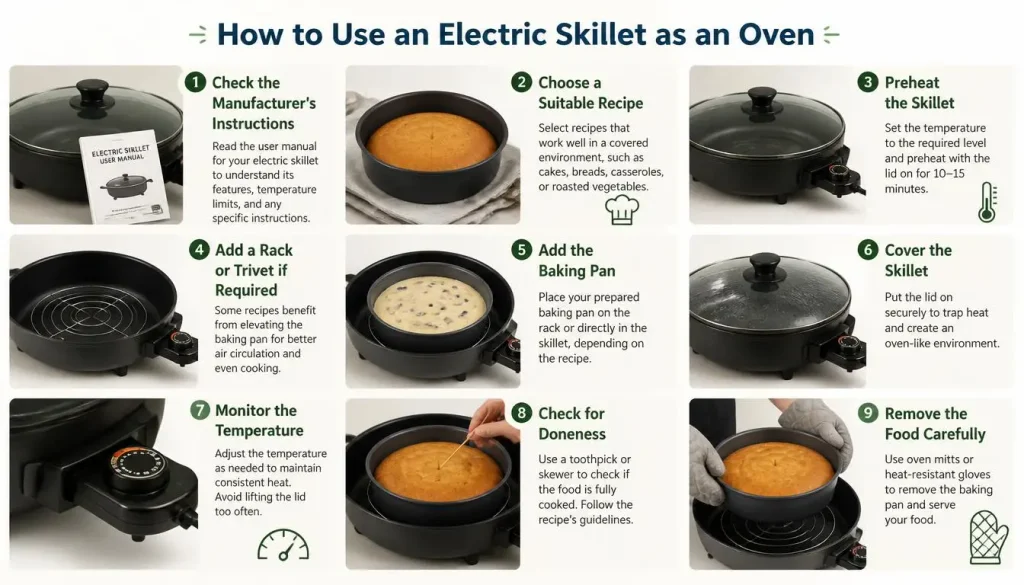
Step 1: Check the Manufacturer’s Instructions
Before baking anything, confirm that your model can be used for covered baking or for the cooking method you plan to use.
Also check the manufacturer’s rules regarding racks, baking pans, foil, parchment, and maximum temperatures.
Step 2: Choose a Suitable Recipe
Start with forgiving foods rather than delicate pastries.
Good beginner choices include:
- Brownies
- Cornbread
- Muffins
- Cobbler
- Casseroles
- Simple cakes
- Baked fruit
Foods that rely heavily on strong top heat are harder to reproduce successfully.
Step 3: Preheat the Skillet
If your model or recipe calls for preheating, set the desired temperature and allow the skillet to reach it before adding the food.
Preheating practices vary by manufacturer. For example, Proctor Silex instructions for normal skillet cooking call for preheating the uncovered appliance for approximately 5 to 10 minutes before food is added.
Follow your own appliance instructions rather than treating one manufacturer’s recommendation as universal.
Step 4: Add a Rack or Trivet if Required
Some baking methods place a rack inside the skillet and position the baking pan on top of it.
The rack creates space between the pan and the hottest part of the skillet, reducing direct bottom heat.
This can help prevent a cake or muffin from developing a burned bottom before the center is cooked.
Only use a rack or trivet when it is suitable for your skillet.
Step 5: Add the Baking Pan
If the recipe uses a separate pan, position it carefully so that the lid can close properly.
Do not force an oversized pan into the skillet.
Step 6: Cover the Skillet
The lid is important when using an electric skillet for baking.
Without it, much of the heat immediately escapes into the room. A closed lid holds warm air around the food and creates a more oven-like cooking environment.
Step 7: Monitor the Temperature
Avoid automatically copying an oven recipe’s temperature without considering how differently the skillet heats.
Because the heating element sits directly beneath the cooking chamber, too much heat can brown or burn the bottom quickly.
Step 8: Check for Doneness
Do not rely entirely on appearance.
The top may remain pale even when the center is fully cooked.
For cakes, muffins, brownies, and similar baked goods, use the appropriate doneness test, such as inserting a toothpick into the center.
For meat and poultry, use a food thermometer and follow established safe internal-temperature guidance.
Step 9: Remove the Food Carefully
Use dry oven mitts or pot holders.
Be particularly careful when removing the lid. Trapped steam can escape rapidly and cause burns.
How to Convert an Oven Recipe to an Electric Skillet
There is no single formula that converts every oven recipe into an electric-skillet recipe.
Skillet depth, wattage, thermostat accuracy, pan material, lid design, food thickness, and recipe composition can all affect cooking time.
A few adjustments make experimentation much more reliable.
Start With a Small Recipe
A smaller quantity is easier to heat evenly and easier to monitor.
Trying to fit a large oven casserole or tall cake into a shallow electric skillet usually produces disappointing results.
Watch the Bottom Closely
Remember that the strongest heat is underneath the food.
If the bottom is cooking too quickly, reducing the temperature or elevating the baking pan on an approved rack may help.
Keep the Lid Closed
Every time you remove the lid, trapped heat escapes.
Check the food when necessary, but avoid repeatedly lifting the lid just to see what is happening.
Check the Food Earlier
Do not assume an oven recipe’s baking time will transfer exactly.
Begin checking before the original baking time has completely elapsed.
Expect Less Top Browning
A pale surface does not necessarily mean that the center needs much more cooking.
Judge doneness using texture, internal temperature, or an appropriate test for the food rather than color alone.
The same principles apply when adapting something like a traditional casserole. This guide on baking a casserole in an electric skillet covers the adjustments in more detail.
Do You Need a Rack to Bake in an Electric Skillet?
Not always.
Some foods can be cooked directly in the skillet, while other recipes work better when a separate baking pan sits on a rack.
A rack can be useful because it lifts the baking pan away from direct contact with the hot cooking surface. This may reduce scorching and produce gentler heating.
Kansas State University’s electric-skillet muffin method, for example, places a muffin pan on a rack inside the covered skillet.
However, this does not mean every electric skillet should be used with a rack. Check your appliance instructions before adding accessories that were not supplied with it.
Can You Bake in an Electric Skillet Without a Rack?
Yes, depending on the recipe.
Brownies, cobblers, skillet cakes, pizza-style foods, baked eggs, and some breads can sometimes be prepared directly on or in the cooking surface.
Recipes that use a separate cake pan or muffin tin are more likely to benefit from some separation between that pan and the skillet’s hottest surface.
If food consistently burns underneath before cooking through, direct bottom heat may be the problem.
Can You Put a Baking Pan Inside an Electric Skillet?
A small baking pan can be used in some electric skillets if the manufacturer allows it and there is enough space.
The pan should:
- Fit comfortably inside
- Allow the lid to close
- Be suitable for the required temperature
- Remain stable during cooking
- Not damage the skillet’s surface
Metal baking pans are commonly used for this type of cooking because they tolerate heat well, but compatibility still depends on the appliance.
What About a Glass Baking Dish?
Do not assume that any glass dish is safe.
Glass bakeware has its own temperature and thermal-shock limitations. You also need to know whether your skillet manufacturer permits a separate dish inside the appliance.
Check both sets of instructions before using glass.
What About Silicone Bakeware?
Heat-rated silicone bakeware may work in some setups, but again, temperature rating and manufacturer instructions matter.
Do not choose cookware based only on whether it physically fits.
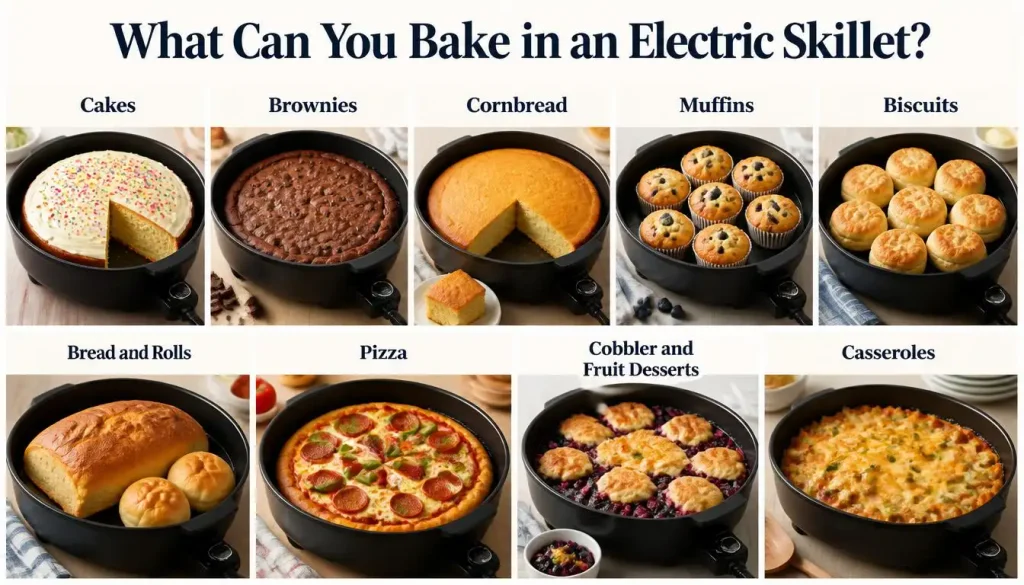
What Can You Bake in an Electric Skillet?
An electric skillet is surprisingly versatile when you choose suitable recipes.
Cakes
Simple, relatively shallow cakes work better than tall or delicate cakes.
Keep the skillet covered and expect less browning on top.
Brownies
Brownies are particularly well suited to covered skillet baking because strong top browning is not essential.
GreenPan, for example, provides a skillet-brownie method using a covered electric skillet.
Cornbread
Cornbread is another good option because it tolerates bottom heat well and does not depend on a delicate structure.
Muffins
Muffins can be baked using a muffin pan and rack in an appropriate skillet.
Do not judge them only by top color because they may remain pale after the centers are fully baked.
Biscuits
Some skillet-friendly biscuit recipes can work, particularly covered recipes designed for stovetop-style cooking.
Traditional oven biscuits that rely on strong surrounding heat for a tall rise and browned top may produce a different result.
Bread and Rolls
Small breads or rolls may work, but large artisan loaves generally need more evenly distributed heat than an electric skillet provides.
Pizza
Pizza-style dishes can work well because direct bottom heat helps cook the crust.
The limitation is the top. Cheese may melt, but you will not get the same intense top browning that a hot oven or broiler provides.
Cobbler and Fruit Desserts
Covered fruit desserts are particularly forgiving because they benefit from retained moisture.
Casseroles
Electric skillets are well suited to many covered casseroles, including breakfast casseroles, rice dishes, pasta dishes, and vegetable casseroles.
For more examples beyond baking, see these 45+ electric skillet cooking ideas.
Electric Skillet Baking Temperature Guide
There is no universal baking-temperature chart for every electric skillet.
Treat the following ranges as general starting points only, not manufacturer-specific instructions.
| Food | Approximate Starting Range | Main Thing to Watch |
|---|---|---|
| Brownies | 300–325°F | Dry edges or overcooked bottom |
| Simple cake | 275–325°F | Center doneness |
| Cornbread | 300–350°F | Bottom browning |
| Muffins | Recipe/model dependent | Center doneness |
| Cobbler | 275–325°F | Topping and filling |
| Casserole | 250–350°F | Center temperature |
| Pizza-style dishes | 325–400°F | Crust before toppings overcook |
Your recipe and skillet manual should take priority over a general chart.
How Long Does Baking Take in an Electric Skillet?
Baking time depends on more than temperature.
Important factors include:
- Skillet wattage
- Thermostat accuracy
- Food thickness
- Recipe volume
- Pan material
- Whether you use a rack
- How often you remove the lid
- Whether ingredients started cold or at room temperature
That is why transferring an oven recipe minute-for-minute is unreliable.
Check the food based on doneness rather than simply waiting for the original oven timer to finish.
Why Does Food Burn on the Bottom?
Bottom burning is one of the most common challenges when using an electric skillet like an oven.
Possible causes include excessive temperature, direct contact with the heated surface, an inaccurate thermostat, hot spots, or simply leaving the food in too long.
Lower the Temperature
If the base browns much faster than the center cooks, reduce the heat.
Use an Approved Rack
When appropriate, placing the baking pan on a rack creates distance from the strongest heat.
Check for Uneven Heating
If food consistently burns in one area but remains pale elsewhere, the appliance may have hot spots.
The problem may not be your recipe at all. See the guide to electric skillet heating unevenly and how to fix it.
Check the Thermostat
If food burns even when the dial is set unusually low, temperature control may be inaccurate.
These signs of a broken electric skillet thermostat can help determine whether the appliance rather than the recipe is causing the problem.
Why Doesn’t Food Brown on Top?
This is usually normal.
A conventional oven may have both lower and upper heating elements, and convection ovens circulate heated air.
An electric skillet has no comparable upper heating element.
As a result:
- Muffins may remain pale
- Biscuits may lack a golden top
- Cheese may melt without deeply browning
- Cake tops may look lighter than expected
Kansas State University’s electric-skillet muffin instructions specifically note that muffins prepared this way will not brown as they would in an oven.
Do not continue cooking solely to achieve a darker top. You may end up burning the bottom while drying out the center.
Can You Use Aluminum Foil in an Electric Skillet?
Foil may be useful in certain recipes, but it should never be used in a way that interferes with the appliance’s temperature control, ventilation, lid fit, or electrical components.
Be particularly careful with nonstick skillets. Dragging or pressing foil against a delicate coating may damage it.
Use foil only when the manufacturer’s instructions permit it and the recipe calls for an appropriate application.
Can You Use Parchment Paper in an Electric Skillet?
Parchment can be useful for certain low- to moderate-temperature baking applications, but it must remain within its manufacturer’s temperature rating.
Never allow loose parchment to contact an exposed heating element or other area the appliance manufacturer says should remain uncovered.
Again, the safest approach is to follow the instructions for both your skillet and the parchment product.
Can You Roast Food in an Electric Skillet?
Some electric skillets can handle pot-roasting or covered roasting-style cooking, particularly deeper models.
You can often brown meat first and then continue cooking it slowly with liquid and the lid in place.
However, this is closer to braising or pot roasting than traditional dry oven roasting.
Large roasts that depend on even dry heat and browning from multiple directions are better suited to a conventional oven.
Foods That Do Not Work Well in an Electric Skillet
An electric skillet is versatile, but it cannot reproduce every oven technique.
Foods that may be difficult include:
- Large roasts
- Very tall cakes
- Large artisan bread loaves
- Delicate pastries
- Soufflés
- Foods requiring powerful top browning
- Broiled foods
- Recipes that require highly controlled convection
- Large batches of cookies
If the recipe depends heavily on dry circulating heat, top heat, or a large cooking chamber, a regular oven or countertop oven will usually produce better results.
Advantages of Using an Electric Skillet Instead of an Oven
Useful for Small Meals
Heating a full-size oven for one small dish can feel excessive. A skillet is often more practical for one- or two-person meals.
Faster Preheating
Because the cooking area is much smaller, many electric skillets reach cooking temperature quickly.
Portable
Electric skillets are useful in RVs, temporary kitchens, holiday cooking setups, and other locations with suitable electrical power.
Adds Extra Cooking Space
When your stovetop and oven are already full, an electric skillet provides another controlled cooking surface.
Keeps the Kitchen Cooler
Running a large oven can add considerable heat to a kitchen. A smaller appliance may be more comfortable during warm weather.
Limitations of Using an Electric Skillet as an Oven
The disadvantages are equally important.
An electric skillet:
- Has limited capacity
- Produces most of its heat from below
- Cannot broil
- Usually provides limited top browning
- May have hot spots
- Is not ideal for tall baked goods
- Cannot accurately reproduce every oven recipe
- Varies considerably from model to model
Think of it as another cooking tool rather than a miniature conventional oven.
Does an Electric Skillet Use Less Electricity Than an Oven?
It can for certain jobs, but avoid assuming that it always will.
Electricity consumption depends primarily on appliance wattage and how long it operates.
Many household electric skillets fall roughly within the 800-to-1,500-watt range, although models vary. You can learn more about how many watts an electric skillet uses.
For a small meal, heating a compact skillet rather than an entire full-size oven may make practical sense. For several large dishes, however, using one oven efficiently may be more sensible than cooking multiple batches in a skillet.
Electric Skillet vs. Other Oven Alternatives
Electric Skillet vs. Toaster Oven
A toaster oven behaves more like a traditional oven because it generally provides both upper and lower heat.
Choose a toaster oven when browning and conventional baking performance matter more.
Choose an electric skillet when frying, sautéing, simmering, one-pan cooking, and occasional covered baking are more important.
Electric Skillet vs. Air Fryer
An air fryer relies on rapidly circulating hot air and is much better at crisping and browning.
An electric skillet provides a larger flat cooking surface and is more suitable for pancakes, eggs, stir-fries, shallow frying, casseroles, and similar dishes.
Electric Skillet vs. Slow Cooker
A slow cooker is specifically designed for long, low-temperature cooking.
An electric skillet offers stronger direct heat and much better browning but should not automatically be treated as a replacement for unattended slow cooking.
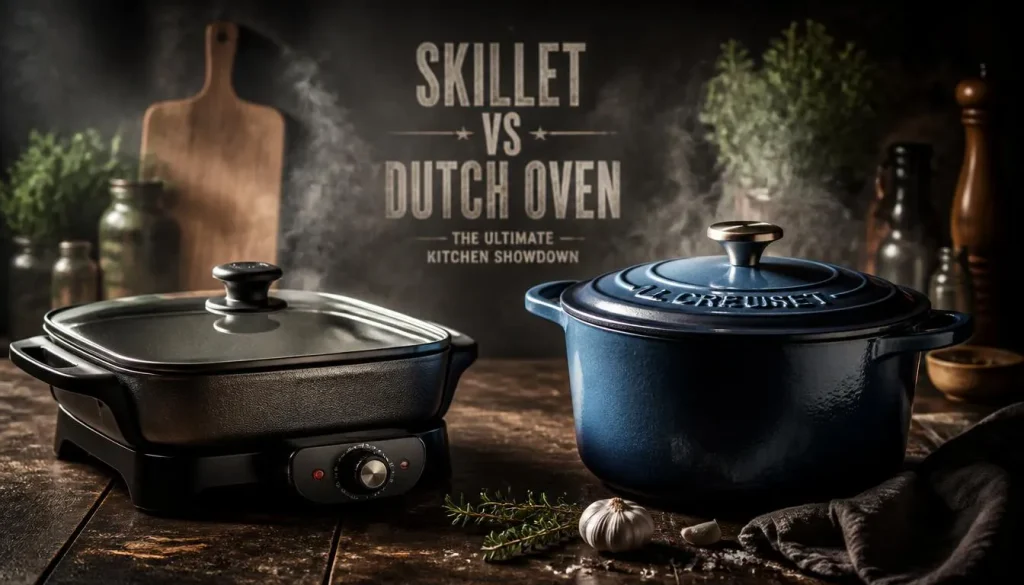
Electric Skillet vs. Dutch Oven
A Dutch oven retains heat extremely well and is excellent for braising, roasting, soups, and baking when used on an appropriate heat source.
An electric skillet has the advantage of its own thermostat and does not require a stovetop burner.
When Is an Electric Skillet a Good Oven Substitute?
Using an electric skillet instead of an oven makes the most sense when:
- Your regular oven is temporarily unavailable
- You are cooking a small portion
- You live in a compact kitchen
- You cook in an RV or similar space
- You need extra cooking capacity during holidays
- You want to avoid heating a full-size oven
- The recipe does not require strong top browning
- The recipe is suitable for covered cooking
For a family-sized roast, several trays of cookies, a tall cake, or delicate pastries, the regular oven remains the better tool.
Electric Skillet Safety Tips
Treat an electric skillet as a high-temperature electrical appliance.
Use it on a dry, level, heat-resistant surface and keep electrical connections away from water.
Do not move the appliance while it contains hot oil or hot food.
When you remove the lid, tilt it away from your face and hands so trapped steam escapes safely.
Use wooden, silicone, or other manufacturer-approved utensils on nonstick surfaces rather than sharp metal utensils that may scratch the coating.
If your skillet begins overheating, heating unpredictably, showing electrical damage, or developing a badly damaged nonstick surface, stop using it until the problem has been properly assessed.
Most importantly, never place the complete electric skillet inside a conventional oven unless its manufacturer specifically states that the relevant components are oven-safe.
Frequently Asked Questions About Can an Electric Skillet Be Used as an Oven
Can an Electric Skillet Replace an Oven Completely?
No. It can replace an oven for certain small, covered dishes and simple baked foods, but it cannot reproduce every type of oven cooking. Broiling, large-volume baking, strong top browning, and recipes requiring even surrounding heat are better handled by an oven.
Can You Bake a Cake in an Electric Skillet?
Yes, some simple cakes can be baked in a suitable electric skillet. Shallow cakes generally work better than tall or delicate cakes. Keep the lid closed and check the center for doneness rather than relying on top color.
Can You Bake Bread in an Electric Skillet?
Some small breads and rolls can be prepared in an electric skillet, but large loaves may cook unevenly because most of the heat comes from underneath.
Can You Bake Cookies in an Electric Skillet?
It is possible with certain skillet-specific methods, but a regular oven generally produces better cookies because it provides more even surrounding heat and better browning.
Can You Make Biscuits in an Electric Skillet?
Yes, skillet-friendly biscuit recipes can work. Expect different browning compared with oven-baked biscuits.
Can You Make Muffins in an Electric Skillet?
Yes. A documented Kansas State University Extension method uses a muffin pan placed on a rack inside a covered electric skillet. The muffins cook through but remain less browned than oven-baked muffins.
Can You Cook Pizza in an Electric Skillet?
Yes. Pizza-style dishes are a good match for an electric skillet because the strong bottom heat can cook the crust effectively. Top browning will usually be weaker than in an oven.
Can You Put a Cake Pan in an Electric Skillet?
In some models, yes, as long as the pan fits properly and the appliance manufacturer permits using a baking pan or insert.
Can You Put a Glass Baking Dish in an Electric Skillet?
Only when both the skillet manufacturer and bakeware manufacturer consider the setup safe. Do not assume ordinary glass cookware is suitable simply because it fits.
Do You Need a Rack to Bake in an Electric Skillet?
Not for every recipe. A rack is most useful when a separate baking pan needs to be lifted away from direct bottom heat.
Do You Need to Preheat an Electric Skillet Before Baking?
Many recipes benefit from preheating, but the correct procedure depends on your model and recipe. Follow the manufacturer’s instructions.
What Temperature Should You Bake at in an Electric Skillet?
There is no single temperature suitable for every recipe. Many skillet-baking recipes use moderate temperatures, but exact settings depend on the food and appliance.
Can You Use an Electric Skillet Without the Lid for Baking?
Usually not effectively for oven-style baking. The lid traps heat around the food, which is one of the main reasons covered electric-skillet baking works.
Can You Use Parchment Paper in an Electric Skillet?
It may be suitable for some recipes if it remains within its temperature rating and the skillet manufacturer permits it.
Can You Use Aluminum Foil in an Electric Skillet?
It may be possible in some applications, but never use foil in a way that damages the nonstick coating, obstructs components, or conflicts with the manufacturer’s instructions.
Can You Put an Electric Skillet in the Oven?
Generally, no. Electric skillets contain electrical and heat-sensitive components. Only put a removable component in an oven when the manufacturer specifically states that it is oven-safe.
Can You Roast Meat in an Electric Skillet?
Some deeper models can handle pot-roasting and braising-style cooking. This is not exactly the same as dry roasting in a conventional oven.
Does an Electric Skillet Use Less Electricity Than an Oven?
It may use less energy for a small meal because you are heating a much smaller appliance, but actual energy consumption depends on wattage and cooking time.
Final Verdict
So, can an electric skillet be used as an oven? Yes, for certain foods and cooking methods.
A good electric skillet with adjustable temperature control and a tight-fitting lid can handle many small baking jobs, including brownies, cornbread, muffins, casseroles, cobblers, pizza-style dishes, and some simple cakes.
The key is understanding its limitations.
An electric skillet heats primarily from below, so it does not provide the same surrounding heat or top browning as a conventional oven. Recipes may need adjustments to temperature, cooking time, pan position, and doneness checks.
For small meals, limited kitchen space, RV cooking, summer cooking, or times when your regular oven is unavailable, an electric skillet can be an extremely useful substitute.
Just do not treat it as a full-size oven with a cord attached. Follow the instructions for your specific model, choose recipes suited to covered cooking, and pay close attention to bottom heat. Once you understand those differences, an electric skillet can do considerably more than simply fry food.

“I believe great cooking starts with the right tools, trusted advice, and a little confidence in the kitchen.”
Hi, I’m Emma Carter. My love for cooking began in my grandmother’s kitchen, where I learned that every great meal starts with simple ingredients and the right cookware. Over the years, I’ve spent countless hours researching, testing, and comparing kitchen appliances, cookware, coffee makers, air fryers, and other everyday kitchen essentials.
Here at KiCook, my goal is to make your buying decisions easier with honest product reviews, practical buying guides, and easy-to-follow cooking tips. Whether you’re upgrading your kitchen or searching for the best appliance for your home, I focus on providing clear, reliable, and research-backed information you can trust.
When I’m not testing new kitchen gadgets or writing in-depth guides, you’ll usually find me trying new recipes, visiting local farmers’ markets, or enjoying a quiet cup of coffee while planning my next kitchen project.